Telkupi: A Medieval Temple Settlement in West Bengal
Site at a Glance
- Popularity
- Medium
- Country
- India
- Primary era
- Early Modern
- Eras represented
- Early Modern, Modern
- Civilizations
- British, Mughal
- Site type
- Religious
- Remains
- Temple
On this page29 sections
History
Telkupi is an archaeological temple site in West Bengal, India, associated with Tailakampi, a commercial center from the tenth to thirteenth centuries. The settlement became the capital of the regional Shikhar dynasty in the eleventh century. Its temples served Shaiva worship, centered on Shiva, and Vaishnava worship, centered on Vishnu, but their builders and the dates of the surviving temple fabric remain uncertain.
Tailakampi and the Shikhar rulers
Rudrasikhara ruled the Shikhar dynasty at Tailakampi. The Panchkot royal chronicle dates his rise to power to 1098. He joined other subordinate rulers in helping Pala king Ramapala recover Varendra, a historic region of Bengal. In the Sanskrit poem Ramacharitam, Sandhyakar Nandi presents Rudrasikhara as a formidable warrior whose power reached across river and mountain regions.
Tailakampi’s position near a Damodar River water-trade route may have contributed to its regional importance. A longstanding tradition credits prosperous merchants with building its temples and associates the shrines with the regional royal houses of Panchkot and Kashipur. These traditions do not settle who built the temples or when the surviving stonework was made.
Worship and changing interpretations
Nineteenth- and twentieth-century observers recorded a changing picture of the site. In 1877, W. W. Hunter counted eight or nine stone temples. Joseph David Beglar published the first detailed description of them in 1878. In 1903, T. Bloch saw ten of the thirteen temples Beglar had described and proposed that about forty had once stood there. Bloch found two comparatively recent shrines, dedicated to Bhairava and Kali, still used for daily worship; he described the others as abandoned and neglected.
The temples’ age was also disputed. An 1896 inventory of Bengal’s ancient monuments assigned them to the early post-Mughal period. Nirmal Kumar Basu later distinguished older temples from later buildings and additions, while leaving the date of the surviving temple fabric unresolved. Basu examined the buildings’ relationships to Odisha and other regional architectural traditions in December 1929.
Accounts of a locally worshipped image likewise differed. Hunter tentatively identified it as Mahavira, a Jain spiritual teacher, although he had not seen it. Debala Mitra understood the local name to refer to Bhairava, a fierce form of Shiva, and identified the shrine as a Bhairava temple. Worship there continued until the shrine was submerged in 1958.
Survey and inundation
Telkupi was in Manbhum district, Bihar, before the district became part of West Bengal in 1956. Construction of the Damodar Valley Corporation dam near Panchet began to submerge the archaeological area in 1957. By 1959, most of the village’s temples were underwater. Mitra surveyed the site that year, recording the condition of the remaining temples and images. She tried to move images from temples 9 and 10, including figures of Vishnu and Ambika and a scene of Shiva slaying Andhakasura, but local boatmen objected and the effort failed.
Remains
Layout and masonry
Beglar grouped the temples in three areas: a northern cluster near the Damodar River, another near and somewhat west of the village, and a southwestern group near the village edge. The northern group contained thirteen temples. In the second area he saw six temples and numerous images, four temples of particular interest to him. The southwestern area included three temples, a large brick mound, a monastery-like ruin in Beglar’s interpretation, and heaps of stone and brick. He also noted additional temples east of the village.
Many temples were built from large, carefully cut stone blocks fitted together without mortar. Builders carved the stones after placing them, filled narrow gaps with smaller stones, and bridged wider openings by corbelling, a method that projects successive stone courses inward. Rounded roofs were also formed this way. An arched opening in a wall between temples was considered a later addition, made to divide them.
Northern cluster
Temple 1
This south-facing stone temple had a single chamber with a Shiva lingam, a symbolic form of Shiva used in worship. Beglar found its upper portion largely intact and noted that its blocks had been laid without mortar. The floor lay about two feet below the doorway sill, which itself stood about two feet below ground level.
Temple 2
The east-facing temple had a Gajalakshmi image above its entrance, showing the goddess Lakshmi with elephants, and a Shiva lingam inside. Its floor was six inches below the sill, while the sill was about eighteen inches beneath ground level. Beglar described its stonework and construction as similar to those of temple 1, though the upper part was damaged.
Temples 3–5
Temple 3, like temple 2 in construction, faced west and contained a Shiva lingam. Accumulated soil and debris buried its doorway about four feet deep, and its floor lay roughly six feet below that material; the upper part was missing. The badly ruined, east-facing temple 4 had a lotus carving above its entrance and a largely intact four-armed image of Vishnu inside. Temple 5 stood directly behind temple 4 and was described as similar to the preceding temples, with its upper part missing.
Temple 6
This large, east-facing temple comprised a main sacred chamber, a great hall, a smaller adjoining hall, and a veranda. Beglar found the chamber and its tall upper structure intact, although the interior roof had collapsed. He noted numerous doorframes and elaborate ornament. A coating of lime and powdered brick covered the tower-like upper section; Beglar thought it had been applied twice after the temple’s original construction. By Mitra’s later survey, the building had collapsed to its foundations.
Temple 7
The small, north-facing temple had one chamber and a Ganesha image above its entrance. Inside was a two-armed figure holding a lotus in each hand, which Beglar thought might represent the Sun. The figure had a raised cranial feature, called an ushnisha, bound with a ribbon. Four smaller figures stood beside it, and two more appeared to fly near its head.
Temple 8
This large, east-facing temple originally had a single chamber, in Beglar’s view; he considered its adjoining great hall a later addition. He contrasted the carefully carved tower with the plain hall, finding their styles incongruous. Ganesha images stood above both entrances. Mitra later found the temple ruined, though in better condition than temple 6.
Wall beside temples 6–8
A granite wall beside these temples had an arched opening. Beglar regarded the wall as pre-Mughal and attributed it, together with the great hall of temple 8, to the period of Man Singh, a Rajput ruler and military commander under the Mughal Empire.
Temple 9
This small, north-facing temple had a lotus carving above its entrance, a four-armed figure in its inner chamber, and a pyramidal roof with deep, broad grooves. Beglar compared the roof with that of the Kalyaneshwari temple. He considered the doorway and sculptures later additions and thought the original entrance had faced west.
Temple 10
The large, north-facing temple comprised a main shrine, an adjoining veranda, a hall, and an entrance chamber. Its hall had three entrances; Beglar found the northern doorway closed. A lotus image stood above an entrance, and a Shiva lingam occupied the interior. Beglar considered the shrine’s architecture ungainly and the building more recent than the other temples. Its great hall had a low pyramidal roof.
Temples 11–13
East-facing temples 11 and 12 each had a Ganesha image above the entrance. Temple 11 contained a Shiva-lingam pedestal without a lingam; Beglar thought a Sun image inside had not originally belonged there, and he found the spire broken. Temple 12 held a Shiva lingam. Temple 13 resembled temples 11 and 12 but faced west.
Village and western cluster
Two Gajalakshmi temples
In this cluster, Beglar found one temple largely intact, with a ribbed crown element and a pot-shaped finial above its tower. Gajalakshmi appeared over the entrance, and an image occupied the inner chamber. Another temple about 1,000 feet to its south also had Gajalakshmi above the entrance and a four-armed Vishnu image in its chamber.
Narasimha temple and ruined Vishnu temple
About 250 metres east of the second temple stood a north-facing shrine. Above its entrance, a seated figure held a lotus beside an upright elephant raising its trunk; Beglar could not determine the figure’s sex. An image of Narasimha, Vishnu’s man-lion form, stood inside. A ruined temple to four-armed Vishnu stood beside it. Its front had collapsed, while its other sides remained intact.
Southwestern temples
Temple 16
The ruins retained parts of the tower’s neck, crown, cap, and finial. Its richly decorated main doorway had male figures at the lower ends of the vertical sides, or jambs. Carvings of Ganga, the goddess associated with the Ganges River, and the nine planetary deities appeared on nearby walls. A broken image of the Sun lay in the inner chamber.
Temple 17
Locally called the Narasimha shrine, temple 17 was relatively well preserved compared with other old temples, though its overall condition was poor. Much of its exterior decoration had disappeared or been damaged.
Temple 18
Mitra identified the image on temple 18 as Lakulisha, a figure associated with a tradition of Shaivism, rather than as a Buddhist or Jain figure. The Shiva lingam inside also indicated the temple’s connection with Shiva worship. Mitra judged the building to be later than temple 17 and interpreted the brick mound beside it as part of an attached structure, not a Buddhist monastery.
The temple’s richly carved doorway was five feet high. Niches at the foot of its jambs held two male figures. One was ornamented and carried a staff; the other had a crown of matted hair, a fierce expression, and a trident in his left hand. A water outlet was carved as a makara, a mythical aquatic creature.
Other southwestern remains
Beglar recorded scattered temples and a large brick mound that he interpreted as a monastery. He thought one temple might have been dedicated to Shiva or Vishnu, and tentatively considered another Buddhist, while allowing that its worn entrance figures might instead be Jain. Near the mound stood another temple, thought by Beglar to have once been larger. Its richly carved entrance included small figures representing incarnations of Vishnu and scenes from Krishna’s life. A village temple was later built with stones taken from temple 19.
Submerged shrines and associated images
Changing water levels
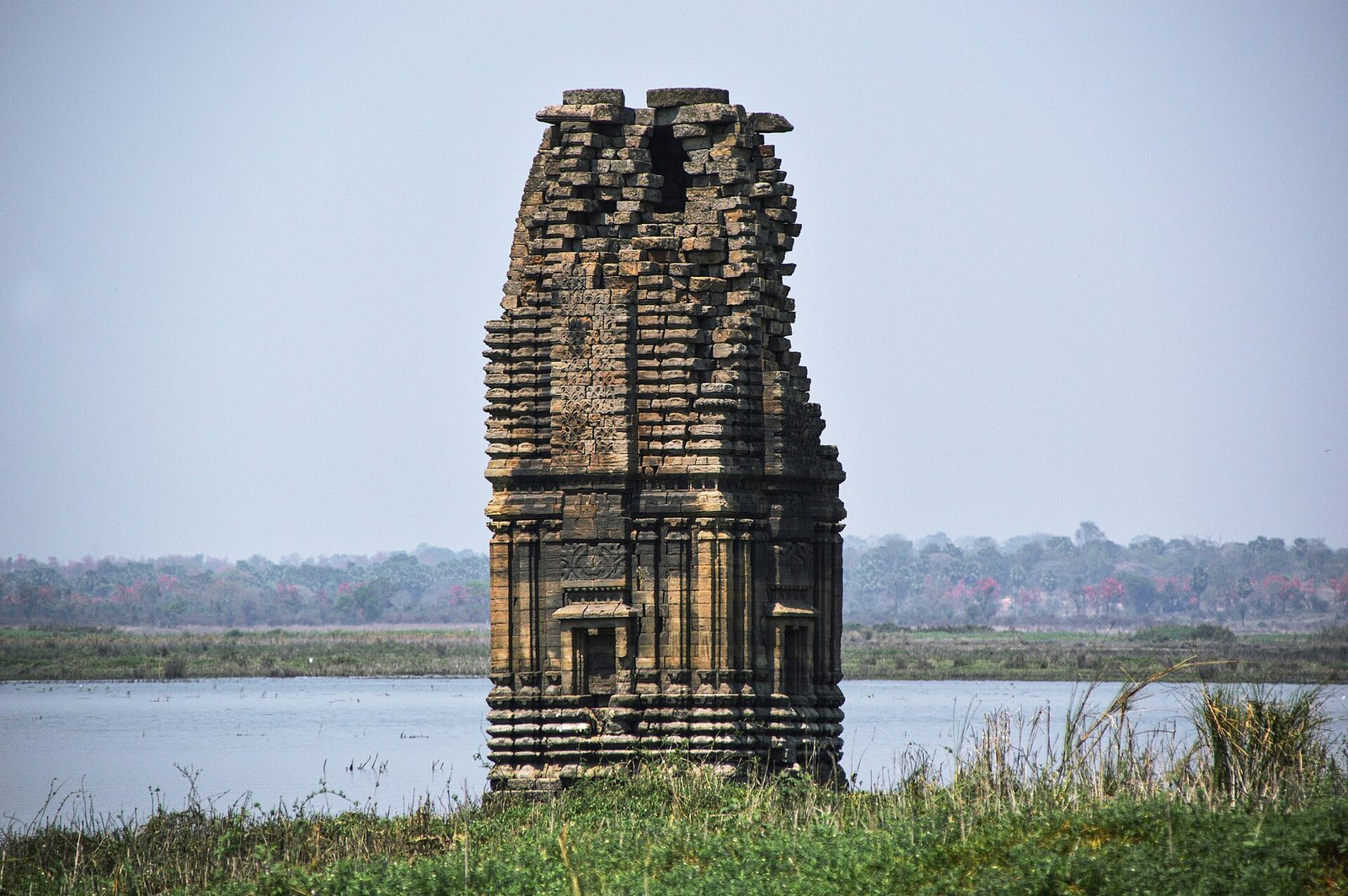
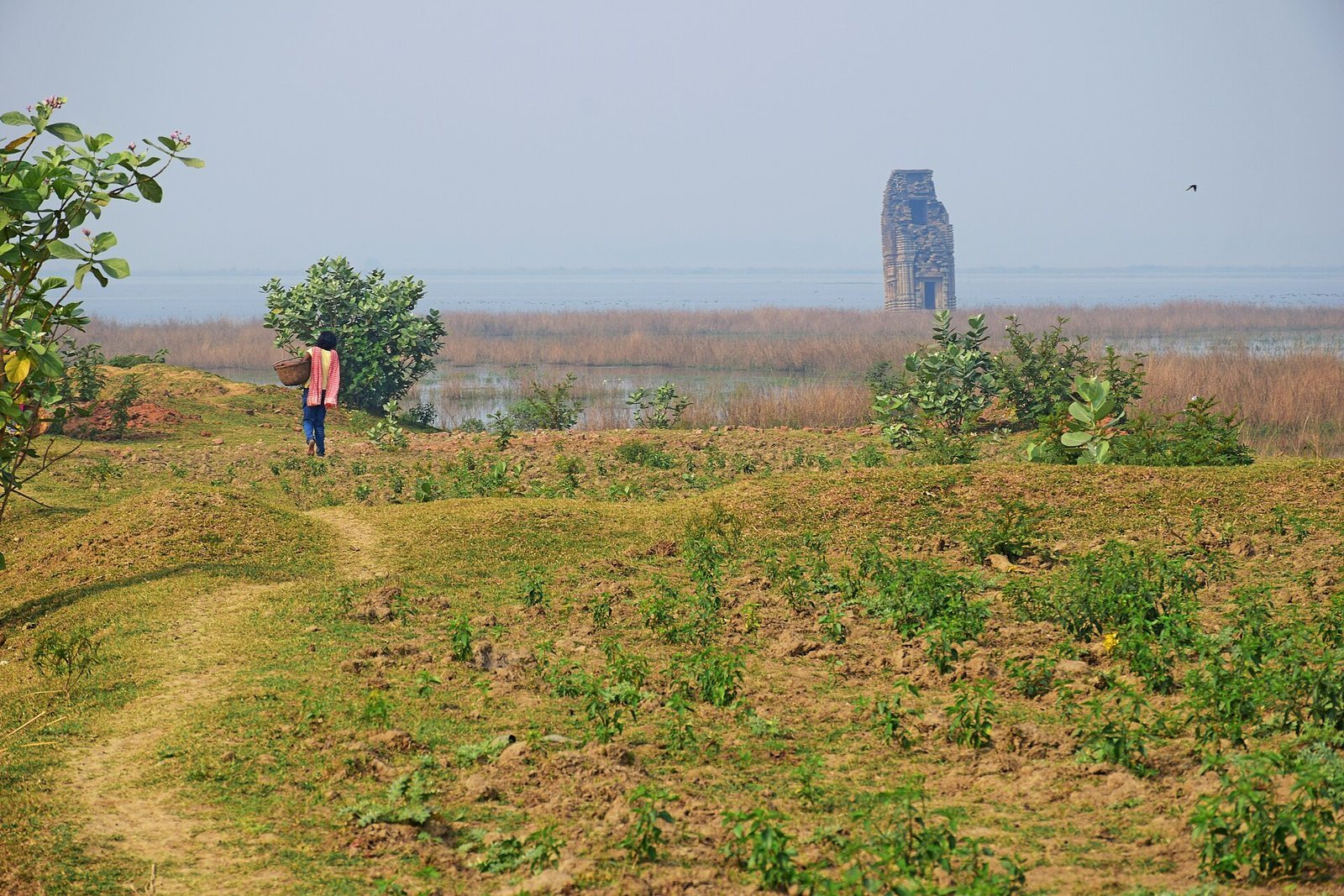
Mitra found that the lower parts of temples in the Bhairava shrine cluster remained underwater throughout the year, with their full forms visible only in June. Among the five temples she saw there in 1959, numbers 9 and 10 were in comparatively better condition during her later visit; temple 6 had fallen to its foundations, and temple 8 was also ruined. Outside the cluster, at least ten temples around fragments of temple 13 had been reduced to heaps of stone. As water levels fall in summer, some temple tops and other antiquities emerge, including the oldest shrine opposite the village where temple 18 stands, a shrine at the water’s edge near another village, and temple 18 on higher ground at a village’s end.
Shrine near temple 13
Near temple 13, Mitra saw a roofless structure dated to 1901–02, where a local form of Mahishasuramardini, the goddess Durga defeating the buffalo demon, was enshrined. About half a dozen images lay partly underwater inside it. These included Pala-period images of Uma and Maheshvara, the goddess and Shiva shown together, as well as an image of Mahishasuramardini.
Images in nearby settlements
Mitra also saw images of Vishnu, Ambika, and the slaying of Andhakasura at temples 9 and 10. In a nearby village, a shrine held a Vishnu image brought from a Shaiva temple. A village Shiva temple contained a Shiva lingam, images of Vishnu and Neminath, a figure revered in Jainism, and several unidentified images. In a rice field, a four-armed mother-goddess figure seated on an elephant stood beneath a jujube tree on a raised field boundary; local women revered her as a mother goddess.