Baga-Zarya: A Bronze Age Rock-Art Site and Medieval Burial Ground
Site at a Glance
- Popularity
- Low
- Country
- Russia
- Primary era
- Bronze Age
- Eras represented
- Bronze Age
- Civilizations
- Unclassified
- Site type
- Civic
- Remains
- Rock Art
On this page7 sections
History
Baga-Zarya is a major rock-art site in southwestern Transbaikalia, in the Republic of Buryatia, Russia. Its two archaeological monuments belong to different periods: Baga-Zarya I is a Bronze Age site of petroglyphs, images made by modifying rock surfaces, while Baga-Zarya II is a medieval burial ground.
Archaeological researcher R. F. Tugutov discovered the carvings in 1948. Impressions were made of all the petroglyphs that year, preserving their designs on another surface; images of more than 80 are held in the village library. A. P. Okladnikov, a Soviet archaeologist known for research on Siberian prehistory, visited in 1949 and in later years. A survey led by E. A. Khamzina examined the site in 1977, while a team led by S. V. Danilov identified Baga-Zarya II in 1992.
A local legend connects a carved horse-hoof mark with Genghis Khan, founder and first great ruler of the Mongol Empire. In the story, his horse left the enormous print while he hunted a legendary fiery fox.
Baga-Zarya is designated a cultural heritage site of federal significance in Russia.
Remains
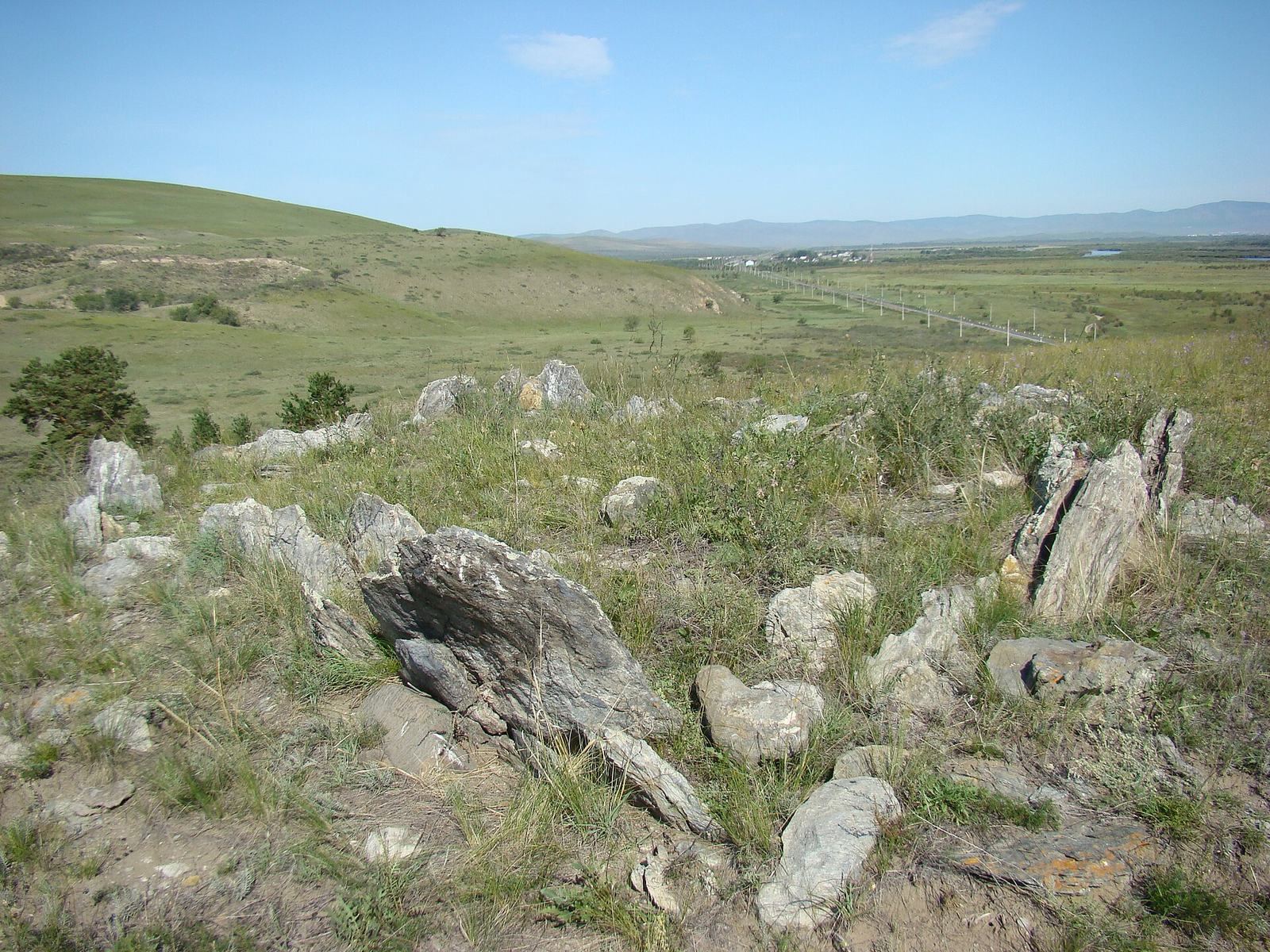
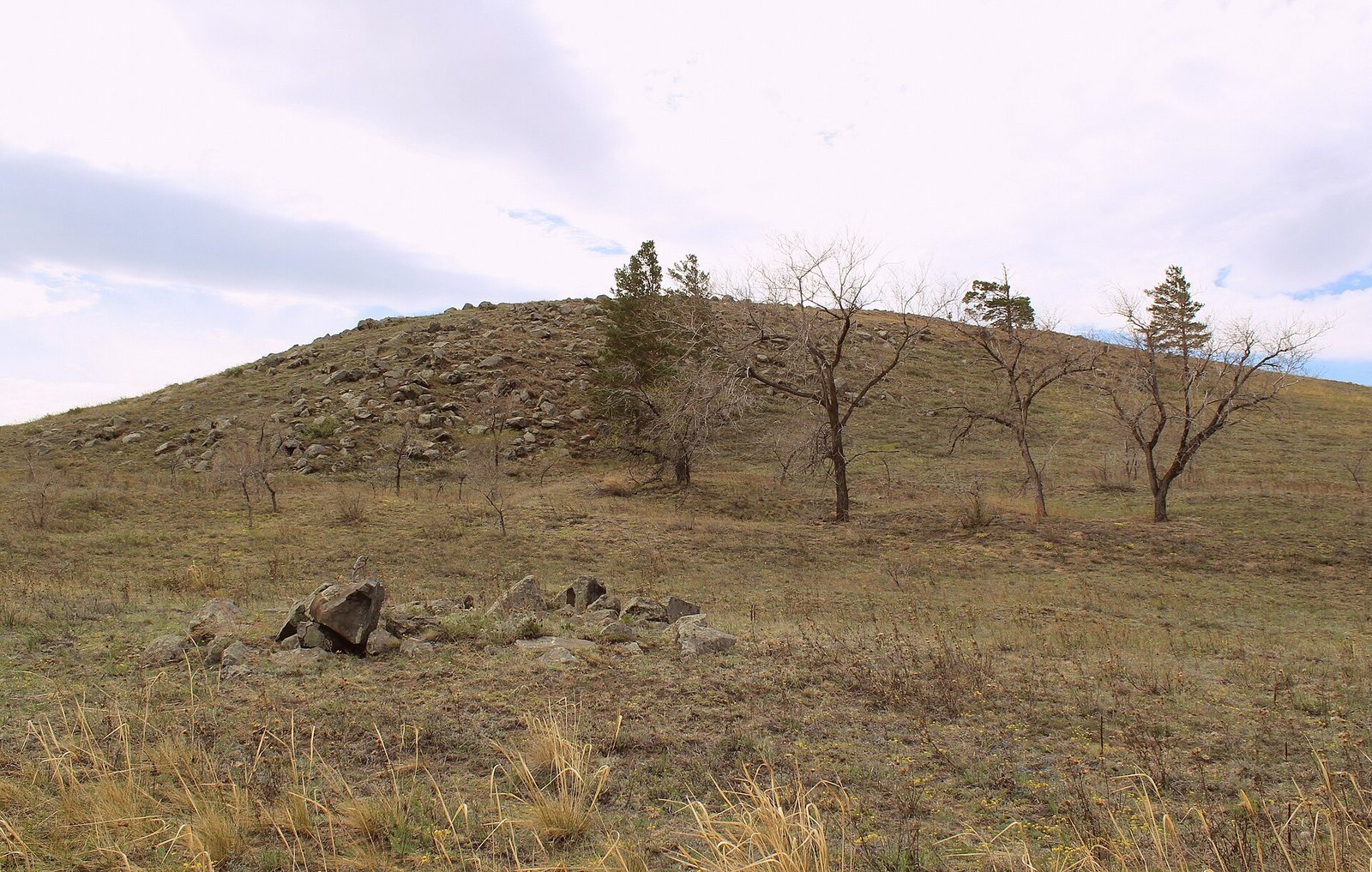
The site has two distinct physical areas: rock carvings on outcrops and separate stones on a mountain, and a burial ground among sandy ridges. The mountain lies 3 km south-southeast of Zarubino village, and the carvings are west of the railway.
Baga-Zarya I: Rock carvings
Surfaces and carving methods
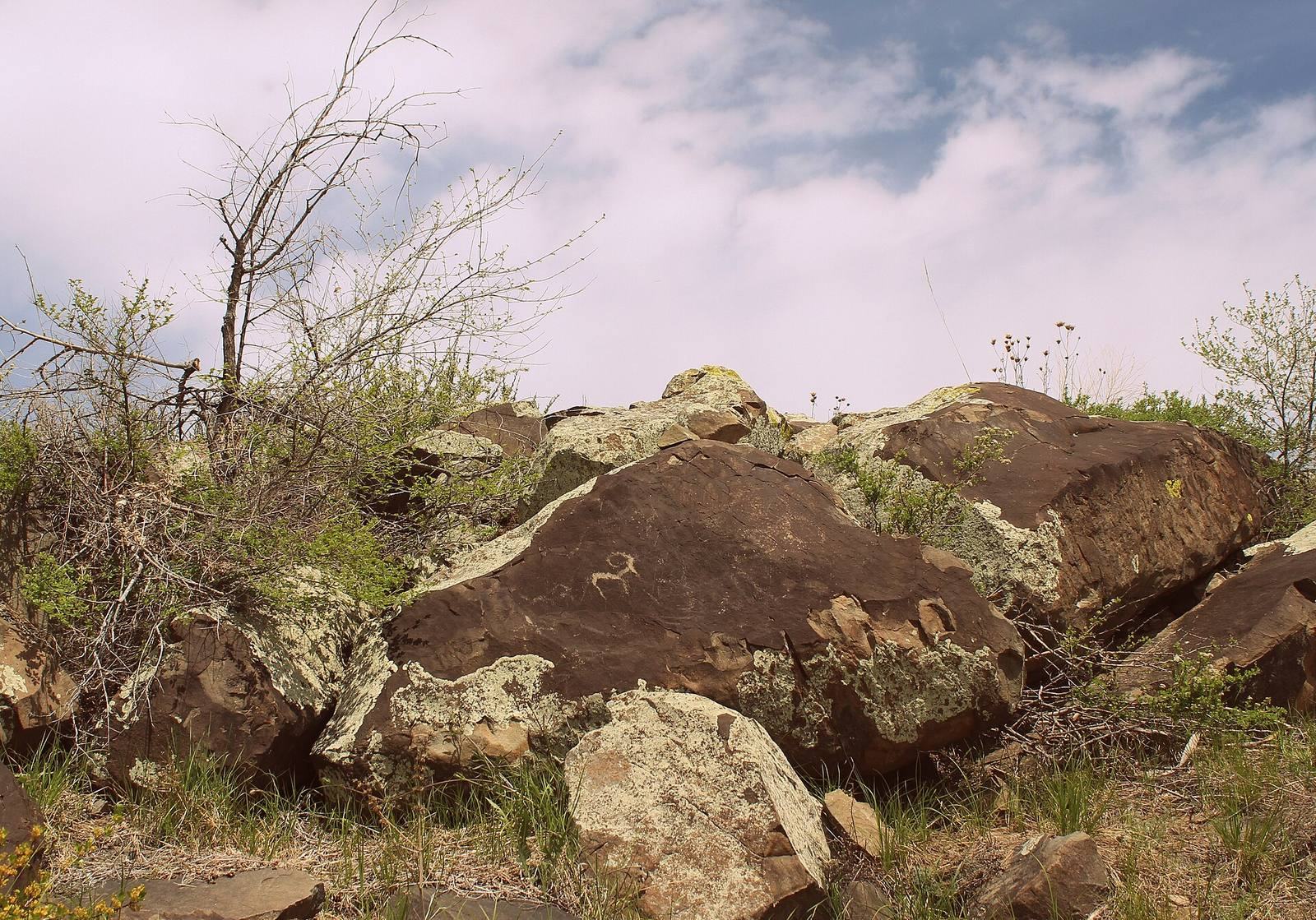
The images occupy gray-granite outcrops and individual stones across the mountain, including surfaces on the slopes and near the summit. Some are carved on vertical faces; others appear on upward-facing or weathered surfaces. Techniques include cut lines, marks made by repeated tapping, dotted marks, and broad grooves. In some cases, a thin layer of stone was removed within an outline to create a filled silhouette.
A dense composition covers a vertically standing stone on the slope measuring 1.3 by 1.2 by 1 m. Its material is described as dark-gray sandstone or possibly dense, fine-grained granite. The carving includes a crossed circle and a divided rectangle near the top, with nine circles of different sizes on the stone’s right-hand face. Below are a horned young goat, a leaping deer with branching antlers, and other animal figures.
Subjects and compositions
Animals are the most varied subjects, including goats, deer, fallow deer, elk, camels, boars, fish, and wolves. The stones also show people, hunting scenes, and animals carrying riders. Some compositions arrange animals one above another or in a line. One depicts two galloping animals with riders; another shows two wolves pursuing an animal that appears to be a fawn.
Circles recur in many forms, including designs crossed by lines, marked with rays, or given forked projections. Animal images range from simple outlines to carefully pecked silhouettes and broad-groove carvings. One composition brings a two-humped camel together with three goats. On another surface, Tibetan-language writing, traditionally written in a distinctive script, crosses over two pecked animal images.
Survival and recorded images
More than 150 drawings were recorded when the carvings were discovered. A separate inventory of Baga-Zarya I listed 84 drawings. Today, no more than 50 of the original 150-plus images survive, and no more than 10 remain from the 84-item Baga-Zarya I inventory.
Baga-Zarya II: Burial ground
The burial-ground area lies among sandy ridges 3.5–3.7 km south-southeast of Zarubino, 0.7 km southeast of the rock carvings, and 0.3 km west of the railway.