Cologne Charterhouse: A Carthusian Monastery in Germany
Site at a Glance
- Popularity
- Medium
- Country
- Germany
- Primary era
- Medieval
- Eras represented
- Medieval, Early Modern, Modern
- Civilizations
- German, Holy Roman Empire, Kingdom of Prussia
- Site type
- Religious
- Remains
- Monastery
On this page19 sections
History
Foundation and growth
The Cologne Charterhouse is a Carthusian monastery in Cologne, Germany, founded by Archbishop Walram of Jülich on 6 December 1334. A charterhouse is a monastery of the Carthusian Order, a Catholic community whose members traditionally followed a secluded, contemplative life. Its church was built in the Gothic style. The foundation brought the order into the Archdiocese of Cologne, where no Carthusian house had existed, and was the city’s last monastic foundation until the sixteenth century.
The monastery occupied land in Cologne’s southern district known as St. Martin’s Field by 1389. A local tradition held that Saint Martin, a fourth-century bishop, had led Walram to the site in a dream. An early-thirteenth-century chapel there was dedicated to Saint Barbara, and the Charterhouse adopted that dedication. Cologne’s Scherffgin and Lyskirchen families helped pay for the chapel’s renovation, while the Lyskirchen and Overstolz families contributed farmland. The chapel’s relics were later transferred to the neighboring Franciscans.
Six monks arrived from Mainz in February 1335 under Johannes of Echternach. The Charterhouse formally joined the Carthusian Order in 1338. That year Heinrich Sternenberg succeeded Johannes as prior, the head of the monastery; Stephan of Koblenz was the first prior elected by the community itself. The new house faced financial difficulties. Walram’s resources were strained in part by military conflicts, so the monks depended on donations from wealthy Cologne residents. They also disputed prebends, income assigned to support clergy, and other revenues with nearby St. Severin Abbey.
After Walram’s death in 1349, the monastery’s finances remained uncertain for a time. Its reputation later drew affluent newcomers and further endowments, creating pressure for more space. Donations toward a larger church are recorded from 1354, when Emperor Charles IV exempted building materials for the Charterhouse from customs duties. Construction may have begun around then. In 1365, Canon Johannes of Brandenburg, a clergyman attached to a church chapter, left adjoining land for a meeting house, a library, and an enlarged church. The church was consecrated in 1393, during Hermann of Deventer’s tenure as prior. The monastery subsequently prospered and became one of Cologne’s wealthiest religious houses. In 1409, Cologne Carthusians established a new charterhouse at Astheim in Bavaria.
The community also gained influence within its order. Prior Roland von Luysteringen represented the Carthusians at the Council of Constance. In 1425 Pope Martin V placed the monastery directly under papal authority, exempting it from the archbishop’s jurisdiction.
Fire, recovery, and the library
A fire on 6 November 1451 destroyed the chapter house, nearby buildings, and the library. Manuscripts being copied in the monks’ cells survived. Donations, especially those of Peter Rinck, rector of the University of Cologne, enabled the chapter house and library to be rebuilt within two years. Replacing the books took much longer. The monks obtained or borrowed manuscripts to copy, using both their own scribes and paid workers. Under Prior Hermann of Appeldorn, who led the house from 1457 to 1472, the library was largely restored, a gatehouse was built, and Meister Christoph painted an altarpiece for the church’s Angels’ Altar. Later work under Johann of Bonn, prior from 1476 to 1507, included kitchen and storage facilities and further church decoration. By the close of the fifteenth century, the collection held about 500 volumes.
Book production was closely tied to the monks’ contemplative routine. They could take manuscripts into their individual cells and copy them at their work spaces. By the mid-fifteenth century, gifts and books brought by educated entrants had made the collection one of medieval Cologne’s largest manuscript libraries. After the fire, the need to rebuild it quickly encouraged the use of paper rather than parchment, less elaborate illustration, and paid scribes. Peter Kaltyseren and Heinrich von Dissen were among the copyists; a 1748 catalogue attributes 46 manuscripts to Heinrich.
The catalogues reveal both the collection’s growth and the community’s interests. A 1695 catalogue lists 6,600 volumes arranged in 14 subject groups. Around 60 years later, the library held about 7,800 books and manuscripts, and eighteenth-century descriptions put its size near 8,000. The detailed 1748 catalogue arranged entries alphabetically by authors’ first names. By about 1600, the library was regarded as one of Cologne’s largest and best, although sales of manuscripts in the eighteenth century reduced its holdings.
The collection reflected the monks’ Catholic outlook as well as their interest in classical learning. Works by Martin Luther and John Calvin were prohibited, while writings by Philipp Melanchthon and Ulrich Zwingli appeared only as additions to other books. Catholic opponents of the Reformation were well represented, including about 40 volumes by Johannes Eck; Jesuit scholarship had a stronger presence than Franciscan or Dominican writing. The library held works by Plato, Aristotle, Cicero, Virgil, and Seneca, along with comedies by Terence and Plautus and books for studying Latin. In 1538 Hugo Loher began a register and set rules for caring for, lending, and periodically recirculating books. The rules addressed the librarian’s duties and the protection of books kept in cells from smoke, rain, and worms. A catalogue note objecting to a work as obscene was later crossed out.
Reformation and continued monastic life
During Prior Peter Blommeveen’s tenure, which began in 1507, the Charterhouse received relics of Saint Bruno, founder of the Carthusian Order, after his remains were rediscovered in 1502 and he was canonized. Canonization is the formal recognition of a person as a saint, and relics are remains or objects associated with a saint. Blommeveen also added a small extension toward Kartäuserwall, where women, who could not enter the monastery, could seek his spiritual counsel. By the early sixteenth century the house had a printing press and a bookbinding workshop. The sacristy was completed in 1511; the great cloister and a cemetery cross were probably finished in 1537.
The monks upheld Catholic teaching during the Protestant Reformation, a sixteenth-century movement that challenged the authority and practices of the Roman Catholic Church and led to the formation of Protestant churches. Their vow of silence prevented them from preaching, so Blommeveen defended Catholic belief in writing and published works by the Carthusian theologian Dionysius van Leeuw. His successor Gerhard Kalckbrenner supported the Jesuits, members of the Catholic Society of Jesus, when they established a community in Cologne in 1544. He also helped the mystic Maria of Oisterwijk settle in the city. The Charterhouse printed works by Maria and Gertrude of Helfta, while Johannes Justus of Landsberg also published Gertrude’s writings.
In the later sixteenth and seventeenth centuries, building work focused mainly on repairs and church decoration. Prior Johannes Reckschenkel, appointed in 1580, wrote and painted, including work in the sacristy, and improved sanitation in the monks’ cells. Donations declined as strict Carthusian piety became less fashionable, but the community numbered 23 monks around 1630, making it Germany’s largest Carthusian house at that time. The church received altars, windows, and choir stalls as part of a Baroque refurbishment, an ornate style that developed in Europe from the late sixteenth century. Roofs were repaired and deteriorated cells replaced. Around 1740, a larger three-winged conventual building was erected along the street.
Occupation, dissolution, and military use
The monastery’s prosperity ended after French forces occupied Cologne on 6 October 1794. On 23 October, Prior Martin Firmenich was ordered to leave the complex within 24 hours so it could serve as a military hospital. Efforts to protect the church treasury failed: looting, forced sales, and destruction scattered books and artworks, although the archive had been removed early. Until religious houses were dissolved in 1802, the monks lived in temporary accommodation at what is now Martinstraße 19–21, provided by Cologne mayor Johann Jakob von Wittgenstein. Afterward, they sought parish positions or other support.
Because the complex had been used as a hospital, its buildings initially remained largely intact. The City of Cologne acquired them in 1810 and exchanged them with the Prussian military authorities in 1816. Military uses included a hospital, laundry, kitchen, arsenal, stable, and carriage house, and brought extensive demolition and alteration. By 1827, 12 bays of the great cloister remained. The complex’s religious, architectural, and artistic importance then faded from public awareness. In 1894, cathedral master builder Ludwig Arntz drew attention to its condition and history, with little immediate practical result. During the First World War, the buildings again housed wounded soldiers; other areas stood empty after hospital use ended.
Protestant worship and reconstruction
After the First World War, the future of the complex became a subject of debate. Following the return of St. Pantaleon to Catholic use in 1921, the Protestant community was offered compensation, but inflation made the payment inadequate. A proposal first raised in 1919 to use the unused Charterhouse church was revived. Inflation delayed the conversion, and the church was dedicated for Protestant worship on 16 September 1928. The former conventual building housed the Cologne-South tax office.
An air attack on 2 March 1945 severely damaged the church, chapter house, cloisters, prior’s house, and newer conventual building, and destroyed the outer wall along Kartäusergasse. A makeshift worship space opened among the ruins, with its first service held on 19 August 1945. The church and surrounding areas were rebuilt in three stages through 1953, and members of the congregation rebuilt the street wall. Parts of both cloisters were restored by 1955. The conventual building was reconstructed and used by the Protestant city church administration from 1960. In 1979, the congregation and the state conservator agreed to rebuild the chapter house using surviving ruins and photographs. Cologne architect Karl-Lothar Dietzsch directed a reconstruction with a recreated exterior and a modern interior for congregational use. Work on the church continued through 1985.
Remains
Setting and monastic precinct
Boundaries and site
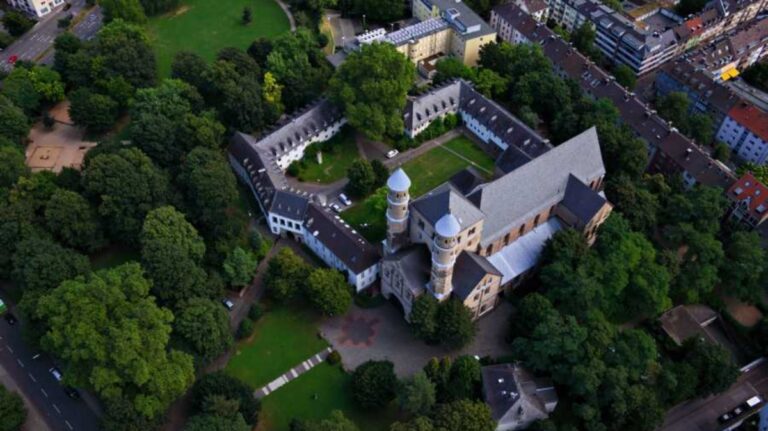
The complex occupies part of the former St. Martin’s Field in Cologne’s Severinsviertel, now Altstadt-Süd. Kartäuserwall bordered the monastery to the south, while Kartäusergasse ran beside its outer wall. The monastery garden, church, cloisters, chapter house, refectory, and other buildings formed the precinct.
Cloisters and cells
Stone-built structures included a cloister and 25 cells, which gradually replaced earlier, simpler buildings believed to have used wood and half-timber construction. Each cell contained a work space where a monk could copy manuscripts. By 1827, 12 bays of the great cloister remained. Portions of both cloisters were restored after the damage of 1945 rather than rebuilt in full.
Communal and service buildings
The monastery also included a refectory, or communal dining hall, a sacristy, a cemetery and cemetery cross, a gatehouse, kitchens, and storerooms. A three-winged conventual building stood along the street. The chapter house and library occupied land adjoining the earlier monastery buildings.
Church and artistic features
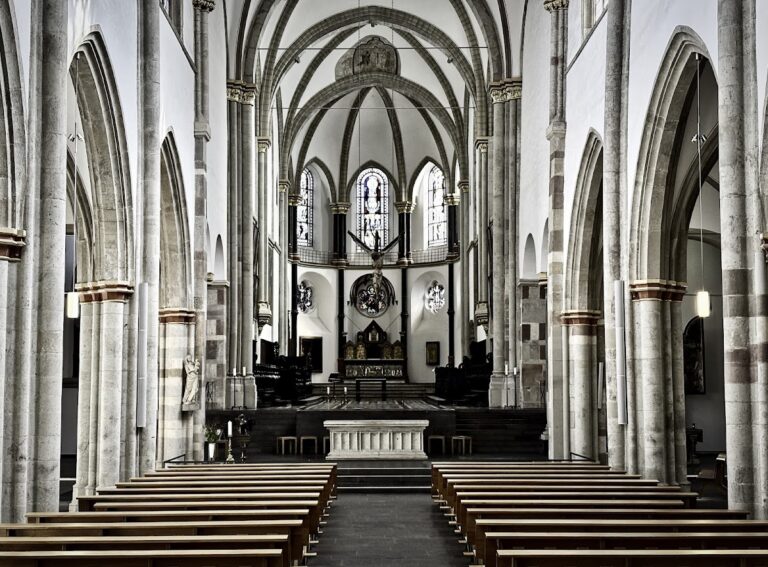
Gothic church
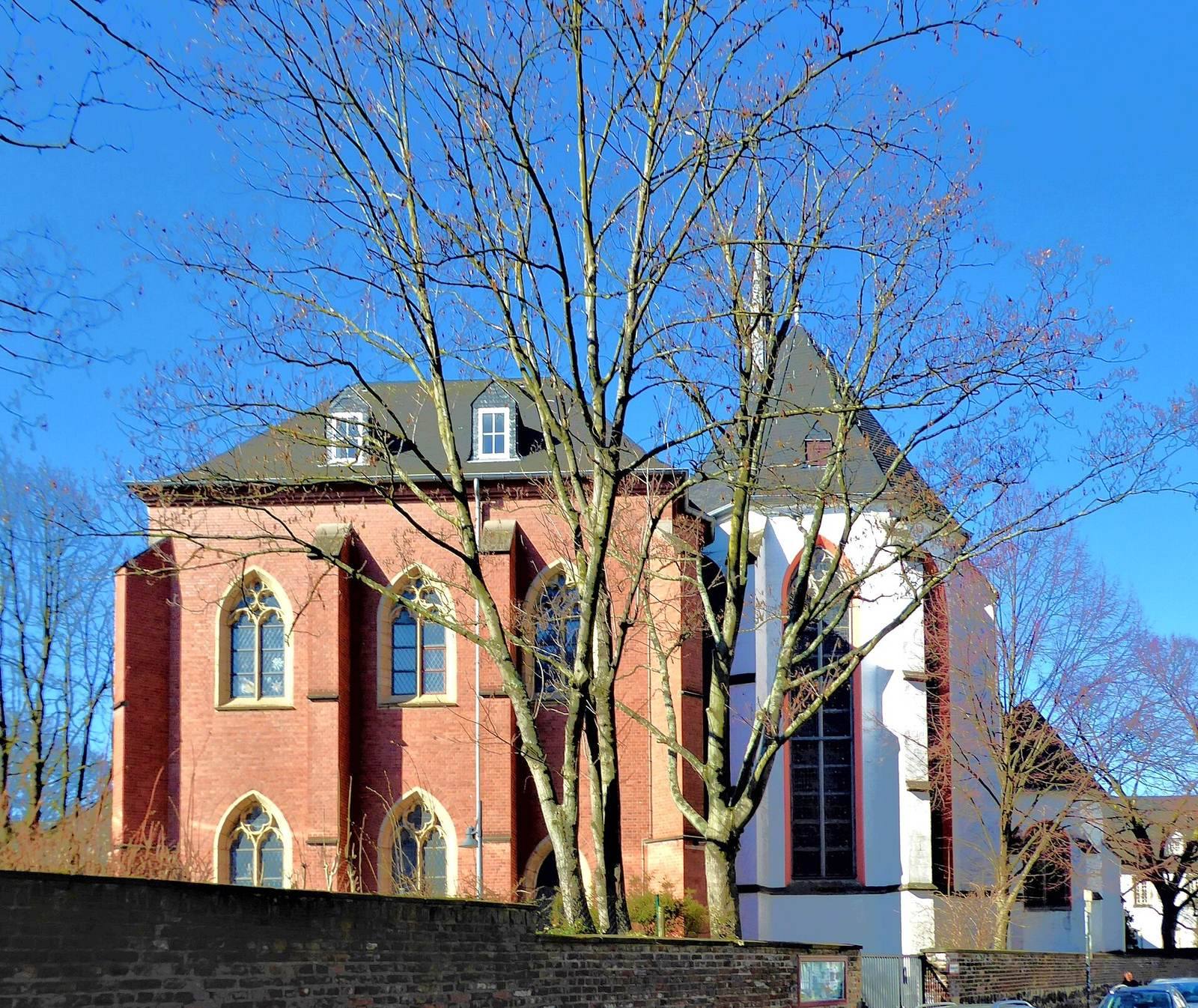
The church’s essential form belongs to the medieval building consecrated in 1393. It is dedicated to Saint Barbara, as was the early-thirteenth-century chapel that preceded the monastery on the site. The church’s west side and main portal are among the identified parts of the complex. Its present fabric includes postwar reconstruction.
Altars and chapels
The church had an unusually large number of richly furnished altars, including the Angels’ Altar, as well as an Angels’ Chapel and a Lady Chapel. The number of altars was exceptional for a Carthusian church; the presence of many priest-monks, each required to celebrate Mass daily, was offered as an explanation. A chapel belonging to the Hardenrath family is also identified within the church.
Paintings and later works
By the end of the fifteenth century, two three-panel altarpieces by the Master of the Saint Bartholomew Altarpiece had been added to the church. They are now held by the Wallraf-Richartz Museum. A large cycle of paintings by the Master of the Legend of Saint Bruno was made for the small cloister, probably around 1486. In the rebuilt church, artist Charles Crodel designed windows for the main and side aisles, and sculptor Gerhard Marcks contributed bronze works.
Chapter house and later alterations
Chapter house
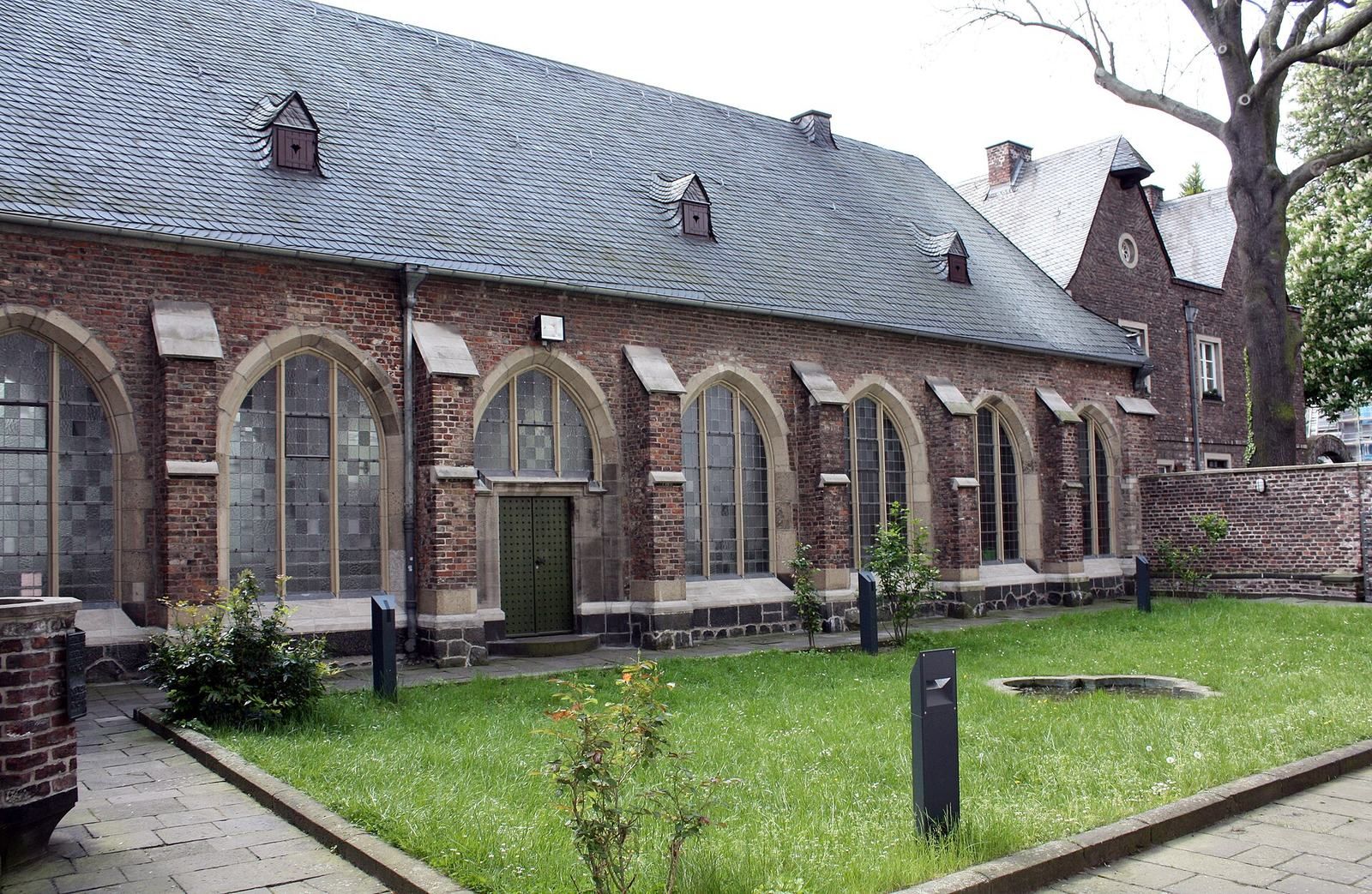
The chapter house was rebuilt after the 1451 fire. Its later reconstruction used surviving ruins and photographs, recreating the exterior while adapting the interior for modern congregational use.
Military alterations
Prussian military use substantially changed the surviving fabric. Existing windows were blocked and new openings cut into walls. Rubble was deposited in wells, and broken stone from burial chambers and crypts was used to block church windows.
Postwar rebuilding
The 1945 attack left the church, chapter house, cloisters, and prior’s house severely damaged and destroyed the wall along Kartäusergasse. The complex visible today is largely the result of postwar reconstruction. The church was rebuilt through several stages, while parts of the cloisters were restored. The chapter house combines a reconstructed exterior with a modern interior.