Pazyryk Burials: Iron Age Tombs of Russia’s Altai
Site at a Glance
- Popularity
- Very High
- Country
- Russia
- Primary era
- Iron Age
- Eras represented
- Iron Age
- Civilizations
- Scythian
- Site type
- Burial
- Remains
- Necropolis
On this page17 sections
History
The Pazyryk burials are tombs from the Iron Age, when iron became an important material for tools and weapons, in the Pazyryk Valley and on the Ukok Plateau in Kosh-Agachsky District, Altai Republic, Russia. Associated with Scythian and Saka peoples, related horse-riding communities of the ancient Eurasian steppe, they give their name to the Pazyryk culture, the archaeological term for the material culture represented by these graves. Barrows 1–5 are dated to the fourth to third centuries BCE.
Pazyryk culture and funerary customs
Sergei Rudenko first used a neutral label for the culture and placed it in the fifth century BCE. Later dating assigned the five principal Pazyryk barrows to the fourth and third centuries BCE. The tombs became a type site for the wider culture, which has since been linked with Scythian communities whose similar burial mounds extend across the Eurasian steppe. The Pazyryk discoveries also helped bring kurgan, a word for a burial mound, into wider archaeological use.
The people associated with the graves were horse-riding pastoral nomads. Some may have accumulated wealth by trading horses with merchants from Persia, India, and China. Burial goods point to connections with Central Asia, China, and the Near East, while trade routes may also have reached India. The concentration of tombs in one area has been interpreted as evidence that it held particular ritual importance. The dead may have been brought long distances for burial. Some funerals included sacrificed horses and, in certain graves, women described as concubines.
Excavation and interpretation
M. P. Griaznov excavated Barrow 1 in 1929, and Rudenko worked on Barrows 2–5 between 1947 and 1949. Although many tombs had been looted before excavation, substantial burial goods survived. In some graves, water entered in antiquity and froze around the contents, preserving organic materials until the tombs were opened.
Cranial measurements made in the 1960s characterized the buried population as predominantly of European ancestry, with some Northeast Asian admixture. A later genetic model estimated ancestry at about 50 percent from a Late Bronze Age Khövsgöl-related source, 36 percent from Western Steppe Middle and Late Bronze Age herders, and 14 percent from a source resembling the Bactria–Margiana Archaeological Complex, a Bronze Age culture of Central Asia.
Later discoveries and heritage
In 1993, archaeologist Natalia Polosmak discovered the well-preserved female burial now known as the Ice Maiden or Altai Lady on the Ukok Plateau. Two years later, archaeologist Vyacheslav Molodin found another frozen burial containing an armed man with tattoos and long braids. A wooden tomb near the Mongolian border yielded a tattooed man believed to have been a Pazyryk chief in 2007. Local opposition to excavation led researchers to move some work across the border into Mongolia, and further tomb discoveries were reported at several locations in 2012.
The Pazyryk site forms part of the Golden Mountains of Altai, which is included on the World Heritage List administered by the United Nations Educational, Scientific and Cultural Organization (UNESCO).
Remains
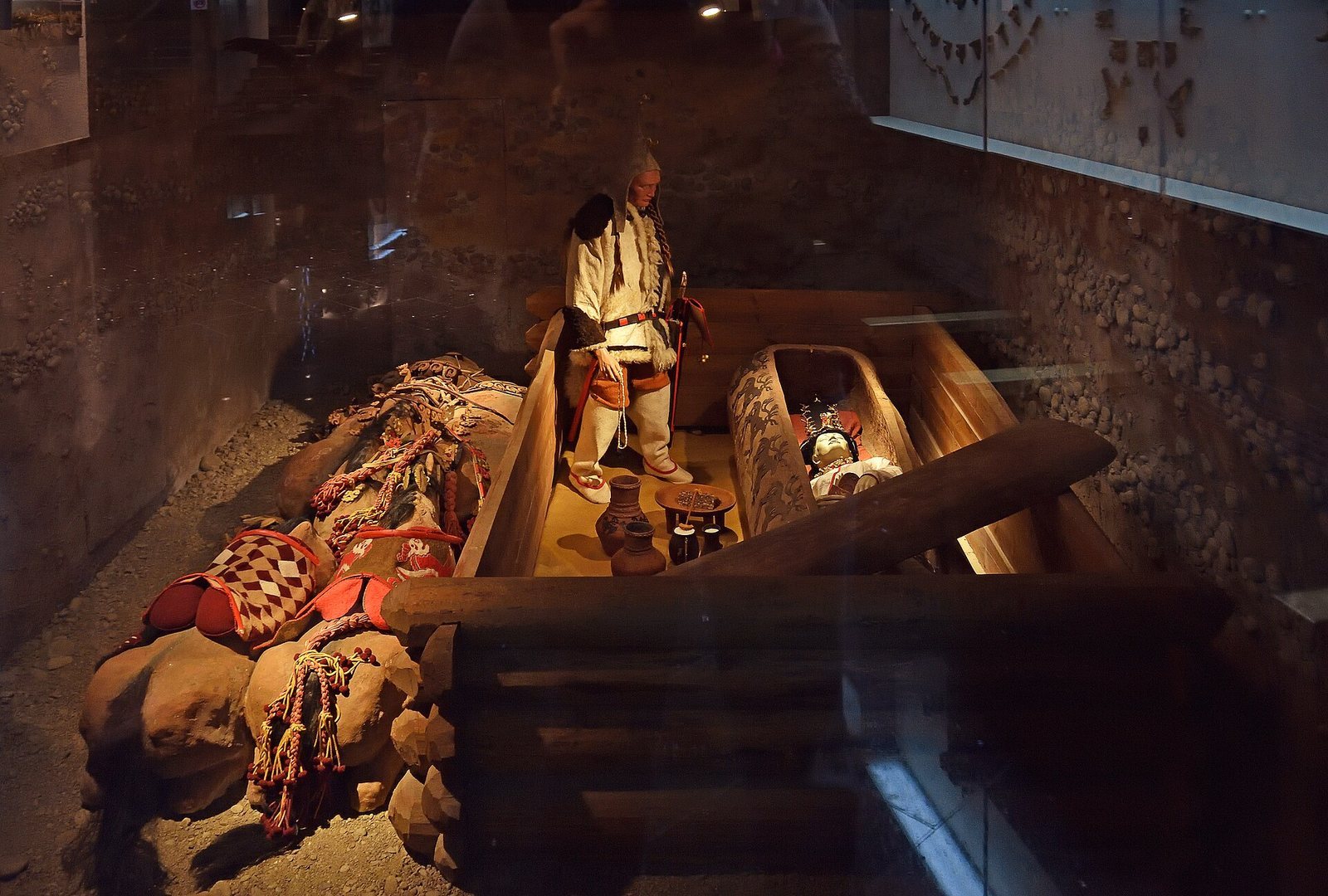
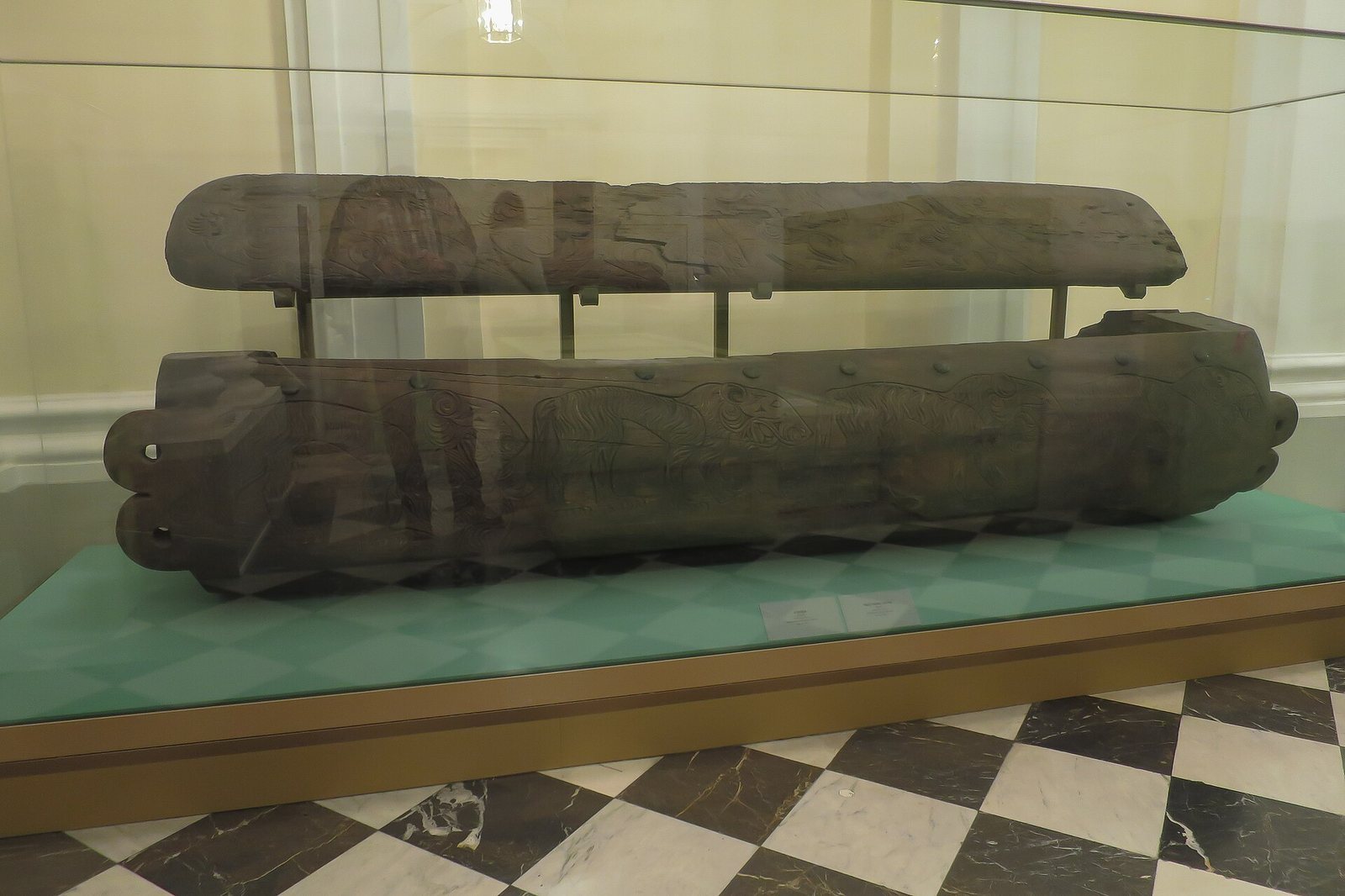
The graves are timber chambers beneath large mounds of stones and boulders. Some chambers contained coffins hollowed from Siberian larch trunks, a wood that may have held sacred meaning. Water that seeped into certain tombs froze around their contents; permafrost, ground that stays frozen for at least two consecutive years, helped preserve bodies and objects.
Burial architecture and individual graves
Barrow 1
Barrow 1 dates to the fourth century BCE. Though its main burial contents had been looted, the area containing sacrificed horses remained intact. The finds include horses wearing deer-antler masks, harnesses decorated with human figures, a decorated saddle, a wooden shield, and a sarcophagus from the chamber. A felt band bears a lion design derived from Achaemenid art, the art of the Persian imperial dynasty that ruled from the sixth to the fourth century BCE.
Barrow 2
The man buried in Barrow 2 was 176 centimetres tall and had died violently, killed with a Scythian-type battle axe and scalped. His carefully embalmed body carried numerous tattoos. On his right arm were a donkey, a mountain ram, two stylized long-antlered deer, and an imaginary predator; two griffin-like creatures marked his chest. Partly obliterated figures on his left arm appear to represent deer and a mountain goat. A fish extended from his right foot to his knee, animal designs covered his legs, and small circles ran along his back beside the spine. A therapeutic purpose for the circles remains uncertain. Infrared photography later revealed tattoos on all five bodies examined from Pazyryk burial mounds.
The man’s head, now in the Hermitage Museum in Saint Petersburg, was crowned with a copper-alloy tiara decorated with six winged, horned, hoofed lion griffins. The wooden figures had once been covered in gold foil, which was looted. A false beard made from hair, sinew thread, and leather lay beside him; its meaning is uncertain, since the Pazyryk mummies were clean-shaven. At the head of the coffin was a carved wooden crest showing a bird of prey holding a deer’s head, thought to have been his headgear.
Barrow 5
Barrow 5 had inner and outer log sarcophagi, covered by five layers of logs and a layer of boulders. Despite looting in antiquity, the grave still held the embalmed remains of a man and a woman, nine horses, carpets, and a dismantled wagon with four large spoked wheels. The horses may have been harnessed to a chariot or prepared for riding.
The Ice Maiden’s burial
The Ice Maiden’s unusual, undisturbed ceremonial grave dates to the fifth century BCE. Her coffin was made from a hollowed Siberian larch trunk and was large enough to hold her tall felt headdress. Carved leather deer and snow leopard figures decorated its exterior. Six sacrificed horses in elaborate harnesses lay north of the burial chamber. Freezing rain appears to have flooded the grave soon after burial, leaving its contents locked in ice.
The woman was 167 centimetres tall. Her body had been treated with peat and bark and placed on its side; her hair was shaved, and she wore a wig and tall hat. Animal tattoos included horned creatures whose forms developed into floral shapes. Swans and gold-covered carved cats decorated her felt headdress. She wore a long red-and-white striped wool skirt, white felt stockings, and a yellow blouse. Fiber examination identified the blouse as a non-Chinese wild silk, possibly from India, rather than the Chinese tussah silk first proposed. Staining suggested it was not a new garment made for the burial.
The 2007 tomb
The wooden tomb found in the Altai permafrost in 2007 contained a tattooed man believed to have been a Pazyryk chief. His sable coat survived in good condition, as did other objects, including one resembling a pair of scissors.
Textiles, vehicles, and other grave goods
The Pazyryk carpet
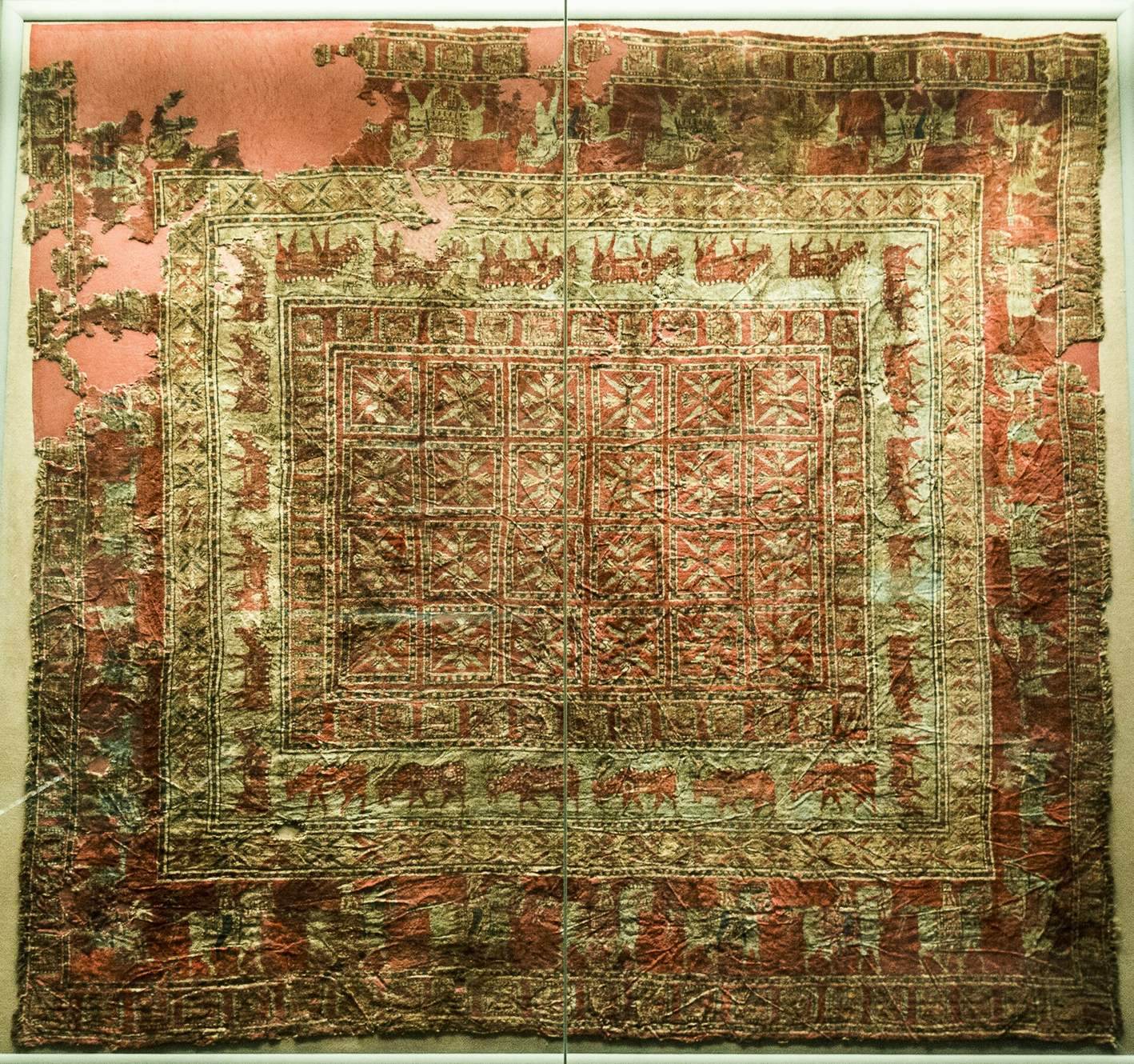
The Pazyryk carpet measures 183 by 200 centimetres and has about 360,000 knots per square metre, a density greater than that of most modern carpets. Often described as probably the oldest surviving pile carpet, it was found deeply frozen and is now in the Hermitage. Its centre has a ribbon design; one border shows a procession of elk or deer, and another depicts horsemen. Its manufacture around 400 BCE has been attributed either to ancient Armenia or to Persia. Arguments for an Armenian connection point to double-knot weaving and Armenian cochineal dye, while a Persian attribution draws on the decoration and horse type. One comparison links the horse design to a Persepolis relief showing part of an Armenian delegation among peoples bearing tribute.
Furnishings and transport
Other excavated organic goods include felt hangings, Chinese silk, rugs, wooden furniture, household objects, and elaborate horse trappings. Many are now displayed at the Hermitage. The tombs also yielded a separate four-wheeled funeral chariot, three metres tall and dated to the fifth century BCE, along with well-preserved cloth saddles and felt and woven rugs.
Art and ritual objects
Animal and geometric designs
Animal imagery is more common at Pazyryk than geometric patterns and solar signs such as circles and rosettes. Some designs combine creatures by joining parts of different animals, a practice less common in the Altai than in southern Russia. Deer and related animals are prominent in Altai-Sayan art. Bearded, mask-like faces in a Greco-Roman style have also been linked to artistic influence from the Hellenistic kingdoms of the Cimmerian Bosporus, the ancient region around the strait connecting the Black Sea and Sea of Azov.
Objects used in funerary rites
A yak-horn vessel and dishes containing coriander seeds were placed near the Ice Maiden’s coffin. Testing of similar dishes in other graves identified coriander, probably used to mask the smell of the body. Another chamber held a fur bag with seeds, a censer filled with stones, and a frame for an inhalation tent. These objects are thought to have served in purification at the close of the funerary rites.