Oguz Kurgan: A Scythian Royal Burial Mound in Ukraine
Site at a Glance
- Popularity
- Medium
- Country
- Ukraine
- Primary era
- Classical
- Eras represented
- Classical
- Civilizations
- Ancient Greek, Scythian
- Site type
- Burial
- Remains
- Burial Mound
On this page11 sections
History
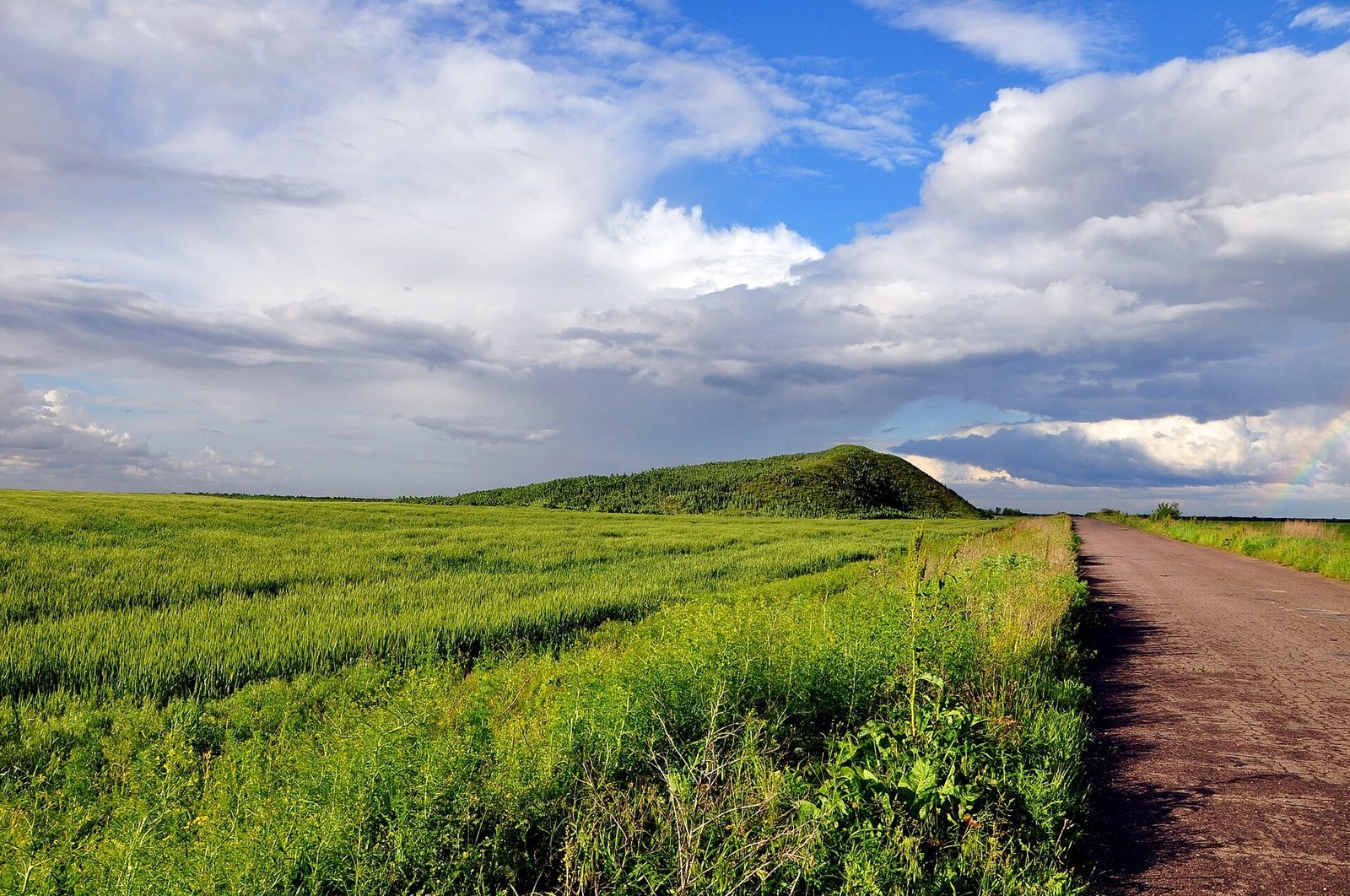
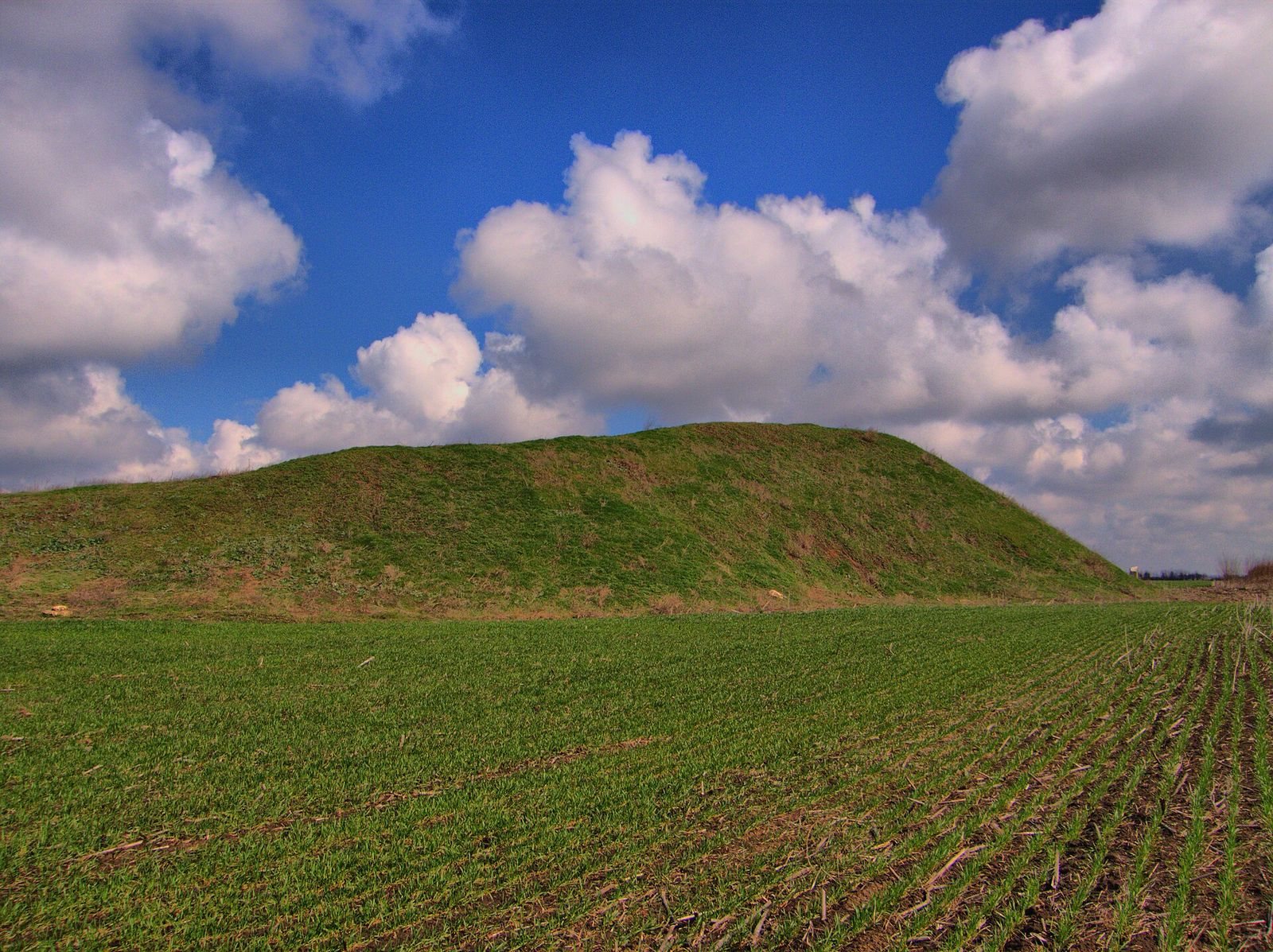
Oguz Kurgan is a Scythian royal burial mound near Nyzhni Sirohozy in Kherson Oblast, Ukraine, built between 330 and 310 BC. It is described as the largest mound in the Black Sea steppe and, by volume, in Eastern Europe. The person buried in its central tomb is unknown, but archaeologist Yuriy Boltryk argued that the mound’s scale, burials of dependent people and horses, and rich grave goods point to a Scythian king.
Royal burial and cultural setting
Boltryk suggested that the central burial may have belonged to a son or another descendant of Ateas, a Scythian king who died in 339 BC fighting Philip II of Macedon. Oguz’s combination of Scythian and Bosporan or Greek-influenced funerary traditions has been linked to the economic and cultural flourishing of Scythia and the Bosporan kingdom, an ancient state centred around the strait now called the Kerch Strait.
Excavations, looting, and reconstruction
Archaeologist Nikolai Veselovsky began investigating Oguz in 1890 with the local community’s permission. He excavated the mound over four field seasons, from 1891 to 1894. In 1901, autumn rain eroded a steep face left by his excavation, exposing gold objects and drawing local treasure hunters. After archaeological authorities sought protection for the mound and recovery of looted objects, archaeologist Vadim Rot undertook further work in 1902. He helped curb the looting and bought back some finds; other objects entered private collections. A lack of government funding prevented a full investigation.
In 1971, archaeologist Oleksandr Leskov called for further excavation. A Kherson expedition under his direction resumed work the following year and recorded how the mound had been built. Politically motivated accusations against Leskov and the death of his deputy, archaeologist Oleksandr Rumyantsev, in an assault interrupted the investigation for several years.
A Taurian expedition led by Yuriy Boltryk worked at Oguz from 1979 to 1981. Before this campaign, more than two-thirds of the mound and the ground beneath it had not been excavated. The team investigated the mound’s boundaries and construction, recovered objects lost during earlier excavation and looting, and excavated the northern grave. In its final season, it examined the other known burials and found further remains, including a horse burial and a warrior-archer burial. Across all campaigns, excavation took place during nine field seasons over about ninety years.
Oguz had been robbed in antiquity, and modern treasure hunters had disturbed several graves. The mound was reconstructed in 1988, the first post-excavation reconstruction of a mound in Ukraine. In 2009, the local community renewed and tidied a commemorative marker whose inscription identifies Oguz as the family tomb of a Scythian king from the second half of the fourth century BC. Finds from the investigations are held in the Hermitage’s Scythian collections and the Treasury of the National Museum of the History of Ukraine; some objects acquired by Rot passed into private collections.
Remains
Oguz is an earthen mound built over a complex of underground graves and horse burials. Its layout includes a central tomb and associated burials, with separate northern, southern, and western graves. Turf blocks, a stone retaining structure, an encircling ditch, and a paved ritual path formed parts of the mound and its perimeter.
Mound and perimeter
In Veselovsky’s time, the mound stood more than 20 metres high and measured over 380 metres around. Its estimated volume is about 117,000 cubic metres, and its base was approximately 125 to 130 metres across. Builders raised it in stages from blocks of turf transported from the Sirohozy ravine, about 3 to 5 kilometres away. A limestone revetment, a retaining facing that supports an earth slope, enclosed the mound; its stone was probably brought from the Dnieper banks, about 50 kilometres distant. The revetment and tomb together used about 5,000 cubic metres of stone.
Outside the stone facing ran a ditch 125 to 130 metres in diameter, 4 to 6 metres wide, and up to 3.5 metres deep. Clay dug from it formed the base of an outer bank. Within the mound, a ritual path was paved with seagrass brought from the coast of the Sea of Azov.
Burial complex
The central tomb and the graves around it combine underground burial spaces with stone construction and wooden coffins. The central crypt and its long passage have been attributed to Greek builders, possibly from the Bosporan kingdom.
Central tomb
The central structure included an entrance pit with four corner niches and a passage that ended within the structure. A long corridor, called a dromos, led from the south toward the tomb. Cut into natural ground, it measured more than 2 metres across and about 35 metres long. A guard was buried about 4 metres from the tomb entrance with a spear, knife, and bronze and bone arrowheads.
The entrance led to a large square pit with three wall niches, approached by two descending ramps. The pit was 16.3 metres square and 6.4 metres deep. Large stones filled it; at its base stood a stone crypt measuring 6.4 metres square, with a stone floor and an area of about 41 square metres. Carefully dressed blocks were set upright to form its walls. A stepped corbelled vault, built from masonry courses that project inward, covered the tomb. Massive iron clamps fitted into drilled holes and secured with lead joined the walls and roof. A woman occupied the northern niche, while an adolescent and an adult, possibly a woman, were buried in the western niche.
Horse burial west of the central tomb
West of the central pit, on a path within the mound, a separate grave held four horses. It had been left unfilled until the mound’s final formation. Three horses were saddled and wore bridles decorated with gold; two also had bronze chest plates. The fourth was unsaddled and had a ritual bridle made with animal teeth. The gold bridle sets from this burial match those recovered in the dromos, apart from the presence or absence of gold chest ornaments.
Northern grave
Found in 1980, the robbed northern grave may have belonged to the wife or daughter of a Scythian king. Excavators recovered about 6,000 small gold ornaments and plaques that had decorated clothing. Their images include the Great Scythian Goddess, a major female deity in Scythian art, and a Scythian figure standing before her, as well as Athena, Apollo, Heracles, and the Gorgon from Greek religion and mythology. Other pieces depict Dionysus, horned griffins, and a human profile. Pendants take the forms of a lion, a ram, and male faces. An earring shaped as a sphinx, a mythical creature, has facial features described as African.
The grave’s fine goldwork includes a classical female head just 6 millimetres high and a 3-millimetre griffin forepart soldered from nine pieces, accompanied by a tiny grape-cluster pendant. Another pendant depicts the head of a young Black man with a grape cluster. A richly decorated wooden sarcophagus, or coffin, was made in a classical style. Surviving pieces include gilded alabaster plaster set against a blue ground, and engraved ivory and tubular-bone plaques cut to shape. The plaques show human figures and a complex plant design of stems, petals, palm leaves, curled acanthus leaves, flowers, and rosettes. The plant imagery has been interpreted as a possible world tree. Five bone cylinders formed part of the hinged lid; other bone objects include fittings for a wooden box, multi-part spindles, and a cosmetic spatula.
At the bottom of the grave’s entrance pit, 5.7 metres down, three horses were buried with silver bridles of a style associated with ancient Thrace in southeastern Europe. Their cheek pieces show a rider killing a panther, a winged deity fighting a lion, and griffins attacking a deer. The horses were harnessed to a cart whose painted sides blocked the entrance to the burial chamber. A canopy above it was decorated with thin bronze plaques shaped as discs, triangles, diamonds, a stylized snake-legged goddess, openwork palm leaves, and bands with a repeating Greek-key pattern. The plaques were found in the pit’s fill, in layers four to six deep across an area about 2 by 4 metres. They appear to have been sewn onto fabric, rolled up, and placed in the partly filled pit.
Southern grave
The southern grave lay 56 metres from the mound’s centre, near the central structure’s entrance pit, and connected to that structure by an ancient robbers’ passage. It was an underground burial chamber reached through an entrance shaft, 4.4 metres deep, with a chamber of about 24 square metres. Its occupant may have been a woman from the royal family.
Horse equipment and associated finds
Rich horse burials and equipment from the mound are attributed to more than 24 horses, although the origin of some objects collected by Rot cannot be securely assigned to Oguz. Finds include tubular gold beads, hemispherical buttons with loops, plaques bearing human masks, six- and eight-petalled rosettes, punched triangles, and floral designs. Particularly noted pieces depict a flying eagle and a reclining lioness; a gold deer’s head may have decorated a headdress.
Silver horse equipment includes forehead and cheek pieces. One set has a forehead fitting shaped as a lioness preparing to leap, paired with an openwork, engraved cheek piece. Another has four lion heads on the forehead fitting and a lioness’s head raised above them. Related plates and cheek pieces show a lioness, stylized animal muzzles, a stag, and two reclining lions. A further set combines a silver forehead fitting shaped as a griffin’s head with four large gilded plaques in swastika forms. Its silver cheek pieces were covered with gold foil and carried a scene of three human figures. The woman shown in profile at the right survives best; the central and left figures remain in fragments.