Magnesia on the Maeander: An Ancient Greek City in Ionia
Site at a Glance
- Popularity
- Very High
- Country
- Turkey
- Primary era
- Classical
- Eras represented
- Iron Age, Classical, Medieval
- Civilizations
- Ancient Greek, Byzantine, Kingdom of Pergamon, Roman
- Site type
- City
On this page24 sections
History
Magnesia on the Maeander was an ancient Greek city near modern Germencik in Aydın Province, Turkey, founded by settlers from Thessaly and Crete. Refounded near 400 BC beside the Lethaios River, it was later redeveloped on a monumental plan under the Attalid dynasty of Pergamon. The city connected coastal Priene, Ephesus, and Miletus with the Anatolian interior through Tralles, while its fertile territory produced wine, figs, cucumbers, and other crops.
Founding and Persian rule
The city’s name referred to its settlers from Magnesia in Thessaly; the addition ‘on the Maeander’ distinguished it from Magnesia ad Sipylum. An inscription found during excavation names the Cretan Leukippos as a participant in the foundation. Although Magnesia lay in Ionia, it was excluded from the Ionian League, an association of Greek cities in the region, because it was regarded as an Aeolian settlement.
Magnesia’s earliest location is uncertain. It may have stood about five kilometres from the later city, near the meeting of the Menderes and Lethaios rivers. Deposits carried by the rivers eventually inundated that settlement. Cimmerian attacks, sometime between the eighth and seventh centuries BC, damaged or destroyed the city; it was later recolonized, possibly by people from Miletus or Ephesus. Lydian rule followed during the seventh century BC.
After Cyrus II conquered Lydia in 547 BC, the Persian commander Mazares devastated Magnesia while suppressing the revolt of the Lydian official Pactyes. From about 546 BC, Persian satraps, or provincial governors, governed the city. Magnesia joined the Ionian Revolt of 499 BC, a rebellion against Persian rule by Greek cities in Asia Minor. In 522 BC, the satrap Oroetes lured Polycrates, the ruler of Samos, to Magnesia and killed him.
Themistocles and the refoundation
Around 460 BC, the Persian king Artaxerxes I appointed the exiled Athenian commander Themistocles governor of Magnesia. The city, together with Lampsacus and Myus, was assigned to provide for his household: Magnesia supplied grain, Lampsacus wine, and Myus fish. Themistocles died and was buried at Magnesia in 459 BC. His son Archeptolis succeeded him, and the family was honoured locally as heroic. A tradition held that Themistocles’ wife or daughter served as priestess at an earlier sanctuary of Dindymene, a title of the mother goddess Cybele.
Around 400 BC, the Spartan commander Thibron occupied Magnesia and was associated with its refoundation at the foot of Mount Thorax. The new city stood beside the Lethaios, a tributary of the Maeander. In 392 BC, Magnesia joined Thibron, Ephesus, and Priene in an effort to defend Greek cities in Asia Minor. The Persian satrap Struthas defeated Thibron’s army, and Thibron died in the battle.
Alexander and the Hellenistic city
After Alexander the Great defeated the Persians at the Granicus in 334 BC, Magnesia and nearby Tralles voluntarily opened their gates to him. Alexander sent his general Parmenion to the cities with orders to remove oligarchic governments, restore democratic rule, respect local laws, and end tribute. After Alexander’s death in 323 BC, Magnesia passed among the competing Successors to his empire. Antigonus I held it until 301 BC; Macedonian, Ptolemaic, and Seleucid rule followed, with a brief period of Egyptian control around 272–258 BC.
By the late third century BC, the city had a democratic government with a council and an assembly. Magnesia issued silver coins from about 400 BC and bronze coins from about 300 BC. In 201 BC, Philip V of Macedon granted the Magnesians territory around Myus, but the settlement returned to Miletus under the Peace of Apamea in 188 BC. After the Seleucids were defeated at Magnesia ad Sipylum, Magnesia came under Pergamene rule, confirmed by that treaty. Its greatest prosperity followed under Pergamon’s Attalid rulers.
The Hellenistic city’s sanctuary was devoted to Artemis Leucophryene. The relationship between this cult and the older Phrygian mother-goddess tradition is uncertain; an earlier sanctuary in Magnesia had honoured Dindymene. In the third century BC, after an appearance attributed to Artemis, Magnesia and its sanctuary gained recognition among other Greek states as places of asylum, a recognized protection from seizure. The city held the Leucophryna every four years in honour of the goddess. Its athletic competitions drew participants from places including Sicily and Persia. Magnesian athletes won at least 15 victories at the ancient Olympic Games and at least one at the Pythian Games.
In 197 BC, Magnesia defeated Miletus. The city’s prosperity under the Attalids accompanied this period of civic and religious activity.
Roman rule and late antiquity
In 133 BC, the kingdom of Pergamon passed to Rome. Magnesia supported Rome in 87 BC, and the Roman general Sulla rewarded it with privileged civic status. A coin of Gordian III later described Magnesia as the seventh city of Asia. Roman imperial coins from the city often showed Artemis Leucophryene or her temple.
A Christian church existed at Magnesia by 110 AD at the latest. Ignatius of Antioch addressed a letter to the Magnesians, and the city later became a bishopric, with eight bishops known by name. Goths sacked and burned Magnesia in 262, after which it did not regain its former prosperity. Arab incursions eventually brought its bishopric to an end. In the early Byzantine period it remained a bishopric and later served as a small frontier fortress. During the war with Persia in the 620s, amid the threat posed by the Persian king Khosrow II, a defensive wall was built near the Artemis sanctuary.
Medieval decline and rediscovery
After 1308, Magnesia’s lands formed part of the Aydinid principality, a Turkish principality in western Anatolia. Repeated flooding made the area marshy, and the settlement was gradually abandoned.
William Hamilton identified the ancient city in 1803. Charles-Félix Texier led a French expedition and excavations there in 1842–1843. Carl Humann directed German excavations from 1891 to 1893, a campaign lasting 21 months that exposed parts of the theatre, agora, temples of Artemis and Zeus, and civic buildings. Excavation resumed in 1984 under Orhan Bingöl of the University of Ankara and the Turkish Ministry of Culture.
Remains
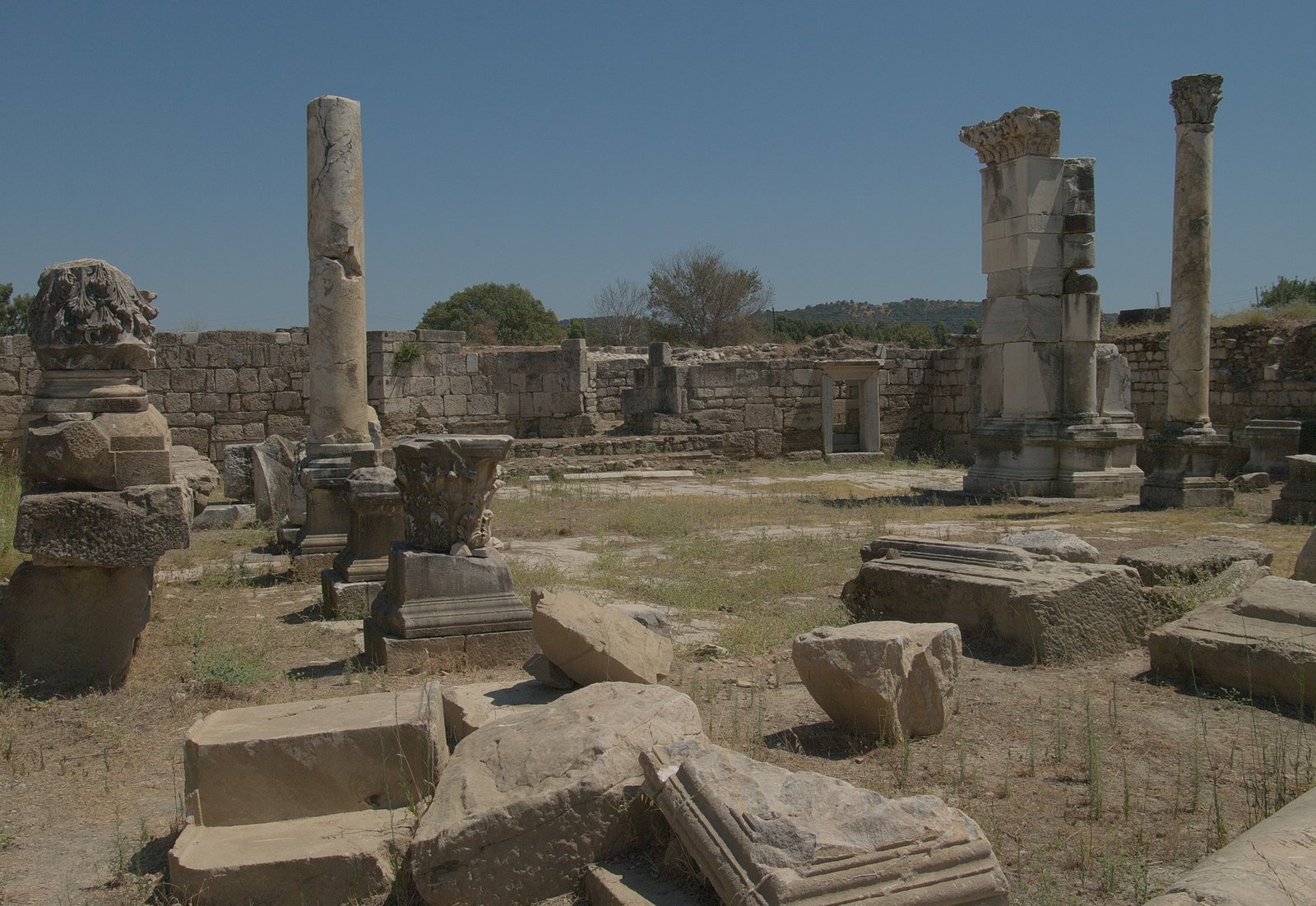
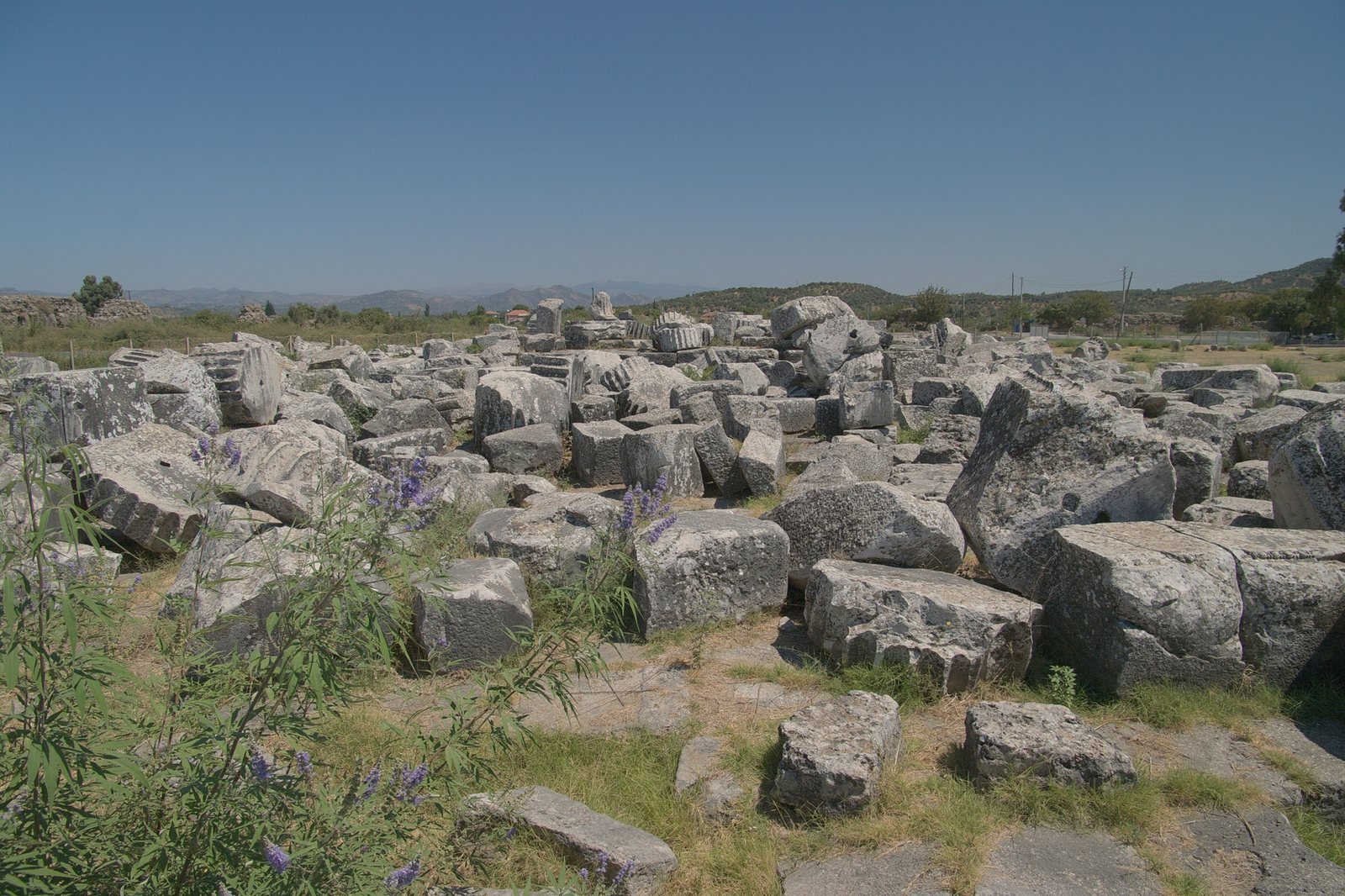
Magnesia’s remains occupy the slope of Mount Thorax beside the Lethaios. They preserve a planned urban grid, large sanctuaries, civic spaces, and public buildings. Much of the city’s architectural fabric was broken up for lime, so surviving structures range from foundations and fragments to the exceptionally well-preserved stadium.
Urban layout and defences
The city’s regular plan is attributed to the architect Hermogenes. Three main roads led northeast to Tralles, east to Priene, and west to Ephesus. Within the city, main streets ran east to west, crossed by streets running north to south. The line of the city walls can still be followed in places. Short sections of Byzantine walling and a tower remain, while the best-preserved stretches lie on hills at the southern end. A section of the later defensive wall near the Artemis sanctuary crosses the modern Ortaklar–Söke road.
Sanctuaries and temples
Sanctuary and temple of Artemis
The sanctuary of Artemis Leucophryene occupied a terrace bordered on three sides by Doric colonnades. It included a sacred spring, an altar in front of the temple, and a large sacred enclosure entered through monumental gates. An approach road passed through these gates to the sanctuary.
Elements of an earlier, smaller Ionic temple, built of limestone in the sixth or fifth century BC, were uncovered during excavation. The later Hellenistic temple, attributed to Hermogenes, measured about 41 by 67 metres and stood on a stepped base. Its Ionic colonnade had eight columns across the front and fifteen along each side. Its pseudodipteral plan, a wide outer colonnade without an inner row of columns, created a broad gallery around the temple.
The entrance porch faced west, while a rear chamber stood at the east end. The main chamber and entrance porch each extended four spaces between columns in depth; the rear chamber extended two. The main chamber’s width matched the three central spaces between columns on the façade, and four central columns stood within it. The entrance and altar were unusually placed on the western side. Three square openings in the open pediment reduced its weight. A carved band about 175 metres long showed a battle between Greeks and Amazons. Probably made in the second century BC, its figures were carved in high relief. The wooden cult image had been transferred from the earlier temple.
Great altar
The great altar stood within the sanctuary on foundations measuring 23.07 by 15.62 metres. Its plan was shaped like a squared U around an open central space containing the altar. The upper structure had two levels, with an Ionic colonnade forming the main front and walls with half-columns along the other sides. Deeply carved figures of deities filled spaces between the columns, while an unfinished carved band ran around the exterior.
Temple of Zeus Sosipolis
The temple of Zeus Sosipolis stood in the southern part of the agora. Built in the early second century BC after Magnesia’s victory over Miletus in 197 BC, it is attributed to Hermogenes of Alabanda. The Ionic temple had four columns across its front. At the opposite end, two columns stood between the projecting ends of the side walls. The main chamber and entrance porch were equal in size; the rear chamber, preceded by two columns, was half as long and measured about 7.4 by 15.8 metres.
Fragments found on the floor of the main chamber belonged to a colossal seated statue of Zeus. The god held a figure of Artemis in one hand and a sceptre in the other. The temple’s surviving remains were damaged by local residents even after Humann’s excavations.
Other temples
A circular temple of Athena stood on a hill near the theatre. Other Hellenistic temples honoured the Dioscuri, the twin heroes Castor and Pollux, Serapis, a Greco-Egyptian deity, and Dionysus, the god of wine and theatre.
Agora and civic spaces
Agora and associated buildings
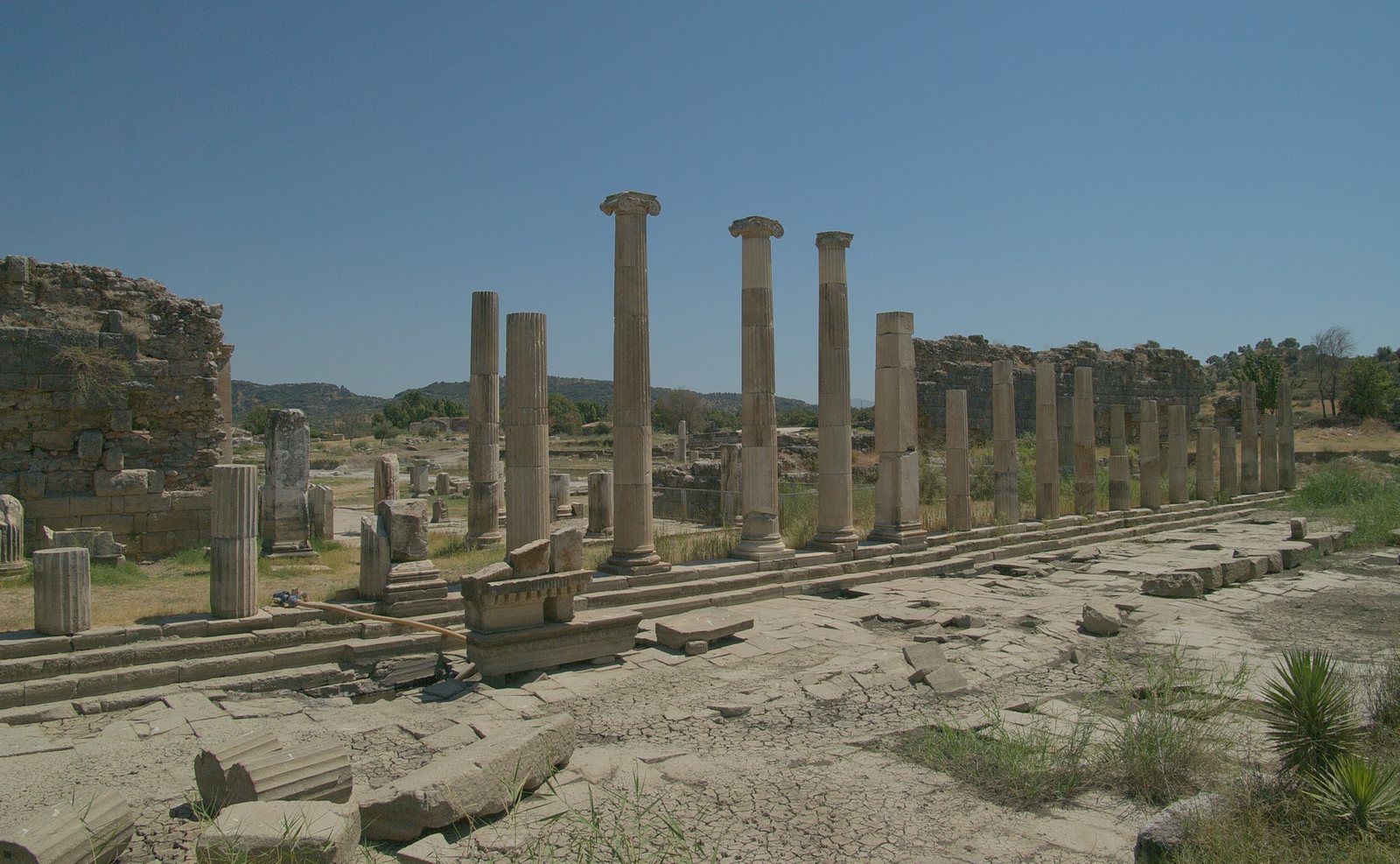
The agora, the city’s central public square, lay beside the Artemis sanctuary. Rectangular, paved, and aligned north to south, it covered about 26,000 square metres. Four covered colonnades stood on three marble steps around the square. Each had two rows of columns, with Ionic columns facing the square and Doric columns on the inner side. A space for the cult of Athena occupied the middle of the western side; two small statues of the goddess were found there.
Four access roads led from the southern colonnade toward residential districts. The prytaneion, a civic building associated with officials and public administration, occupied the southwestern block. A monument to the athlete P. Aelius Aristomachus stood at the southwest corner and was dedicated in AD 138.
Theatres and sports buildings
Greek theatre
The Greek theatre stood southwest of the city centre on the northwestern slope of Mount Thorax. Its earliest surviving phase, built with porous stone walls, dates to shortly after the refoundation around 400 BC. The theatre extended slightly beyond a semicircle and was completely rebuilt in the early decades of the second century BC. An inscription names Apollophanes as the architect responsible for that reconstruction.
Six radial stairways divided the semicircular seating into five sections. The marble-paved central performance area had a deep channel running from the stage to its centre, where it divided into two opposing arms. The straight stage front consisted of five parallel chambers made of porous stone on limestone-block foundations. After the Hellenistic rebuilding, columns in superimposed orders decorated the stage building. In the Roman imperial period the stage front was moved forward, and the two side entrances to the seating were closed to the public and incorporated into the stage area. The seats had 26 rows, with lion-paw decorations at their ends.
Other theatres and the odeon
A second theatre, called the theatron, was built south of the Greek theatre in the first century AD; its purpose is uncertain. Another theatre was left unfinished. An odeon stood between the Artemis temple and the Greek theatre. A basilica was added in the odeon’s area during the Roman period.
Stadium
The stadium occupied a valley between hills in the southwestern part of the city, with seating laid along the natural slopes. It measured 185.9 metres and held 2,500 seats. Rebuilt in marble during the Roman period, it has been partly excavated and remains exceptionally well preserved.
Gymnasia and aqueduct
Magnesia had two gymnasia based on the model at Miletus. One stood in the central area and included baths; the other was in the east near the Lethaios. A Roman aqueduct descended Mount Thorax to supply a sports complex with wrestling grounds, baths, and meeting rooms.
Later buildings and finds
Market building and church
A three-aisled building, possibly connected with the agora, served as a covered market and later as a church. Its column capitals depicted scenes involving Scylla, the sea monster in Homer’s Odyssey.
Heating building and mosque
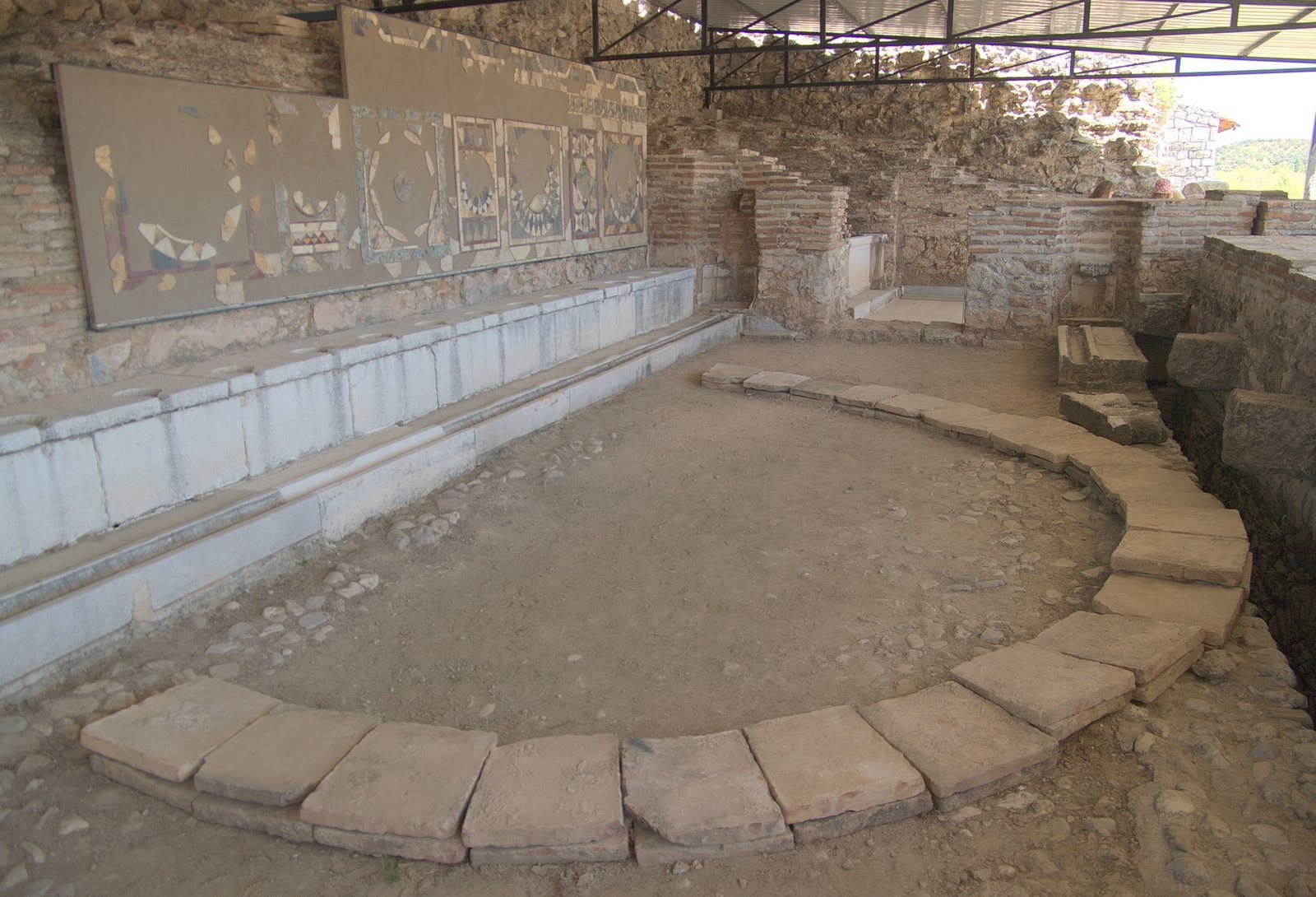
A building with a hypocaust, an underfloor heating system, dates to the second or third century AD. A mosque at the site dates to the fifteenth century.
Sculpture and dispersed architectural remains
Excavations in the ruins of the Artemis temple in 2018 uncovered six statues: four female figures, one male figure, and one figure whose sex could not be determined. A sculpted portrait recovered at Magnesia was first unidentified and later recognized as Euthydemus I of Bactria through comparison with portraits on coins. Other finds from the city are displayed in Istanbul and Aydın, as well as Berlin and Paris.
The façade of the Zeus temple was removed to Germany and is displayed at Berlin’s Pergamon Museum, which also houses a replica of its entrance porch and a replica of one bay of the Artemis temple. Fragments of the Artemis temple’s carved band are held in Paris, Berlin, and Istanbul. Turkey has repeatedly sought the return of Magnesian antiquities to museums in Istanbul and Ankara.