Castle Stalker: A Medieval Stewart Tower House in Scotland


Site at a Glance
- Rating
- 4.6
- Popularity
- Low
- Country
- United Kingdom
- Primary era
- Medieval
- External website
- Open
- Eras represented
- Medieval, Early Modern
- Civilizations
- Kingdom of Scotland
- Site type
- Military
- Remains
- Castle
On this page10 sections
History
Castle Stalker is a medieval Scottish castle in the United Kingdom, built for Clan MacDougall around 1320 on an island in Loch Laich. The MacDougall leaders held the title of Lords of Lorn, and the early fortified building formed part of their power in this historic lordship on Scotland’s western coast. The present tower developed mainly during the 1440s under John Stewart, after Lorn and Castle Stalker had passed to Clan Stewart in 1388.
MacDougall and Stewart rule
John Stewart had an illegitimate son, Dougald, with a woman of Clan MacLaren. In 1463, John married Dougald’s mother at Dunstaffnage, but Alan MacCoul murdered him near the church. Because the marriage had taken place, Dougald gained full hereditary rights and became chief of the Stewarts of Appin.
Conflict between the Stewarts, MacLarens, and MacDougalls continued. In 1468, the Stewarts and MacLarens defeated the MacDougalls at the Battle of Stalc. Dougald personally killed Alan MacCoul during the fighting, taking revenge for his father’s murder. Dougald himself died in 1497 during a raid against the lands of MacDonald of Keppoch, which had been undertaken after cattle theft. His eldest son, Duncan Stewart, succeeded him.
James IV, king of Scotland and a relative of the Stewarts of Appin, frequently stayed at Castle Stalker while hunting in the Highlands. He also used the castle as a base. During this period, the building was enlarged, including the addition of its upper floor and roof.
Sixteenth-century clan conflicts
Duncan Stewart was killed in 1512 and succeeded by his younger brother Alan. The following year, the chief of the Stewarts of Appin and five of his sons fought for James IV at the Battle of Flodden. The Scottish army suffered a decisive defeat, and James IV was killed, although all six members of the Appin family survived.
In 1520, Alexander Stewart was killed by members of Clan Campbell while fishing near Castle Stalker. A local tradition says that Alexander’s nurse hid his young son Donald in the castle during the raid, then carried him to Morvern after the Campbells had departed. Donald later became known as Donald Hammer because of his exceptional strength.
In 1544, Donald summoned the Stewarts of Appin and killed nine Campbells at Dunstaffnage in revenge for his father. He also led the Stewarts at the Battle of Pinkie on 10 September 1547. Donald died in 1607 and was buried on Lismore.
Campbell ownership and military use
Around 1620, Duncan Stewart, the seventh Stewart lord, transferred Castle Stalker to a Campbell of Airds in a drunken wager, exchanging the castle for an eight-oared cargo boat. The building returned to the Stewarts in 1689, but their defeat at the Battle of Dunkeld on 21 August that year forced them to transfer it back to the Campbells. The Stewarts refused, and the Campbells besieged Castle Stalker for several months before it surrendered in 1690.
The castle was again involved in conflict during the Jacobite rising of 1745, an attempt to restore the exiled Stuart line to the British throne led by Charles Edward Stuart. Approximately 59 government soldiers under Campbell command garrisoned Castle Stalker. The Stewarts of Appin supported Charles Edward Stuart and besieged the castle with 300 men, but the garrison held out.
Abandonment and restoration
The last Campbell born at Castle Stalker arrived in 1775. The Campbells continued living there until about 1800, when they built a new house at Airds and converted the castle into a storehouse. Around 1840, the roof collapsed or was dismantled to avoid the roof tax, and the building was subsequently abandoned.
Charles Stewart bought Castle Stalker from the Campbells in 1908 and carried out basic conservation work to slow its deterioration. In 1947, his successor, Duncan Stewart, Governor of Sarawak, was murdered by Dyaks. Ownership then passed to his widow.
Lieutenant Colonel D. R. Stewart Allward acquired the castle in 1965 and directed about ten years of restoration that made it suitable for habitation. Allward, his wife Marion, members of their family, and friends carried out the work rather than professional workers. After their deaths, on 5 February 1991 and 7 July 2005, care of the castle passed to their children. Castle Stalker remains privately owned and forms part of the Lynn of Lorne National Scenic Area, a protected landscape in Scotland.
Remains
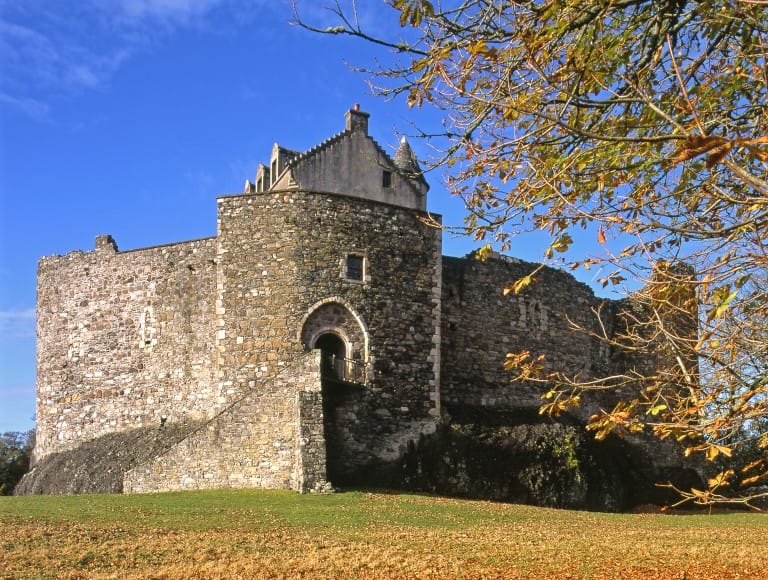
Castle Stalker is a stone tower house and keep, meaning a fortified residence arranged vertically within a compact tower and its principal stronghold. It stands on a small tidal island in Loch Laich, an inlet on Scotland’s west coast, approximately 40 km north of Oban and about 1.5 miles, or 2.4 km, northeast of Port Appin. Mountains rise behind the island. The rectangular tower measures 15.2 by 12.1 metres, reaches between 11.8 and 14.8 metres in height, and has four above-ground storeys.
The tower house
Entrance and lower rooms
The entrance is centrally positioned in the southwest wall at first-floor level and is reached by stone steps. A sandstone Stewart coat of arms is carved above the doorway. Double doors and machicolations, projecting parapets with openings through which defenders could observe or attack people below, protected the entrance.
The ground floor contained three cellars and a prison cell. The cell could be entered only through a trapdoor in the floor of the first storey. On the first floor, the hall has windows on three sides and a fireplace with a decorated lintel in the west wall. The first- and second-floor rooms were originally large halls with slightly sloping floors designed to drain water during stormy weather.
Corner turret
A bartizan, a small projecting turret used for observation and defense, occupies the southeastern corner of the castle. It contains several gun openings and preserves a sculpture of a human head, probably representing the master mason.
Island defenses and access
Fragments of the foundations of defensive walls survive around the tower, together with part of a wall at its northern corner. This wall may originally have been approximately 3.9 metres high. No remains of a permanent crossing have been identified, so the castle was probably reached originally by water. Because the island is tidal, it could also be reached on foot at low tide.
The roof was lost around 1840, and the building later underwent restoration. Despite these changes, Castle Stalker is regarded as one of the best-preserved surviving medieval fortifications in western Scotland.