Nalanda Mahavihara: An Ancient Buddhist Monastic and Learning Centre in Bihar
Site at a Glance
- Rating
- 4.5
- Popularity
- Very Low
- Country
- India
- Primary era
- Medieval
- Eras represented
- Classical, Medieval
- Civilizations
- Pala Empire
- Site type
- Religious
- Remains
- Monastery
On this page18 sections
History
Nalanda Mahavihara is an ancient Buddhist monastic and higher-learning institution at Bargaon in Bihar, India, generally founded around 427 CE during the Gupta period. A mahavihara was a great Buddhist monastery that could also serve as a residential centre for teaching, debate, and manuscript study. Nalanda became an international centre of Buddhist learning and remained active, with changing fortunes, for many centuries.
Traditions before the Gupta period
Later traditions connect the area with Mahavira, Gautama Buddha, and Shariputra. Mahavira was said to have spent fourteen monsoon retreats at Nalanda, while Buddha was believed to have taught in a nearby mango grove. Shariputra, one of Buddha’s principal disciples, was traditionally associated with the area as both his birthplace and the place where he attained nirvana. These traditions point to an early settlement, but archaeological evidence does not establish a Buddhist institution at Nalanda before the fifth century.
A later Tibetan tradition attributed a temple at Shariputra’s commemorative monument to Ashoka, the third-century BCE Mauryan emperor traditionally associated with major support for Buddhism. It also connected Nalanda with the philosophers Nagarjuna and Aryadeva. These early institutional claims have not been confirmed by archaeology. The Chinese pilgrim Faxian visited the region in the early fifth century and mentioned a stupa associated with Shariputra’s final nirvana, but did not describe a monastery or university at Nalanda. The absence of securely dated monumental remains from before the fifth century suggests that the great monastery had not yet been established.
Gupta foundation and expansion
Nalanda’s dateable history begins in the fifth century. A site seal names a monarch called Shakraditya as the founder of a sangharama, or monastic complex. Shakraditya is generally identified with Gupta emperor Kumaragupta I, whose coins have been found at Nalanda. Under Kumaragupta and his successors Budhagupta, Tathagatagupta, Baladitya, and Vajra, the institution expanded and flourished through the fifth and sixth centuries.
The Gupta Empire ruled much of northern India from approximately the fourth to the sixth century and supported a wide range of artistic, intellectual, and religious institutions. Although the dynasty was traditionally Brahmanical and religiously diverse, its rulers provided sustained patronage to Nalanda. The institution also experienced disruption. Hunnic forces under Mihirakula attacked it during the reign of Skandagupta in the fifth century, after which Gupta rulers rebuilt or restored the monastery. A further severe attack by a ruler of Gauda in Bengal is attributed to the eighth century.
Royal patronage and international study
After the Gupta period, Nalanda received support from successive rulers. Harshavardhana of Kannauj became its most prominent post-Gupta patron. He built a brass monastery, assigned the revenues of 100 villages to the institution, and ordered 200 households from those villages to provide rice, butter, and milk for the monks. Approximately 1,000 Nalanda monks attended his religious assembly at Kannauj.
The institution’s intellectual life is especially well known through the visits of Chinese pilgrims. Xuanzang first reached Nalanda in 637 CE and returned in 642 CE. He spent about two years there, studying under Shilabhadra, the head of the institution. He learned Yogachara Buddhism, grammar, logic, and Sanskrit, received the Indian name Mokshadeva, and later taught at Nalanda. On his return to China, he carried 657 Buddhist texts and 150 relics in 520 cases transported by 20 horses. He translated 74 of the texts, and at least eleven Chinese and Korean travellers visited Nalanda during the following three decades.
Yijing arrived in India in 673 CE and spent ten of his fourteen years in the country at Nalanda. He returned to China in 695 CE with 400 Sanskrit texts that were later translated. His account describes monastic regulations, daily rituals, and administrative procedures. Resident monks decided matters through assemblies and consensus. A proposal could be rejected by a single monk, and coercion was not used to obtain agreement.
Nalanda’s curriculum extended well beyond Buddhist scripture. It included Mahayana Buddhism, the teachings of the eighteen Buddhist schools, the Vedas, logic, grammar, philology, medicine, astronomy, literature, mathematics, law, city planning, Samkhya philosophy, and writings connected with ritual practices. Debate and formal reasoning formed an important part of advanced study. Xuanzang recorded about 1,510 teachers, including approximately 1,000 who could explain 20 collections of sutras and treatises, 500 who could explain 30, and 10 who could explain 50. Shilabhadra alone was said to have studied all the major collections.
Pala support and Buddhist networks
Under the Pala dynasty, which ruled much of eastern India from approximately the eighth to the late twelfth century, Nalanda continued to receive substantial support. Pala religious patronage encouraged an increasing integration of Mahayana, the Buddhist tradition centred on the bodhisattva path, with Vajrayana, its esoteric and tantric form. Pala rulers also supported or founded other major monasteries, including Odantapuri, Jagaddala, Somapura, and Vikramashila. Their proximity and intellectual competition reduced Nalanda’s unique position and drew some learned monks elsewhere, but the institution remained active and influential.
Dharmapala supported Nalanda, while his son Devapala became its most important Pala patron. Inscriptions and metal images found at the site preserve evidence of Devapala’s support. Balaputradeva, a Shailendra ruler of Suvarnadvipa, identified with Sumatra, established a monastery at Nalanda and asked Devapala to assign five villages to its maintenance. Devapala granted the request. An inscription from his reign also records his patronage of Viradeva, a Vedic scholar who later became head of Nalanda. The institution’s seal described its community as the Community of Venerable Monks of the Great Monastery of Nalanda.
Students, teachers, and pilgrims travelled to Nalanda from across India and from Tibet, China, Korea, Japan, Central Asia, Indonesia, Persia, and regions associated with Turkey. Nalanda contributed to the development and transmission of Mahayana and Vajrayana Buddhism. Its teachers and traditions influenced Tibetan Buddhism, and Shantarakshita, Kamalashila, and Padmasambhava were associated with the transmission of Buddhism to Tibet. The institution was also connected with major Buddhist thinkers including Nagarjuna, Aryadeva, Asanga, Vasubandhu, Chandrakirti, Dignaga, Shantideva, Atisha, and Dharmakirti, a major Buddhist logician and theorist of Buddhist atomism.
Fire, destruction, and decline
Nalanda suffered attacks and fires at several points in its history. A tenth- or eleventh-century inscription records a fire followed by restoration during the reign of Mahipala, who ruled approximately from 988 to 1038. Archaeological evidence indicates that major fires affected several buildings on more than one occasion.
Around 1200 CE, forces led by Muhammad Bakhtiyar Khalji raided Nalanda. Thick ash layers across separated buildings indicate a catastrophic fire that was probably connected with the destruction. The contemporary Persian account usually cited for this event explicitly describes the nearby monastery of Odantapuri, so the precise attribution of every detail to Nalanda remains uncertain.
The institution did not cease functioning immediately. When the Tibetan monk Dharmasvamin visited around 1235, most of the complex was damaged or deserted, but a smaller community had resumed teaching. The elderly teacher Rahula Shribhadra instructed about 70 students, and some buildings remained usable. Later Tibetan traditions describe a diminished community supported by rulers of Bengal into the fourteenth century. They also preserve stories of repairs and a destructive library fire, although these accounts are not independently confirmed. Nalanda’s final abandonment is variously placed in the late thirteenth or fourteenth century, with some traditions extending limited activity to approximately 1400. Its decline formed part of the wider weakening of Buddhist institutions in Bihar and Bengal.
Rediscovery and protection
Francis Buchanan-Hamilton surveyed the ruins in 1811 and 1812. Major Markham Kittoe identified them with historical Nalanda in 1847, and Alexander Cunningham and the Archaeological Survey of India carried out an official survey in 1861 and 1862. Systematic excavations took place from 1915 to 1937, followed by a second programme of excavation and restoration between 1974 and 1982. Conservation, restoration, and drainage measures helped protect excavated floors and structures.
Nalanda Mahavihara was inscribed on the UNESCO World Heritage List in 2016 as the Archaeological Site of Nalanda Mahavihara at Nalanda, Bihar, under cultural criteria iv and vi. In 1951, the Government of Bihar founded Nava Nalanda Mahavihara near the ruins as a modern centre for Pali and Buddhist studies; it received university status in 2006. A separate modern Nalanda University began its first academic year at nearby Rajgir in 2014, continuing efforts to revive the ancient institution’s educational legacy.
Remains
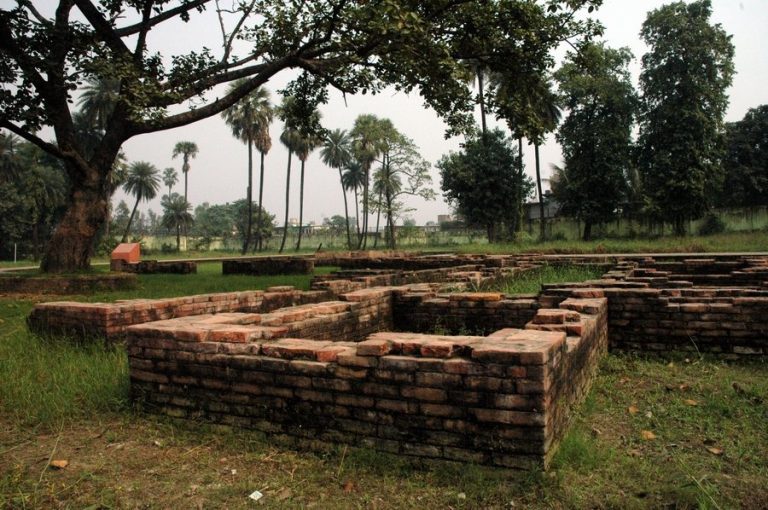
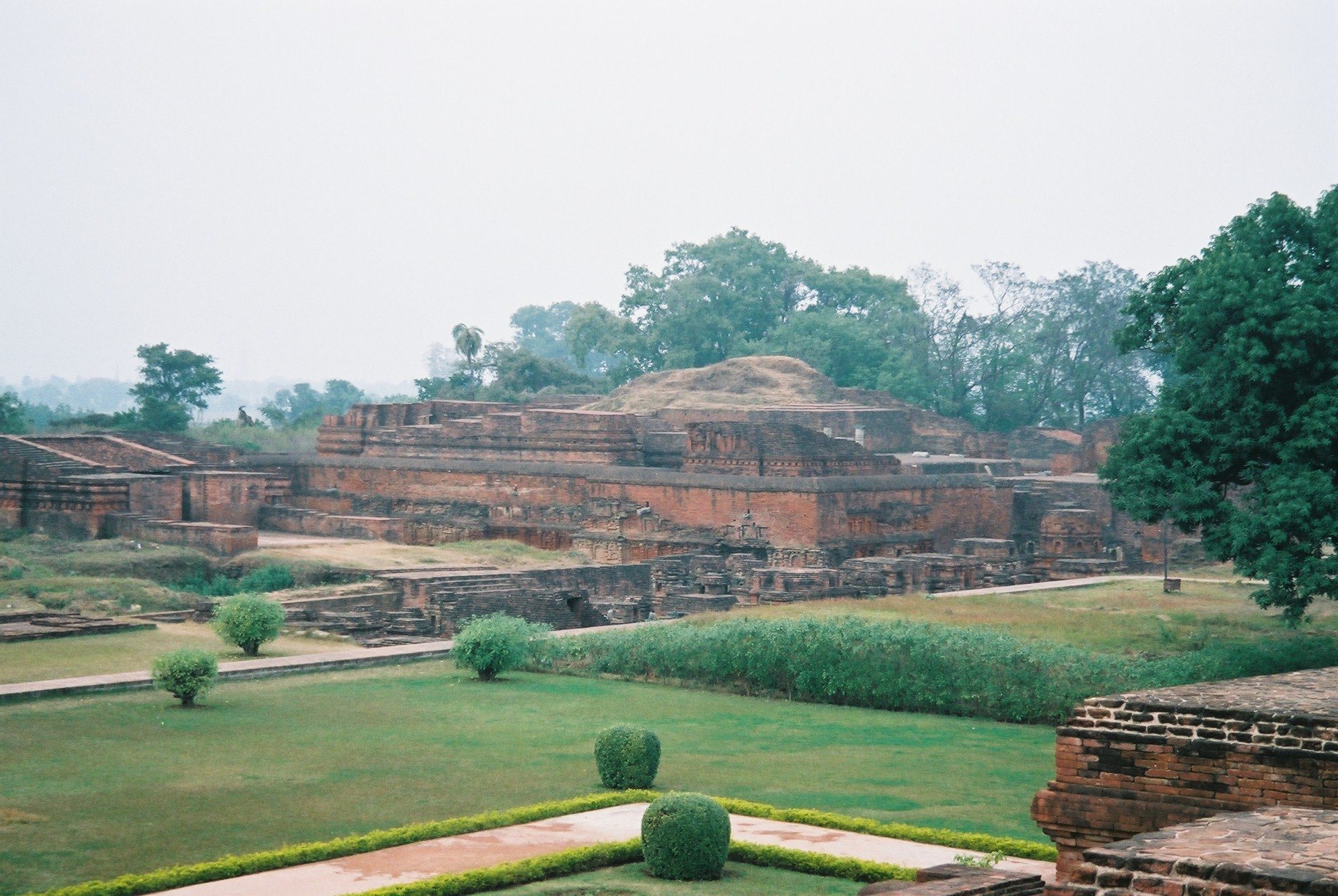
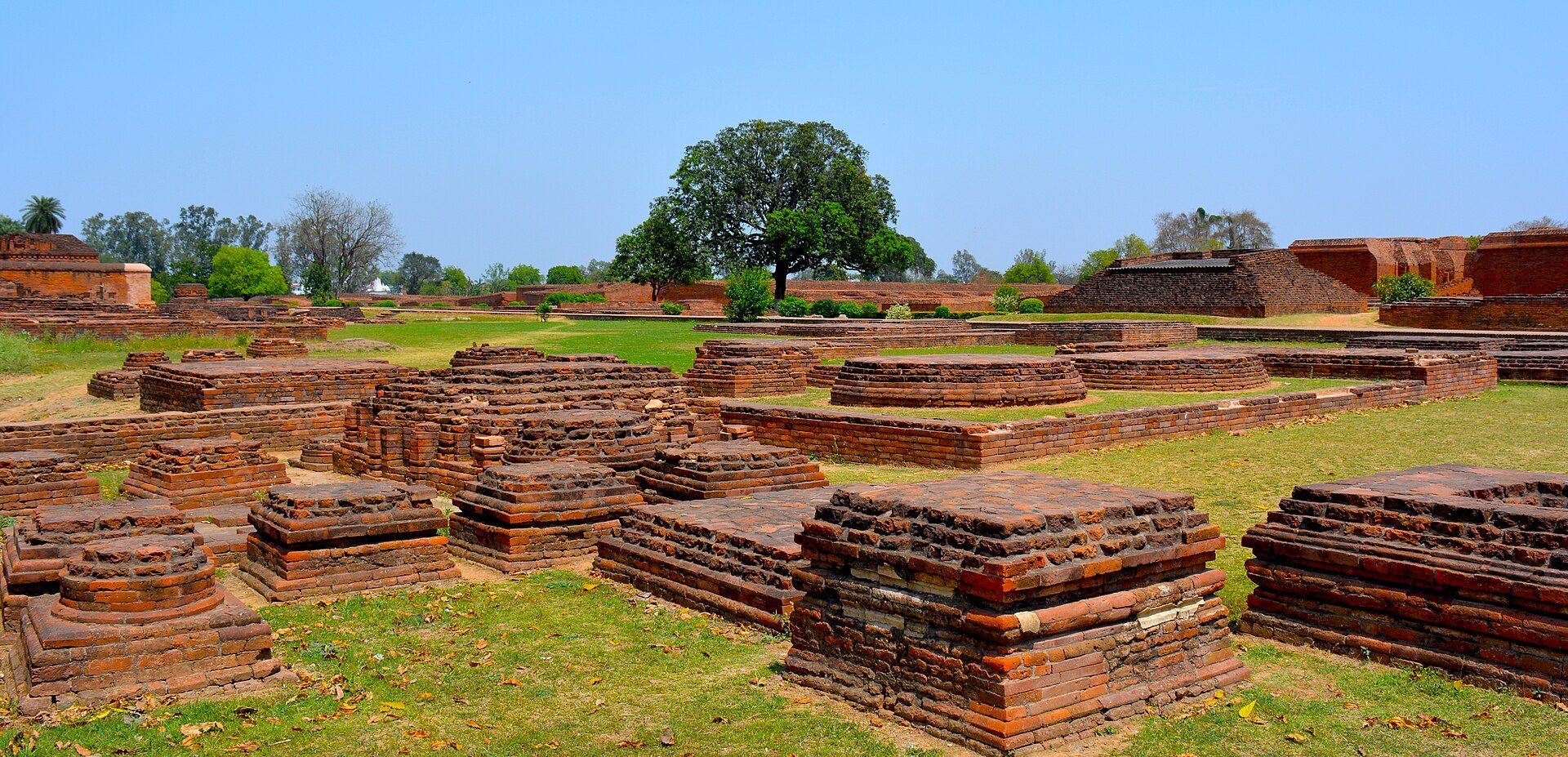
The excavated core extends approximately 488 metres from north to south and 244 metres from east to west, covering about 12 hectares. The medieval institution occupied a considerably larger area. Within the excavated complex, eleven monasteries and six major brick temples follow an ordered plan. A passage about 30 metres wide runs north to south, with temples on its western side and monasteries on its eastern side. A substantial brick wall enclosed the complex, which had a single principal entrance.
Monastic complex
The monasteries were generally rectangular. Each contained a central quadrangular courtyard surrounded by a verandah and an outer row of monks’ cells. A shrine chamber faced the entrance across the courtyard, placing it directly within the principal line of sight on entry. Except for Monasteries 1A and 1B, the buildings faced west, had drainage outlets on the east, and possessed staircases at their south-west corners. Most structures went through several construction phases, with later buildings raised over the remains of earlier ones. Many also preserve evidence of fire damage.
Monastery 1
Monastery 1 is regarded as the oldest and most important of the excavated monasteries. It has as many as nine construction levels. Its lower monastery is attributed to the ninth-century patronage of Balaputradeva during the reign of Devapala. The original building was at least two storeys high and contained a colossal seated Buddha. A copper-plate inscription recording Balaputradeva’s endowment was found in the antechamber.
Residential and ritual facilities
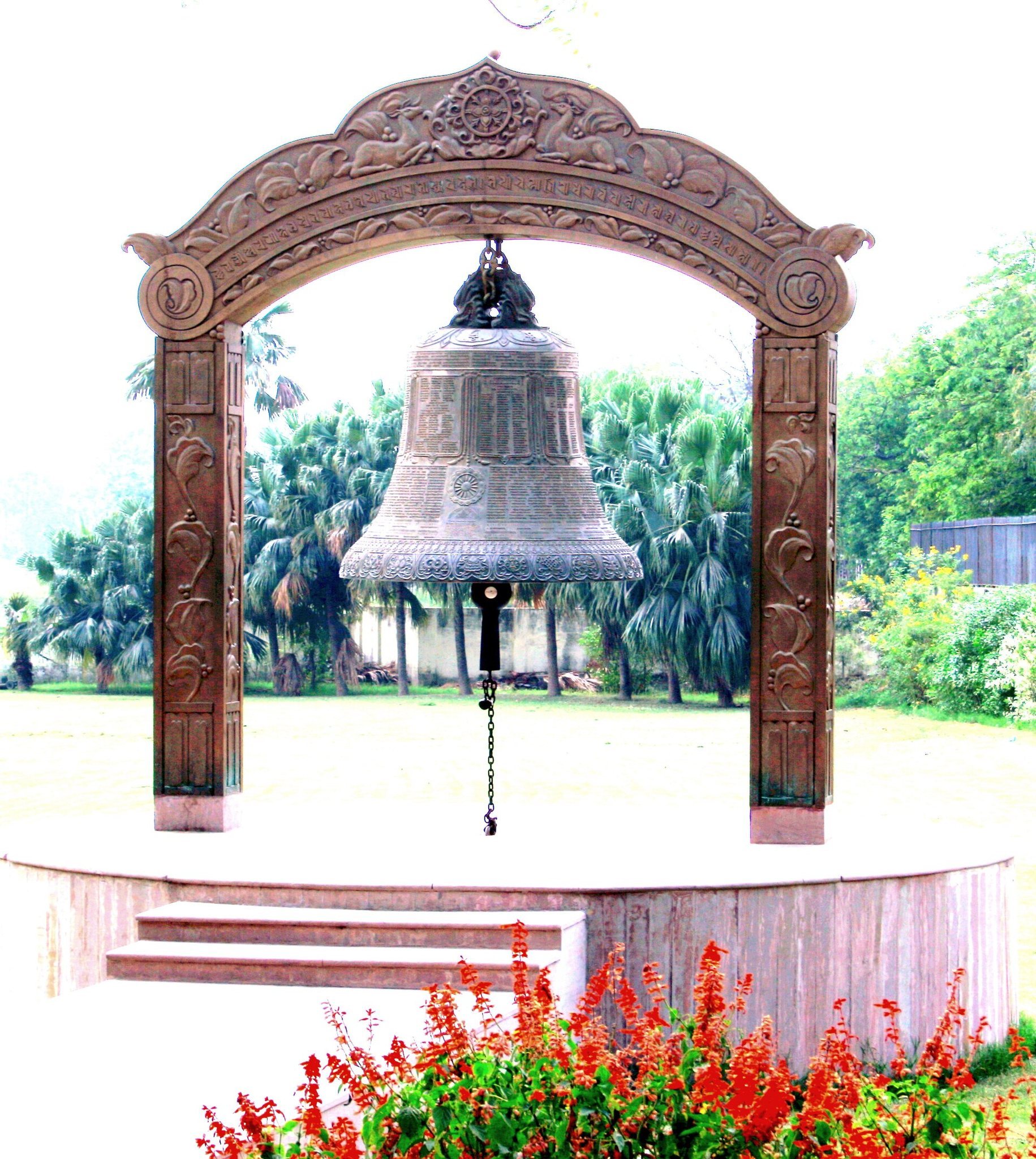
Yijing described approximately 300 residential cells or rooms and eight halls. He also mentioned large bathing pools and daily rituals associated with bells, bathing, worship of the Buddha, and evening observances at a commemorative Buddhist monument. Xuanzang described richly decorated towers, pavilions, upper rooms, and structures called harmikas, which are architectural elements placed above the dome or upper part of a stupa. He also referred to water surrounding the monasteries, blue lotuses, red flowers, and mango groves.
Temples and stupas
The temples formed the western side of the main north-south passage. Temple 2 faced east, while Temples 12, 13, and 14 faced toward the monasteries. The complex’s layered construction is particularly clear in these buildings, where later structures rose over earlier foundations and several phases of rebuilding remain visible.
Temple 3 and the Shariputra Stupa
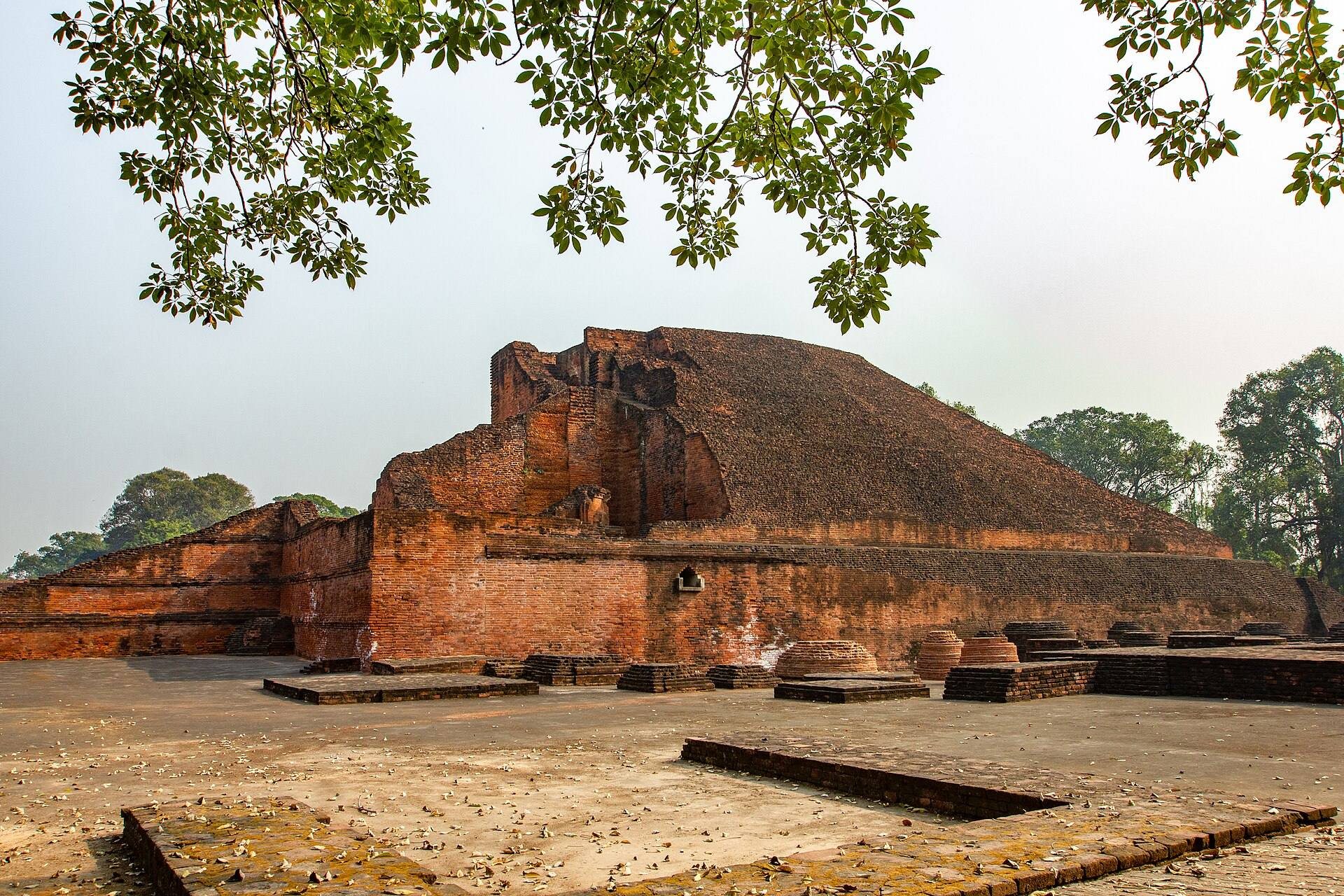
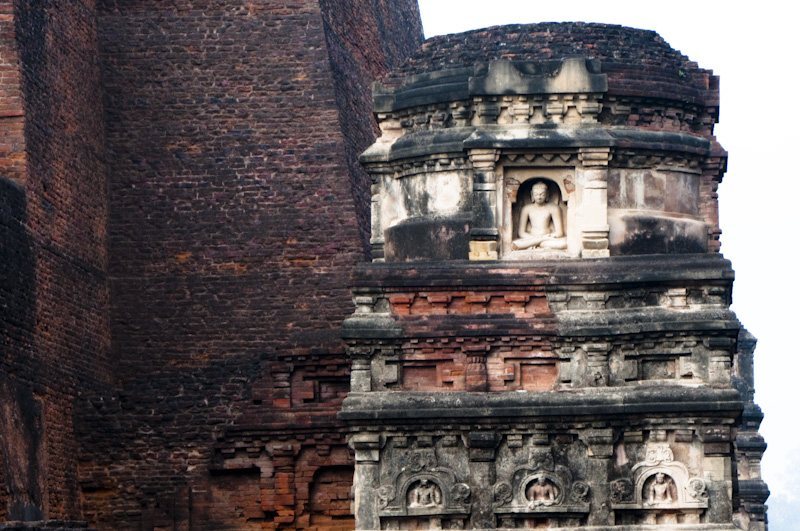
Temple 3, also known as the Shariputra Stupa, began as a small structure and grew through successive enlargement. At least seven rebuilding phases accumulated around it, with several flights of stairs leading toward the summit. Numerous small devotional stupas surrounded the temple. Some were built of brick and bear passages from Buddhist scriptures. A shrine chamber at the summit now contains the pedestal on which a large Buddha image once stood.
A large image of Avalokiteshvara was found in a shrine near the base of the temple stairs and was later moved to a museum. Avalokiteshvara is a bodhisattva associated with compassion. The stupa’s architectural history, surrounding votive monuments, and recovered images preserve the importance of this area as a place of Buddhist devotion.
Temple 5
Temple 5 is regarded as the most impressive and best-preserved of the layered temples. It had four corner towers, three of which are exposed, while its stairway sides and towers carry decorative panels in Gupta-style stucco. Stucco is a mouldable plaster-like material used for architectural decoration and sculpture.
The panels show Buddhas, bodhisattvas, scenes from the Jataka stories, Shiva, Parvati, Kartikeya, Gajalakshmi, musicians, makaras, and human couples. A makara is a mythical aquatic creature used in South Asian art. The combination of Buddhist and Brahmanical imagery reflects the varied religious art associated with Nalanda.
Temple 2
Temple 2 has a dado decorated with 211 sculpted religious and secular panels. The scenes include religious motifs, Hindu deities, musicians, makaras, amorous couples, artistic performances, and episodes from daily life. Together, the panels provide a broad view of the subjects represented in the temple’s decorative programme.
Temples 13 and 14
Temple 13 contained a four-chambered brick furnace used for metalworking. Burnt metal and slag found there indicate that the furnace was used in metal production. The remains of Temple 14 lie to its north. A monumental Buddha image was found at Temple 14, and fragments on its pedestal form the only surviving example of mural painting known from Nalanda.
Sarai Mound and the Black Buddha Temple
The Sarai Mound contains the remains of a multi-storeyed Buddhist temple enclosed by a massive wall and containing numerous stupas and shrines. Evidence in its sanctuary indicates that the Buddha image there was approximately 24 metres high.
Near Temple 14 stands a structure known as the Black Buddha Temple, also called Telia Bhairav. It contains an ancient black Buddha image shown in the earth-touching gesture. The building has also been identified with Baithak Bhairab, a structure named in an 1861 to 1862 Archaeological Survey of India report.
Library traditions and archaeological finds
Traditional Tibetan accounts describe Nalanda’s library as Dharmaganja, a group of three multi-storeyed buildings called Ratnasagara, Ratnodadhi, and Ratnaranjaka. Ratnodadhi was said to have nine storeys and to contain important manuscripts, including the Prajnaparamita Sutra and the Guhyasamaja Tantra. The size of the collection is unknown, although tradition estimates hundreds of thousands of manuscripts. Its subjects included Buddhist scriptures, grammar, logic, literature, astrology, astronomy, and medicine. The collection may have followed a classification system associated with Panini, with Buddhist works arranged according to the three divisions of the Tripitaka.
Excavations have recovered sculptures, murals, copper plates, inscriptions, seals, coins, plaques, pottery, and works in stone, bronze, stucco, and terracotta. Buddhist images include representations of the Buddha, Avalokiteshvara, Jambhala, Manjushri, Marichi, and Tara. Hindu images include Vishnu, Shiva and Parvati, Ganesha, Mahishasuramardini, and Surya.
Other inscriptions record the construction of a Buddha image by Purnavarman, the building of a monastery by the monk Vipulashrimitra, and donations to Nalanda. Monks fleeing the destruction carried manuscripts away, and examples associated with Nalanda survive in collections including the Los Angeles County Museum of Art, the Asia Society, and the Yarlung Museum at Tsetang. One Sanskrit palm-leaf Prajnaparamita manuscript has 139 leaves and painted wooden covers, and its colophon dates its donation to the late eleventh century.