Grave Creek Mound: An Adena Burial Earthwork in West Virginia
Site at a Glance
- Rating
- 4.8
- Popularity
- Low
- Country
- United States
- Primary era
- Classical
- External website
- Open
- Eras represented
- Classical
- Civilizations
- Unclassified
- Site type
- Burial
- Remains
- Burial Mound
On this page8 sections
History
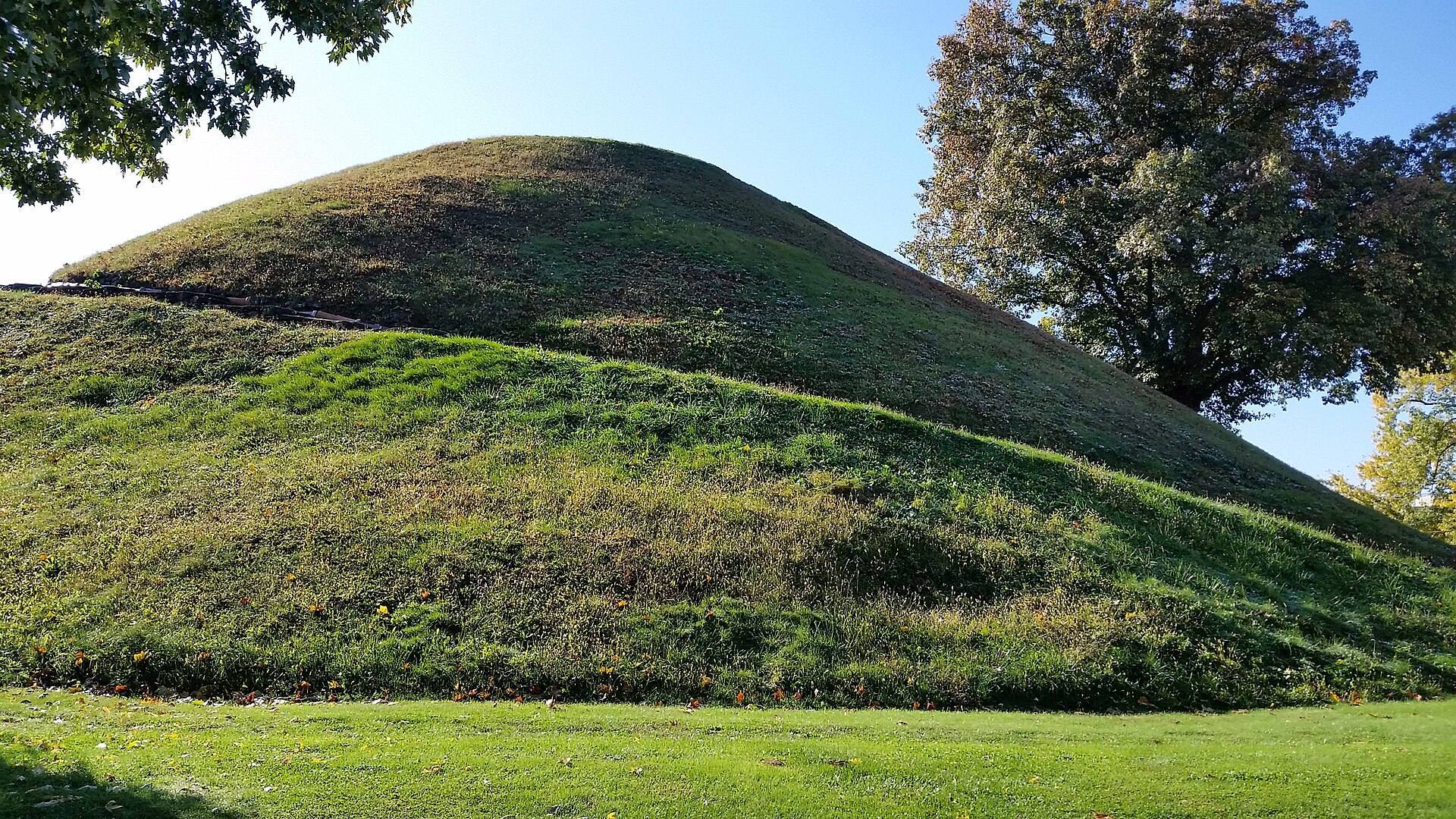
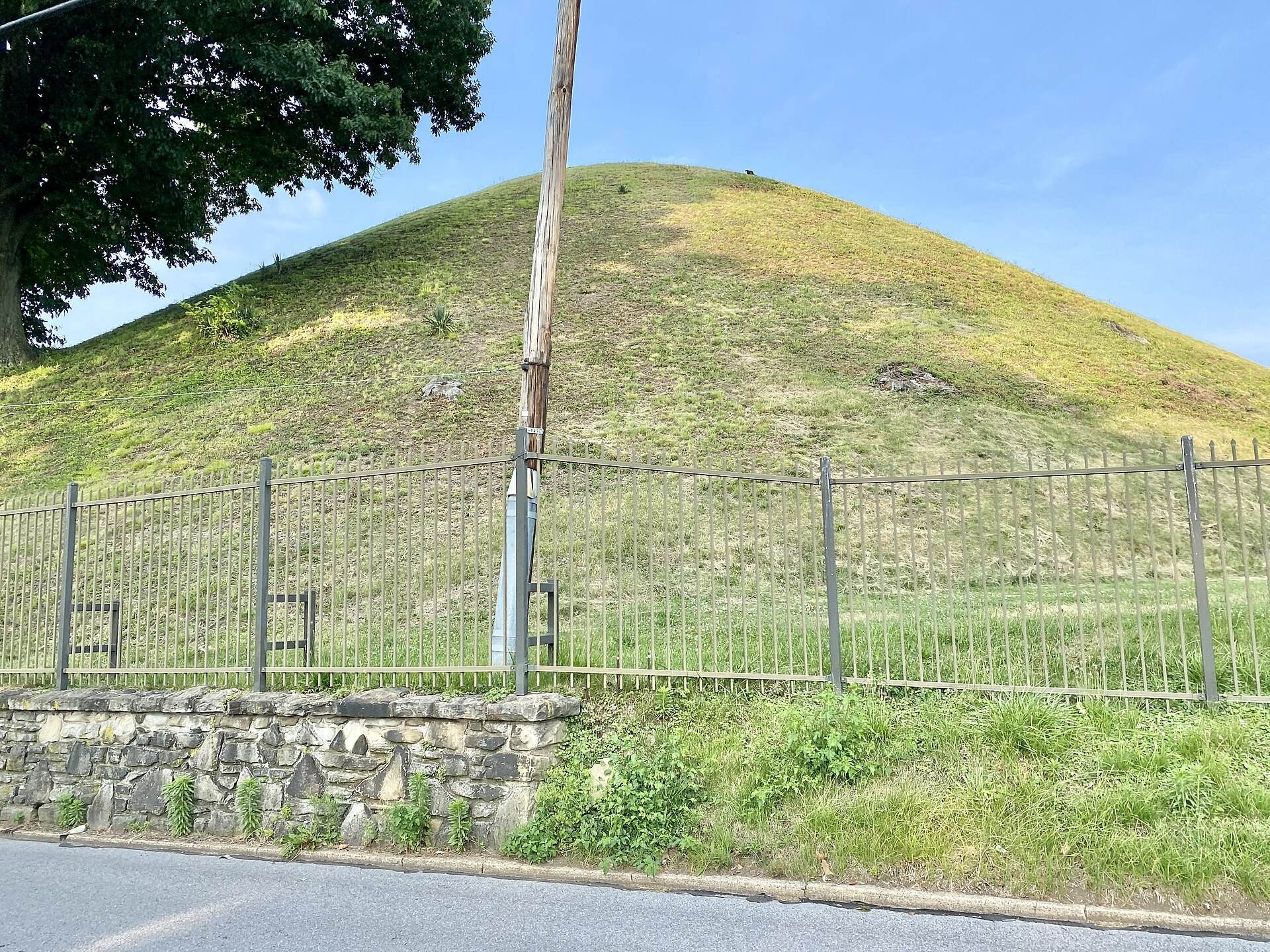
Grave Creek Mound is an Adena burial mound in Moundsville, West Virginia, United States, built around 200 BC during the Woodland period. Constructed in successive stages by Indigenous people of the late Adena culture, it required the movement of more than 60,000 tons of earth. It is the largest surviving mound built by the Adena culture and one of the largest conical burial mounds in the United States.
Early Encounters and Nineteenth-Century Excavation
The mound was probably first seen by a European American in 1770, when Joseph Tomlinson and his brother established a log cabin at Grave Creek Flats. Tomlinson later built a family cabin about 300 feet from the mound. Nicholas Cresswell recorded it during his 1775 canoe journey down the Ohio River, and Meriwether Lewis described it in his journal in 1803. Modern Moundsville developed near the Ohio River around the site.
On March 19, 1838, Abelard Tomlinson and his brother-in-law Thomas Biggs began the first recorded excavation with permission from the landowner, Jesse Tomlinson. They cut three shafts or tunnels into the mound and exposed two burial chambers at different levels. The work destroyed archaeological evidence that could have helped comparisons with other mounds. Tomlinson later enlarged the lower chamber and opened a museum inside the mound. A museum associated with the site opened in 1839, but insufficient funds and declining visitor numbers led to its closure or abandonment in 1846 or 1847.
Decline and Preservation
Artifacts recovered during the nineteenth-century excavations passed into private collections and eventually disappeared. After one tunnel collapsed, the mound was sold in 1858, and a later owner built a saloon on its summit. Following another change of ownership in 1874, the mound deteriorated and plans were made to level it for development.
In 1908, women of the Wheeling Chapter of the Daughters of the American Revolution raised funds to prevent its demolition. West Virginia purchased the property for preservation in 1909. Professional archaeological investigations led by E. Thomas Hennings under the supervision of the West Virginia Geological and Economic Survey took place in 1975 and 1976. Radiocarbon dating, which estimates age through the decay of carbon isotopes in organic material, placed the construction of the mound at approximately 200 BC using wooden beams from inside it.
Interpretation and Heritage Status
The Delf Norona Museum opened at the site in 1978. Named for archaeologist Delf Norona and operated by the West Virginia Division of Culture and History, it interprets Adena culture and theories about the mound’s construction while displaying artifacts associated with the site. In 2010, an agreement with West Virginia led the United States Army Corps of Engineers to transfer nearly 450,000 artifacts to the museum for archival storage and curation. These materials came from 1990s excavations at the Marmet Lock replacement site on the Kanawha River and represent about 10,000 years of Indigenous habitation in the Kanawha Valley. They are not all from Grave Creek Mound.
Grave Creek Mound became a National Historic Landmark in 1964, a designation for properties judged to possess exceptional national historical importance. It was added to the National Register of Historic Places, the United States government’s official list of historically, architecturally, and archaeologically important places, in 1966.
Remains
Earthwork and Enclosure
Grave Creek Mound is a conical earthwork that now rises about 62 feet and measures approximately 240 feet across. A measurement made in 1838 gave a height of 69 feet and a base diameter of 292 feet. The builders raised it in successive stages, placing burials at different levels. The earth came from the same general material as the surrounding ground, although burned human remains changed the color of some interior soil to blue. A moat about 40 feet wide and 5 feet deep originally surrounded the mound, with one causeway crossing it. The moat was described as having a defensive purpose.
Burial Chambers and Excavated Interior
The first excavation shaft entered the north face about 4 feet above ground level, probably allowing removed earth to be placed in the moat. After extending about 111 feet into the mound, the excavators reached a chamber cut into the original ground surface. The lower chamber was reported as a cuboid about 8 by 12 feet, aligned north to south and dug 7 to 8 feet into the natural ground. It contained two burials, one on the eastern side and one on the western side. The western burial was associated with about 650 beads, identified variously as shell or ivory.
Further shafts from the summit and northern side reached a second burial level. A single burial discovered there on June 9, 1838, was accompanied by about 1,700 ivory beads, 500 sea shells, and five copper bracelets. Other reported grave goods included animal bones and the Grave Creek Stone, a small sandstone tablet said to bear unusual inscriptions. The stone is generally regarded as a hoax, and the original has been lost, although a photograph and plaster cast are preserved in the Smithsonian Museum of Natural History. The nineteenth-century shafts and a later tunnel collapse altered the interior and destroyed or compromised archaeological evidence.
Museum Collections
The Delf Norona Museum contains exhibits of artifacts associated with the mound and materials interpreting Adena culture. Its archival holdings also include the collection transferred from the Marmet Lock excavations, including stone projectile knives, a hand-carved sandstone cooking bowl approximately 3,000 years old, and stone jewelry from a Fort Ancient village. Fort Ancient was a prehistoric Indigenous archaeological culture of the central Ohio Valley, distinct from the earlier Adena culture.