Alligator Effigy Mound: A Fort Ancient Ceremonial Earthwork in Ohio
Site at a Glance
- Rating
- 3.9
- Popularity
- Very Low
- Country
- United States
- Primary era
- Medieval
- External website
- Open
- Eras represented
- Medieval
- Civilizations
- Unclassified
- Site type
- Religious
- Remains
- Sanctuary
On this page6 sections
History
Alligator Effigy Mound is a prehistoric animal-shaped earthwork near Granville, Ohio, in the United States, probably built by people of the Fort Ancient culture between AD 800 and 1200. Radiometric dating, which estimates age from the decay of radioactive material, placed charcoal from the mound’s base at about AD 950. The Fort Ancient culture was an Indigenous tradition of the Ohio Valley associated with settlements, earthworks, and other monuments.
Construction and ceremonial interpretation
The mound was probably created for ceremonial purposes. An effigy mound is an earthwork shaped as an animal, person, or other figure, and its form could carry symbolic meaning beyond practical use. After surveying the site in 1848, Ephraim George Squier and Edwin Hamilton Davis proposed that it might have been used for sacrifices or other unusual ceremonial occasions. Their work was undertaken for the Smithsonian Institution and published that year in Ancient Monuments of the Mississippi Valley.
Changing identifications
Squier and Davis recorded the local name “the alligator,” although they considered the shape equally compatible with a lizard or another reptile. In 1999, Brad Lepper and Tod A. Frolking carried out a professional archaeological investigation. Lepper proposed that the figure represented an underwater panther, a powerful supernatural creature associated with water and danger in the traditions of several Indigenous peoples of the eastern woodlands and Great Lakes regions. He suggested that early European settlers may have misunderstood Indigenous explanations of the creature as a fierce water-dwelling being that ate people.
The mound has been listed on the National Register of Historic Places since 1971, and an Ohio State Historical Marker was erected at the site in 1998. It is one of two known surviving effigy mounds in present-day Ohio, the other being Serpent Mound in Adams County.
Remains
Animal-shaped earthwork
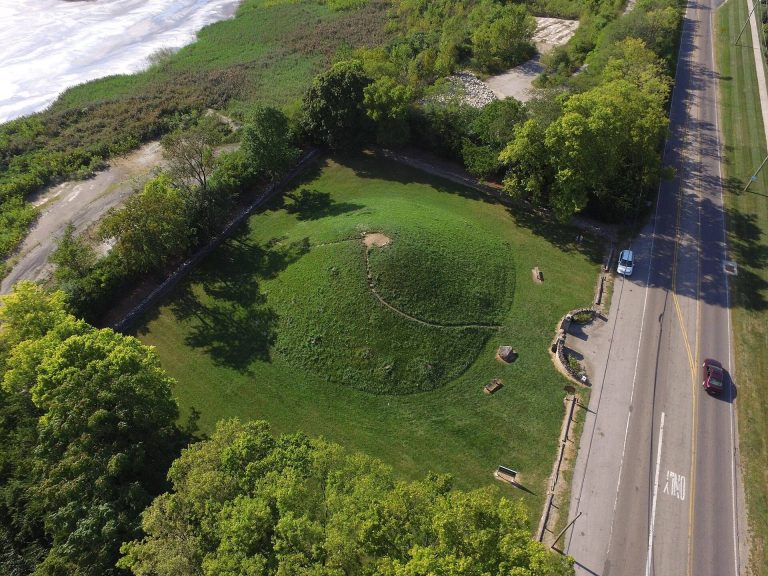
The effigy extends approximately 250 feet from its head to its tail, with the head pointing southwest. Its body is about 40 feet wide, and each leg measures approximately 36 feet. The head, shoulders, and rump rise higher than the rest of the figure, while the mound generally stands between about 4 and 6 feet high. The ends of the paws broaden slightly from the adjoining sections, suggesting an intentional representation of spread toes. These features give the earthwork its animal form, although the creature remains interpreted either as an alligator or as an underwater panther.
Altar and construction
A small mound occupies the middle of the effigy. Squier and Davis interpreted it as an altar, and stones covering it included some marked by earlier fires. A graded path about 10 feet wide leads from the altar toward the top of the figure. Excavated portions showed that the mound was built with clay brought from another area. The earthwork stands on a rounded spur of land, whose shape Squier and Davis questioned whether people had modified. They also observed damage to the headland. Other prehistoric earthworks, including those of the Newark group, were visible from this elevated setting.