Wat Si Chum: A Sukhothai Buddhist Temple Ruin in Thailand
Site at a Glance
- Rating
- 4.8
- Popularity
- Medium
- Country
- Thailand
- Primary era
- Medieval
- Eras represented
- Medieval
- Civilizations
- Unclassified
- Site type
- Religious
- Remains
- Temple
On this page12 sections
History
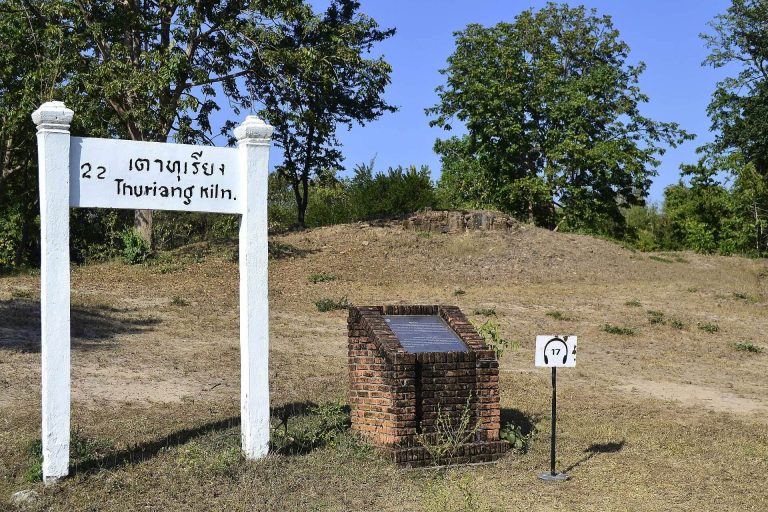
Wat Si Chum is a Buddhist temple ruin in the northwestern part of the old Sukhothai city, outside its northern wall in Thailand. It belongs to the Sukhothai period, when the early Thai kingdom flourished from approximately the thirteenth to the fifteenth century, and forms part of Sukhothai Historical Park. Its foundation date and original patron remain uncertain, although the temple has traditionally been associated with King Ramkhamhaeng and, in other traditions, with the later King Lithai. Another tradition places its construction in the late fourteenth century, while the monumental Buddha may have been begun around 1292.
Sukhothai foundations and later maintenance
The name Si Chum is interpreted as “forest of bodhi trees” or “temple of the bodhi tree.” A late Ayutthaya chronicle misunderstood the original meaning and called the place “Ruesi Chum.” The temple underwent a major restoration during the reign of King Lithai, a Sukhothai ruler known for his Buddhist interests and patronage, and continued to receive maintenance afterward.
Wat Si Chum was probably abandoned during the late Ayutthaya period. In the late sixteenth century, tradition associated the temple with King Naresuan, an Ayutthaya monarch linked to the restoration of Ayutthaya independence from Burmese control. He is said to have assembled troops here before campaigning against Si Satchanalai, then known as Chaliang. A loyalty oath ceremony is also traditionally connected with the temple.
The Speaking Buddha tradition
A concealed passage behind the main Buddha image was traditionally used to make the image appear to speak to soldiers. This story gave the image the title “Speaking Buddha.” The tradition links the temple’s architecture with the military history associated with Naresuan, although the temple’s wider history reaches back to the Sukhothai period.
Inscription, restoration, and heritage status
Wat Si Chum was the discovery place of the Wat Si Chum inscription, also called Inscription No. 2. The text discusses the origins of the Phra Ruang and Pha Mueang dynasties and the establishment of Sukhothai. It has also been regarded as important evidence in assessing the authenticity of Inscription No. 1. Thad Sirisamphan, then serving under the title Luang Samosonphonkan, discovered it in the temple’s tunnel in the late nineteenth century. The inscription is now held at the Bangkok National Museum.
A restoration project directed by Thailand’s Fine Arts Department began in 1952. The Buddha image was restored under the direction of Silpa Bhirasri and Khien Yimsiri between 1953 and 1956, and the mandapa area was restored again in 1967. Wat Si Chum is included within the Sukhothai World Heritage property under cultural criteria (i) and (iii), and it is registered as an archaeological monument by the Fine Arts Department.
Remains
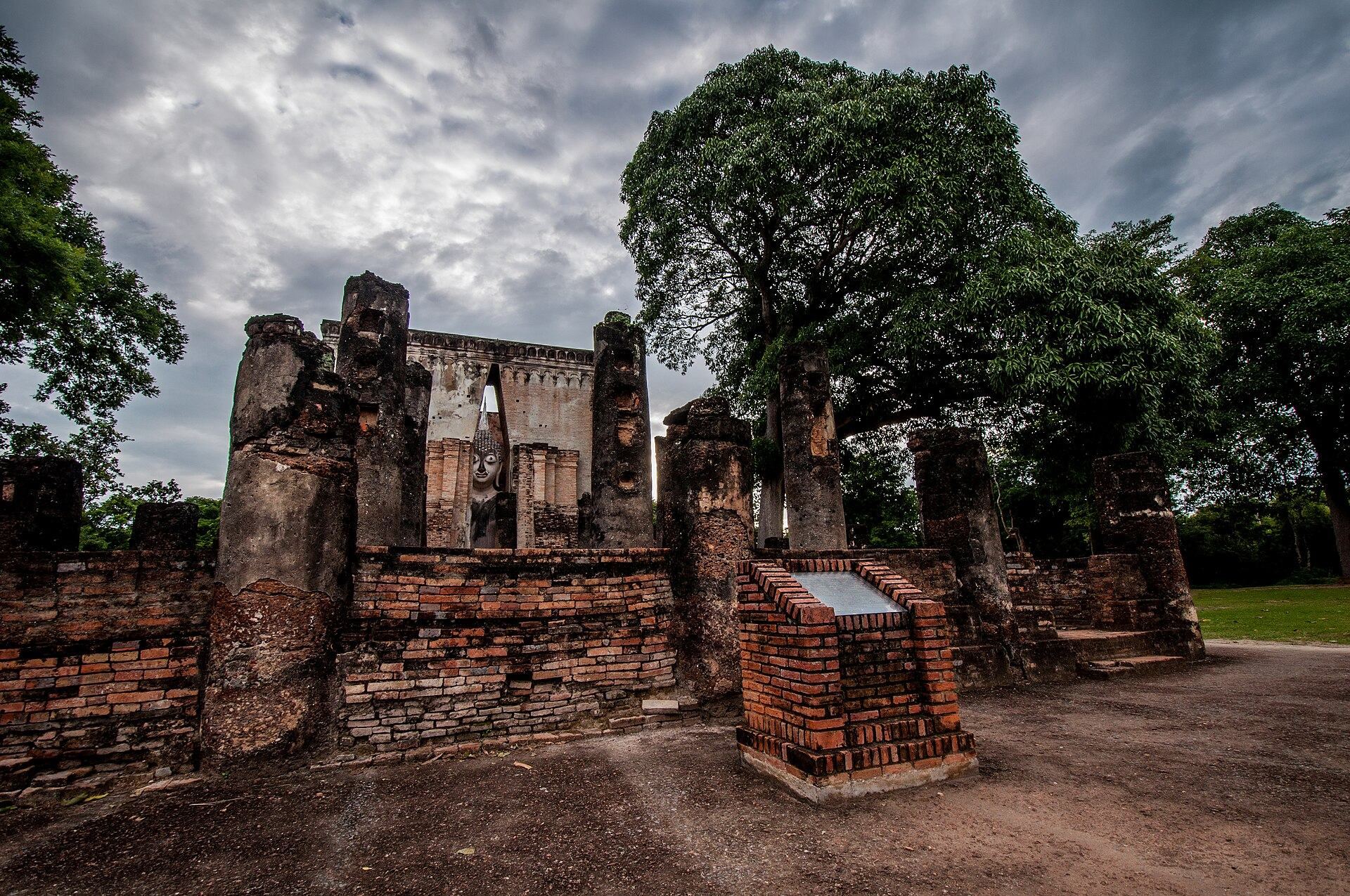
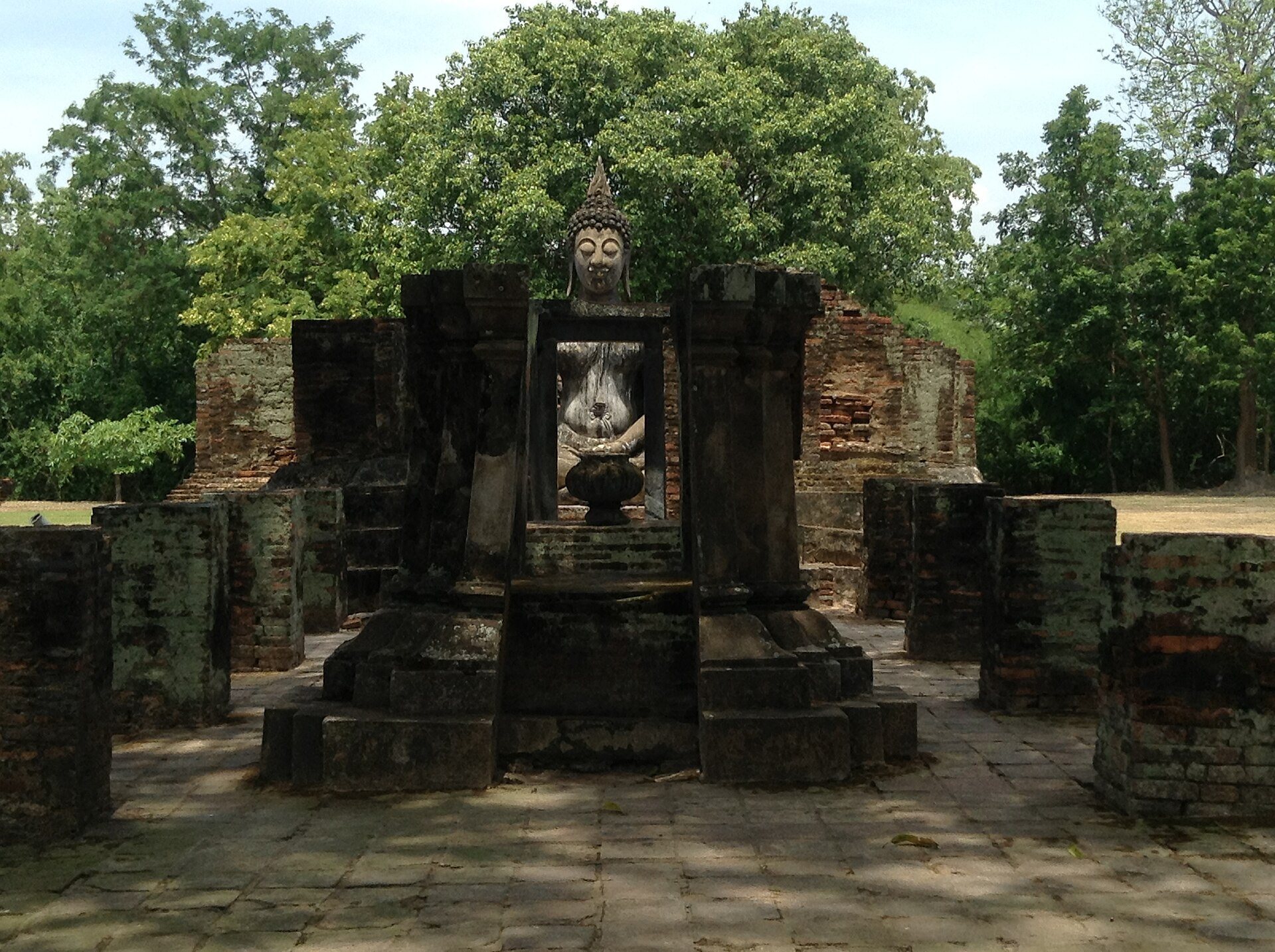
The temple compound is enclosed by a moat and faces east. A square mandapa, a substantial shrine or pavilion for a sacred image, occupies the centre, while a principal vihara, or Buddhist assembly hall, extends from its eastern side. Additional chapels lie to the north. The complex is especially notable for replacing the usual principal chedi with a shrine built around a monumental Buddha image.
The central mandapa
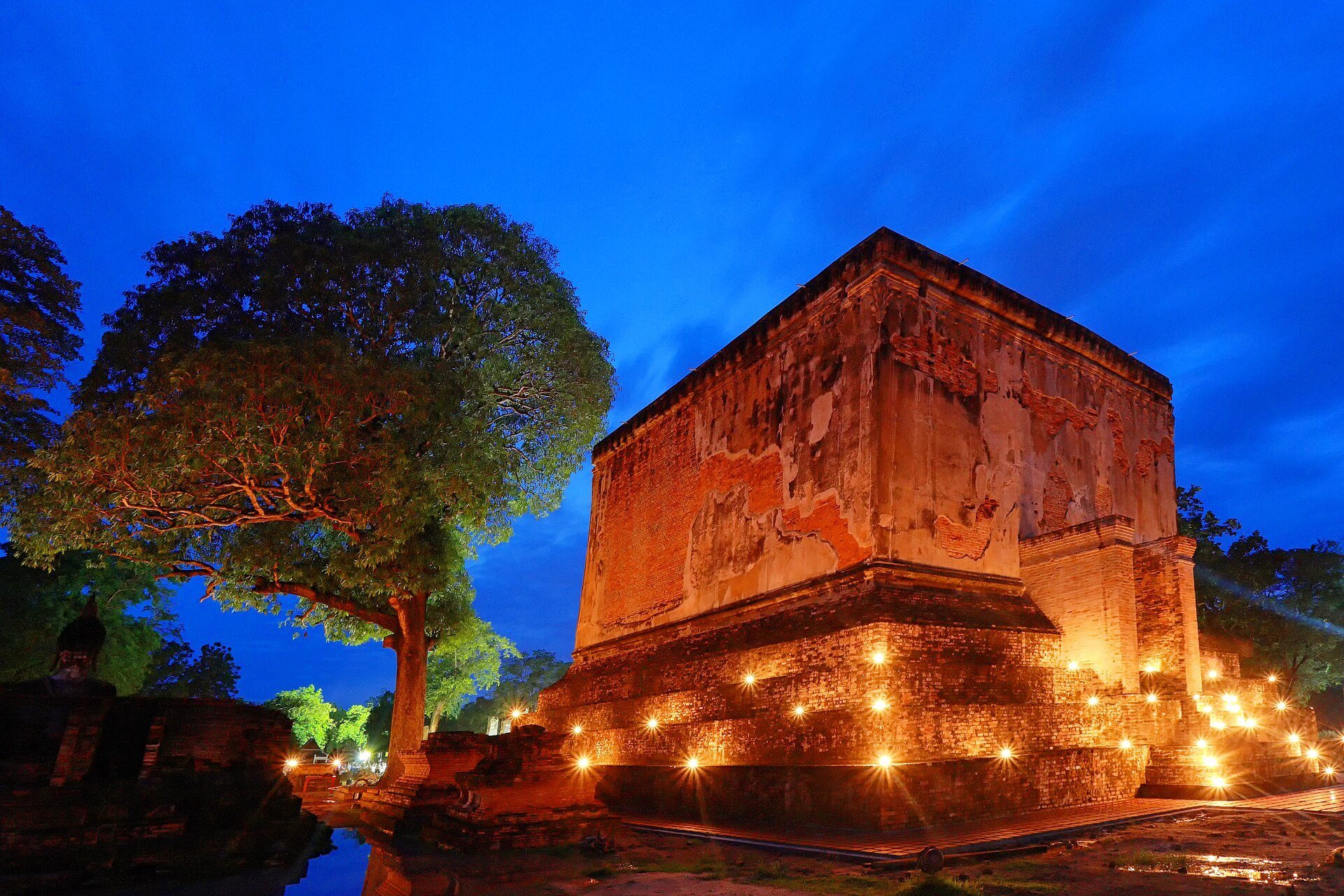
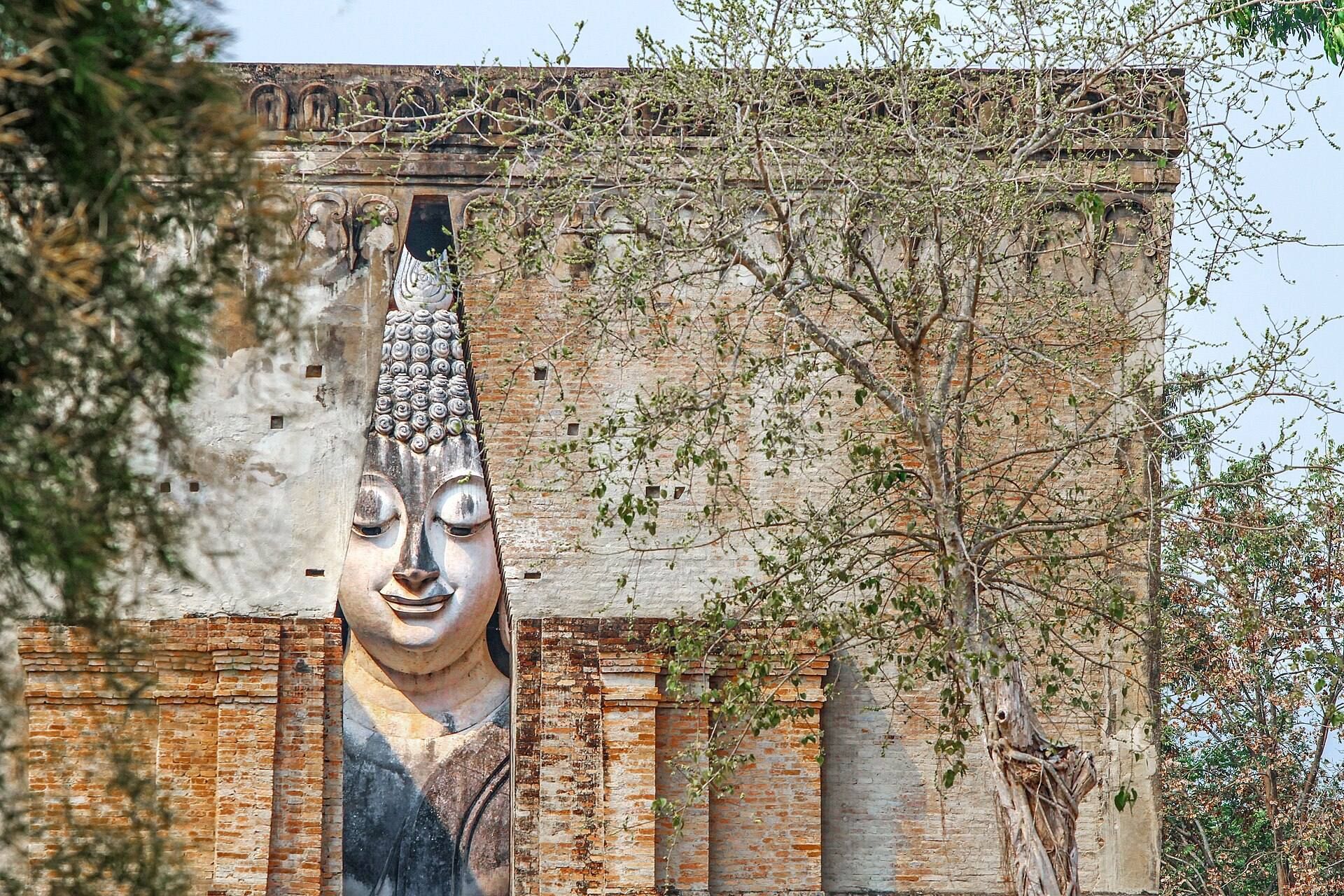
The mandapa measures approximately 32 by 32 metres and rises about 15 metres above its raised square base. Its walls are approximately 3 metres thick and use a double-wall construction. A gap of about 1.5 metres between the walls contains a narrow stairway passage leading toward the rear and roof. The original roof has collapsed, leaving the enclosing walls and the Buddha image open to the sky. The structure may originally have carried a domed or temple-style roof.
The mandapa’s unusual design has been interpreted as possibly embodying the idea of a gandhakuti, the Buddha’s residence during his lifetime. The central image may therefore have functioned as a symbolic or representational stupa, a Buddhist monument associated with the Buddha or his relics.
Phra Atchana
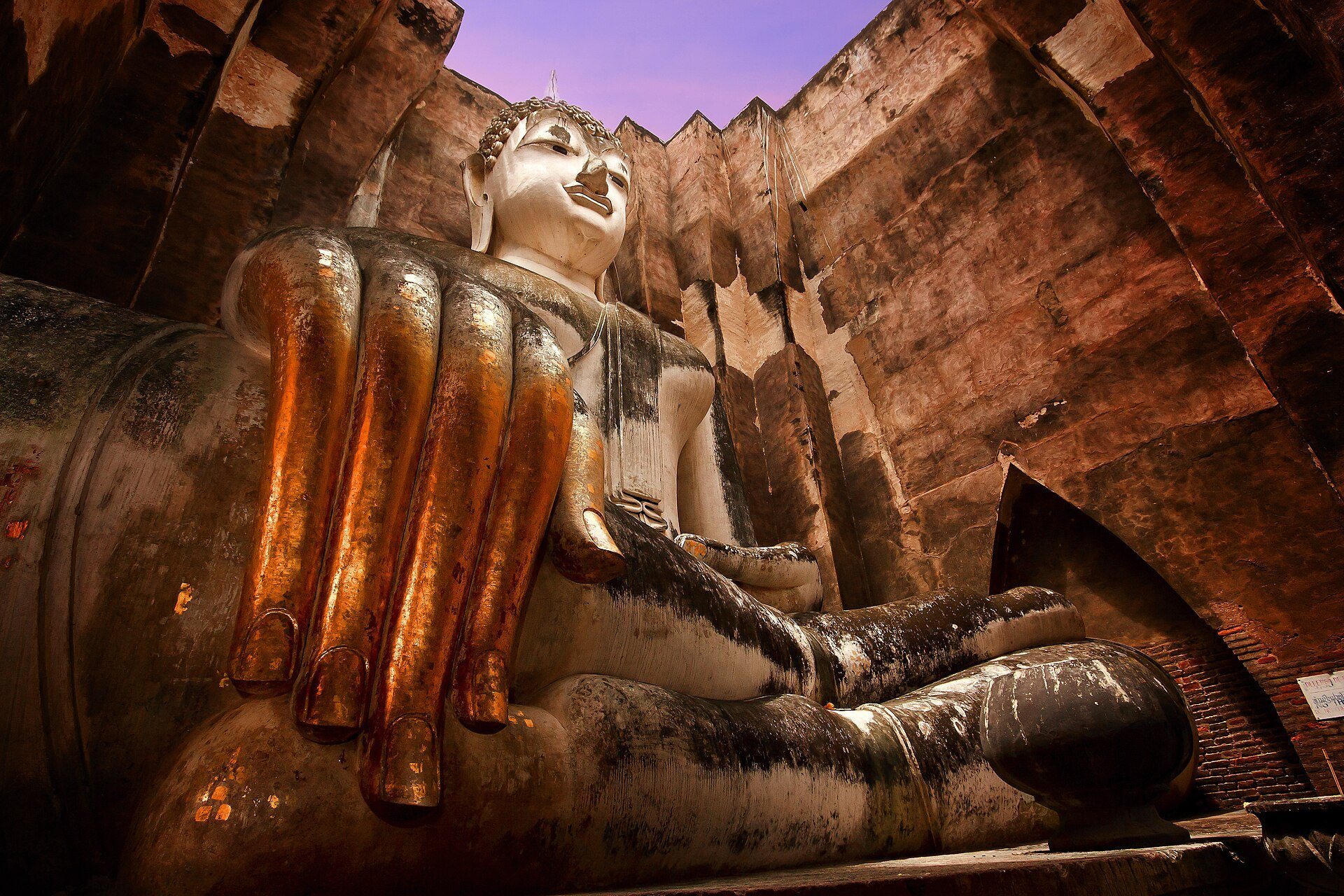
Phra Atchana is a large Sukhothai-style stucco Buddha seated in the earth-touching gesture, with a brick and laterite core. It is approximately 15 metres high and has a lap about 11.3 metres wide, filling much of the mandapa. The name is associated with a Pali term meaning immovable, unwavering, or stable.
The Buddha’s right hand reaches toward the ground in the earth-touching gesture, which represents the Buddha calling the earth to witness his enlightenment and victory over Mara. The image is also traditionally identified as the “Speaking Buddha” because of the story connected with the concealed passage behind it.
Halls and northern chapels
The principal vihara in front of the mandapa had six bays. Its surviving remains include fragments of columns and the bases of three Buddha images. North of the mandapa are the remains of a small chapel and another smaller chapel that contains a Buddha image.
Slate panels and Buddhist imagery
Jataka panels
The narrow passage within the mandapa contains, or formerly contained, more than 50 slate panels carved with scenes from Jataka narratives and other Buddhist subjects. Jataka stories recount the Buddha’s previous births and form a major theme in Buddhist art. The panels are attributed to the late thirteenth century, or approximately 700 years ago, and are regarded as among the oldest surviving examples of Thai pictorial art.
The imagery was associated with accounts of the Buddha’s previous lives, including the 550 Jataka births. Some traditions state that the slate panels were originally carved for the nine-spired chedi at Wat Mahathat and that walking Buddha-disciple figures were installed there in their place. Most of the panels were later removed to the Ramkhamhaeng National Museum, while the panels at Wat Si Chum are no longer open to visitors.
Wat Si Chum inscription
The Wat Si Chum inscription is a leaf-shaped shale slab approximately 67 centimetres wide, 275 centimetres high, and 8 centimetres thick. Its first face carries 107 lines of Old Sukhothai Thai script, and its second face carries 95 lines. The inscription is dated approximately to 1880–1910 in the Buddhist Era and provides historical material concerning the dynasties associated with Sukhothai and the kingdom’s establishment.
Tree and surrounding compound
A large wild mango tree stands north of the mandapa. More than 200 years old and over 20 metres high, it has been conserved and registered as a national heritage tree. Together with the moat, central shrine, eastern vihara, northern chapels, and surviving passage features, it forms part of the physical setting of the temple compound.