St. Paul’s Church, Edenton: A Colonial Episcopal Parish Church
Site at a Glance
- Rating
- 4.7
- Popularity
- Very Low
- Country
- United States
- Primary era
- Early Modern
- External website
- Open
- Eras represented
- Early Modern, Modern
- Civilizations
- British
- Site type
- Religious
- Remains
- Church
On this page7 sections
History
Colonial foundation and construction
St. Paul’s Church, Edenton, is a Georgian brick Episcopal church in Edenton, North Carolina, United States. Its parish was established on November 12, 1701, under an act of the North Carolina General Assembly that divided the colony into five parishes. The law empowered each vestry, the governing body of an Anglican or Episcopal parish, to tax landowners for church construction and aid to impoverished people.
In December 1701, the vestry met at Thomas Gilliam’s house near the future town of Edenton and agreed to build a small wooden church on land donated by Edward Smithwick. That property is now part of Hayes Plantation. For nearly seventy-five years, the parish was supported and administered by the Society for the Propagation of the Gospel, an Anglican missionary organization serving churches in overseas colonies.
The churchyard began functioning as Edenton’s cemetery about fifteen years before the present church was built. After Edenton was incorporated in 1722, work on a permanent church at a new town location began in 1736. Limited funding delayed completion of the roof until 1748, leaving the structure exposed to the weather during the intervening years. The building is generally dated to 1760.
Parish identity and the Revolutionary era
The Reverend Clement Hall became rector on February 25, 1744, and the parish took its present name during his tenure. Hall died in 1759 before construction was complete, and the Reverend Daniel Earl succeeded him. The congregation included Governor Samuel Johnston and James Iredell Jr. Johnston served as warden for many years. Joseph Hewes, one of North Carolina’s three signers of the Declaration of Independence, had been a vestryman before the American Revolutionary War.
On June 19, 1776, the vestry declared loyalty to the king while opposing the authority of the British Parliament, defying the North Carolina Provincial Congress during the political crisis that led to American independence. After the war, St. Paul’s fell into disrepair and was used only occasionally by the 1790s. In 1806, the English architect William Nichols directed a renovation that added a new spire and renewed the interior.
Thomas and Penelope Barker, often regarded as leaders of the Edenton Tea Party, belonged to the congregation. That 1774 protest was organized by Edenton women against British taxation and trade policies. The church is also connected with Harriet Jacobs’s family history. Her daughter, Louisa Matilda, was baptized at St. Paul’s, an event Jacobs described in Incidents in the Life of a Slave Girl.
Reconstruction and continuing use
A separate church for St. Paul’s Black congregants was begun in 1879. Hebert H. Page financed the building, and Bishop Theodore B. Lyman organized and consecrated it on April 6, 1881. Violent winds destroyed the church in 1884. A replacement began the following year and was not consecrated until 1897.
Fire nearly destroyed St. Paul’s in 1949. The church was rebuilt with the help of measured drawings prepared by the Historic American Buildings Survey and the results of a 1933 architectural survey led by Charles E. Patterson. Its interior was restored to its nineteenth-century appearance, and a steel roof was added. The property was listed on the National Register of Historic Places, the United States’ official list of historically and architecturally significant properties, on May 29, 1975, as St. Paul’s Episcopal Church and Churchyard.
The parish remains Episcopal and Anglican in tradition. It belongs to the Episcopal Diocese of East Carolina, the Albemarle Deanery, and the Sewanee Province, which form successive levels of the church’s regional administration. St. Paul’s remains an active parish church and is described as the only colonial church in North Carolina still in regular parish use.
Remains
Church building
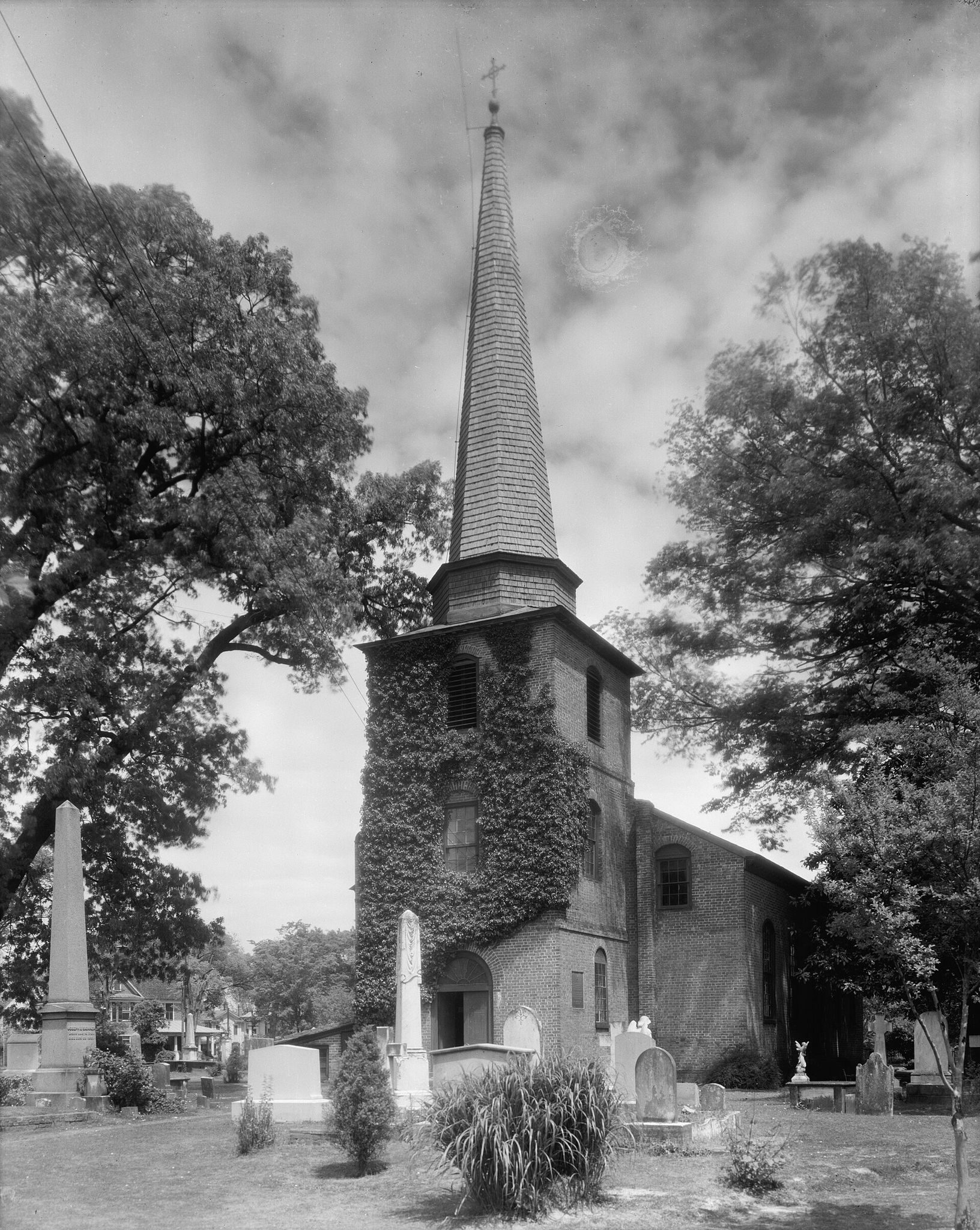
St. Paul’s is a five-bay brick church, meaning that five principal divisions or window bays mark its main elevation. It has a gable roof and a slightly engaged square tower that projects only partly from the wall. The brickwork uses Flemish bond, a pattern in which alternating long and short brick faces appear in each course. The building follows Georgian architecture, an eighteenth-century style based on symmetry, orderly classical proportions, and restrained ornament. Brick is the principal material, while the roof was replaced with steel after the 1949 fire. The interior was restored to its nineteenth-century appearance during the rebuilding.
Churchyard and historic possessions
The churchyard and associated property cover approximately 2 acres, or 0.81 hectares. The burial ground predates the present church and contains the tombs of governors Charles Eden, Thomas Pollock, and Gabriel Johnston. These burials preserve a physical connection between the parish and North Carolina’s colonial and early governmental history.
The oldest surviving possessions associated with the church include a vestry-minute book begun in 1701 and a silver chalice and paten presented by Edward Moseley in 1725. The minute book preserves the proceedings and decisions of the parish vestry. The paten is the plate used to hold the bread during the Eucharist.