Bynum Mound and Village Site: A Middle Woodland Burial and Habitation Complex
Site at a Glance
- Rating
- 4.6
- Popularity
- Very Low
- Country
- United States
- Primary era
- Classical
- External website
- Open
- Eras represented
- Classical
- Civilizations
- Unclassified
- Site type
- Burial
- Remains
- Necropolis
On this page9 sections
History
Middle Woodland construction and use
Bynum Mound and Village Site is a Middle Woodland archaeological site near Houston in Chickasaw County, Mississippi, United States. Communities associated with the Miller culture built and used its six burial mounds and habitation area between 100 BC and AD 100, during the Miller 1 and Miller 2 phases. The Middle Woodland period in eastern North America was marked by regional communities, mound building, elaborate mortuary practices, and wide exchange networks.
Bynum participated in the Hopewell exchange system, a network through which materials, objects, and religious ideas moved over long distances. Non-local goods from the site, together with comparable high-status objects from the contemporary Pharr Mounds site, point to connections extending beyond Mississippi. Among these links was probably an association with Hopewell communities in Illinois.
Excavation and preservation
National Park Service archaeologists excavated five mounds during the 1940s. Three mounds were also investigated during preparations for construction of the Natchez Trace Parkway. The two largest mounds were restored after excavation. Bynum was added to the U.S. National Register of Historic Places in 1989 as part of the Natchez Trace Parkway designation, at milepost 232.4.
Remains
Site layout and burial mounds
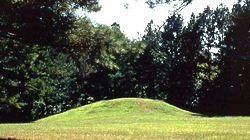
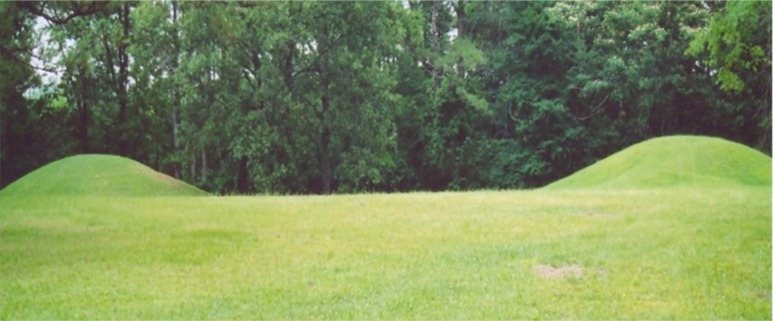
The site covers about 6 hectares on a low ridge overlooking Houlka Creek within the Tombigbee River drainage area. Six conical burial mounds, between approximately 1.5 and 4.3 meters high, form an alignment south of the contemporary habitation area. Together, the mounds and settlement represent a Middle Woodland complex used for both habitation and mortuary activity.
Mound A
Mound A contained a female burial at its base. The body lay between two parallel oak logs that had been burned. Copper spools, cylindrical ornaments worn in stretched earlobes, were found at the woman’s wrists. The remains of two adult males and one child were located nearby.
Mound B
Mound B, the largest mound, covered a crematory pit lined with logs. Its ash-covered floor contained human remains, including both cremated and unburned material. Twenty-nine polished greenstone celts, stone tools often interpreted as ax or adze heads, were arranged in an L-shaped pattern. The mound also held copper ear-spools, nineteen chert projectile points believed to have come from Hopewell communities in Illinois, and a piece of galena, a lead sulfide mineral used in prehistoric exchange and craft contexts.
Other crematory features
Crematory structures were identified in two mounds. Burned human remains found nearby support the interpretation of these structures as facilities for cremation. Excavated materials included greenstone, copper, galena, and distinctive projectile points made from materials that originated outside the site and Mississippi, providing physical evidence of the mound complex’s participation in non-local exchange.
Habitation and environmental remains
The habitation area occupied the same site as the mound group and dates to the same period. Excavations recovered numerous deer remains, mammoth teeth, hickory nuts, and acorns. These remains, together with the burial evidence and imported materials, provide archaeological evidence for the community’s food resources, mortuary practices, and connections with wider Woodland-period networks.