Dzibanche: A Major Maya City and Kaanu’l Dynastic Capital
Site at a Glance
- Rating
- 4.7
- Popularity
- Low
- Country
- Mexico
- Primary era
- Classical
- External website
- Open
- Eras represented
- Classical, Medieval
- Civilizations
- Maya
- Site type
- City
On this page14 sections
History
Dzibanche is a major Maya city in Quintana Roo, Mexico, whose monumental architecture began to develop around AD 200 during the Early Classic period. Originally called Kaanu’l, meaning “place of snakes,” it became the first capital of the Kaan kingdom and the birthplace of the Kaanu’l dynasty, a powerful Maya ruling lineage. The city reached its political and dynastic height between approximately AD 300 and 600, when it was the dominant political power in the region.
Origins and the rise of Kaanu’l
The settlement began during the Late Preclassic as a small agricultural community with platforms and buildings made from perishable materials. Around AD 200, it developed into a major urban center and began constructing the monumental buildings that survive at the site. Its inscriptions preserve the Kaan dynasty’s emblem glyph, the earliest known records of the dynasty, and references to some of its first rulers.
During the fifth and sixth centuries, Kaanu’l served as the seat of the Kaan kingdom. The dynasty expanded through warfare, political subordination, and alliances across southern Quintana Roo, Campeche, the northern Peten, and other parts of the Maya lowlands. Dzibanche’s monuments record the capture of high-ranking individuals and reveal the city’s role in this expansion.
A hieroglyphic stairway at Dzibanche contains the earliest known use of the Kaan dynasty’s emblem glyph, dated to AD 495. The city subdued El Resbalon and other nearby centers, formed alliances with Naranjo and Caracol, and entered into conflict with Tikal. In AD 562, Kaanu’l forces defeated Tikal, executed its king, and reduced its remaining rulers to vassalage. Dzibanche’s control over Tikal appears to have continued for about a century.
Rulers, ceremonies, and military expansion
Chak Yak, a Kaanu’l ruler, erected a miniature stela in Pom Plaza on a date corresponding to AD 322 or 374. The monument apparently honored the deity Chaahk Way and may have been associated with a New Year ceremony. His accession is dated to AD 329 or 381.
Yuknoom Ch’een I became ruler in AD 402. The captive stairway records a series of his military victories, including the capture of Yax K’ahk’ Jolo’m around AD 428, another individual in AD 438, and his sixteenth and last recorded captive between AD 452 and 454.
Tuun K’ab Hiix is associated with political and ceremonial activities at Yaxchilan, Naranjo, and La Corona between AD 537 and 546. On April 19, 550, the accession of K’ahk’ Ti’ Ch’ich’ was recorded. In AD 562, K’ahk’ Ti’ Ch’ich’ and Yajaw Te’ K’inich Tzu[b]Tzi’h II of Caracol defeated Wak Chan K’awiil of Tikal. Caracol then joined the coalition of kingdoms under Kaanu’l authority.
Yuknoom Jo’m Uhut Chan, also known as Uhut Chan or “Sky Witness,” ruled approximately from AD 561 to 572 and pursued an expansionist policy against Tikal. The first major Kaanu’l assault on Tikal occurred in AD 562, and he died in AD 572. Uk’ay Kaan, formerly read as Uneh Chan and also known as “Serpent Curl,” ruled approximately from AD 579 to 611. He renewed large-scale campaigns and attacked Palenque in AD 599 and 611.
Yuknoom Ti’ Chan was ruler in AD 619 and supervised the accession and investiture of the Caracol ruler Tutum Yohl K’inich Tzu[b]Tzi’h II. Tajoom Uk’ab K’ahk’ ruled from March 28, 622, until his death on October 1, 630.
The dynastic division and later history
A dynastic conflict involving Waxaklajuun Ubaah Kan and Yuknoom Ch’een II unfolded between approximately AD 630 and 640. Waxaklajuun Ubaah Kan was ruling Dzibanche by AD 635, was defeated in AD 636, and was killed in AD 640. He was the last known Kaanu’l ruler of the Kaan kingdom to rule at Dzibanche. The conflict may have resulted from a succession dispute and the formation of a divergent dynastic line at Calakmul.
During the seventh century, part of the Kaan lineage transferred its political seat to Calakmul, which became the dynasty’s principal center and a second capital. The change took place broadly between the late sixth and early seventh centuries, with AD 636 specifically associated with the division of the lineage. The branch that remained at Dzibanche continued developing the city and achieved victories over nearby centers.
Ajxib’saaj Chan K’inich is identified as a Kalo’mte’, a high-ranking Maya royal title associated with authority over a wider political domain, on a vessel from Dzibanche dating to the late seventh century. A fragment of a lintel from the Temple of the Owl records the death of a noble named B’alun Pet Usa? in AD 695, although his status as a ruler of Dzibanche is uncertain.
During the Late and Terminal Classic periods, approximately AD 600–1000, construction shifted from enormous ceremonial temple bases toward urban expansion. Public buildings, palaces, houses, neighborhoods, and agricultural works extended the settlement and supported increasingly differentiated economic and productive activities. The political and social system began to fragment around the end of the Terminal Classic period, approximately AD 1000. Construction ceased, and the city was gradually abandoned, probably during the eleventh century. After AD 1200, a more dispersed rural population occupied former plazas and dismantled some buildings to reuse their materials.
During the fifteenth and sixteenth centuries, people continued visiting the ruined temples to deposit offerings and conduct ceremonies for ancestors. The archaeologist Thomas Gann rediscovered and recorded Dzibanche in 1927. He gave the site its modern name after finding carved wooden lintels with calendrical inscriptions in Building 6, the Temple of the Lintels. The name Dzibanche means “writing on wood” in Maya. The site is administered by Mexico’s National Institute of Anthropology and History and is recognized as an archaeological site of the Maya civilization.
Remains
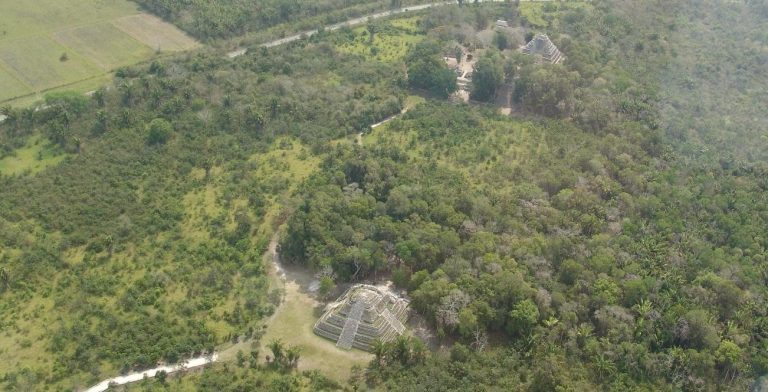
Dzibanche was a planned urban settlement covering approximately 40 square kilometers, or up to about 60 square kilometers when agricultural areas are included. Its four monumental groups were the Main Group, also called Dzibanche, Tutil, Lamay, and Kinichna. White-plastered raised roads, known as sacbe causeways, and other routes connected the groups, including a pre-Hispanic route to Ichkabal. The city combined civic and ceremonial plazas, temples, pyramids, platforms, palaces, residences, agricultural modifications, and ball courts. Its architecture joins Peten-style forms with a local Kaanu’l style characterized by paired pilasters. Much of Tutil and Lamay, along with parts of the other groups, remains beneath the forest.
The Main Group
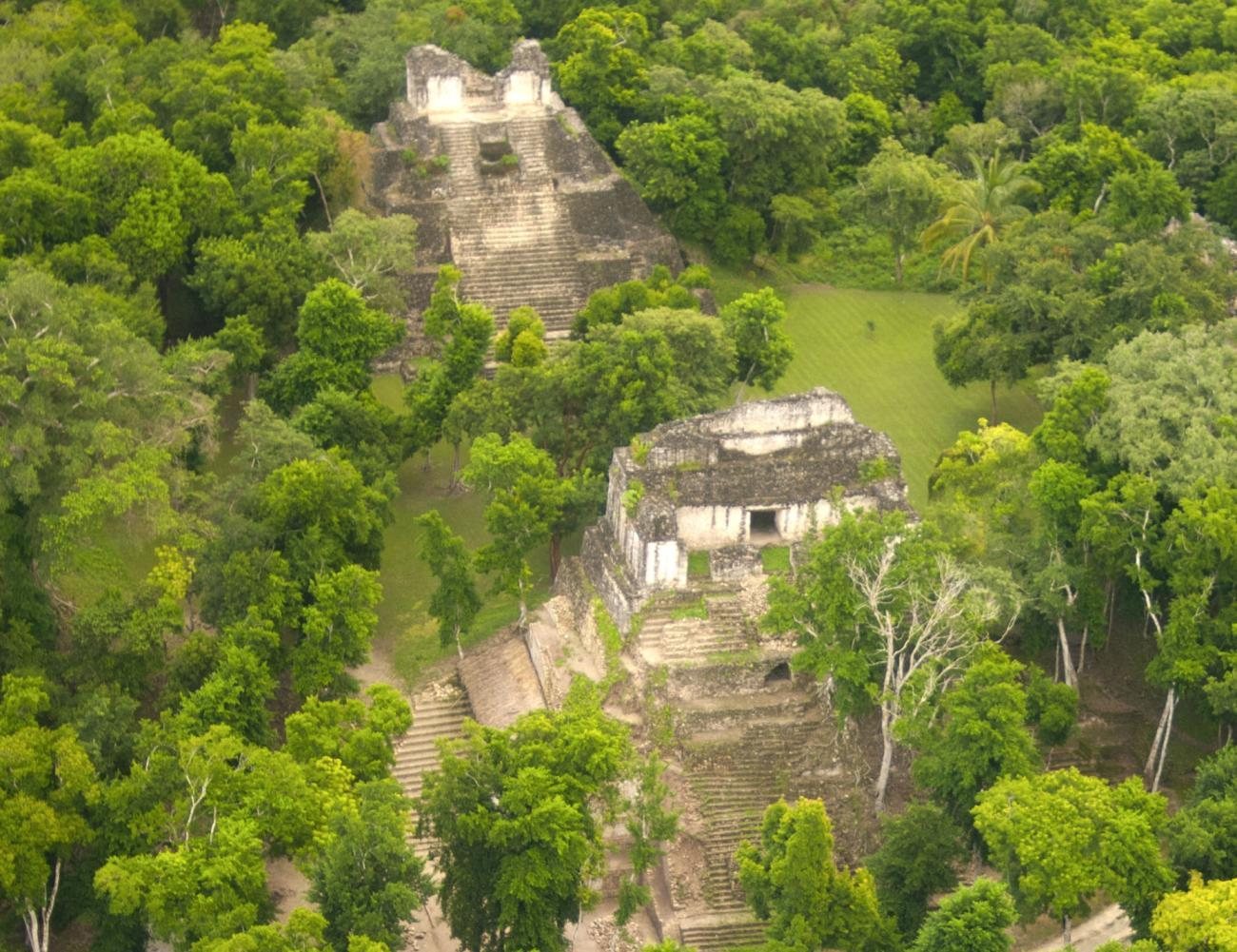
The Main Group was Dzibanche’s principal civic, ceremonial, and political center. Excavated buildings are arranged mainly around Gann Plaza, Xibalba Plaza, and Pom Plaza. The complex included royal residences, large pyramids, temples, palatial buildings, and structures now known as the Temple of the Captives, Temple of the Toucans, Pop Palace, Temple of the Cormorants, and Temple of the Owl.
Temple of the Lintels
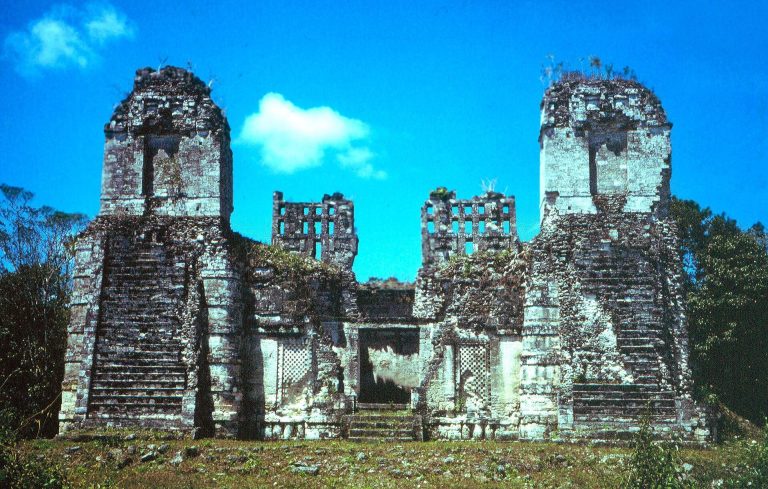
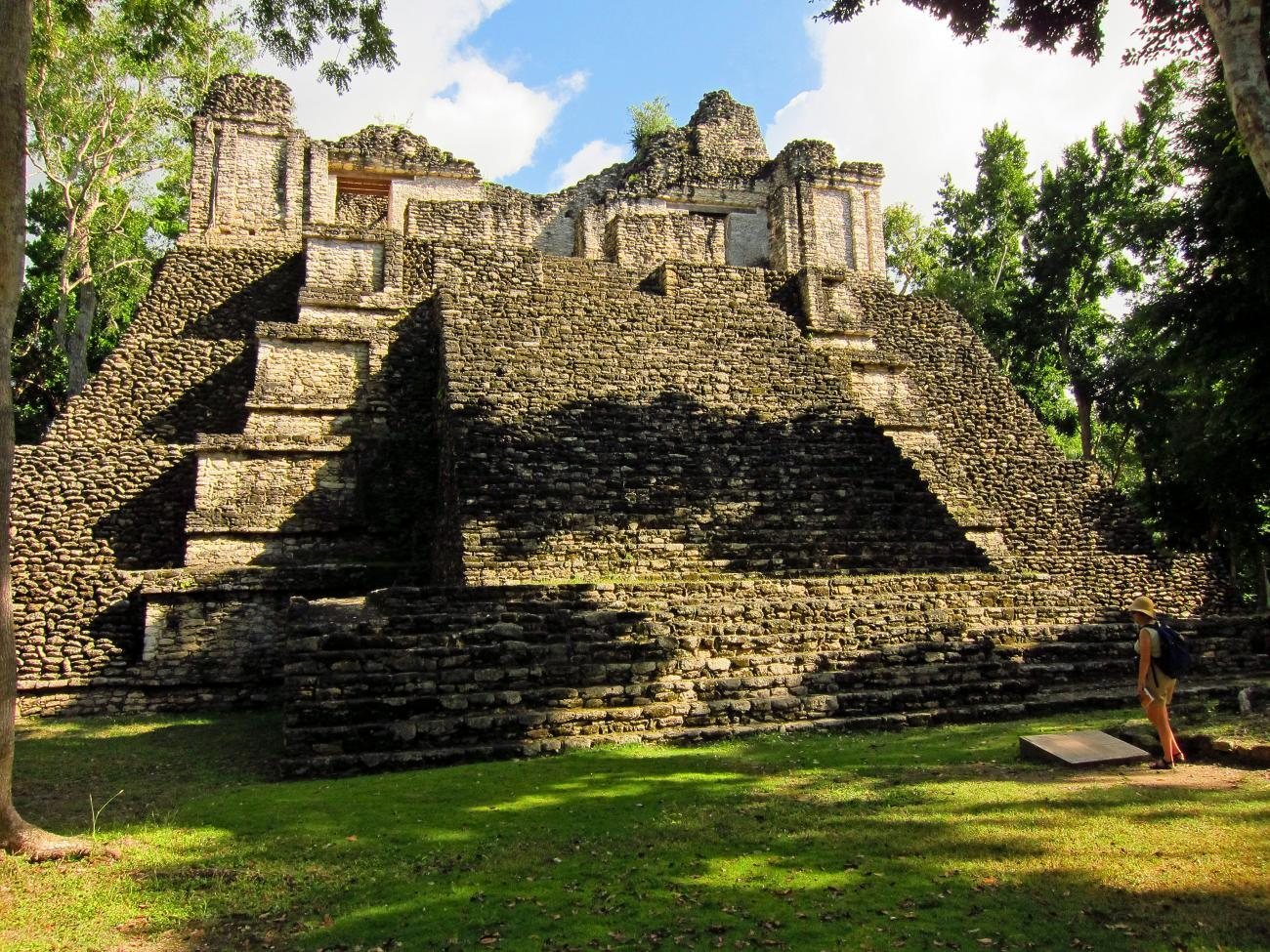
Building 6, the Temple of the Lintels, is a large stepped pyramid with four levels. Its earliest construction phase has a sloping-wall and vertical-panel base known as talud-tablero, a form comparable to contemporary Teotihuacan architecture. The upper temple belongs to a later phase and contains two vaulted rooms and the remains of a tall roof comb, an architectural framework raised above a temple roof. One room contained a carved wooden lintel with hieroglyphic and calendrical inscriptions dated to AD 554.
Gann Plaza
Gann Plaza is an extensive ceremonial area used for public civic and religious ceremonies. The Temple of the Captives borders it to the west, the Temple of the Toucans to the north, Pop Palace to the south, and the Temple of the Cormorants to the east. A large platform contains a hieroglyphic stairway showing bound captives taken by Yuknoom Ch’een I, including Yax K’ahk’ Jolo’m. At least two sculpted blocks may date to the fifth century.
Xibalba Plaza
Xibalba Plaza was the city’s principal center during an early period. The Temple of the Owl stands behind the Temple of the Cormorants within this plaza.
Temple of the Owl
The Temple of the Owl, or Building 1, is an Early Classic funerary and ceremonial pyramid topped by a temple with a roof comb. A three-level stairway inside its base leads to a chamber containing a tomb dated to approximately AD 400. The burial held the skeletal remains of a high-ranking woman, ceramic vessels, bowls, jade necklaces, and a white spondylus-shell pectoral carved with a ruler’s image and decorated with jade inlays. The building takes its modern name from a ceramic vessel with an owl-shaped lid found in the burial.
Temple of the Cormorants
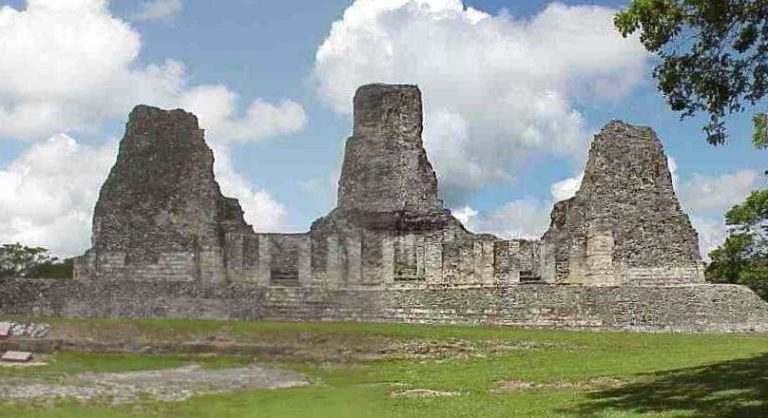
The Temple of the Cormorants, or Building 2, is the tallest structure in the Main Group, rising approximately 34 meters. A large square pyramidal base supports an exceptionally tall and narrow temple with a roof comb. Built during the fifth century in a Teotihuacan-influenced talud-tablero style, it has stucco-sculpted friezes coated with red paint and decorated with Teotihuacan-style symbols.
The pyramidal base contains a sacred mausoleum with several tombs belonging to members of the Kaanu’l lineage. Their offerings included jade masks, ceramic vessels, obsidian objects, knives, necklaces, and other rich funerary equipment. The most important is the royal tomb known as the Tomb of the Lord of Dzibanche, associated with the ruler Sky Witness. His remains were found with painted ceramics and jade masks placed on a jaguar pelt. The temple’s modern name comes from a ceramic vessel decorated with cormorants, birds associated with the Maya underworld.
Other Main Group buildings
The Temple of the Captives, the Temple of the Toucans, and other buildings surrounding the Main Group plazas formed part of the city’s ceremonial and political architecture. Buildings 10, 11, 12, and 14 were residential structures built during the Late and Terminal Classic periods, approximately AD 600–1000. Building 11 is also known as the Pop Palace, while Building 16 is identified as the Temple of the Toucans.
Kinichna
The Kinichna group lies approximately 2 kilometers north of the site core and is connected to it by a causeway. Its principal structure, the Acropolis of Kinichna or Kinichna Pyramid, is a monumental triadic pyramid approximately 35 meters high. This arrangement centers on a main structure with two subsidiary structures facing it across a shared platform. Low palace-like buildings surround a plaza and may have served as platforms for smaller temples or as residences. The group may have housed an elite lineage and extended the city’s control toward the northern part of the surrounding seasonal wetlands.
Kinichna was named after a stucco element bearing the K’in glyph, associated with the sun or day, preserved on the rear of the upper temple. Several tombs belonging to members of the Kaan lineage were found within the acropolis. The most notable burial, in the Temple of the Jaguar at the summit, contained the skeletons of two people and a jaguar, together with jade jewelry and artifacts including necklaces, bracelets, ear ornaments, and a mask.
Lamay, Tutil, and funerary remains
Lamay is a smaller outlying architectural group within the urban settlement. Tutil is another of Dzibanche’s four major architectural groups. Both remain largely covered by the forest.
Royal tombs have been found throughout the city’s structures. Their offerings included obsidian, shell, jade, ceramics, masks, necklaces, jewelry, and other funerary equipment. Monuments and sculpted elements commemorate Kaanu’l military victories and represent mythological themes associated with the ruling lineage.