Maidam: Ahom Royal Funerary Monuments and Burial Tradition
Site at a Glance
- Rating
- 4.7
- Popularity
- Very Low
- Country
- India
- Primary era
- Early Modern
- Eras represented
- Medieval, Early Modern
- Civilizations
- Unclassified
- Site type
- Religious
- Remains
- Tomb
On this page8 sections
History
Maidam is an Ahom funerary monument and burial tradition in Bhokot Gaon, Assam, India, developed by the Ahom dynasty, which ruled the Brahmaputra valley for several centuries. Most surviving large maidams date from the late seventeenth and eighteenth centuries. The royal maidams at Charaideo form the UNESCO World Heritage property “Moidams – the Mound-Burial System of the Ahom Dynasty,” inscribed in 2024 under criteria (iii) and (iv).
Origins and religious practice
The name is shortened from the Tai-Ahom term Phrang-Mai-Dam. Phrang-Mai means burial, while Dam refers to the dead or ancestral spirits. Burial was the principal funerary rite of the Tai people, from whom the Ahoms originated, and contrasted with Hindu cremation. After Ahom kings adopted Hinduism, cremated ashes were placed in the burial mounds instead of the intact body. The practice remains part of the tradition of the Mo-Hung, Mo-Cham, Chaodang, and Mo-Plong clans.
Maidams are connected with Ahom ancestor worship and the annual Me-Dam-Me-Phi observance. The Ahom community has regarded the excavation of the tombs as an affront to this religious tradition. The height and size of a maidam expressed the status or power of the ruler buried there, although natural calamities have reduced many mounds. Most were not marked with royal names, making individual identification difficult. The maidams of Gadadhar Singha and Rudra Singha are notable exceptions.
Royal burial customs
The Chang-Rung Phukanor Buranji, an Ahom historical chronicle, describes royal burial procedures, construction, and the objects placed inside the tombs. Earlier ceremonies could include attendants buried alive to serve the deceased ruler in the afterlife. Rudra Singha abolished this practice.
According to Ahom tradition, members of the Gharphaliya and Lukhurakhan hereditary groups were permitted to conduct royal burials. The Chang-Rung Phukan constructed the maidams and served as chief architect of the Ahom kingdom. Maidam Phukans supervised their protection and maintenance, while guards known as Maidamiya watched over them.
When a king or warrior died in battle, his severed head could be brought to Charaideo for burial. After the Ahom conquest of the Chutia kingdom in 1524, the heads of the Chutia king and his son were buried among the Charaideo tombs.
Looting, excavation, and protection
Many maidams were excavated and looted for valuables by local plunderers, the Mughals, and the British. During his brief occupation of Garhgaon in the seventeenth century, the Mughal general Mir Jumla looted maidams. Further British looting followed after 1826.
Serjeant C. Clayton supervised an excavation in the 1840s and produced the earliest known sketch of a maidam in 1848. In June that year, at the request of the British official T. Brodie, Clayton and his group removed gold and silver ornaments, containers, and other objects. A person identified as Bedford later acquired them. In 1905, an Ahom prince was taken to a maidam and made to excavate it.
Excavations by the Archaeological Survey of India found that some maidams had already been defiled and that objects listed in the Chang-Rung Phukanor Buranji were missing. Maidams occur at Charaideo, Sivasagar, and elsewhere in the Brahmaputra valley. Thirty are protected by the Archaeological Survey of India and the Assam state archaeology department. The monuments and their adjoining buffer areas are jointly protected and managed under India’s Ancient Monuments and Archaeological Sites and Remains Act of 1958, amended in 2010, and the Assam Ancient Monuments and Records Act of 1959.
Remains
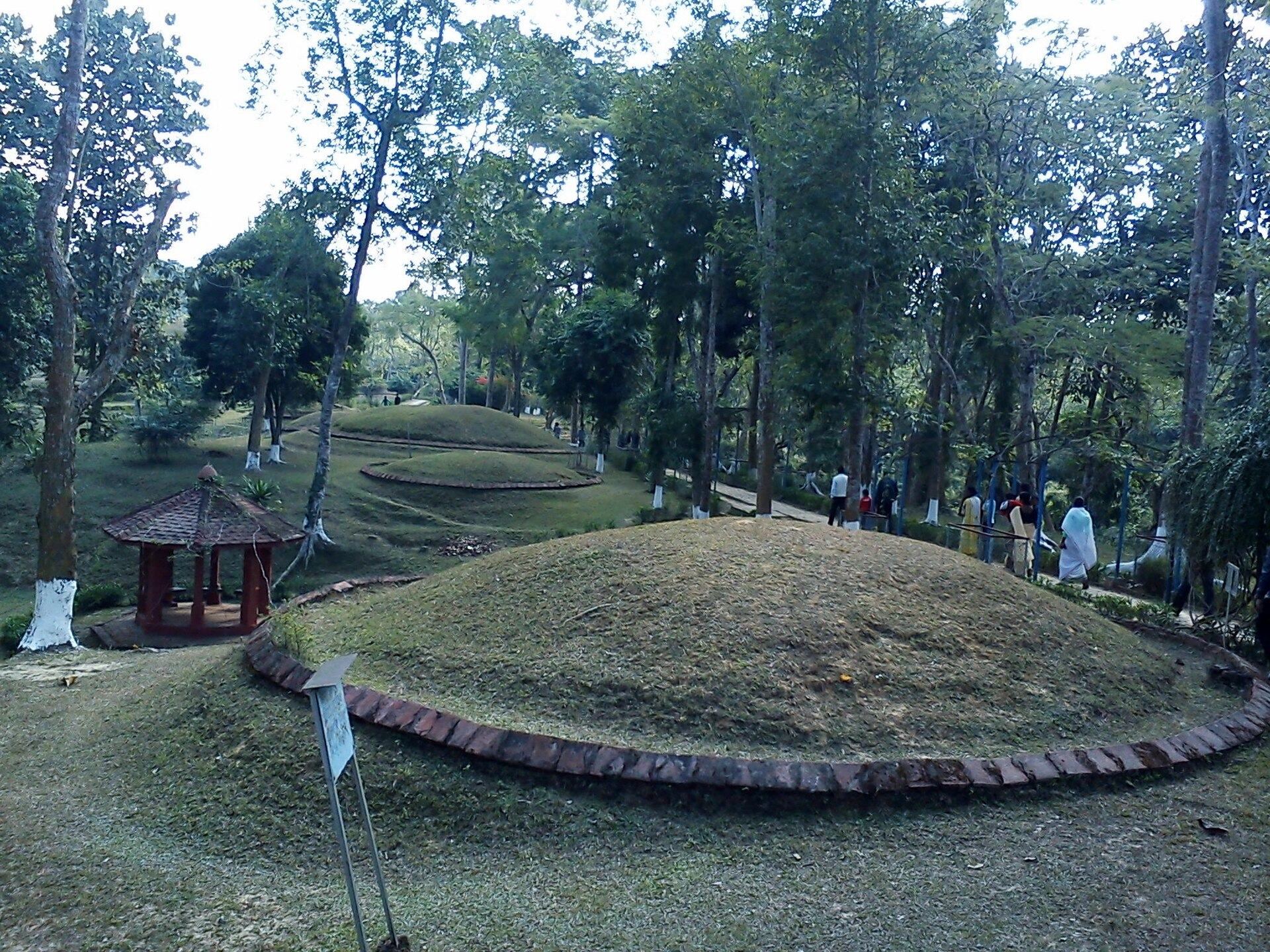
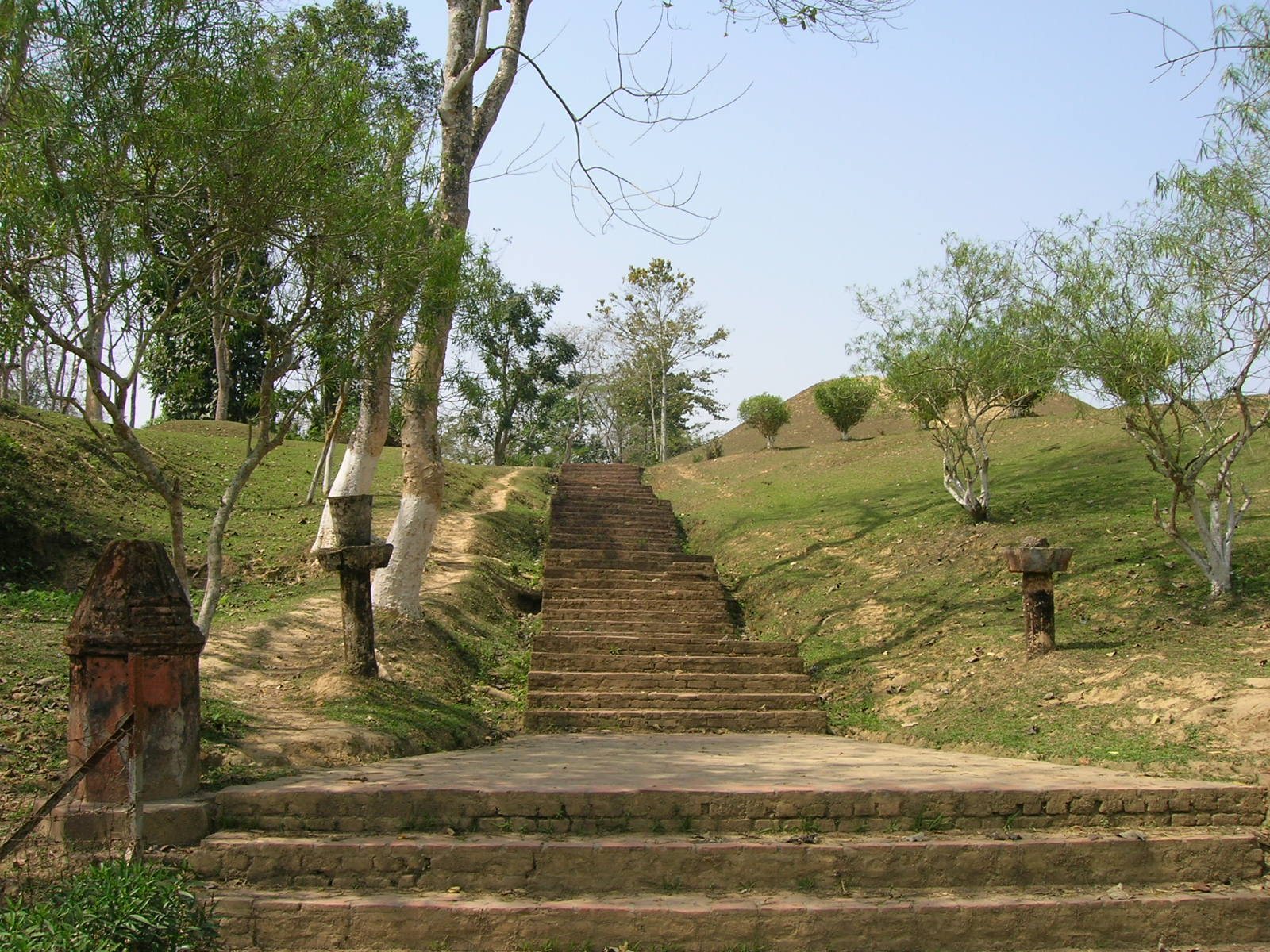
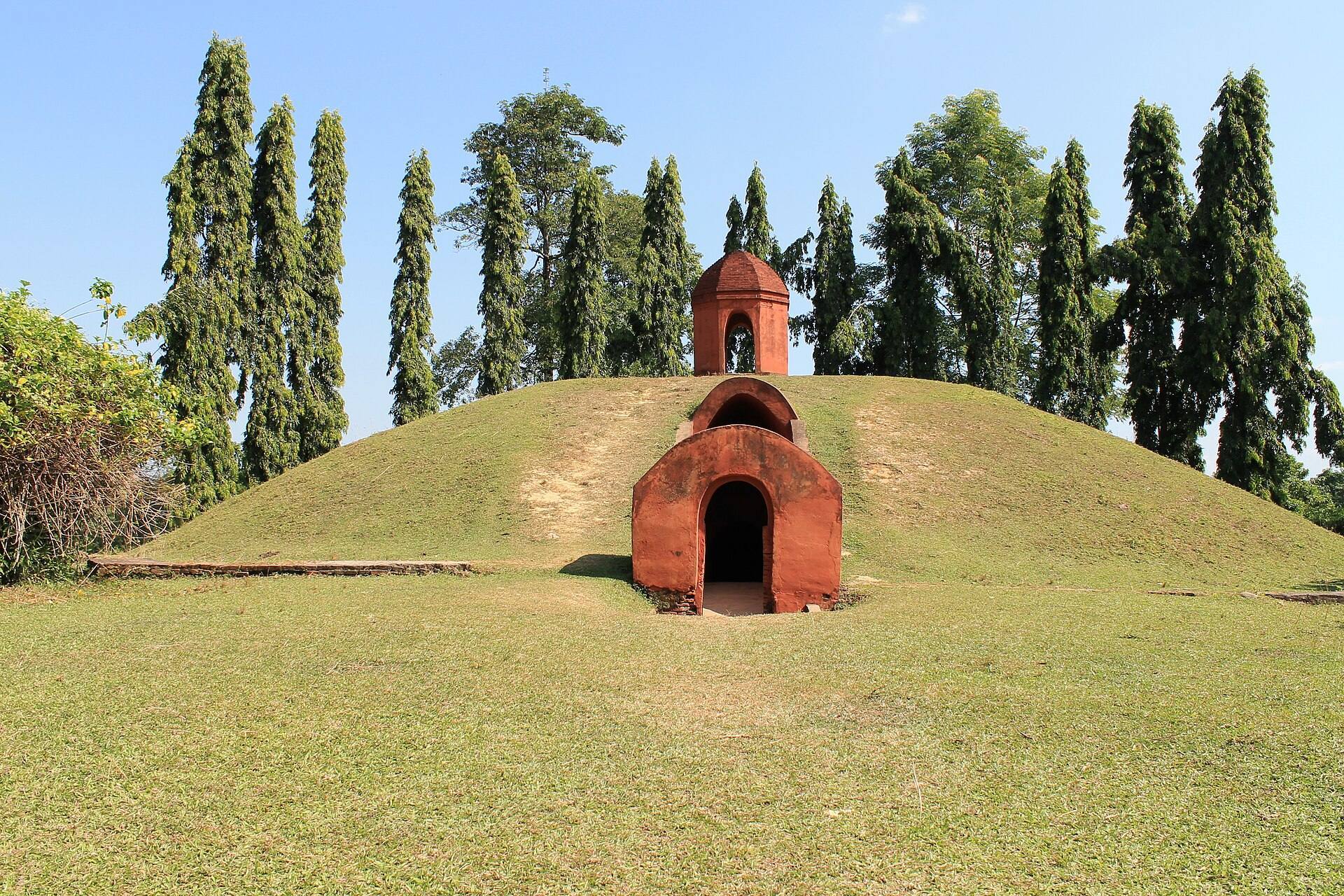
A maidam combines an underground burial vault, a domed superstructure, a hemispherical earthen mound, and an open pavilion called a chow chali at the summit. A small octagonal wall encloses the monument, with its entrance on the western side. Ritual observances for the dead took place outside this boundary.
Burial structure and construction
The principal underground chamber held the deceased king in a Rungdang, a wooden royal coffin, together with objects intended for his afterlife. The timber identified for these coffins is Bischofia javanica. Other chambers could hold servants, attendants, horses, and elephants. A structure called the Kareng-rung-dang was built over the coffin’s burial place and could contain personal possessions, pottery, wooden, ivory, iron, and gold objects, weapons, containers, furniture, and equipment associated with attendants.
The earthen mound rose above the Kareng-rung-dang, and some examples were divided internally into several chambers. The summit pavilion was a distinctive part of the monument, although small maidams could lack the usual sculptural elements. Earlier burial chambers, including examples from the thirteenth through seventeenth centuries, relied mainly on substantial timber posts and beams. From the beginning of the eighteenth century, stone and burnt brick increasingly replaced timber, probably during the reign of Rudra Singha and those of his successors.
Construction used bricks and stones of different sizes, including broken fragments, held together with lime-based mortar. One recorded mixture contained earth, jaggery, duck eggs, rohu fish, lime, and conch shells. The changing materials and layered form preserve the development of Ahom royal burial architecture across several centuries.
Maidam No. 2 at Charaideo
Maidam No. 2 at Charaideo was excavated by the Guwahati Circle of the Archaeological Survey of India in 2000–02. Its vault and covering mound were made of burnt brick and enclosed by an octagonal boundary wall. Its exact construction date is uncertain, but it is estimated to belong to the first half of the eighteenth century. A hole in the roof indicated earlier looting, and excavation revealed an arched entrance on the western side that had originally been covered with brick and stone masonry.
Despite the earlier robbery, the excavation produced skeletal remains of five individuals, ivory decorative pieces, wooden objects, copper fragments, cowries, a gold pendant, and several cannon-shot balls. The wooden finds included a pillar-shaped traditional tray. An ivory panel carried royal Ahom insignia, while other carvings depicted elephants, peacocks, and floral motifs.
Other identified maidams
Jorhat contains the maidam of Purandar Singha, the last Ahom king, and the maidam of Lachit Borphukan, the Ahom commander remembered for his role in the Battle of Saraighat.