Debre Bizen: An Orthodox Monastery in Eritrea
Site at a Glance
- Rating
- 4.7
- Popularity
- Very Low
- Country
- Eritrea
- Primary era
- Unclassified
- Eras represented
- Unclassified
- Civilizations
- Unclassified
- Site type
- Religious
- Remains
- Monastery
On this page6 sections
History
Debre Bizen is an Orthodox monastery on Mount Debre Bizen near Nefasit in Eritrea, founded around 1350 by Abuna Filipos, a disciple of Abba Absadi. It became one of the oldest and most venerated monasteries of Eritrea’s Orthodox Church and remains associated with the Eustathian tradition.
Foundation and Eustathian Tradition
By around 1400, the monastery followed the rule of Ewostatewos, also known as Eustathius, whose teachings formed the basis of the Eustathian monastic tradition. A gadl, a hagiographical account of a saint’s life and religious works, was later composed at Debre Bizen about Ewostatewos.
The monastery’s institutional relationship with the Ethiopian Orthodox Tewahedo Church remains uncertain. It may have retained an independent position, or it may have continued to depend on the church centered at Axum. A surviving charter from Emperor Zara Yaqob, whose reign belonged to the fifteenth century, granted land to Debre Bizen.
Ottoman Campaigns and Later History
Debre Bizen was among the settlements damaged during the Ottoman Empire’s sixteenth-century campaigns to establish the Habesh Eyalet, an Ottoman administrative province in the region.
The monastery also played a part in the escape of Abuna Yohannes XIV, a church leader who had come from Cairo to serve as head of the Ethiopian or Eritrean Church. After the local naib, an Ottoman-era administrative official, held him for ransom at Arkiko, the abbot of Debre Bizen helped him escape.
In 1937, approximately 300 Coptic monks inhabited the monastery. Its long religious continuity and connection with the Eustathian tradition have kept it among Eritrea’s most revered Orthodox monastic institutions.
Remains
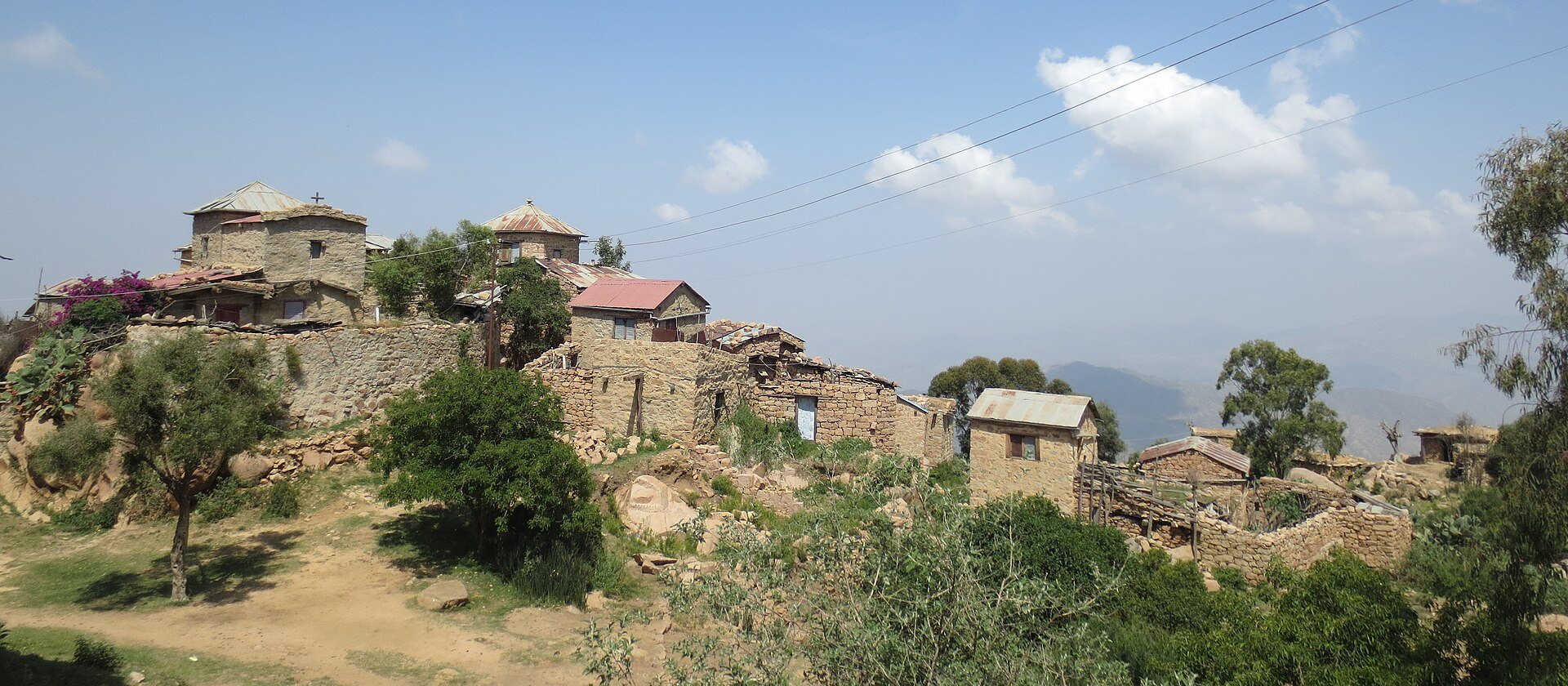
Debre Bizen occupies the summit of Mount Debre Bizen at approximately 2,460 metres above sea level. The complex is arranged as a monastic settlement of individual huts together with two churches and a library preserving religious manuscripts.
Monastic Settlement and Churches
Numerous huts form the residential part of the monastery. Each hut was occupied by a monk and one or more servants who assisted with domestic tasks. The complex also contains two churches, one dedicated to Saint Philip and the other to Saint John.
Library
The monastery’s library preserves many important manuscripts in Ge’ez, including manuscripts dating from the fifteenth century. These texts form part of the surviving material associated with Debre Bizen’s religious and intellectual life.