Rock Paintings of Hua Mountain: A Luoyue Cultural Landscape in China
Site at a Glance
- Rating
- 4.8
- Popularity
- Very Low
- Country
- China
- Primary era
- Classical
- Eras represented
- Classical
- Civilizations
- Unclassified
- Site type
- Civic
- Remains
- Rock Art
On this page8 sections
History
The Rock Paintings of Hua Mountain are a Luoyue cultural landscape in Ningming County, Guangxi, China, created between the Warring States period, beginning around the fifth century BCE, and the Eastern Han period, which ended around the second century CE. Associated with ancestors of the Zhuang people, the paintings preserve images interpreted as records of Luoyue social life and ritual practices.
Luoyue traditions and historical setting
The paintings belong to the cultural world of the Luoyue, an ancient Yue-related population associated with the Zuo River region. They are also connected with the wider Dong Son cultural sphere, whose communities extended across southern China and mainland Southeast Asia. The area entered Qin territory in 214 BCE, during the period when the Qin dynasty expanded and unified much of ancient China.
Most chronological interpretations place the paintings from the Warring States period through the Eastern Han. Radiocarbon results have also raised the possibility that some images may be much earlier, dating to approximately 16,000 years ago, while others may be as recent as about 690 years ago. These results indicate that painting activity across the wider landscape may have extended beyond the principal historical period usually associated with the sites.
Bronze-drum culture
The imagery is associated with the bronze-drum culture formerly widespread in southern China and mainland Southeast Asia. Drums and related objects appear among the painted subjects and are understood as symbolic records of this tradition. Bronze drums continue to be respected in southern China as symbols of power, while the painted people, objects, and ritual postures provide evidence for interpreting Luoyue material culture and religious practice.
Recognition and protection
The Huashan scenic area was recognized as a National Key Scenic Area in 1988, and the Ningming County rock paintings were placed on China’s national list of protected monuments in the same year. The site entered China’s tentative World Heritage list in 2008 and was formally nominated in 2015. On July 15, 2016, the cultural landscape was inscribed on the UNESCO World Heritage List at the 40th session, under criteria (iii) and (vi), becoming China’s 49th World Heritage site.
The World Heritage property consists of three separated areas containing 38 rock-art sites in Ningming County, Longzhou County, Jiangzhou District, and Fusui County. It covers 6,621.6 hectares, with a buffer zone of approximately 12,149 hectares. Some rock-art areas lie within Nonggang National Nature Reserve, while the right bank of the Ming River is designated as the Huashan Rock Art Scenic Area. The Zhuang Nationality Museum in Chongzuo maintains an exhibition on the history and interpretation of the paintings.
Remains
River cliffs and distribution
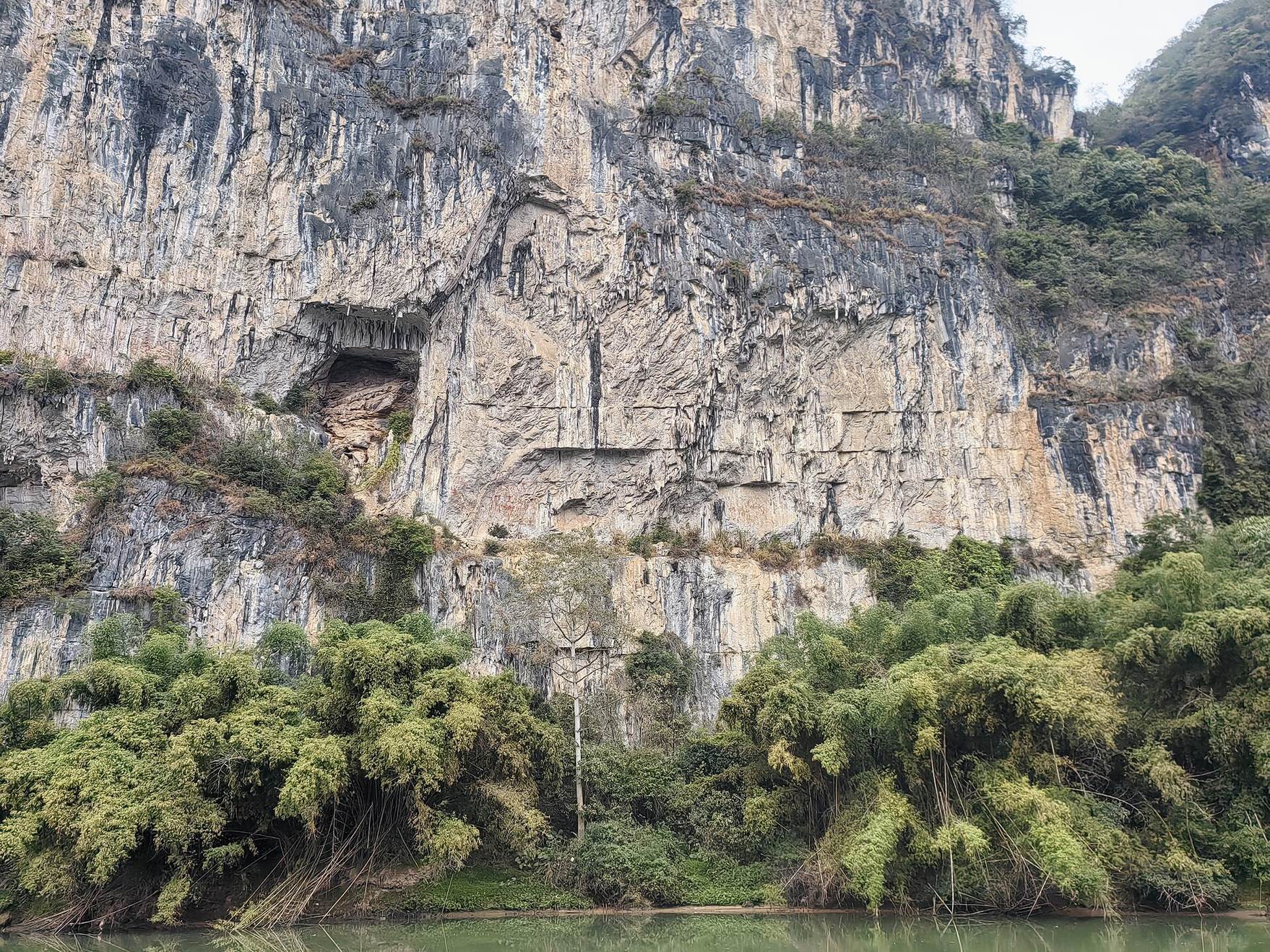
The rock art occupies steep, relatively smooth limestone cliffs beside the Zuo River and the Ming River. The painted surfaces often face the water, and the wider distribution follows more than 100 kilometers of riverbank. The 38 sites are divided among three areas, creating a dispersed cultural landscape rather than a single enclosed monument.
The principal concentration covers a cliff approximately 170 meters wide and 40 meters high. About 1,900 separate images are arranged in roughly 110 groups on the rock face. Most paintings lie between about 30 and 90 meters above the river, while some reach approximately 130 meters.
Human and object imagery
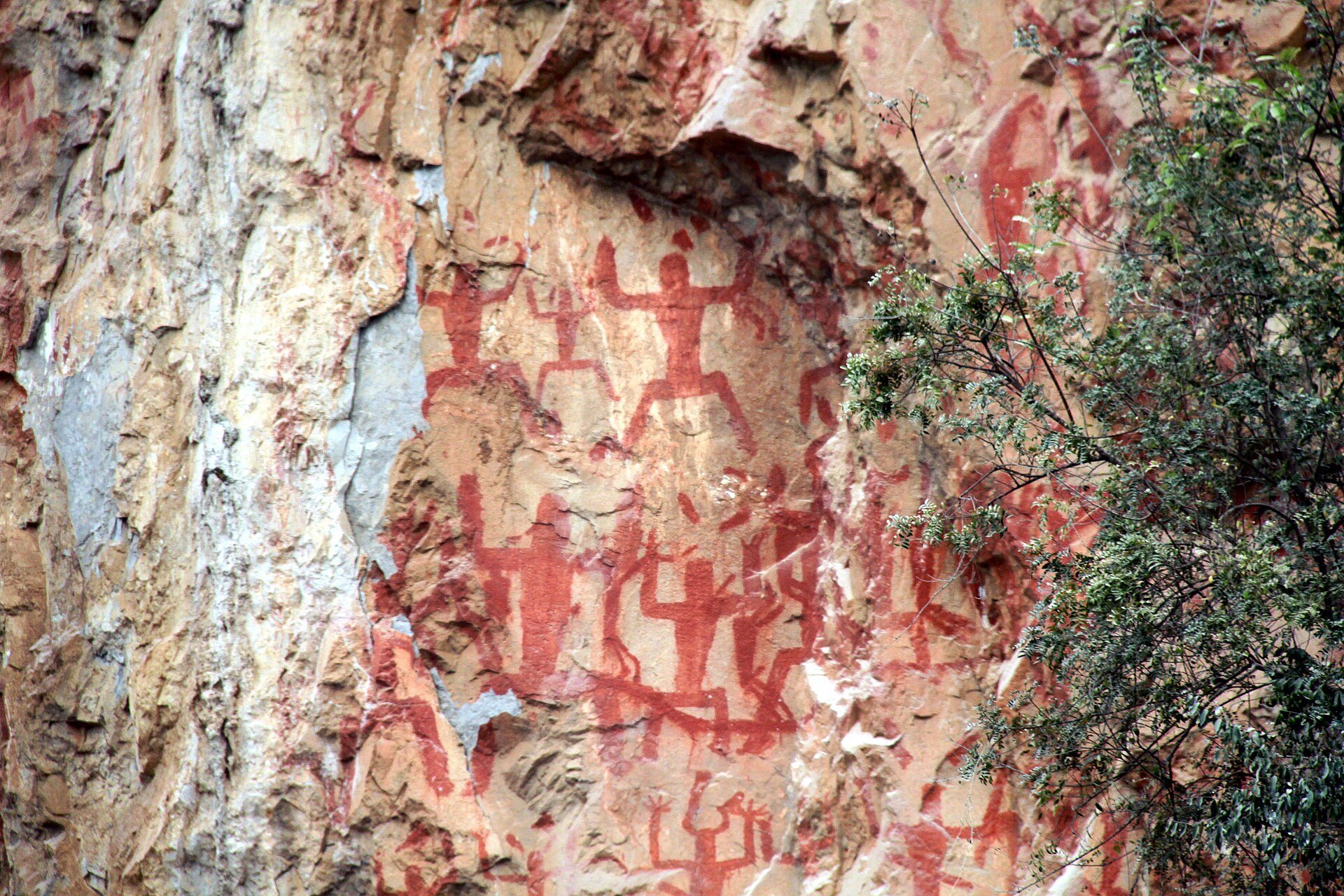
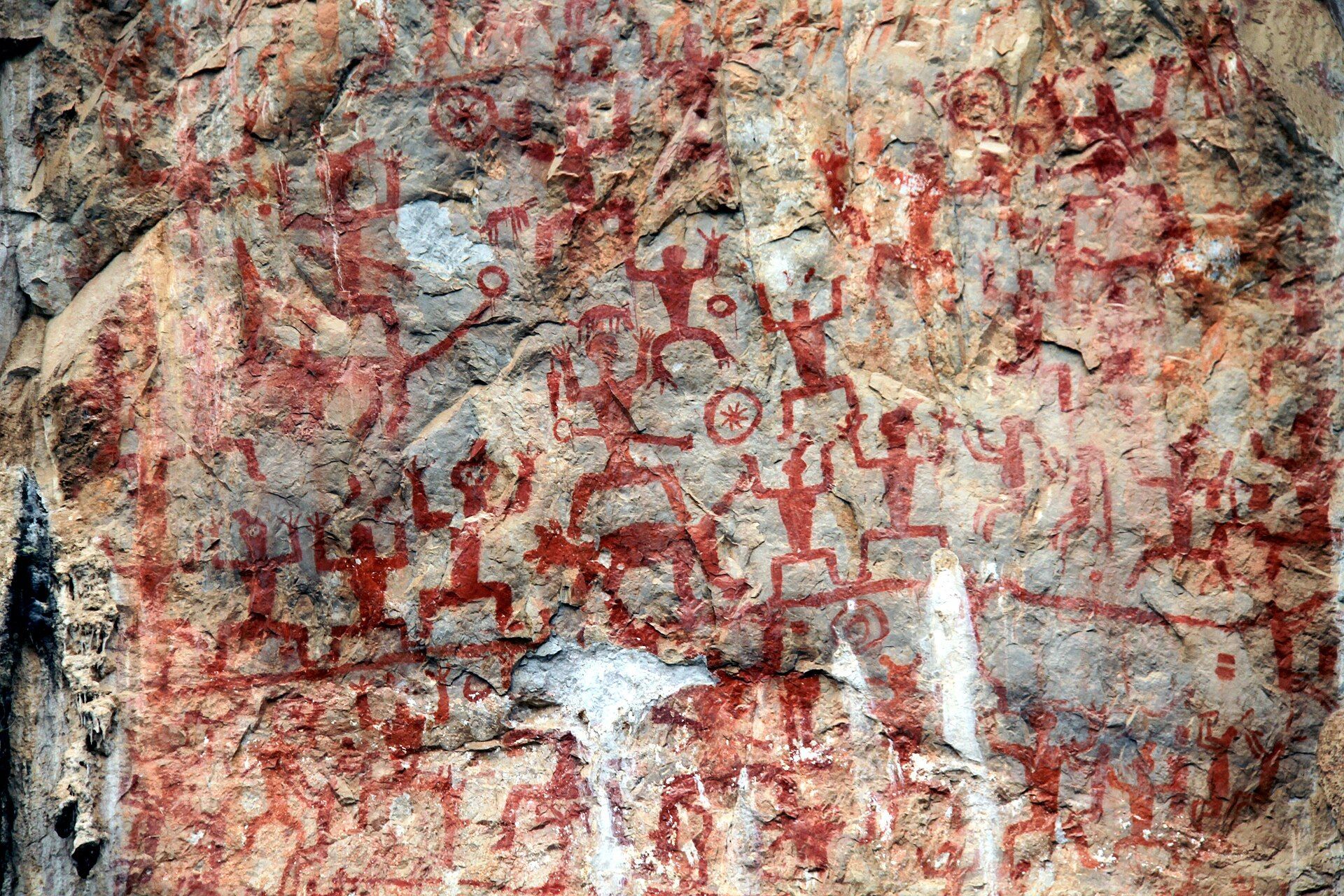
Human figures dominate the compositions. Many have raised arms and bent legs, a posture generally interpreted as ritual activity. Most figures measure about 60 centimeters to 1.5 meters high, although individual images range from roughly 20 to 30 centimeters to a maximum of about 3.58 meters. Animals, knives, swords, bells, ships, drums, bronze gongs, and other objects accompany the human figures.
A recurring circle containing a central dot is thought to represent a drum. The imagery has been compared with designs on Dong Son bronze drums from southern China and Vietnam. This relationship helps connect the painted scenes with the wider material culture and ritual life associated with the Luoyue.
Pigment and cliff access
The paintings are predominantly red or reddish-brown. Their pigment is described as based on hematite or red ochre, iron-rich minerals that produce these colors, with plant sap, animal glue, blood, and oxalic acid included in reported formulations as mixing or binding agents.
How the painters reached the high cliff faces remains uncertain. The remains of stakes have been interpreted as evidence for scaffolding. Other possibilities include suspension from the cliff tops or climbing upward from below. The height and position of the images preserve the physical challenge involved in creating them, while the surviving pigment and compositions retain the visual record of Luoyue ritual imagery.