Hueco Tanks: A Texas State Historic Site of Rock Art and Ancient Water Basins
Site at a Glance
- Rating
- 4.7
- Popularity
- Medium
- Country
- United States
- Primary era
- Medieval
- External website
- Open
- Eras represented
- Stone Age, Bronze Age, Iron Age, Classical, Medieval
- Civilizations
- Unclassified
- Site type
- Civic
- Remains
- Rock Art
On this page10 sections
History
Hueco Tanks is a state historic site in El Paso, Texas, United States, built by neither a single civilization nor a single period but shaped by thousands of years of human use in a high-altitude desert basin. Its history begins about 10,000 years ago with the Desert Archaic Culture, early hunter-gatherer societies of the North American deserts, and later includes Paleo-Indian hunting, Jornada Mogollon farming and village life, Native American ceremonies, military encounters, ranching, and archaeological preservation.
Early habitation and the Jornada Mogollon
Paleo-Indians hunted Ice Age animals in the region using Folsom points, finely flaked stone projectile points associated with hunting large animals. Later inhabitants included the Jornada Mogollon, a Southwestern cultural tradition connected at Hueco Tanks with agriculture, village life, and distinctive rock art. Farming developed in the area around 1000 AD, including the cultivation of corn.
Archaeological excavation identified a Jornada Mogollon village between North Mountain and West Mountain. About 700 years ago, the small agricultural area around Hueco Tanks could no longer support the village population. Settlements shifted to playas, or shallow seasonal lakebeds, south, west, and northwest of the site. These communities continued in the region until severe droughts affected it around 1450. By about 1600, Apache groups had entered the area from Canada.
Native peoples and later encounters
Mescalero and Lipan Apaches, Jumano people, Comanche, Kiowa, and Tiguas later used or inhabited Hueco Tanks. Spanish and Mexican travelers visited only rarely. The place also retained cultural and spiritual importance for Native American peoples, including the Mescalero Apache, Kiowa, Hopi, and Pueblo peoples. Its painted rock surfaces form one expression of that continuing significance.
In 1837, the Kiowa signed a treaty with the United States. Shortly afterward, Mexican soldiers forced Kiowa participants into a six-day siege at Hueco Tanks, during which most of them died. The earliest known modern graffiti dates from the 1840s. Later Anglo graffiti included the inscription “1849,” painted over earlier rock paintings. Inscriptions left by Texas Rangers and United States cavalrymen, along with Native American artifacts and paintings, preserve evidence of successive historical uses.
Rock art and its study
The earliest paintings are attributed to the Desert Archaic Culture and consist of abstract designs dating from approximately 6000 to 3000 BC. Animal and human figures were added between about 3000 BC and 450 AD, while most of the pictographs, images painted onto rock surfaces, are attributed to the Jornada Mogollon.
Some Jornada Mogollon paintings may have been connected with prayers for rain. Their religious traditions were influenced by Mesoamerican religions, and many paintings depict Tlaloc, a deity associated with rain and agricultural fertility, and Quetzalcoatl, a prominent deity traditionally represented as a feathered serpent.
Forrest and Lula Kirkland produced the first scientific overview of the rock art in the summer of 1939. In 1972, the El Paso Archaeological Society and the Anthropology Club of the University of Texas at El Paso systematically recorded the paintings and their condition, documenting 300 pictographs that had not previously been registered. Park ranger Dave Parker and archaeologist Ron Ralph plotted the locations of all known pictographs in 1988. Robert Mark and Evelyn Billo began a digital database of the paintings and their geographic positions in 1999.
Military, ranching, and preservation
United States Boundary Commissioner John R. Bartlett visited Hueco Tanks in 1852 and recorded some of its pictographs. The Butterfield Overland Mail operated a stagecoach station there from 1858 to 1859, abandoning it after a better location was found farther south.
El Paso businessman Juan Armendariz acquired much of the land for ranching in 1895. Silverio Escontrías purchased it in 1898, and his family operated the property as a ranch and tourist attraction until 1956. The National Park Service offered to purchase the land in 1935, but the Escontrías family declined. Fort Bliss leased part of the property for training during the 1940s and 1950s.
After the ranch entered the real-estate market in 1956, archaeological and historical societies publicized the importance of the area. El Paso County assumed control of the land in the mid-1960s. Discussions about transferring the park to the Tiguas took place in 1968. In 1969, the El Paso County commissioners deeded the property to the Texas Parks and Wildlife Commission, which acquired additional land in 1970 and made Hueco Tanks a Texas state park.
The property entered the National Register of Historic Places in 1971, a federal inventory of significant historic properties. George Kegley directed archaeological excavations in 1972 and 1973. The site was renamed Hueco Tanks State Historic Site in 1998 and became a National Historic Landmark in 2021, a designation recognizing exceptional national historical significance. The Texas Parks and Wildlife Department manages the property, whose historic artifacts, plants, and wildlife are protected by Texas law. A brief closure of the entire park led to a Public Use Plan implemented in June 2000, after increasing visitor and climbing crowds made management more difficult.
Remains
Mountains, rock formations, and water
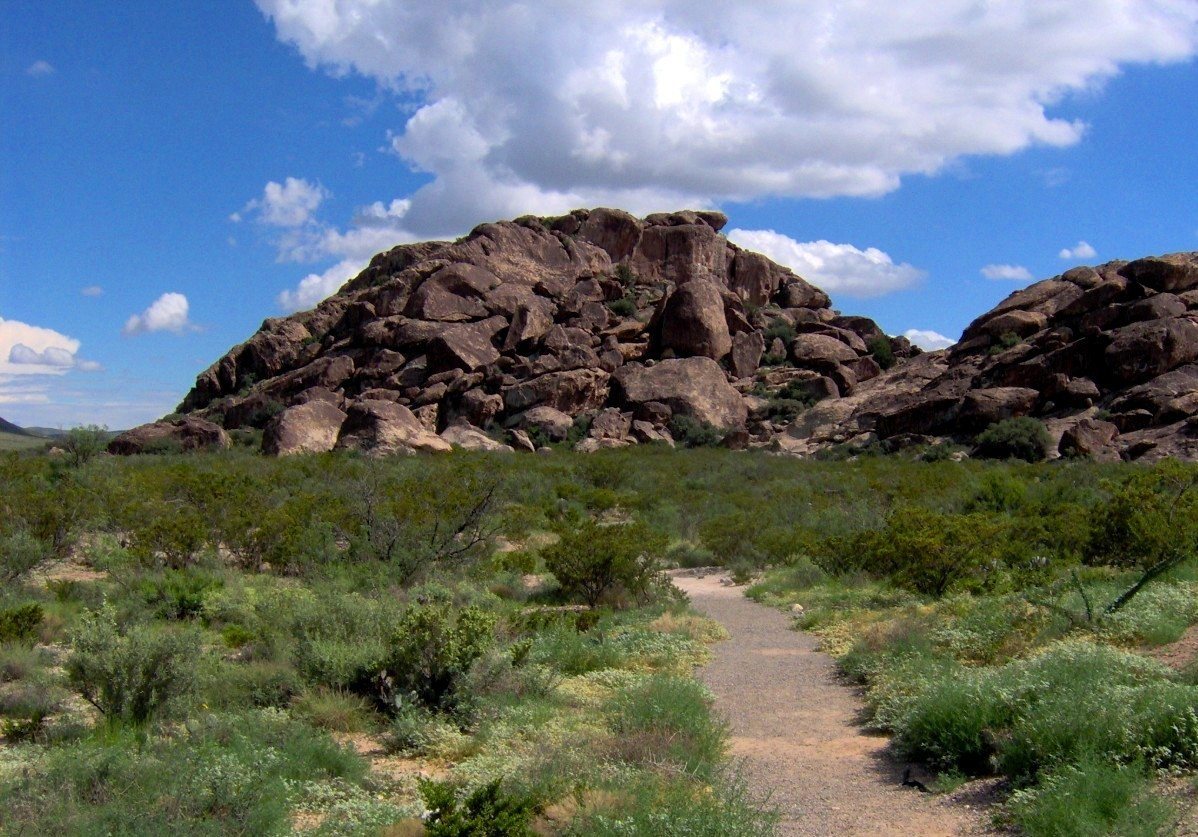
Hueco Tanks covers about 860 acres, or 350 hectares, in a high-altitude desert basin between the Franklin Mountains to the west and the Hueco Mountains to the east. The site consists of three syenite mountains, North Mountain, West Mountain, and East Mountain. Syenite is a coarse-grained intrusive igneous rock resembling granite but containing little or no quartz.
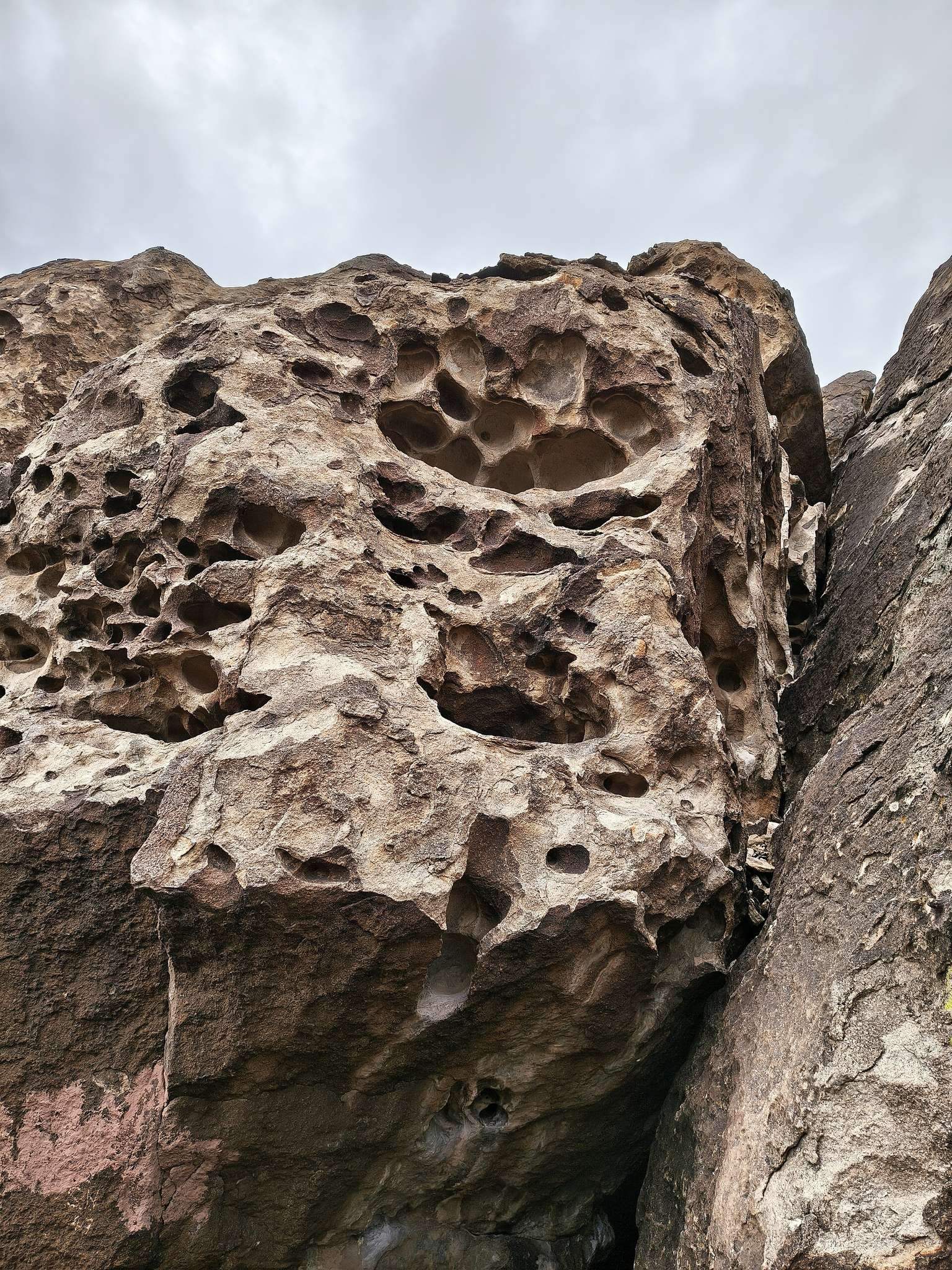
The syenite pluton formed approximately 34 to 38 million years ago as part of the Hueco Mountains, whose geological history extends back more than 320 million years to a time when the region was covered by an inland sea. Weathering exposed the pluton above the desert floor. Sunlight, sand, and water produced a dark desert patina, the weathered coating that covers many exposed rock surfaces. Cracks, hollows, and water-holding depressions shape the site’s characteristic terrain.
The name Hueco Tanks refers to the many natural rock basins and hollows, or huecos, that retain rainwater in the boulders and rock faces. These reservoirs supplied water to people and travelers in the arid region for millennia and could once hold as much as a year’s water supply. Permanent and seasonal springs also occur at the site, which receives less than 14 inches, or approximately 360 millimeters, of rain each year.
Rock art and archaeological remains
Pictographs occur throughout the rock formations. Mineral pigments supplied most of their colors, and as the paintings aged, they became bound to the rock surfaces. Hueco Tanks contains the largest concentration of Native American mask paintings in North America. The paintings range from abstract designs to animal, human, and mask figures, with many associated with the long sequence of Native American use described in the site’s history.
The archaeological remains of a Jornada Mogollon village lie between North Mountain and West Mountain. Native American artifacts occur with the village remains and the painted rock surfaces. Later inscriptions by Texas Rangers and United States cavalrymen occupy the same broader landscape, providing physical evidence of later military use alongside earlier paintings and artifacts.
Ranch buildings and living environment
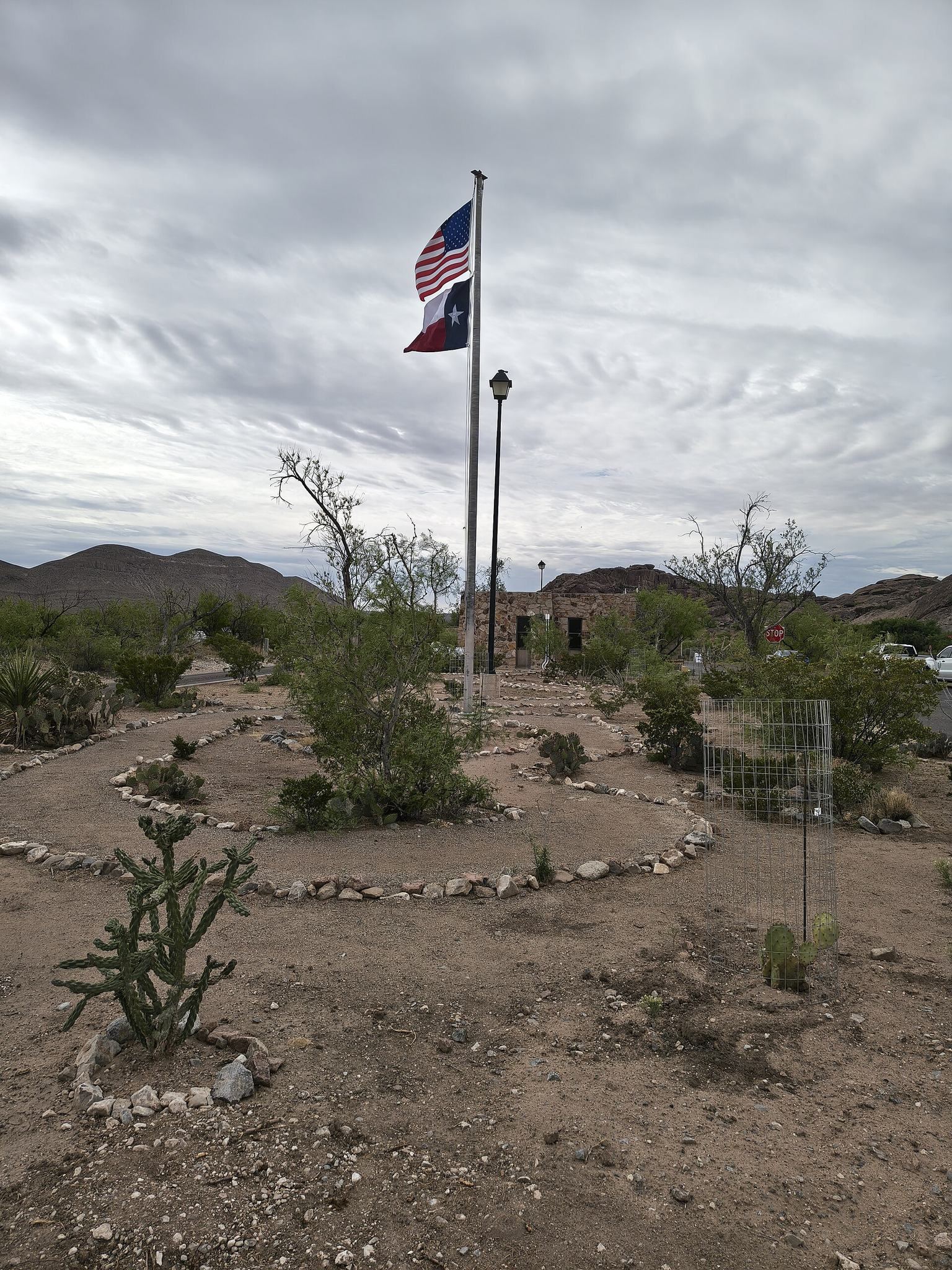
The former Escontrías ranch house was reused as the park’s information center, retaining a physical connection with the property’s late nineteenth- and early twentieth-century ranching period.
Hueco Tanks supports Chihuahuan Desert scrub dominated by creosote bush. Water retained in the rock formations supports Arizona white oak and one-seed juniper, both surviving from the last ice age, as well as netleaf hackberry, Texas mulberry, Mexican buckeye, and catclaw acacia. The site contains the only population in the United States of Colubrina stricta.
The animal life includes longtail tadpole shrimp, Couch’s spadefoot, barred tiger salamanders, about 30 reptile species, mule deer, aoudad, American black bear, gray fox, coyote, American badger, ringtail, striped skunk, common raccoon, black-tailed jackrabbit, desert cottontail, rock squirrel, six bat species, and 20 rodent species. In 2002, 222 bird species were documented at Hueco Tanks. Migratory waterfowl and songbirds pass through the site, while species that likely breed there include white-throated swift, black-chinned hummingbird, ash-throated flycatcher, Crissal thrasher, blue grosbeak, Scott’s oriole, prairie falcon, burrowing owl, and lesser goldfinch.
Bouldering landscape
Hueco Tanks is a major bouldering area with more than 2,000 documented bouldering problems. Bouldering is a form of rock climbing on relatively low faces or boulders, normally practiced without ropes and with protective landing equipment. The area’s climbing appeal is associated with the type, concentration, and quality of its rock, adding a modern recreational use to a landscape shaped by ancient water collection, settlement, and ceremonial activity.