Toniná: Maya City and Capital of the Kingdom of Po
Site at a Glance
- Rating
- 4.7
- Popularity
- Medium
- Country
- Mexico
- Primary era
- Medieval
- Eras represented
- Classical, Medieval
- Civilizations
- Maya
- Site type
- City
On this page16 sections
History
Toniná is a Maya city and former capital of the kingdom of Po in Ocosingo, Chiapas, Mexico. Originally known as Po or Popo, it developed as a major urban and political center during the Classic Maya period, especially between the seventh and ninth centuries. Its modern name comes from Tzeltal and is commonly interpreted as “house of stone” or “place where stone sculptures are raised.”
Early occupation and formation
People occupied Toniná discontinuously from at least the first or second century AD. Its foundation and early formation have also been associated, more tentatively, with population movements during the Olmec period. The city’s formative phase is conventionally placed around AD 300 to 500, while evidence for its Early Classic history remains limited because later construction buried much of the earlier settlement.
The earliest recorded date connected with Toniná refers to AD 217 in an eighth-century text. The ruler named there is known only by a title. In October 440, an alliance involving Palenque, Yaxchilán, and Tenosique temporarily subdued Toniná, but the city soon recovered its independence. Ruler 1 was already in power by AD 514, when he was represented on an altar.
K’inich Sawan B’alam Yaxuun Acal, also called Tihl, became ruler on January 16, 568. A record from Chinikihá states that he was captured in AD 573 and may have been sacrificed there. Toniná’s first securely dated local inscription, Monument 106, dates to AD 593. The city’s inscriptions later recorded royal births, accessions, marriages, military victories, deaths, tomb ceremonies, and other dynastic events.
Competition with Palenque
During the Late Classic period, Toniná competed with Palenque and other Maya kingdoms for regional authority. Control of the Chalchihuitán area gave Toniná’s dynasty access to jade sources. Between AD 697 and 702, the subordination of Bolonkin, Natentsun, and Mukana secured an extensive trade route toward Tabasco and the Gulf coast.
K’inich Hix Chapat was born in AD 606 and became king at the age of eight in AD 615. In AD 633 he installed two subordinate lords, and his final known mention appears on a monument dated AD 665. Ruler 2 acceded in AD 668. His reign was marked by warfare and images of bound captives, while his monuments established the strongly three-dimensional sculptural style associated with later Toniná.
Ruler 2 may have been defeated and captured by K’inich Kan Balam II of Palenque in September 687, possibly ending in sacrifice. K’inich B’aaknal Chaak became ruler in AD 688 and restored Toniná’s regional power through repeated victories over Palenque. On October 4, 692, he captured K’awiil Mo’, a Palenque military commander, and the official B’uk’. B’uk’ was probably sacrificed during the dedication of Ballcourt 1 on June 29, 696.
Ballcourt 1 was dedicated in AD 699 to commemorate three victories over Palenque. During this period, Toniná’s military and political influence reached its height, and the city became the dominant power in the lower Usumacinta region.
Royal power in the eighth century
Ruler 4 came to power in AD 708 while still very young. In AD 711, Toniná captured K’inich Kan Joy Chitam II of Palenque. The event was followed by a ten-year interruption in Palenque’s dynastic record and confirmed Toniná’s dominance in the lower Usumacinta region. Ruler 4 continued to commemorate period endings, or calendrical transitions marked by royal ceremonies, in AD 716 and 721.
K’inich Ich’aak Chapat succeeded Ruler 4 in AD 723 and fought Piedras Negras around AD 725. He marked events between AD 726 and 729 and rededicated K’inich B’aaknal Chaak’s tomb in AD 730. K’inich Tuun Chapat later commemorated the period ending of AD 736 and remodeled Ballcourt 1. A damaged inscription indicates renewed warfare with Palenque, although the identity of the captive is uncertain.
A successor identified as Ruler 7 defeated Palenque around AD 764 and may have been the woman known as Lady K’awil, whose death is recorded in AD 774. Lord Wak Chan K’ak’, apparently a royal heir, died in AD 775 before becoming king.
Late Classic power and decline
Ruler 8 was Toniná’s last successful warrior king. Between AD 789 and 806, he defeated Pomoy, captured Ucha’an Aj Chih, rededicated Ruler 1’s tomb in AD 799, remodeled the upper Acropolis, and adopted the title “He of Many Captives.” His victory over Sak Tz’i’ also indicates that Toniná’s regional power had begun to contract.
Under Uh Chapat, the city was clearly in decline. A stucco scene showing captives with clubs at their throats may belong to his reign, and one event from AD 837 can be securely associated with it. Toniná nevertheless survived the decline of many other Classic Maya centers and continued into the Terminal Classic, the later phase around and after AD 800 when many Maya political centers weakened.
Ruler 10 is associated with monuments dated AD 904 and January 15, 909. The latter carries the last known Long Count date on a Maya monument. A Long Count date records elapsed time from a mythic creation-era starting point. Ceramic evidence indicates that occupation continued for another century or more, although the site was eventually abandoned. Later occupation included the destruction and decapitation of sculptures, the looting of earlier tombs and offerings, and the use of the Acropolis as a necropolis.
Toniná’s relative isolation helped it survive after the collapse of the Classic Maya political system. Later traditions connected its decline with the arrival of Mexica power in the fourteenth century and with an early tenth-century Toltec incursion. The chronology after the tenth century remains uneven, and another tradition places the site’s final occupation near the period of Spanish arrival.
Rediscovery and archaeological investigation
Fray Jacinto Garrido produced the first published description of the ruins at the end of the seventeenth century. Guillaume Dupaix led the first documented nineteenth-century expedition in 1808. John Lloyd Stephens and Frederick Catherwood visited in 1840, after which Stephens published an extensive description.
Eduard Seler and Caecilie Seler-Sachs studied the monuments around the turn of the twentieth century. Karl Sapper visited in 1895 and 1896, while Frans Blom and Oliver La Farge investigated the site in the 1920s. Eric Thompson and Sylvanus Morley studied its monuments in 1944.
The French Toniná Project excavated the site from 1972 to 1975 and again from 1979 to 1980 under Pierre Becquelin and Claude Baudez. Mexico’s National Institute of Anthropology and History began its own excavations the following year under Juan Yadeun Angulo. The work identified more than 200 buildings, although excavation has covered only part of the legally protected area. More than 300 hieroglyphic texts have been found, providing records of Toniná’s rulers and political history.
The excavated and protected area covers about 2 square kilometres, while the ancient urban area occupied approximately 94 hectares. Mexico’s National Institute of Anthropology and History administers the site, and a museum preserves sculptures and other materials associated with Toniná and nearby Ocosingo.
Remains
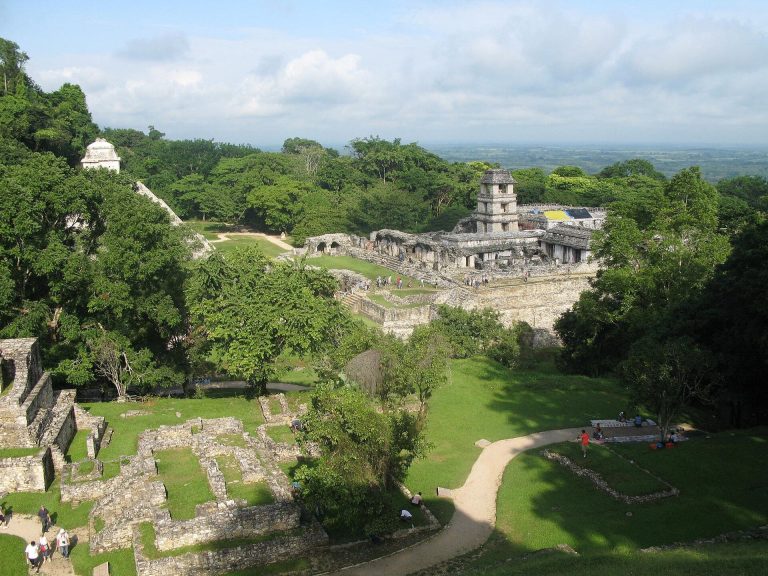
Toniná occupies a wooded natural rise in the northern Ocosingo Valley, on clay-rich ground approximately 71 to 75 metres above the surrounding plain. Its urban core stood on an ascending limestone ridge beside a seasonal tributary of the Jataté River. The principal center was an Acropolis formed by seven south-facing terraces and platforms, with temples and palaces above residential and agricultural areas that extended around the core and across the valley.
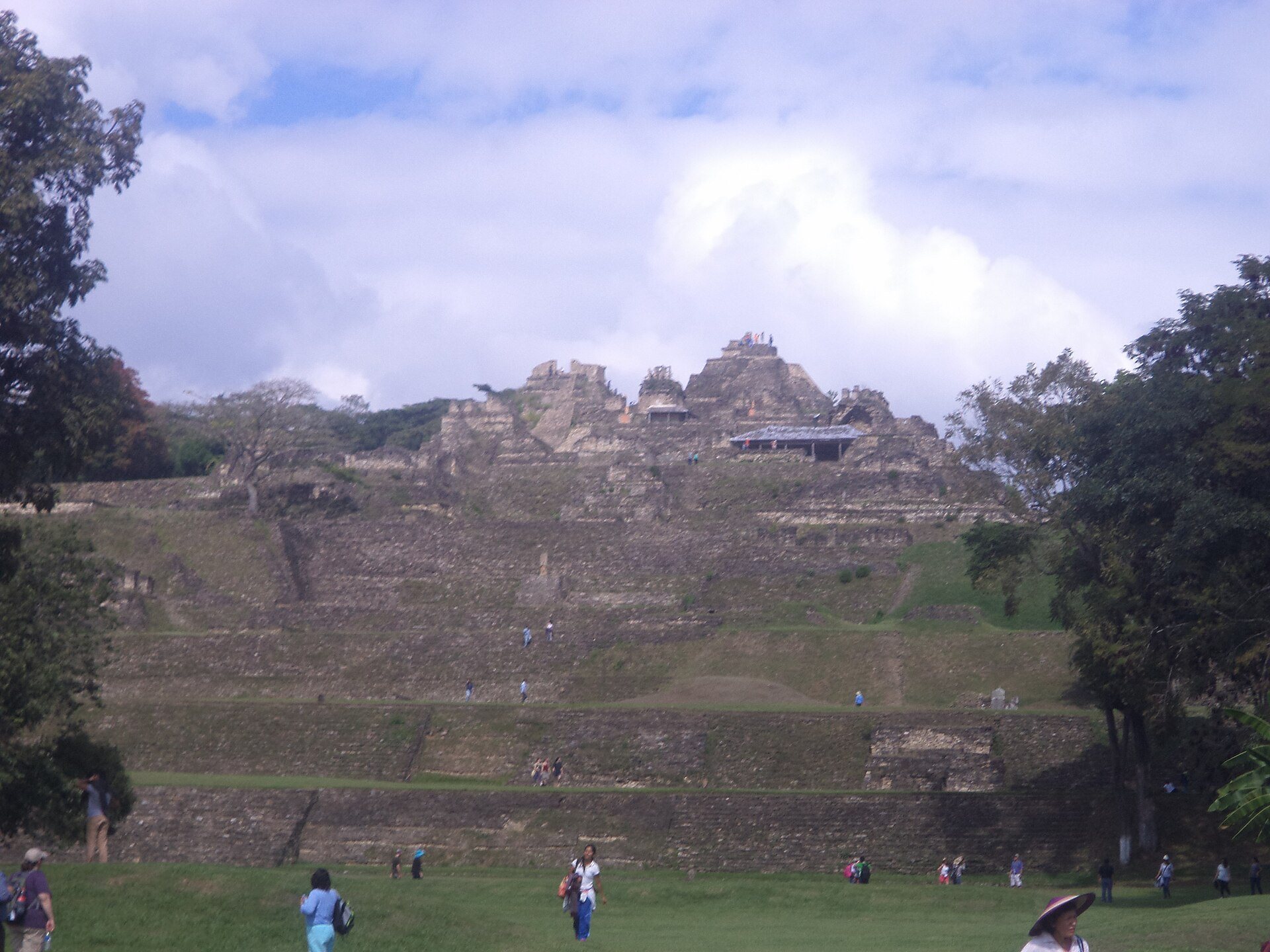
The Acropolis and its terraces
The terraces were made partly by cutting and coating natural slopes with stone to create stable pyramidal platforms. Stone, lime, alkaline-treated clay and ash, stucco, and mortar were used in construction. Repeated building placed temples, palaces, and stairways over earlier structures, producing a complex architectural labyrinth. Many buildings follow regular right-angle relationships.
The central stairway crosses all seven platforms and contains 260 steps. The Acropolis includes 13 temples, about 40 altars, and more than 50 additional stairways. At least 97 buildings have been identified in one inventory, while the wider site contains more than 100 carved monuments, two ballcourts, subterranean spaces, residences, and 38 identified tombs.
Palaces and upper temples
The second platform contains the Palace of the Underworld, entered through three step-vaulted arches on the eastern side of the terrace. Its lower level includes a labyrinthine entrance area and a dry well in the courtyard. The surviving upper portion is largely a raised foundation with remains of columns and an eastern wall.
The Palace of Frets, also called the Palace of the Friezes, extends across the third and fourth terraces. Its southern facade has four large stepped frets in a style associated with Teotihuacán, a major highland Mexican metropolis whose architecture and imagery influenced other Mesoamerican centers. An eastern stairway leads to a stucco-covered stone throne, and one room retains decoration showing feathered serpents, crossed bones, and geometric frets.
The seventh platform contains the Temple of the Prisoners and the Temple of the Smoking Mirror. The latter rises approximately 71 to 75 metres above the lower plaza and forms the highest point of the complex. It is among the tallest known Maya and pre-Hispanic pyramidal structures in the Americas. The neighboring Pyramid of War, also called the Pyramid of the Prisoners, is slightly lower, and its eastern side descends almost to the level of the main plaza.
Early temples and sacred imagery
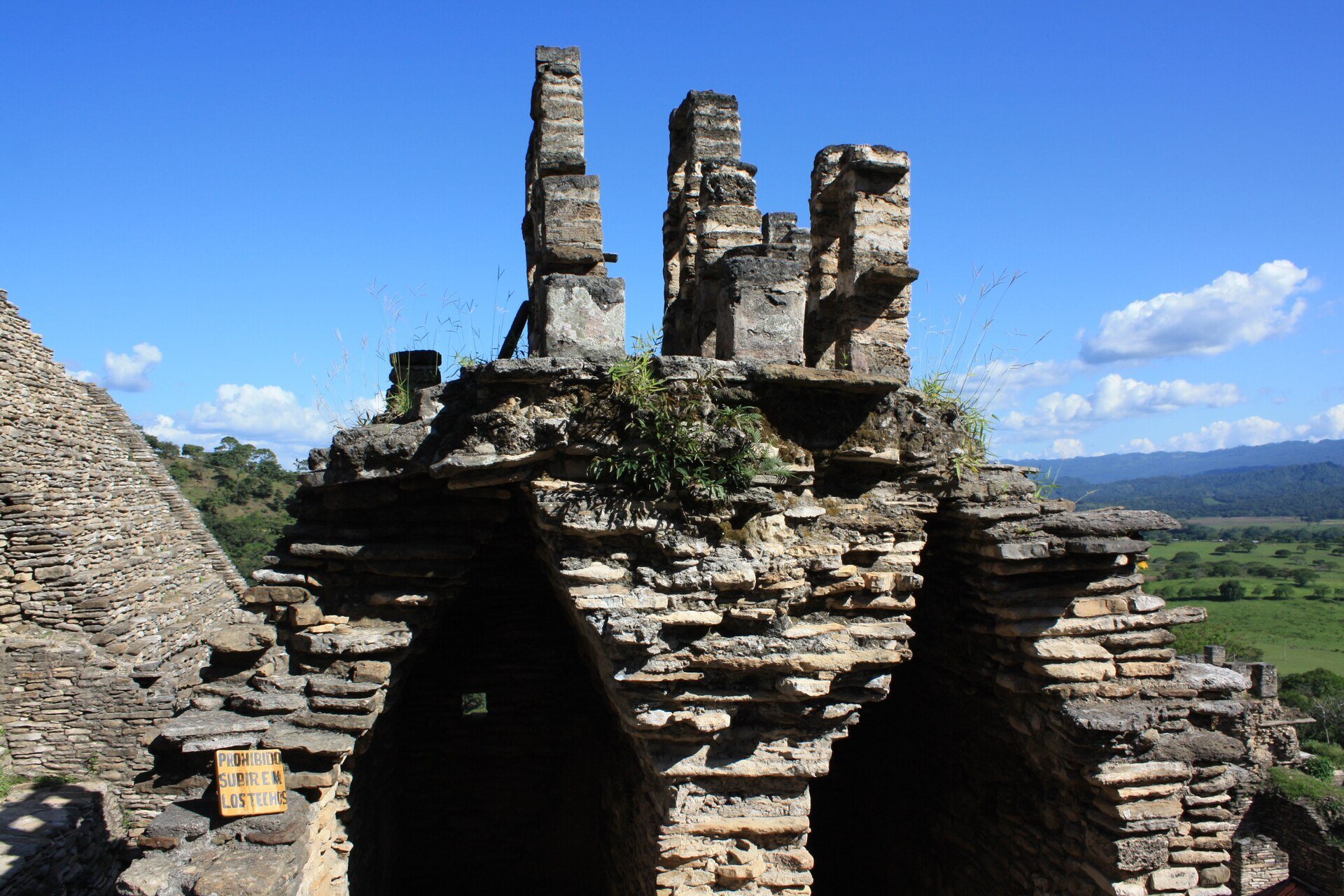
Building E5-5, an unnamed temple near the Temple of the Earth Monster, is considered one of the oldest structures in the complex. About half of its roof survives, including 27 low square columns and remnants of thin stone latticework. The Temple of the Earth Monster stands a few metres away and may form a compositional unit with it. Shaped like a monstrous head with small eyes and a large fanged mouth, it held a red stone sphere in its mouth. Its stucco decoration is poorly preserved.
Ballcourts and ritual remains
Ballcourt 1, the larger of Toniná’s two ballcourts, measures approximately 75 by 30 metres. Dedicated in AD 699, it originally had six sculptures of bound captives, including vassals of the Palenque ruler, serving as markers or associated court sculptures. The court was later remodeled by K’inich Tuun Chapat. Ballcourt 2 is smaller and lies on the northern side of the plaza at the foot of the Acropolis.
Urns containing cremated remains of Maya rulers were found in the Temple of the Sun. They held rubber, charcoal, and roots, materials associated with making the solid rubber balls used in the Mesoamerican ballgame. Their contents suggest that royal remains may have been incorporated into ritual ballgame practices.
Monuments and inscriptions
Toniná’s monuments are generally smaller than those at many other Maya sites, with most stelae under 2 metres high. Many were carved on multiple sides so that figures project as three-dimensional sculptures rather than flat reliefs. Hieroglyphic texts often run down the figure’s back or spine. Together, the monuments record royal ceremonies, warfare, captivity, ritual, and dynastic succession.
Royal portraits and dated monuments
Monument 3 survives in several fragments, five of which were recovered in Ocosingo and Toniná during the twentieth century and mostly reunited in the site museum. It portrays a ruler and records K’inich B’aaknal Chaak’s accession and the promotion of Aj Ch’aaj Naah to the priesthood. Monument 5 is a severely eroded, life-size human statue recovered from a school in Ocosingo and transferred to the museum.
Monument 7 is a yellow-sandstone stela base with well-preserved hieroglyphs on all four vertical sides. K’inich Ich’aak Chapat dedicated it in AD 728. Monument 8, dating to Ruler 2’s reign, commemorates the period ending of AD 682 and depicts three war captives. Monument 12 is a three-dimensional sculpture of Ruler 2 dated AD 672, while Monument 106, from AD 593, depicts Ruler 1 and is Toniná’s earliest securely dated monument.
Monument 101 carries the final known Maya Long Count date, marking the end of a period in AD 909. Monument 158 bears a late date of AD 904 and was erected during the reign of Ruler 10. Monument 146 depicts Ruler 8 holding a ceremonial bar ending in lunar deity heads. He wears a solar headdress and jade ornaments, and the inscription gives him the title “He of Many Captives,” dates the monument to May 17, 787, and names the sculptor Bahlam.
Captive imagery and political history
Monument 27 is a carved stair block depicting K’awiil Mo’, the Palenque military lord, as an elderly captive lying on his back with bound arms. Its placement presents the captive’s profile as an image to be repeatedly trodden upon. Monument 122 commemorates Ruler 4’s defeat of Palenque and capture of Kan Joy Chitam II in AD 711, showing the Palenque ruler nearly naked and bound.
Monument 178 depicts K’awiil Mo’ kneeling and bound after his capture by K’inich B’aaknal Chaak on October 4, 692. His military headdress and the attributes of his office remain part of the scene. Monument 151 shows a bound captive identified as an aj k’uhun, a high-ranking official with religious and political responsibilities. Monuments 152 and 154 depict other kneeling or bound captives, with inscriptions identifying their names, origins, or captors.
Monument 148 depicts a woman fighting an unidentified man. She holds a stone and the man’s hair, while a preserved hieroglyphic prefix identifies her as female. Monument 99 is an undated fragment showing a female captive, an uncommon subject in Maya art. Monument 69, recovered from the center of Ballcourt 1, records the death of Wak Chan K’ak’, a probable heir to the throne, in AD 775.
Reused monuments and ceremonial texts
Monument 28, originally carved between AD 615 and 668 as a portrait of K’inich Hix Chapat, was probably reused in the seventeenth century as the pedestal of a Christian baptismal font at San Jacinto de Polonia Church in Ocosingo. Monument 166, a partially destroyed portrait of Ruler 4 originally carved between AD 708 and 721, was probably reused in the same way. Both are now in the Regional Museum in Tuxtla Gutiérrez.
Monument 172 is a rectangular cubic panel showing an underworld ballgame between K’inich B’aaknal Chaak and Ruler 2. Its text dates the scene to October 28, 727 and relates it to the third creation of the universe and the defeat of the underworld lords by the Hero Twins, figures known from the K’iche’ Maya narrative called the Popol Vuh.
Monument 175 records a fire-entry ceremony carried out by K’inich Chapat at Ruler 1’s tomb on October 31, 799. It also records K’inich Chapat’s capture of Aj Chan Chih of Pomoy in AD 789 and depicts the captive making a gesture associated with fear. Monument 114, dedicated by Ruler 8 in AD 794, commemorates the death of an important noble who was apparently a relative or vassal of Tuun Chapat.
The Frieze of the Four Suns
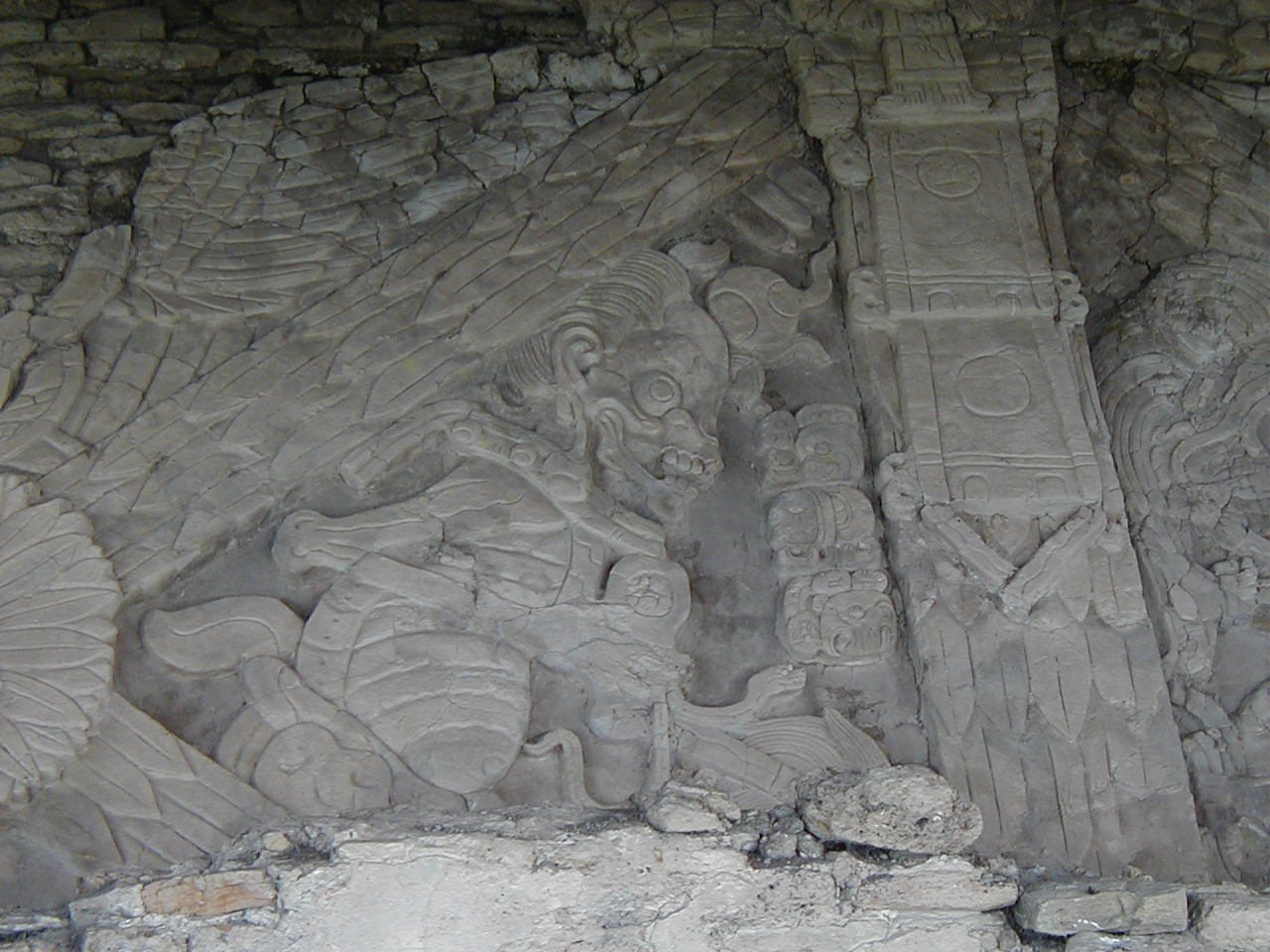
The Frieze of the Four Suns, also called the Frieze of the Four Eras or Frieze of the Dream Lords, is a stucco mural discovered in 1992 at the eastern end of the fifth terrace. It measures approximately 3.3 to 4 metres high and 16 metres long and is divided into four sections by feathered bands.
The composition includes supernatural beings, severed heads, spirit companions associated with Maya rulers and elites, skeletal figures, a decapitated head, a serpent, and a ball associated with a captive. Its scenes connect with the Popol Vuh and with the cyclical succession of powers in the underworld, earth, and sky. One section is almost completely destroyed. The mural was originally painted in red, blue, ochre, black, and white, and its style has strong parallels with the murals of Atetelco, a Teotihuacán compound known for its painted walls. The date and interpretation of the surviving composition remain partly uncertain.