Haemieupseong: A Joseon Walled Town and Military Center
Site at a Glance
- Rating
- 4.4
- Popularity
- Medium
- Country
- South Korea
- Primary era
- Medieval
- External website
- Open
- Eras represented
- Medieval
- Civilizations
- Joseon
- Site type
- Military
- Remains
- Fortified Town
On this page17 sections
History
Haemieupseong is a Joseon-period walled town in Seosan, South Korea, built by the Joseon dynasty on level ground between 1417 and 1421. The Joseon dynasty ruled Korea from 1392 to 1910. Created as a military response to Japanese pirate incursions, the fortress became a major defense and administrative center in the Chungcheong region and is now preserved as South Korea’s Historic Site No. 116.
Foundation as a military stronghold
Construction began in 1417 under King Taejong and was completed in 1421 during the reign of King Sejong. The Chungcheong-do Provincial Military Commander was stationed at the fortress, placing Haemieupseong within the region’s organized defense system. Its position on level ground distinguished it from many Korean fortifications built in mountainous settings.
The name Haemi dates from 1407, when Jeonghae-hyeon and Yeomi-hyeon were merged. After the Joseon military system was reorganized into the Jingwan system under King Sejo, a system that divided regions into local defense commands, Haemieupseong continued to serve as an important military base in Chungcheong. Yi Sun-sin, later known for his naval victories during the Imjin War, spent ten months there in 1579 as an officer attached to the Chungcheong-do Military Command.
From command center to county seat
In 1651, the military command moved to Cheongju, and the Haemi county government office was transferred into the fortress. A commander with both civil and military responsibilities was appointed, and the command was renamed the Hoseo Left Command. Hoseo was the historical name for much of the Chungcheong region. Haemieupseong, previously called Haemi Naesangseong, consequently became a regional administrative center as well as a military installation.
The command later shared responsibility for military affairs and public order across thirteen counties in northwestern Chungcheong. In 1791, Jeong Yak-yong, a leading scholar of the late-Joseon Silhak movement, was temporarily exiled to Haemi after being falsely accused of being a Catholic. Silhak was a school of practical learning that emphasized empirical study and administrative reform. King Jeongjo ended Jeong Yak-yong’s exile after ten days. The fortress also served as a backdrop to the Donghak Rebellion in 1864, a nineteenth-century peasant and religious uprising associated with opposition to social and political abuses.
Persecution, abolition, and restoration
Haemieupseong became closely associated with the persecution of Catholics in the late Joseon period. The military command was responsible for arresting and punishing local Catholic believers, and more than 1,000 Catholics are said to have been executed at the fortress. The persecution began with the Sinyu Persecution of 1801 and intensified during the Gihae Persecution of 1839, the Byeongin Persecution of 1866, and events following the 1866 French expedition and the 1868 grave-robbing incident. Haemieupseong is regarded as a Catholic martyrdom site.
In 1895, Haemi-hyeon became Haemi-gun during an administrative reorganization. In 1914, during Japanese colonial rule, Haemi County was incorporated into Seosan County and the walled town was abolished. Former administrative buildings were reused as a township office and a school. Cheongheojeong was converted into a Shinto shrine, while houses and other urban development increasingly occupied the enclosure.
Restoration began in the 1970s. Buildings erected inside the fortress were removed, and the former East Hall, guesthouse, inner quarters, and other facilities were reconstructed. Maintenance and restoration continued from the 2000s. The Haemieupseong Historical Experience Festival began in 2004. In 2014, Pope Francis attended the unveiling of a memorial to three Haemi martyrs and presided over the closing Mass of the Sixth Asian Youth Day at the Haemi Martyrdom Sanctuary memorial hall.
Remains
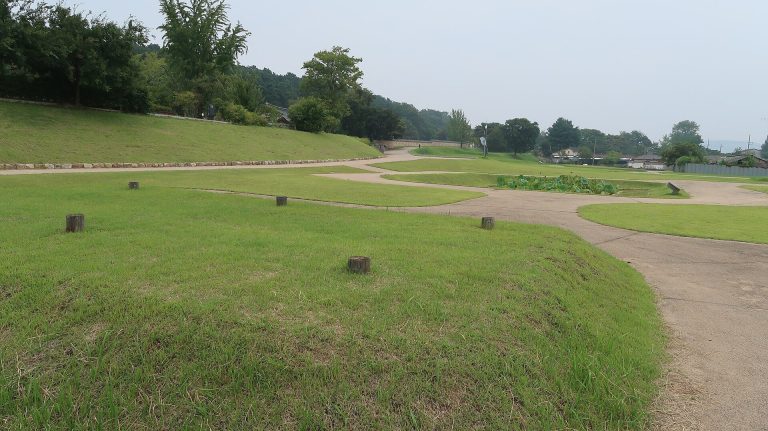
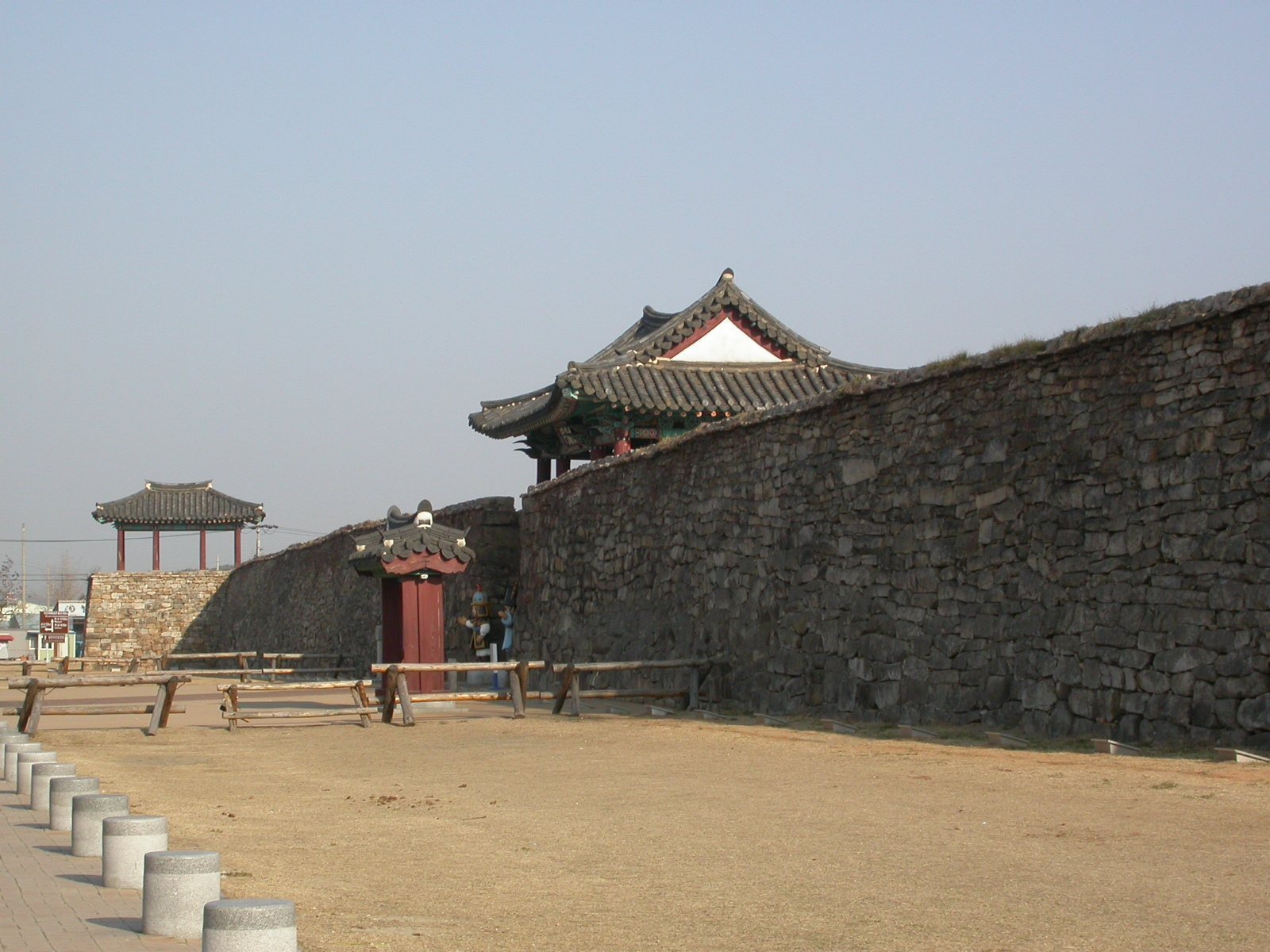
Haemieupseong occupies approximately 194,102 square metres on level ground. Its broadly oval plan resembles an egg. The enclosing walls extend for about 1,800 metres, rise to approximately 5 metres, and are bordered by a moat about 2 metres deep. Together, the walls and surviving or reconstructed buildings preserve the layout of a Joseon military and administrative settlement.
Walls and principal entrance
Fortification walls
The walls define the oval enclosure and formed the principal defensive boundary of the town. Their scale, together with the surrounding moat, reflects the fortress’s original military function. The walls remain part of the principal physical fabric of Haemieupseong alongside its gates, administrative halls, and other reconstructed structures.
Jinnammun
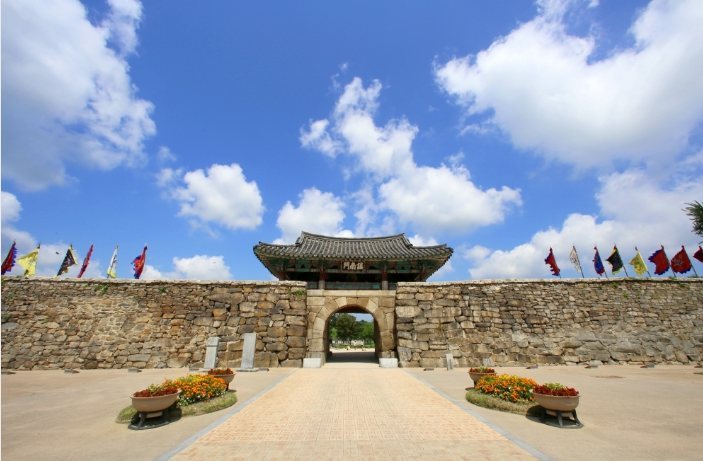
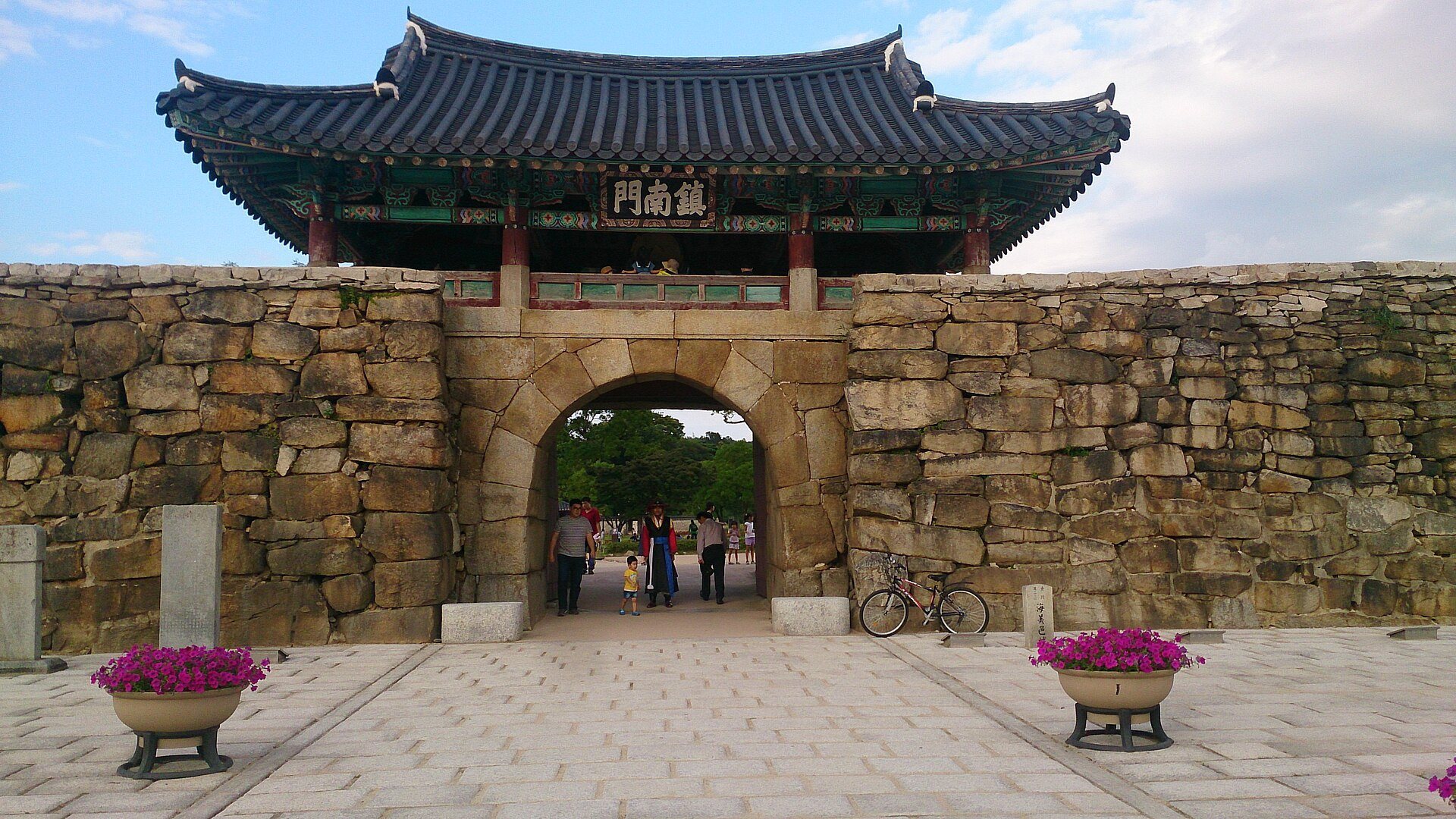
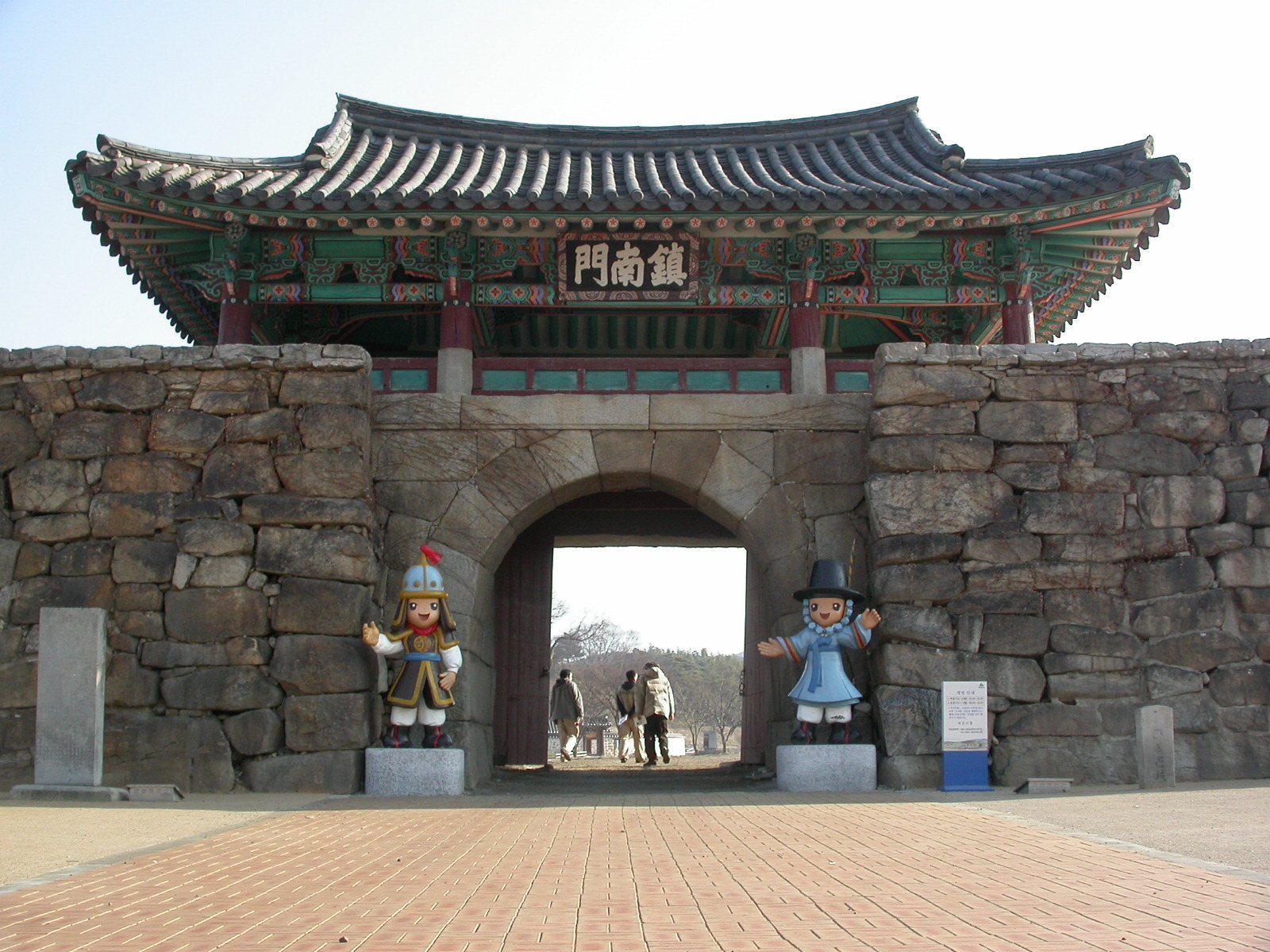
The main administrative gate is called Jinnammun because it stands at the exact center of the southern side. It served as the principal gate of the Hoseo Left Command office. The two-story gate tower has three bays across its front and two along its side. The lower level contains the passage through the gate, while the upper level forms a pavilion.
Administrative buildings
Guesthouse
The guesthouse accommodated visiting high officials, including provincial governors. Its reconstruction forms part of the surviving group of civic buildings inside the fortress.
East Hall and inner quarters
The East Hall served as the county administrative office. The inner quarters were the magistrate’s living quarters, linking the government functions of the walled town with the residence of its chief local official.
Archive room
The archive room stored books and documents and also provided living quarters for the county magistrate’s children. It represents the record-keeping and household functions that operated alongside the county administration.
Cheongheojeong
Cheongheojeong is a pavilion within the fortress that was used as a resting room. Its later conversion into a Shinto shrine during the Japanese colonial period forms part of the site’s modern physical history.
Prison and associated features
Prison
The prison was reconstructed from a 1935 publication concerning the Haemi martyrs. It represents the prison where numerous Catholics were confined for roughly a century beginning in 1790, preserving a physical setting associated with the fortress’s role in religious persecution.
Reconstructed folk house
East of the prison, a reconstructed folk house represents three Joseon-period residents: a wealthy farmer, a minor clerk, and a merchant. The structure adds domestic settings to the military, administrative, and religious remains within the enclosure.
Pagoda tree
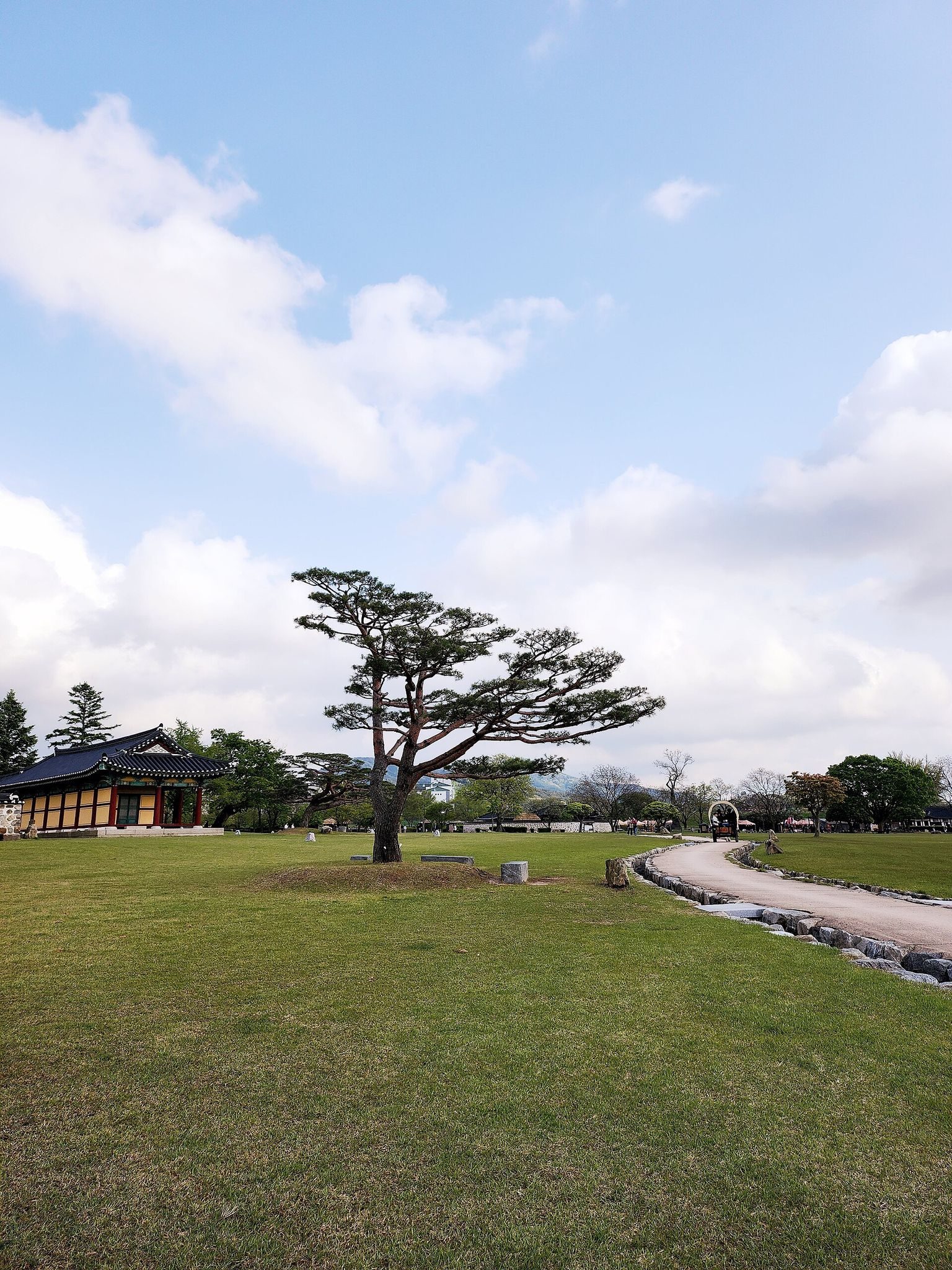
A pagoda tree, also known as a Chinese scholar tree, is estimated to be more than 300 years old. Tradition holds that Catholic believers were hung from the tree and tortured during the 1866 persecution. The tree remains associated with the fortress’s Catholic martyrdom history.