Gaochang: An Ancient Silk Road Oasis City in China
Site at a Glance
- Rating
- 4.6
- Popularity
- Very Low
- Country
- China
- Primary era
- Classical
- Eras represented
- Classical
- Civilizations
- Chinese
- Site type
- City
On this page13 sections
History
Gaochang is an ancient oasis city and archaeological settlement in the Turpan region of Xinjiang, China. Built as a Chinese military colony in the first century BCE, it became a major stopping point on the Silk Road, the network of trade and communication routes linking China with Central Asia, South Asia, the Middle East, and the Mediterranean. Its position in an irrigated desert oasis made it valuable to merchants, armies, and successive states.
Han frontier settlement
Before Han expansion, the Turpan region was associated with the Jushi, also called Cheshi, kingdom. During the Han period, military settlers and their families established agricultural colonies that supplied and defended the frontier. A military base known as Gaochang Wall or Gaochang Rampart was created, and the Han placed a military office there to administer the area.
Control shifted at times between the Han and the Xiongnu before Jushi rulers pledged allegiance to the Han. Later Han, Wei, and Western Jin administrations continued similar arrangements, although the area was sometimes attached to Dunhuang Commandery. A commandery was a major administrative division in Chinese states. In 327, under the Former Liang ruler Zhang Jun, Gaochang Commandery was established and divided into several counties. The region later passed under the Former Qin, Later Liang, Western Liang, and Northern Liang.
Formation of the Gaochang Kingdom
In the fifth century, Gaochang came under the control of remnants of the Northern Liang and then the Rouran Khaganate, an Inner Asian power. In 439, the Northern Liang rulers Juqu Wuhui and Juqu Anzhou established themselves at Gaochang. The Rouran conquered the region in 460, appointed Kan Bozhou as king, and created Gaochang as a separate vassal kingdom. This event is regarded as the beginning of the Gaochang Kingdom.
The kingdom was subsequently ruled by the Kan, Zhang, Ma, and Qu families. The Gaoche ruler Afuzhiluo killed King Kan Shougui and installed Zhang Mengming, a Han Chinese from Dunhuang, as a vassal king. Zhang was later killed during an uprising. Ma Ru succeeded him, but was overthrown and killed in 501.
The people of Gaochang then appointed Qu Jia of Jincheng in Gansu as king. His accession established the Qu dynasty, which ruled from 501 to 640. The kingdom was governed largely through Chinese political and administrative models by Han Chinese migrants and their descendants. Sogdians, Tocharians, and other western immigrants also lived in the region, while influential families such as the Zhang, Fan, Yin, Ma, Shi, and Xin families strengthened their positions through marriage alliances.
Administration, agriculture, and diplomacy
Qu Jia first submitted to the Rouran and later to the Gaoche. The Qu rulers subsequently became vassals of the Göktürks, a Turkic imperial power. Gaochang also maintained tributary and diplomatic relations with the Northern Wei, Western Wei, Northern Zhou, Sui, and Tang dynasties. In the early sixth century, Qu Jia requested Chinese books and teachers, and Chinese classics and Confucian learning were taught at the court.
Gaochang prospered through agriculture, irrigation, and commerce. Water management supported grain cultivation and could produce two harvests a year. The oasis also yielded fruit, silk, honey, salt, and wine. Horses and sheep were pastured in concealed mountain areas to protect them from raids. Taxes were paid in silver, while people unable to pay in money used linen cloth instead.
Turkic forces defeated four Gaochang cities in 590, prompting about 2,000 people to migrate to China. Under Qu Boya, Gaochang maintained relations with the Sui and with Turkic powers. Qu Boya visited the Sui court in 609, accompanied the emperor during the campaign against Goguryeo, received Sui titles, and married a Sui imperial princess.
Conquest by the Tang
Qu Wentai succeeded Qu Boya in 619. He initially maintained relations with the Tang court, which ruled China from 618 to 907, but later allied with the Western Turks as Tang influence expanded into the Tarim Basin. Gaochang blocked routes used by western states sending tribute to Tang China, planned an attack on the Tang-allied state of Yiwu, and attacked three cities of Karasahr in 638.
In 640, Tang Emperor Taizong sent an army commanded by General Hou Junji against Gaochang. Qu Wentai died after learning that the Tang army was approaching, and his son Qu Zhisheng succeeded him. After the capital fell, Qu Zhisheng surrendered. The kingdom’s three prefectures, five counties, and 22 cities were brought under Tang control.
The Tang transformed Gaochang into Xizhou, initially called Xichangzhou, and established the Anxi Protectorate there. This frontier administration supported Tang efforts to extend authority into the Tarim Basin. Chinese, Sogdian, and Tocharian inhabitants were included in the Tang administration, while Qu Zhisheng was sent to Chang’an and remained attached to the imperial court.
Uyghur rule and abandonment
Tang control weakened after the An Lushan Rebellion in 755, a major uprising that disrupted Tang rule. Tibetans first took the region, followed by Uyghurs in about 803. After the Uyghur Khaganate collapsed in 840, Uyghur refugees occupied the area and established the Kingdom of Qocho, also called Kara-Khoja, in 850. Qocho was a Uyghur Buddhist kingdom centered in the Turpan region.
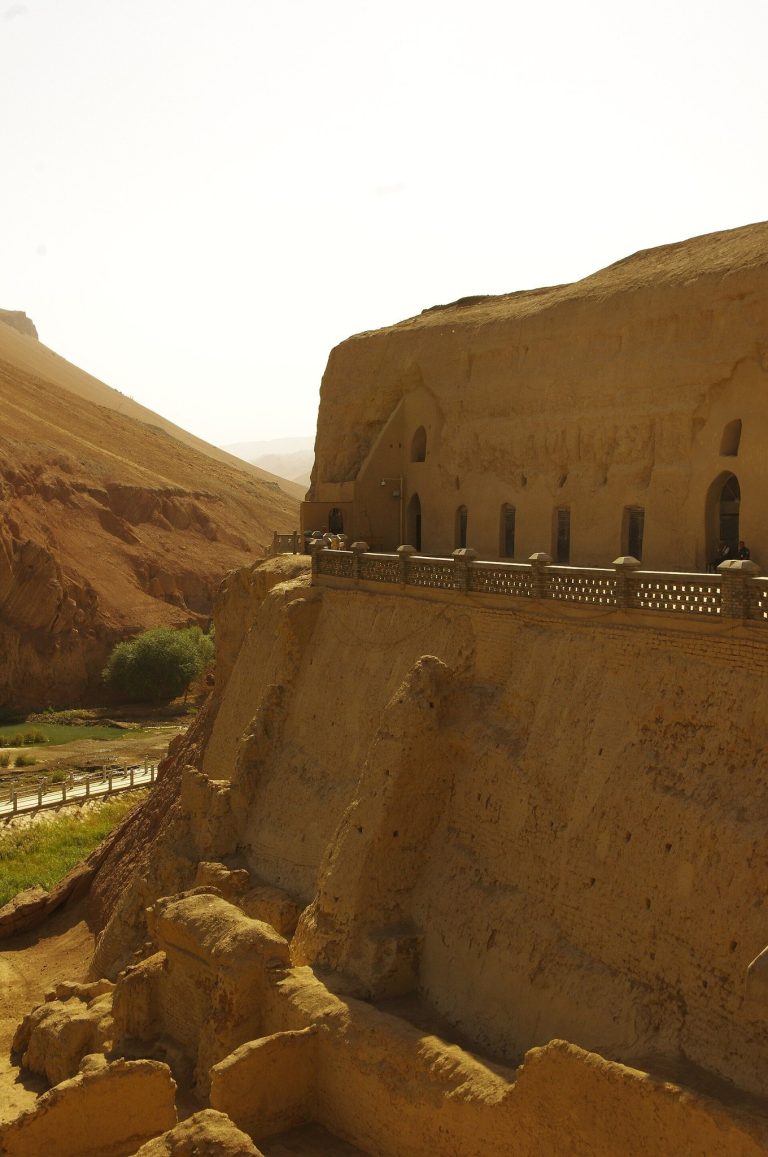
The Uyghur kingdom practiced Buddhism, Manichaeism, and Christianity. Manichaeism was a universal religion founded in late antiquity that spread across Central Asia. Buddhist rulers sponsored temple caves at the nearby Bezeklik Thousand Buddha Caves, where portraits of Uyghur donors survive. The rulers used the title idiqut, and spent winters at Qocho before moving seasonally to Bishbalik near present-day Urumchi.
Qocho later became a vassal of the Kara-Khitans, a Central Asian state also known as Western Liao. In 1209, its ruler Barchuq submitted to Genghis Khan, and the Uyghurs entered Mongol service. Their script was adapted for Mongolian, and Uyghur officials became important in the Mongol administration.
From 1275 to 1318, the Gaochang region was contested by the Chagatai Khanate and other Mongol powers. Repeated attacks forced the Uyghur ruling family to move eastward from Kara-Khoja to Kumul and later to Yongchang. The oasis was eventually abandoned as the desert advanced and the population declined. The city was deserted by the fourteenth century.
Religious history and archaeological rediscovery
Buddhism was one of Gaochang’s most important religions. Buddhist cave construction in the surrounding region probably began during the period of the Liang states, when Buddhism was spreading along the northern Silk Road. Gaochang also maintained worship of a heavenly deity, while Zoroastrianism, an Iranian religious tradition, and Daoism influenced the region at different times.
The Buddhist monk and pilgrim Xuanzang visited Gaochang in 629 or 630 while traveling toward India. Qu Wentai received him hospitably, and Xuanzang described more than 50 monasteries or temples within the city. When Xuanzang returned in 640, Gaochang had already been conquered, so he referred to it as the former land of Gaochang.
The ruins were first investigated in the early twentieth century by the German archaeologist Albert von Le Coq. In 2014, Gaochang was inscribed as part of the UNESCO World Heritage property Silk Roads: the Routes Network of Chang’an-Tianshan Corridor.
Remains
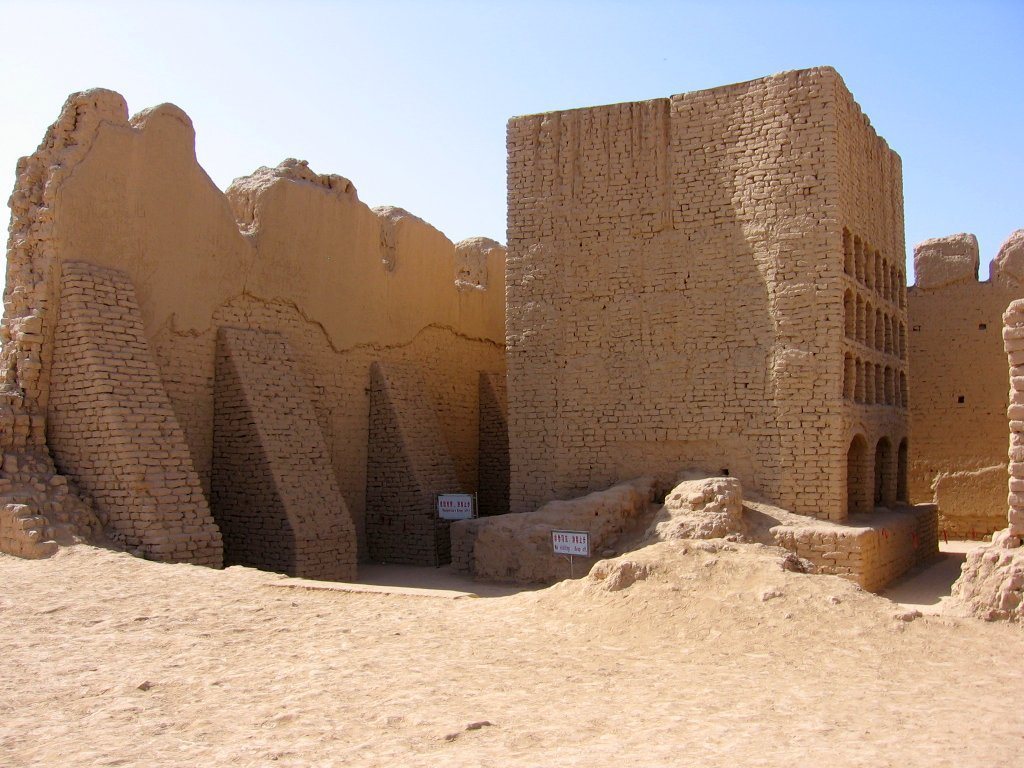
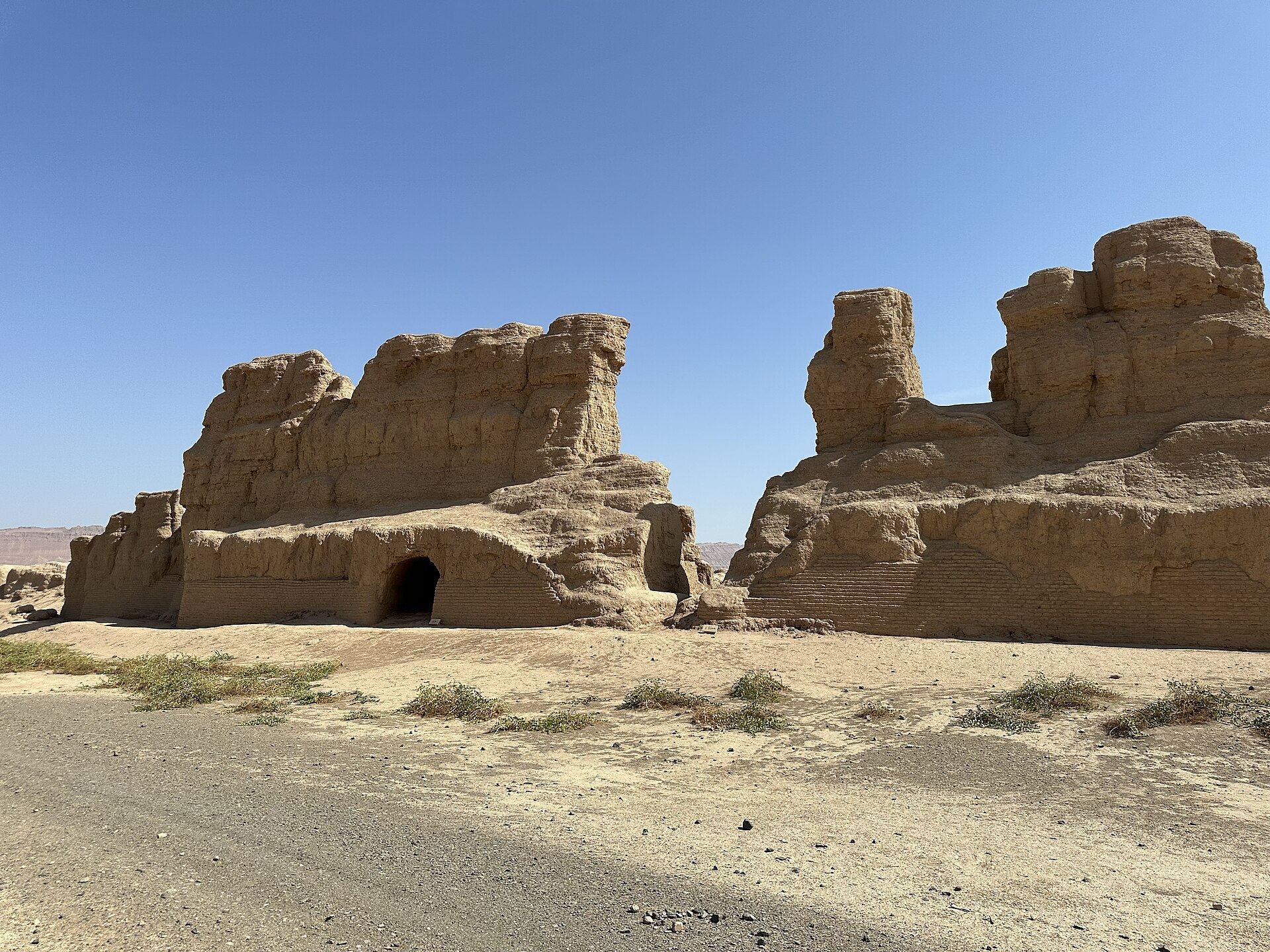
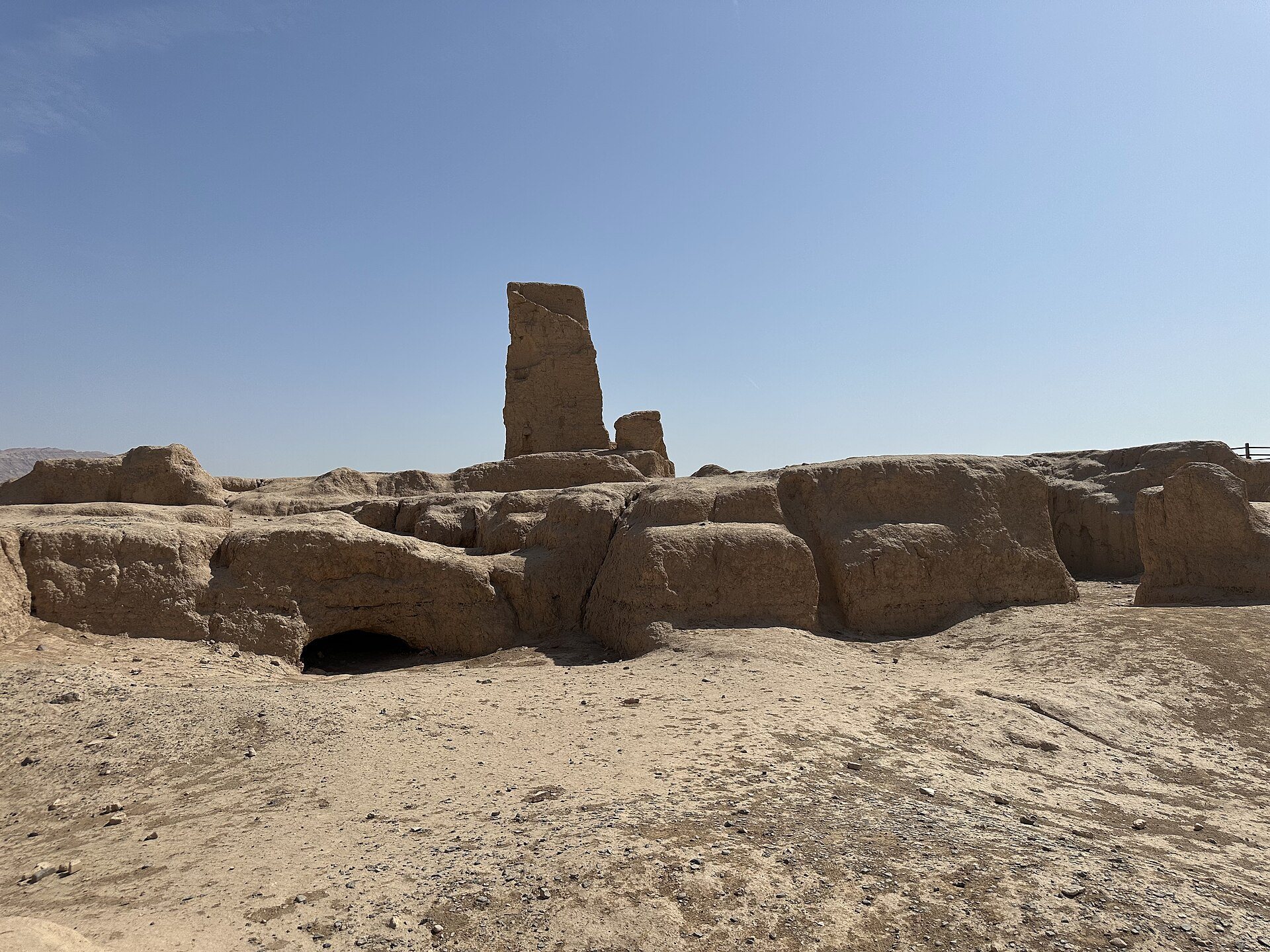
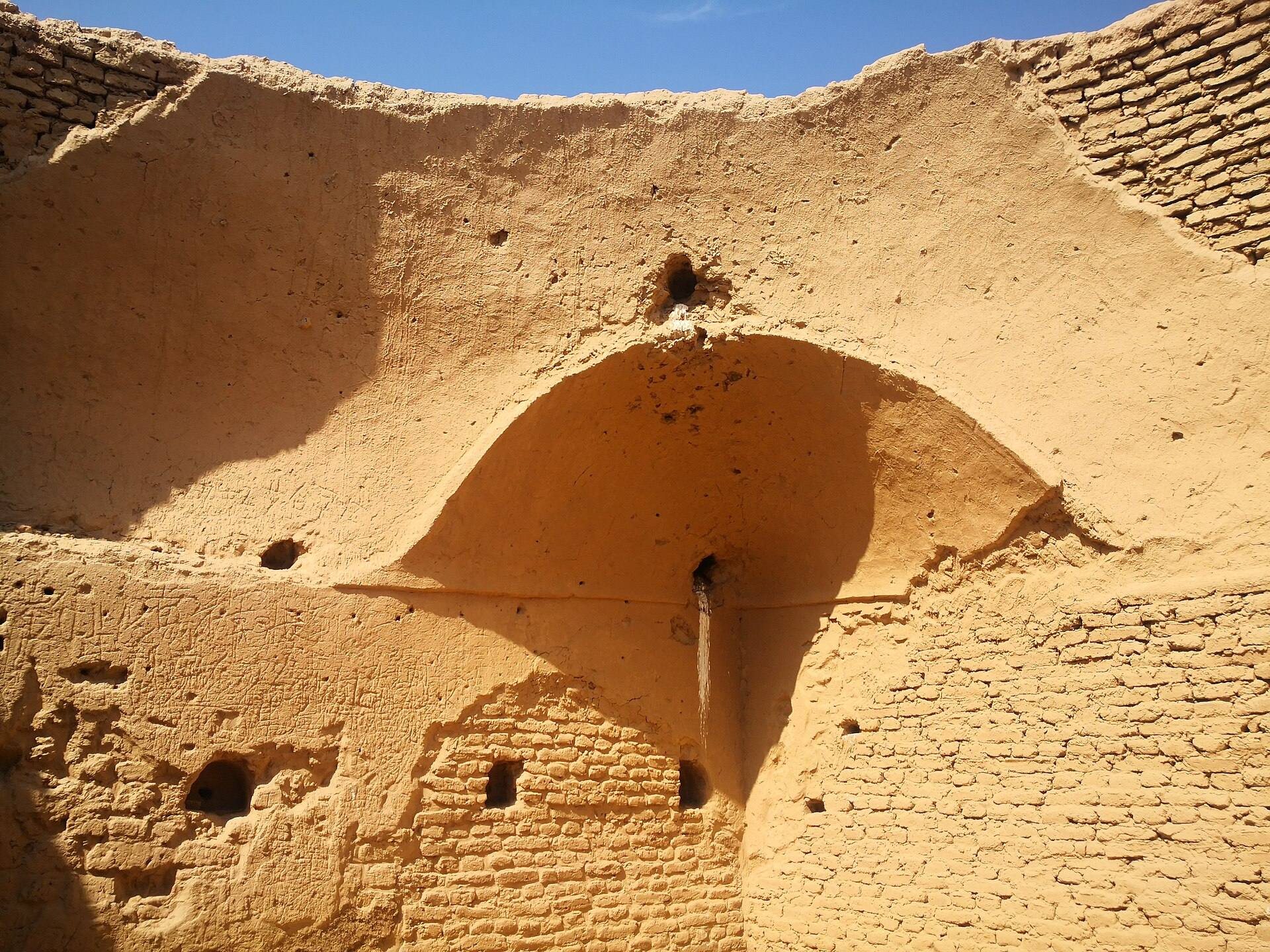
Gaochang’s ruins lie approximately 40 kilometers east of the modern Turpan urban area, within an irrigated oasis enclosed on much of its perimeter by mountains. Red Stone Mountain lies to the north, with the snow-bearing Tanhan Mountains farther beyond. The archaeological settlement covers the remains of an outer city, an inner city, and a palace city within a perimeter of approximately 5 kilometers. The surviving structures are heavily damaged, forming a largely barren ruin landscape.
Urban and administrative areas
The former city preserves the broad divisions of its urban plan, including the outer and inner zones and the palace area. Gaochang was a fortified city and administrative center, while the wider historical territory contained many other cities. Records describe 16 cities during the Northern Zhou period, 18 during the Sui period, and 21 or 22 under the Tang. Individual buildings within the main settlement generally survive in heavily ruined form.
Religious and associated archaeological remains
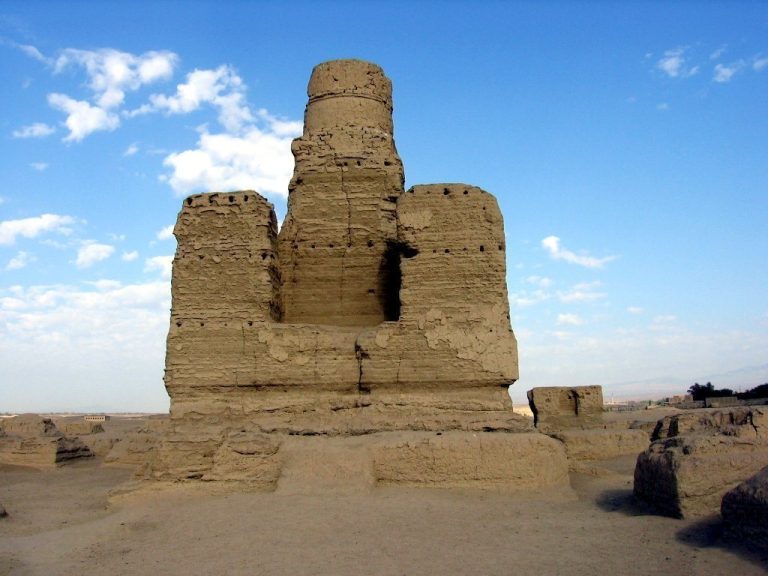
Buddhist stupa
A Buddhist stupa survives among the ruins. A stupa is a Buddhist monument associated with relics, veneration, or memorial worship. It forms part of the religious remains of the former city, whose wider region also included the Bezeklik Thousand Buddha Caves and their representations of Uyghur patrons.
Jiaohe City
Gaochang was associated with Jiaohe City, the former capital of the Gaochang Kingdom and an earlier residence of the Former Cheshi rulers. Jiaohe survives separately as the archaeological ruin known as the Jiaohe Ancient City.
Tiandi City
Tiandi City was formerly the seat of the Han military office responsible for the Turpan region. It accommodated a permanent garrison of about 10,000 soldiers, and its remains survive as a separate archaeological ruin.