Town Creek Indian Mound: A Pee Dee Ceremonial and Village Center in North Carolina
Site at a Glance
- Rating
- 4.6
- Popularity
- Low
- Country
- United States
- Primary era
- Medieval
- External website
- Open
- Eras represented
- Medieval
- Civilizations
- Unclassified
- Site type
- Religious
- Remains
- Sanctuary
On this page13 sections
History
Town Creek Indian Mound is a Pee Dee ceremonial, residential, religious, and trading center at the confluence of Town Creek and the Little River near Mt. Gilead, North Carolina, United States. Built by the Pee Dee, a regional South Appalachian Mississippian tradition, the site was occupied from about 1150 to 1400 CE. It is the only identified Pee Dee ceremonial mound and village center within North Carolina.
A Pee Dee regional center
The Pee Dee developed in the region by about 980 CE and flourished along the Pee Dee River region of North and South Carolina during the pre-Columbian period. Town Creek became a major center for habitation, religion, and trade. Local clans held discussions about trade there, while high-ranking people lived, died, and were buried at the settlement. Among the Pee Dee, political and religious authority could be held by the same elites.
Its position beside two waterways supported the site’s role as a gathering place. Town Creek hosted religious ceremonies and tribal feasts, including periodic clan gatherings called busks. These communal occasions involved cleaning and repairing the temple, houses, and grounds, settling debts and grievances, and carrying out purification rites. Participants fasted, bathed, took cathartic medicine intended to induce purging, and performed ritual scratching with garfish teeth.
The gathering ended with a poskito, or new-corn feast. Participants then carried embers from the sacred fire back to their villages. The shared fire is believed to have symbolized Pee Dee unity.
Abandonment and archaeological investigation
Town Creek was abandoned after about 1400 CE for reasons that remain unknown. Because the Pee Dee left no written record, archaeology provides the principal means of reconstructing the site’s history, settlement, ceremonies, and mortuary practices.
Local residents began amateur digging in 1927 after finding arrowheads and other relics. Scraping with a mule-drawn implement probably caused permanent damage, while also exposing artifacts, animal and human bones, and pottery fragments. Professional excavation began in 1937 through the Works Progress Administration, a federal employment program created during the Great Depression, in a project conducted by the University of North Carolina at Chapel Hill.
Joffre Coe of the university led the archaeological work from 1937 and directed research at Town Creek for more than 50 years. Regular scholarly excavation continued until 1987, followed by limited work. Keeping a long-term research base at the site enabled Coe and his team to pursue a consistent program of investigation without transferring the artifacts and research to a distant facility.
Preservation and historical recognition
In the 1930s, landowner L. D. Frutchey permitted exploratory work and later donated the mound and about one acre of surrounding land to North Carolina. The property was first called Frutchey State Park, was renamed Town Creek in the 1940s, and became the first North Carolina state historic site developed for visitor interpretation.
Town Creek is owned by the North Carolina Department of Natural and Cultural Resources and administered through the state historic-sites system. It was listed on the National Register of Historic Places and designated a National Historic Landmark on October 15, 1966. A National Historic Landmark is a United States designation for a place judged to possess exceptional historical significance. Town Creek is identified as the only National Historic Landmark in North Carolina commemorating American Indian culture. The site is also associated with the modern Pee Dee people, who are based in South Carolina, where the state has recognized four bands and one group.
Remains
Settlement layout and ceremonial buildings
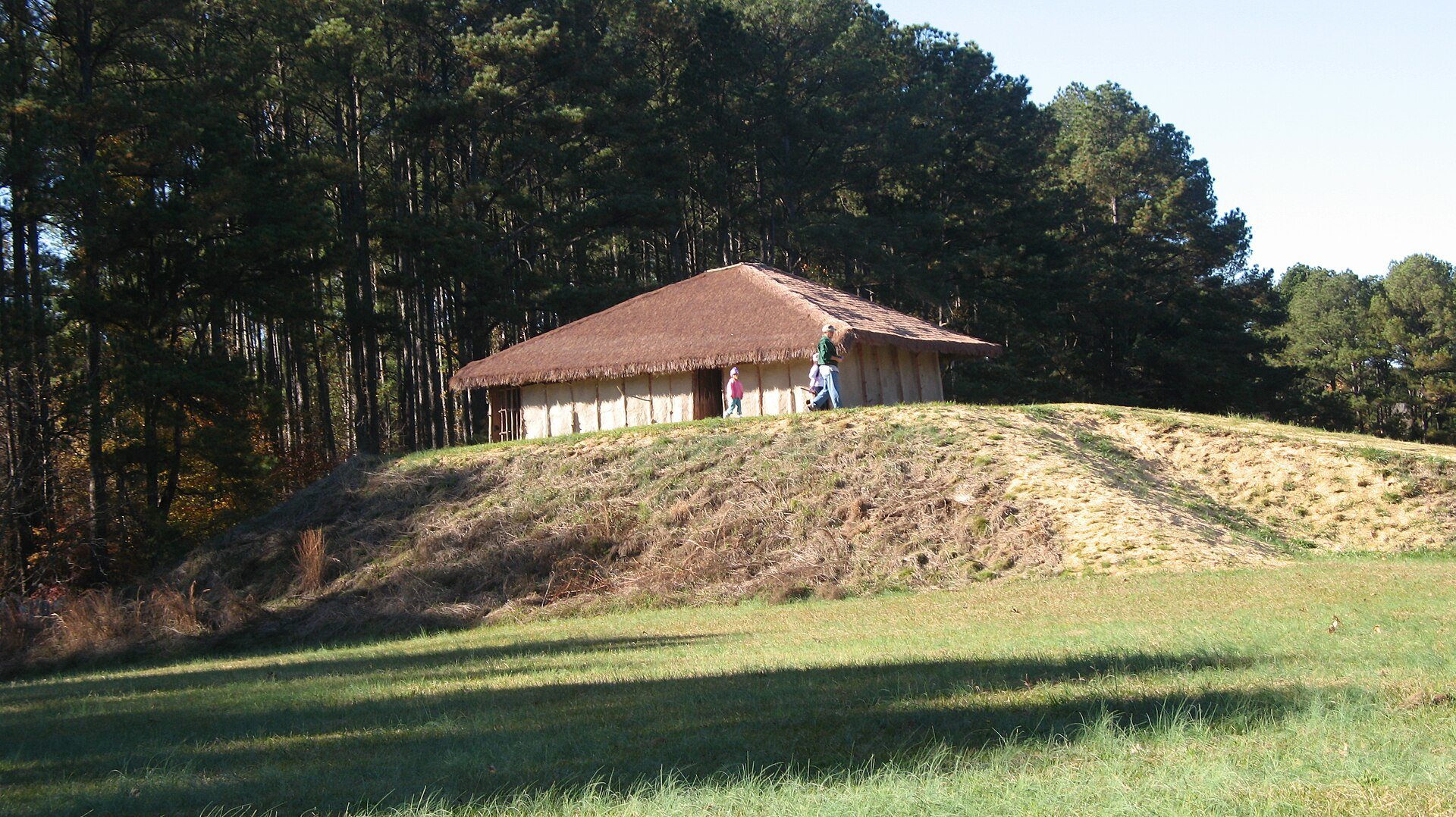
The site occupies a low bluff at the meeting of Town Creek and the Little River. Its main elements were a platform mound, a flat graded plaza, a surrounding village, and a wooden defensive palisade. A platform mound is a flat-topped earthen mound designed to support a building or ceremonial structure. The mound rises about 15 feet and was built over the remains of a rectangular earth lodge, a building whose walls and roof were supported and covered with earth.
Platform mound
Three successive structures occupied the mound. The earliest was a rectangular earth lodge that eventually collapsed through age. A temple was then built over it and later burned. A subsequent ceremonial structure was constructed in the same place, with an east-facing ramp descending toward the plaza. The state has restored the mound and reconstructed a ceremonial center that includes a temple on its summit.
Plaza and support buildings
The flat plaza in front of the mound served for ceremonies and public meetings. Buildings associated with this space included a burial house and a mortuary house, a structure connected with the handling or commemoration of the dead. The burial house is believed to have been important to a particular clan. A minor temple and a mortuary have also been reconstructed on the property.
Defensive enclosure
Palisade and entrances
The mound, village homes, burial house, and mortuary house were enclosed by a protective wooden palisade. A palisade is a defensive barrier made chiefly from wooden stakes or posts. Archaeological evidence shows that the enclosure was built and destroyed at least five times. The remains of two gates and guard towers were found at the northern and southern ends of the settlement.
Burials and archaeological evidence
Burial practices
Excavation revealed 563 burials believed to belong to the Pee Dee. Some graves were simple, with bodies placed casually. Other individuals were buried fully extended or may have been reburied as bundles of bones. Infants and young children were tightly wrapped in deerskins and placed in large pottery vessels used as burial urns.
Material remains
Animal and human bones, pottery fragments, artifacts, burial vaults, and palisade remains preserve evidence of the settlement’s former habitation, ceremonial activity, and mortuary practices. Together with the mound, plaza, reconstructed buildings, and outdoor monuments, these remains present the archaeological history of Town Creek and the cultural history of the Pee Dee.