Kul-e Farah: An Elamite Open-Air Sanctuary in Iran
Site at a Glance
- Rating
- 4.5
- Popularity
- Low
- Country
- Iran
- Primary era
- Iron Age
- Eras represented
- Iron Age
- Civilizations
- Elamite
- Site type
- Religious
- Remains
- Sanctuary
On this page12 sections
History
Kul-e Farah is an Elamite open-air sanctuary near Izeh in Khuzestan Province, Iran, created during the Neo-Elamite period between the ninth and sixth centuries BC. Set at about 800 metres above sea level in a gorge beside a seasonal stream, it belonged to the ancient Elamite political centre of Aiapir. Its six rock reliefs preserve evidence for religious practice, political authority, military organization, music, and communal ritual before and during the rise of the Achaemenid Empire.
Aiapir and the Neo-Elamite sanctuary
The reliefs were carved over several centuries, although the date of each individual panel remains debated. Their scenes are associated with the worship of older Elamite deities and with an idealized, socially ordered community gathered in sacred space. The natural setting was also part of the sanctuary’s character. The gorge, watercourse, and surrounding mountains formed the landscape in which ritual images and movement were experienced.
Kul-e Farah I names Tirutir, an Elamite deity whose identity is not otherwise securely established in surviving Elamite evidence. The same inscription identifies Hanni as the ruler or chief of Aiapir and names him as the son of Tahhi. Hanni was subordinate to the Elamite king Shutur-Nahhunte. The relief and its inscription connect local authority, military activity, religious devotion, and the protection of the carved monument.
The scenes present processions, animal sacrifice, music, worship, banquets, and the carrying of divine or royal images. Differences in figure size, dress, gesture, position, and activity express a hierarchy among rulers, officials, attendants, musicians, worshippers, and other participants. Earlier interpretations associated the figures with Iranian-speaking nomadic pastoralists, but an agro-pastoral economy, shifting political structures, and regional alliances within the Elamite kingdom now provide a more plausible context.
Influence and archaeological study
The reliefs occupy an important place in the history of Elamite and later Persian art. Their processions, banquet scenes, royal imagery, and ordered compositions have been regarded as precedents for features that later appeared in Achaemenid sculpture, including the reliefs at Persepolis, one of the dynasty’s major ceremonial centres.
H. C. Rawlinson made the earliest recorded reference to the reliefs in 1836. A. H. Layard examined them in 1846 and prepared a preliminary account of their cuneiform inscriptions, a writing system formed from wedge-shaped signs. Members of the French archaeological mission in Persia later studied selected panels, including Gustave Jéquier, Jean-Vincent Scheil, and J. de Morgan. A Belgian mission directed by L. Vanden Berghe began more systematic documentation in 1963, and Eric De Waele carried out fieldwork from 1970 to 1975. Later research included studies by W. Henkelman and J. Álvarez-Mon.
The sanctuary has suffered damage, inadequate monitoring, and allegations of deliberate destruction. After nearby inhabitants relocated following a conflict in the 1960s, the local guardian and guide Abdolrahim Asadpur protected and interpreted the site for many years. He died in October 2021. Iran registered the rock inscriptions nationally under number 133 in 1310 of the Solar Hijri calendar, and the wider Kul-e Farah archaeological complex was registered under number 2597 in 1999. In 2024, the Ayapir cultural-heritage base promised a second phase of site organization. The ancient mounds of Parchestan and Chogakreh and the Miangaran wetland are also part of the wider archaeological landscape whose excavation and protection affect the interpretation of Kul-e Farah.
Remains
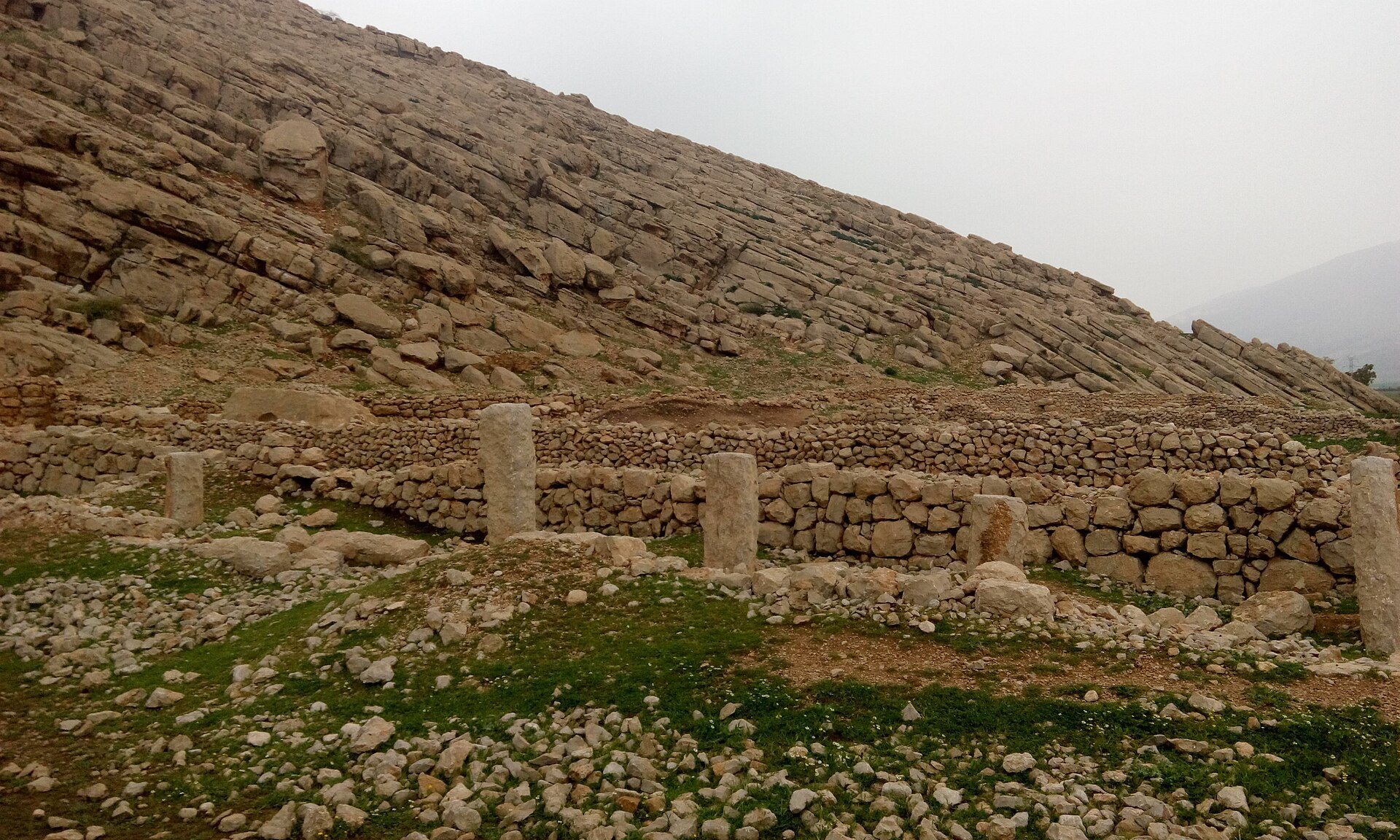
The sanctuary occupies a small gorge on the eastern side of the Izeh valley, beside a seasonal creek bed and near Kahbad-e Do. Five principal reliefs are concentrated within the gorge, while Kul-e Farah VI lies about 300 metres away. The images were carved on irregular natural rock surfaces, sometimes across several faces of one boulder. Graves, a water channel, building remains, and a watchpoint accompany the reliefs and inscriptions, supporting the interpretation of the site as a former religious complex.
Setting and carving technique
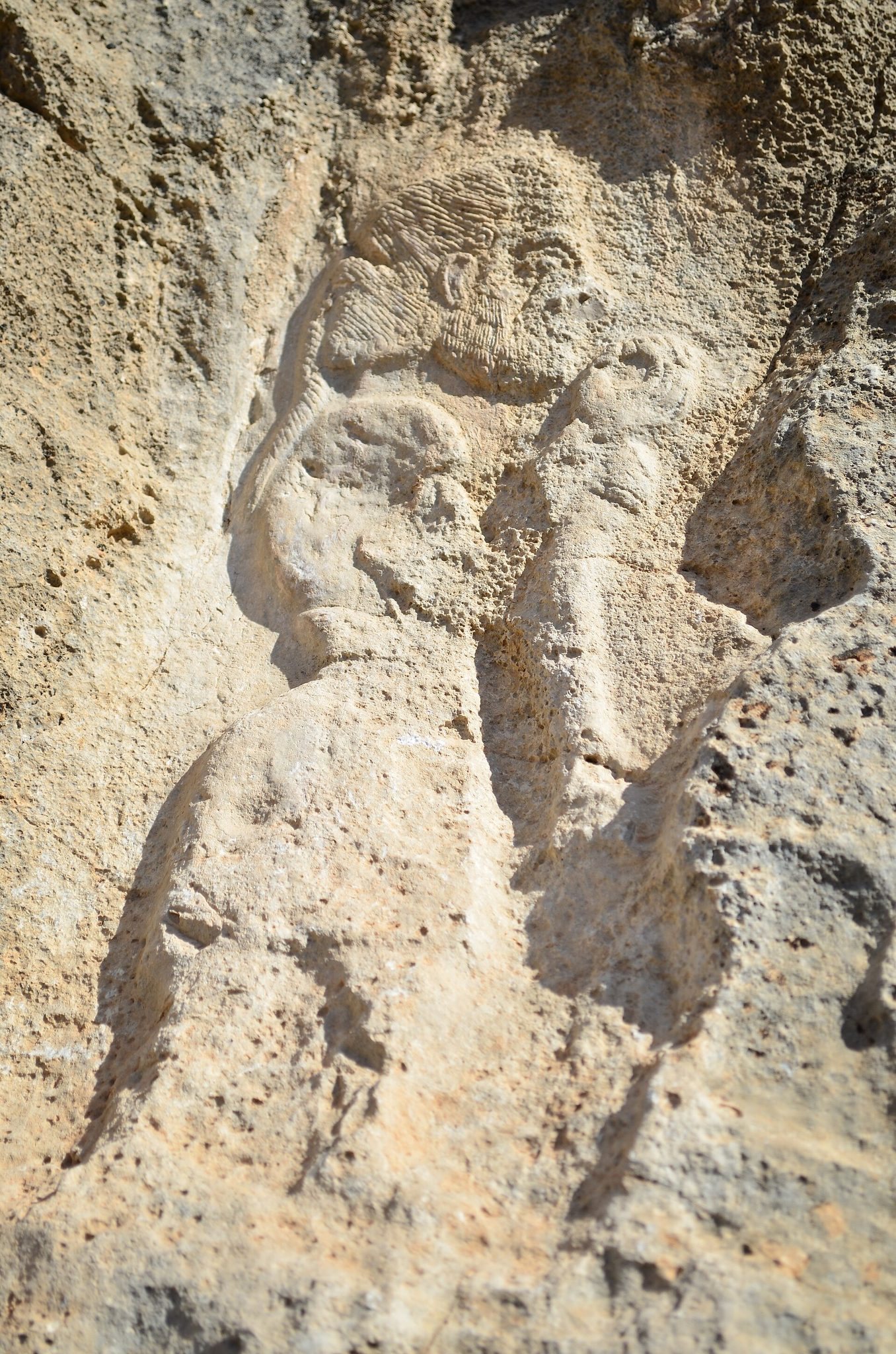
The reliefs were probably produced by first cutting a flat panel into the rock, then carving the figures in low relief, a shallow form of carving that leaves the images projecting only slightly from the surface. Plaster and a hard bitumen-like modelling material were applied before details were incised with a sharp tool and the completed surface was painted. Traces of plaster, incision, and possible pigment survive on parts of Kul-e Farah IV. The placement of the panels beside the seasonal watercourse and their use of the surrounding rock faces joined the imagery to the natural landscape and to ritual movement.
The principal rock reliefs
Kul-e Farah I
Measuring about 1.35 metres high and 1.68 metres wide, Kul-e Farah I is carved on a rock face above the surrounding slope. Hanni stands with clasped hands and is accompanied by two court officials, including Shutruru, the Master of the Palace and an arms bearer. Three musicians play a horizontal harp, a vertical harp, and a square drum. Nearby are a goat herder, three slaughtered rams, two men killing a zebu, and a priest beside a fire altar.
A long Elamite cuneiform inscription identifies Hanni as Tahhi’s son, describes his devotion and military activity, dedicates the complex to Tirutir, and threatens anyone who damages the relief. The text gives the panel a direct connection with the sanctuary’s patron, its deity, and the protection of its carved surface.
Kul-e Farah II
Kul-e Farah II measures about 2.40 metres high and 3.55 metres wide. It occupies the southwestern face of a triangular or irregular boulder near Kul-e Farah III and IV. Four worshippers with clasped hands appear in a small rectangular panel beside a large male figure who raises an extended index finger. A separate sacrificial scene shows a standing nude figure, another nude figure bending over a zebu, and six smaller sheep with rounded horns.
Kul-e Farah III
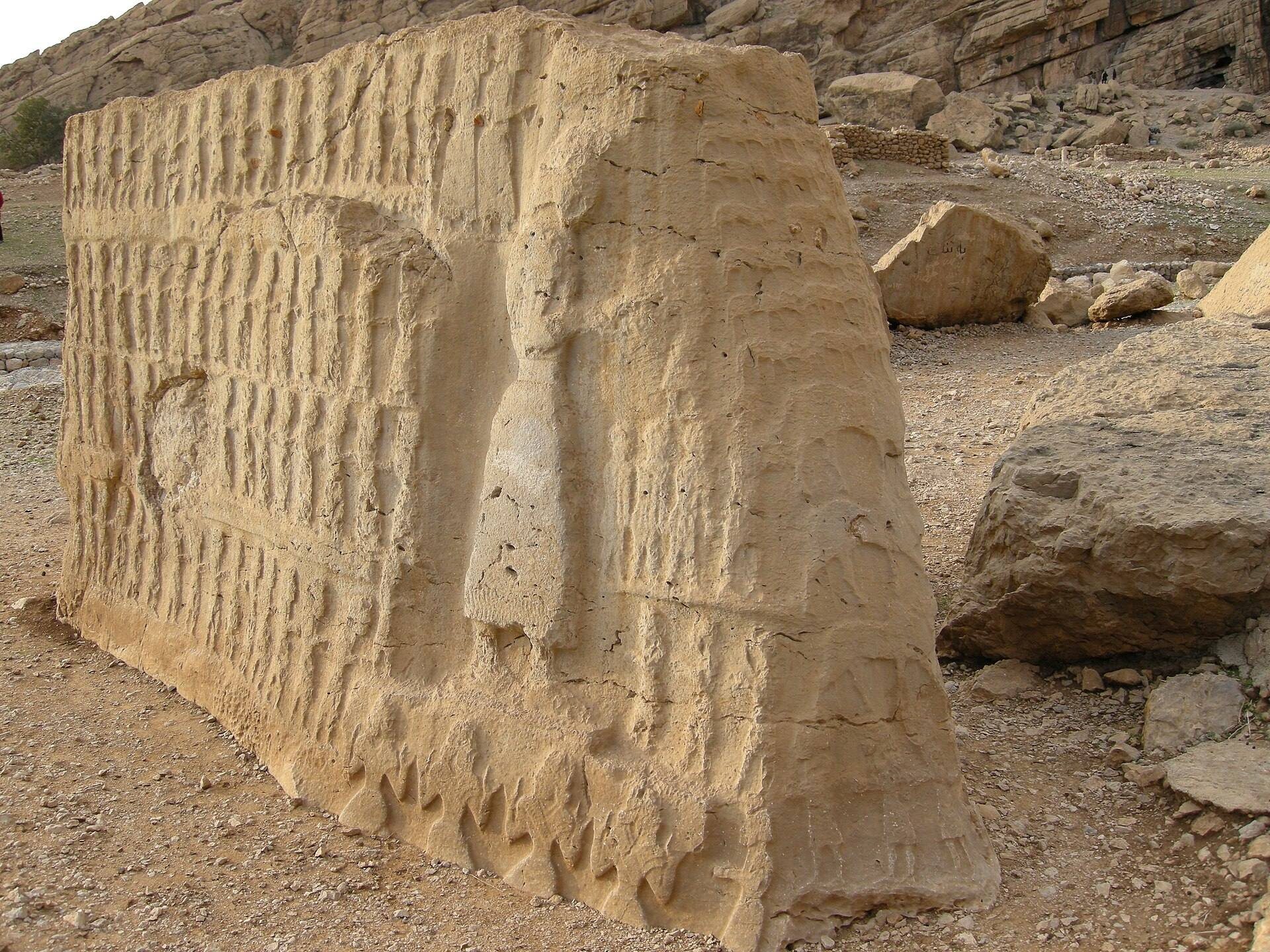
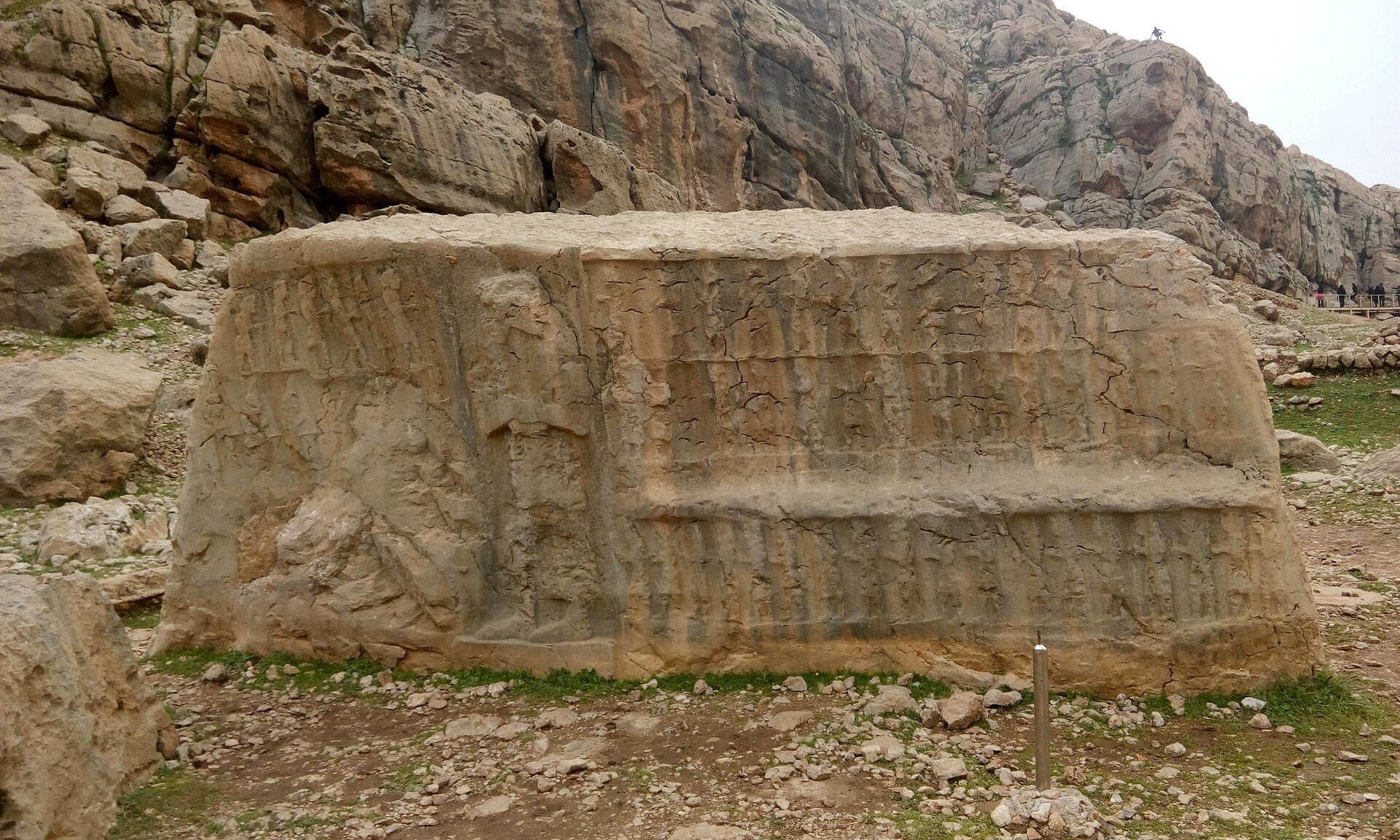
Kul-e Farah III extends across the faces of a large boulder about 1.9 to 4 metres high and 16 metres wide. It presents a procession of at least 200 people and domestic animals. Four elite men in caps and long fringed garments kneel while carrying a large male figure on a platform, a raised support used for a ruler or deity. Other large figures face groups of eighteen rams and three zebus.
The composition also includes nude figures, people in long and short garments, three harp players, a vessel bearer, and numerous worshippers arranged in registers, or horizontal bands, with clasped hands. Other groups contain 67, 49, 45, and 9 human figures. Seven small naked figures may represent war captives. The different scales and orderly groupings create a complex visual arrangement of ritual participants, animals, elites, and subordinate figures.
Kul-e Farah IV
Kul-e Farah IV is carved across a broad vertical cliff surface about 6 metres high and 17.70 metres wide. It depicts a banquet involving approximately 140 participants. A seated ruler occupies a high-backed throne between two tables, one supporting vessels and the other possibly intended for food. Additional vessels and two tall, narrow cups appear in lower registers.
Attendants, an arms bearer, archers, six harp players, and more than one hundred participants with long braided hair and short garments fill the scene. Many raise food to their mouths, while the figures stand in orderly rows on either side of an approximately central axis. One well-preserved figure appears in profile with a short composite bow, broad shoulders, a narrow waist, and a short-sleeved garment with a short skirt. Varying carving depths give the body a naturalistic form, although erosion has removed much of the relief’s original volume.
Kul-e Farah V
Kul-e Farah V measures about 2.40 metres high and 1.85 metres wide. It is carved near Kul-e Farah IV on the vertical face of a rocky outcrop on the left bank of the seasonal stream. A large male figure gestures toward an animal sacrifice, while four worshippers stand behind him with clasped hands. A fire altar appears beneath the sacrificial scene.
Kul-e Farah VI
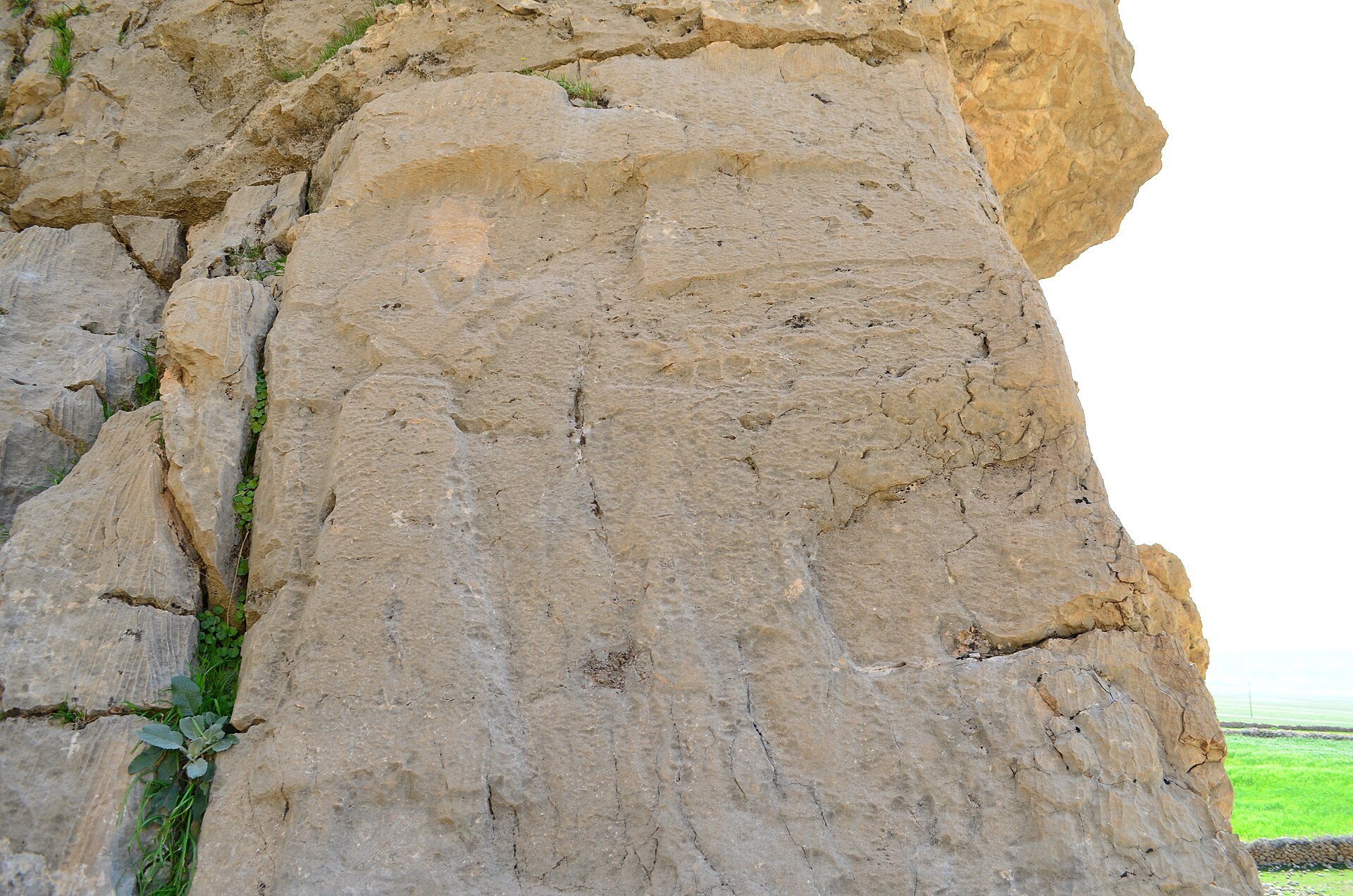
Kul-e Farah VI is carved on the northwestern face of a boulder outside the main gorge. It measures about 3.7 metres high and 2.8 metres wide. A large figure in a long fringed garment stands on a pedestal atop a platform carried by four kneeling bearers. Nine worshippers stand behind the figure in three horizontal registers, with another worshipper below.
The bearers wear long fringed garments and close-fitting round caps, and have short beards and gathered hair. An arms bearer carries or appears to carry a bow, dagger, quiver, and long sword, together with an uncertain U-shaped object. The arrangement reinforces the relief’s association between elevated authority, ritual attendance, and military equipment.