Moghalmari: A Buddhist Monastic Excavation Site in West Bengal
Site at a Glance
- Rating
- 4.4
- Popularity
- Low
- Country
- India
- Primary era
- Medieval
- Eras represented
- Medieval
- Civilizations
- Unclassified
- Site type
- Religious
- Remains
- Monastery
On this page7 sections
History
Moghalmari is a village and archaeological excavation site in Dantan I, Paschim Medinipur district, West Bengal, India, where Buddhist communities established a monastery between the sixth and twelfth centuries. The excavated remains represent several construction phases, although their precise number remains uncertain. The site is owned by the Archaeological Survey of India.
Excavation and Buddhist remains
Archaeological work began in 2002–03 under Ashoka Datta, a professor of archaeology at the University of Calcutta. The first detailed excavation phase started in 2003, when two areas, MGM1 and MGM2, were selected for investigation. Work expanded in 2006–07 with more extensive excavation at MGM1 and the newly selected MGM3. Further discoveries in 2012 included architectural and religious remains, while a State Archaeological Directorate campaign in November 2013 recovered several artifacts and six tablets.
The excavations established the presence of Buddhist monastic establishments in the area. Their existence has also been associated with the records of Fa Hien and Hiuen Tsang, Chinese Buddhist pilgrims and travelers who described Buddhist institutions in India. A member of the excavation team, Rajat Sanyal, connected the central temple with Vajrayana Buddhism, a developed form of Mahayana Buddhism associated with esoteric practices and a wider range of Buddhist and related deities. The interpretation draws partly on figures of Jambala and Saraswati incorporated into the architectural decoration.
The name and the Battle of Tukaroi
Moghalmari, also known as Mogolmari, is traditionally understood as meaning “the killing of Mughals.” Historical gazetteers associate the name with the Battle of Tukaroi in 1575, when Mughal forces commanded by Munim Khan and Raja Todar Mal fought the Bengal Sultanate forces of Daud Khan Karrani. The locality is linked in this tradition with the reported slaughter of many Mughal soldiers.
Remains
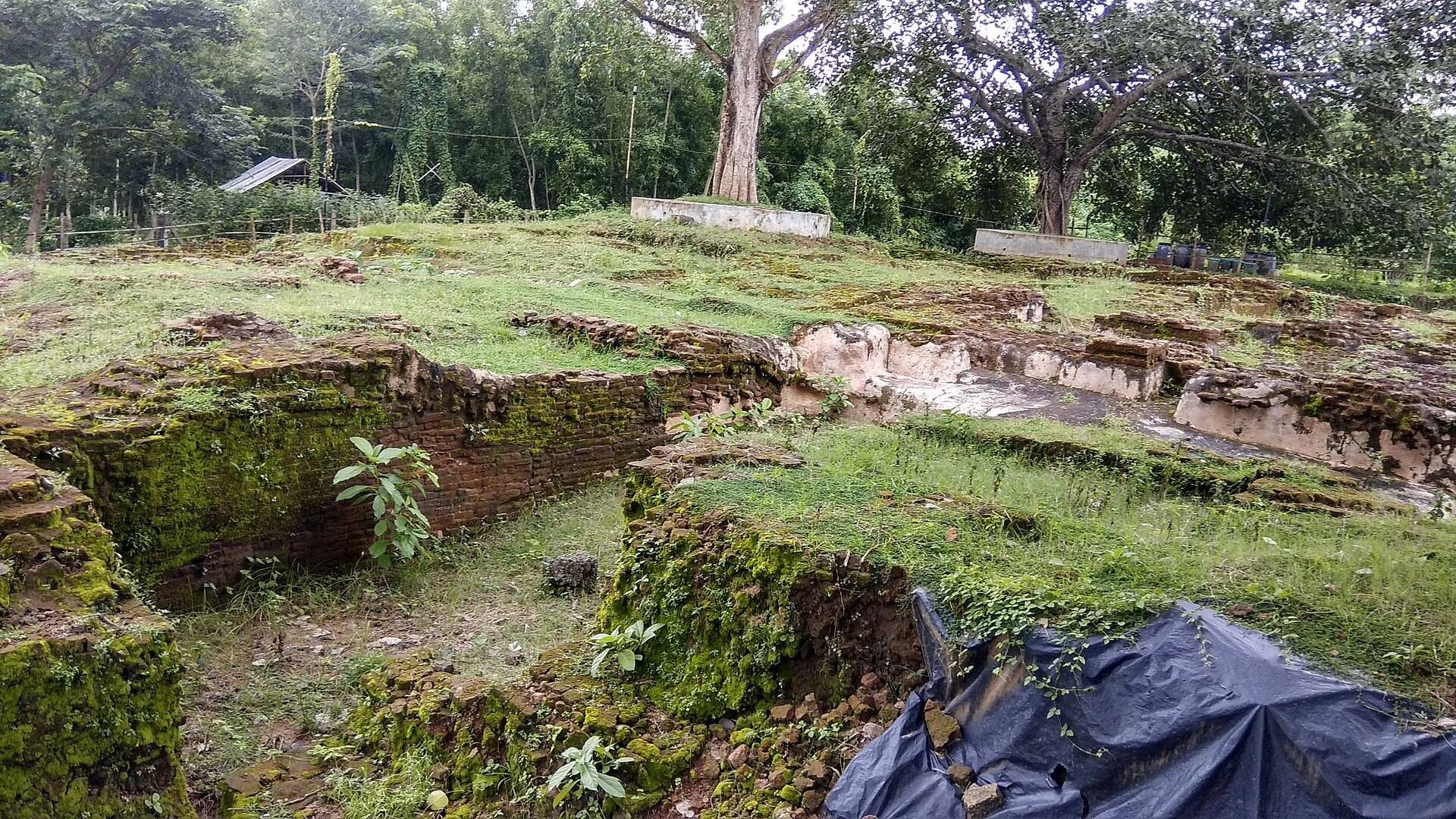
The excavated complex includes a central temple surrounded by cells arranged around a square courtyard. A circumambulatory path, used for ritual movement around a sacred structure, ran along the eastern and southern parts of the site. Brick construction, decorated stucco, sculpted figures, tablets, and pottery together reveal a monastic and ritual centre that developed through several building phases.
MGM1 and MGM3
MGM1 consisted of a structural brick mound known locally as Sakhisener Dhibi or Sashisener Dhibi, with bricks scattered across its surface. Its western side had a triratha projection, an architectural projection divided into three vertical facets, while a north–south wall formed part of a small monastic complex. Square and rectangular structures were interpreted as cells or small rooms. Excavation at MGM1 and MGM3 exposed a long wall decorated with stucco, a moldable plaster-like material used for figures and ornament. Floral, animal, and human forms appeared on the wall, which had been built through multiple phases.
MGM2 and the stupa bases
MGM2 lay within an area of present habitation. Excavation identified three circular brick structures interpreted as stupa bases, along with five circular brick bases in the area. A stupa is a Buddhist monument or reliquary structure. Pottery was scattered across the surface, and the remains were associated with the sixth or seventh century. A 55-centimetre layer of silt covered artifacts, while objects made in black-and-red ware lay beneath it.
Sculpture, tablets, and inscriptions
A slate-stone Buddha image was recovered during the 2006–07 excavations. Work in 2012 uncovered stucco figures and votive tablets showing Buddha as the central figure with Bodhisattvas at either side. A Bodhisattva is a figure who postpones final buddhahood to assist other beings. The finds also included Buddhist inscriptions. Jambala, a Buddhist deity associated with wealth and prosperity, and Saraswati, a goddess associated with learning, eloquence, music, and the arts, formed part of the wall decoration. The sculptures and other artifacts reflect the influence of Gupta artistic traditions from the middle Ganges region.