Toolesboro Mound Group: Havana Hopewell Burial Earthworks in Iowa
Site at a Glance
- Rating
- 4.5
- Popularity
- Very Low
- Country
- United States
- Primary era
- Classical
- External website
- Open
- Eras represented
- Classical
- Civilizations
- Unclassified
- Site type
- Burial
- Remains
- Necropolis
On this page7 sections
History
The Toolesboro Mound Group is a Havana Hopewell burial complex on the north bank of the Iowa River near its discharge into the Mississippi, east of Wapello, Iowa, in the United States. The Havana Hopewell, a regional tradition within the wider Middle Woodland Hopewell culture, built the earthworks between 200 BCE and 100 CE. The mounds served as burial places, where grave goods expressed the status of the dead and may have reflected religious or social leadership.
Havana Hopewell Community
The rank of those buried indicates that the mound builders belonged to an organized community with an established social hierarchy. A nearby Hopewell village probably supported the cemetery, although its location remained unidentified by December 2006. Later shifts in the Iowa River and the accumulation of rich river silt may have flooded or buried the settlement.
The mouth of the Iowa River offered abundant food, including wild plants growing in alluvial soil, fish, shellfish, and waterfowl. The community may also have exported blades made from local flint and freshwater pearls. Its connections may have extended into the Hopewell Interaction Sphere, a broad exchange network through which materials and finished goods circulated across much of eastern North America. Copper, seashells, mica, and obsidian reached communities through these long-distance contacts.
Later Earthworks and Archaeological History
An earthwork known as the “old fort” was once regarded as part of the Hopewell group. Its relationship to the mounds remains uncertain, because it may instead have been built about a thousand years later by the Oneota, Native American communities associated with a later Upper Midwest archaeological tradition. The nearby McKinney and Poison Ivy sites, both identified as Oneota sites, support that possibility.
During the late nineteenth century, the Davenport Academy of Natural Sciences excavated the mound group in an inexpert manner and recovered artifacts. Early records referred to as many as 12 mounds near Toolesboro, while later settlement and excavation reduced the surviving number to seven. The family of local landowner George M. Mosier donated the land containing the group to the State of Iowa. The State Historical Society of Iowa owns and displays the mounds, and the state has assigned the site to the society’s custodial responsibility.
Toolesboro Mound Group became a National Historic Landmark on May 23, 1966. This designation identifies places judged to possess exceptional national historical importance. It was also added to the National Register of Historic Places on October 15, 1966, the federal inventory of places important in American history, architecture, archaeology, engineering, or culture. A small visitor center and parking lot were built near the site in 1969.
Remains
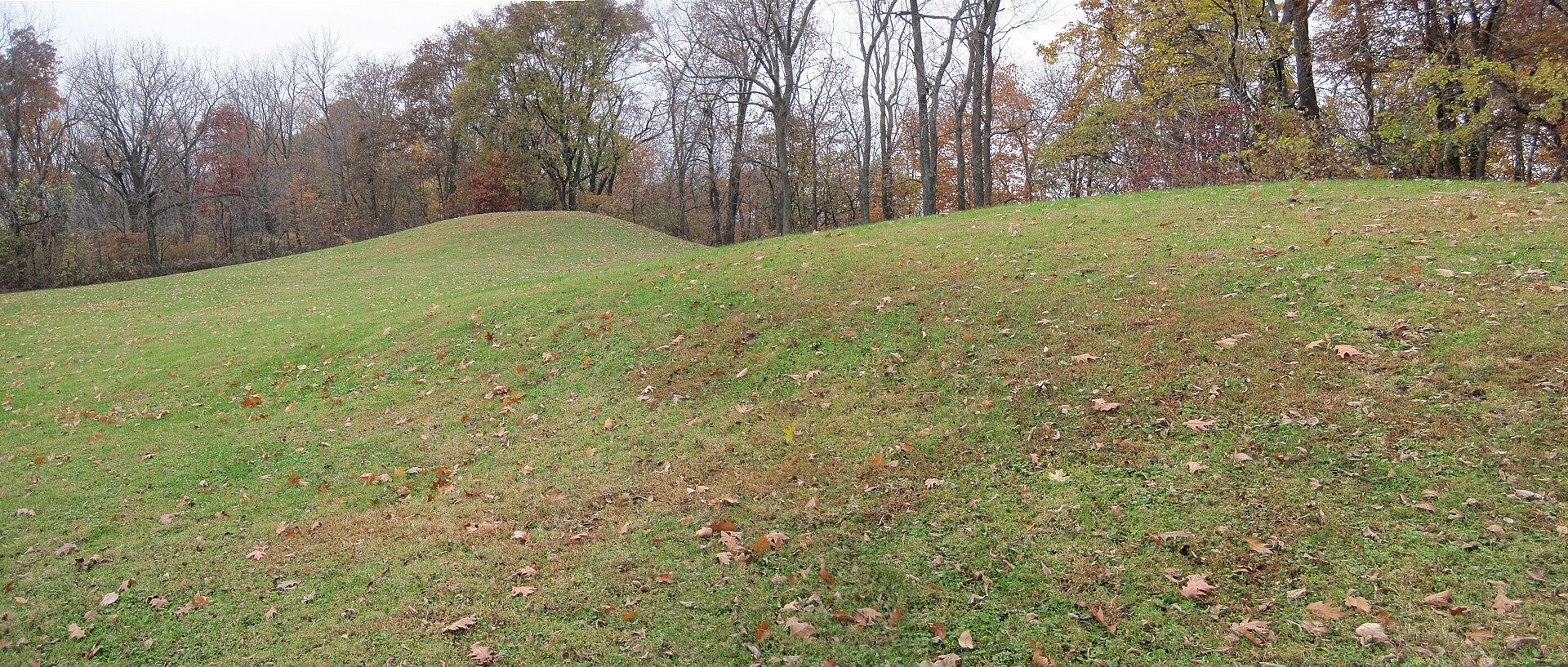
The surviving site consists principally of seven earthen burial mounds on the north bank of the Iowa River. Two stand on the grounds of the Educational Center, while five occupy an adjacent woodlot separated from the center by a wire fence. The group’s position near the Iowa River’s mouth places the mounds within a river landscape shaped by movement of water and the deposition of alluvial silt.
Burial Mounds and Related Earthwork
Seven Hopewell Mounds
Seven earthen mounds survive as the principal physical remains of the Havana Hopewell complex. Built between 200 BCE and 100 CE, they served as burial places for people whose accompanying grave goods expressed status and may have related to religious or social leadership. The surviving mounds are divided between the Educational Center grounds and the neighboring woodlot, preserving the basic distribution of the group across these two areas.
The “Old Fort”
The nearby “old fort” is another earthwork whose date and cultural affiliation remain uncertain. It may belong to the Hopewell complex, or it may represent a later Oneota construction made about a thousand years afterward. Its relationship to the seven burial mounds therefore remains an unresolved part of the site’s archaeological interpretation.