Yulin Caves: A Buddhist Cave-Temple Complex in China
Site at a Glance
- Rating
- 4.5
- Popularity
- Very Low
- Country
- China
- Primary era
- Medieval
- Eras represented
- Medieval, Early Modern
- Civilizations
- Chinese, Western Xia, Yuan
- Site type
- Religious
- Remains
- Sanctuary
On this page19 sections
History
The Yulin Caves are an ancient Buddhist cave-temple complex in Guazhou County, China, developed principally from the Tang through the Yuan periods within the Chinese tradition of rock-cut Buddhist architecture. Located along the Yulin River, the caves form part of the wider Dunhuang cave-art system together with the Mogao Caves and the Western Thousand-Buddha Caves. Their name refers to the elm trees growing beside the river, and they are also known as Yulin Temple and Wanfo Gorge.
Origins and Tang-period development
The foundation date of the complex remains uncertain because no founding inscription or sufficiently reliable historical record has been found. Earlier accounts placed its beginnings in the Northern Wei period, but the earliest securely identifiable remains belong to the Tang dynasty. Construction continued over many centuries, and approximately fourteen surviving caves are attributed to the Tang period, although many were later repaired or repainted.
Cave 25 is generally regarded as preserving Tang-period wall paintings in an especially intact form. It was probably excavated in the late eighth century, around the period of Tibetan control of Guazhou after 776. Proposed dates between 776 and 786, or between 776 and 781, remain debated. Its paintings and Old Tibetan inscriptions reflect interaction among Chinese Buddhist art, esoteric Buddhist imagery, and Tibetan culture. Figures wearing clothing associated with the Tibetan period further connect the cave with the political and cultural conditions of late Tang Guazhou.
The Guiyi Army period
During the late Tang and early Northern Song, Guazhou and Shazhou were successively controlled by the Zhang and Cao regimes of the Guiyi Army. This regional government ruled the Dunhuang and Guazhou area during the transition from the late Tang to the early Song and supported Buddhist cave construction as an expression of religious merit, political authority, family standing, and relationships among local elites. About twenty-three caves were newly excavated or rebuilt during the Five Dynasties and Song periods.
The work involved ruling authorities, Guazhou officials, prominent families, painting-workshop artisans and their relatives, and donors connected with neighboring political groups such as Khotan and Tuyuhun. The resulting caves served as Buddhist worship spaces while also presenting family status and political alliances. Donor portraits and processional scenes preserve information about clothing, official insignia, ceremony, and relationships among ruling families.
Cave 12 is associated with Murong Guiying, a long-serving Guazhou official, and his wife, Cao. Its imagery shows the couple with officials, attendants, musicians, dancers, and ceremonial guards. The composition reflects political and marital ties between the Murong family and the Cao regime, while its processional imagery was influenced by representations of Zhang Yichao and Cao Yijin at the Mogao Caves.
Cave 19 belongs to the major artistic remains of the Cao Guiyi Army period. Its entrance passage contains portraits of Cao Yuanzhong, the Lady of Liangguo Zhai, and their son Cao Yanlu. Cao Yuanzhong controlled the Guiyi Army regime approximately from 944 to 974. Inscriptions give him titles including Guiyi Army Military Governor, Grand Preceptor of the School of the Heir Apparent, and Chancellor, indicating that the cave presented the merit and status of his family.
Uyghur influence and the Western Xia
By around the eleventh century, Uyghur political and cultural influence had become important in the Guazhou and Shazhou region. Several caves contain Uyghur-style donor figures, Uyghur inscriptions, and paintings shaped by Uyghur artistic traditions. Cave 39 is central to study of this phase. Its entrance passage contains male and female donors in Uyghur dress and inscriptions in the Uyghur script, but the identities of the patrons remain uncertain. They have been interpreted as Uyghur royalty or aristocrats, members of the Shazhou Uyghur polity, or the Uyghurized Sogdian An family.
In 1036, the Western Xia, a Tangut-led state that ruled parts of northwestern China from 1038 to 1227, overthrew the Cao Guiyi regime and gradually took control of Guazhou and Shazhou. Before the state was destroyed in 1227, the Yulin Caves became an important Buddhist site of the Western Xia in the Hexi region. Earlier caves were repaired, while substantial new complexes were excavated.
Western Xia and early Mongol-Yuan art at Yulin brought together Chinese Buddhist transformation scenes, Tibetan Buddhist mandalas, Uyghur artistic elements, and images of Tangut people. These works reflect exchanges among the artistic traditions of the Song, Liao, Jin, Uyghur, Tibetan, and South Asian Buddhist worlds. Cave 3, excavated during the later Western Xia period, combines Chinese Mahayana and esoteric Buddhist imagery with materials in Sanskrit, Tibetan, Chinese, and Tangut, making it important for the study of Western Xia Buddhism and multi-ethnic cultural exchange.
Yuan, Ming, and Qing periods
Construction and rebuilding continued after the Yuan conquest of the Western Xia. Caves 4 and 10 are generally regarded as representative Yuan-period caves, when esoteric Buddhist subjects became more prominent. Most transverse passages connecting caves were probably cut during the Yuan period and had been created by no later than 1341. Large-scale excavation and painting activity is generally considered to have ended during the Yuan period.
The complex continued to function as a Buddhist and temple site during the Ming and Qing periods. Activity then focused mainly on repairing paintings, adding Buddhist platforms, remodeling sculptures, and maintaining worship spaces rather than undertaking large-scale new construction. Qing-period alterations are especially important because many sculptures were repaired or reshaped, complicating the use of surviving polychrome figures as evidence for the original dates of their caves.
Modern study and conservation
A local government survey of the Mogao Caves, Yulin Caves, and Western Thousand-Buddha Caves in 1922 is among the earliest modern official records of Yulin. During the 1940s, Zhang Daqian, Xie Zhiliu, and other researchers numbered, photographed, documented, and copied paintings at the site. Zhang Daqian’s group carried out concentrated copying work in 1943.
The Dunhuang Cultural Relics Research Institute assumed administrative responsibility in the 1950s and published a systematic survey in 1956. An investigation in 1964 by the Institute of Ethnic Studies of the Chinese Academy of Sciences and the Dunhuang Cultural Relics Research Institute helped identify and classify Western Xia caves. Later study of Uyghur inscriptions led to some reclassification. Research and conservation stagnated during the Cultural Revolution, before expanding again in later decades.
The Yulin Caves were included among the first group of Major National Historical and Cultural Sites under state protection on March 4, 1961. The Yulin Cultural Relics Management Office was established under the Dunhuang Academy in 1986. Expanded research and documentation between 1991 and 1993 was followed by a comprehensive catalogue in 1996 and the first complete illustrated study of the caves in 1997. In 2016, the management office became the Yulin Cultural Relics Conservation and Research Institute, directly administered by the Dunhuang Academy. In 2008, the Yulin Grottoes were submitted for possible inscription on the UNESCO World Heritage List as part of the Chinese Section of the Silk Road.
Remains
Cliff groups and cave layout
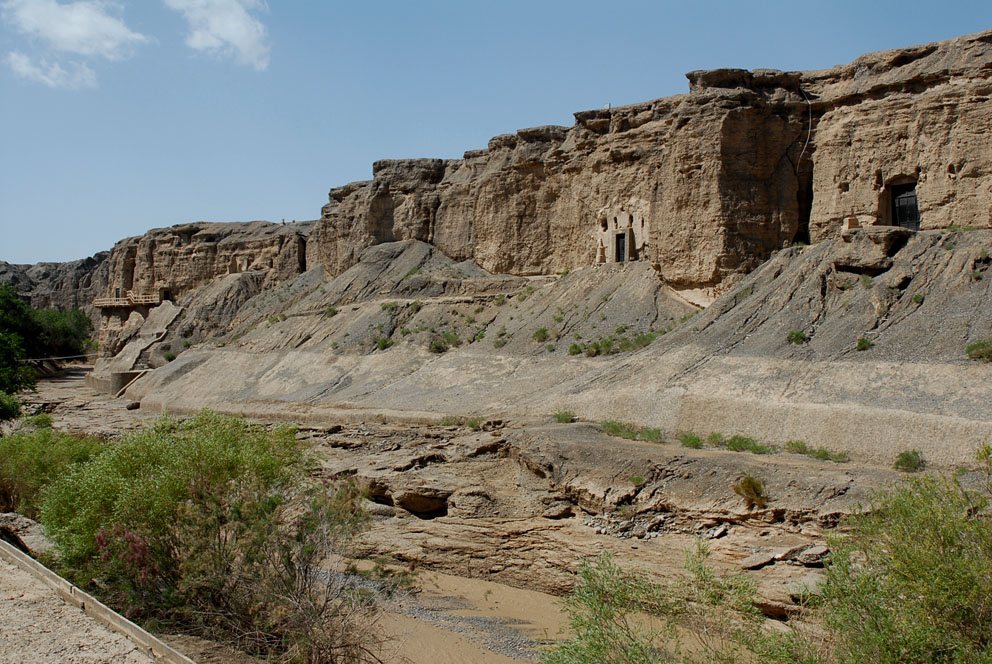
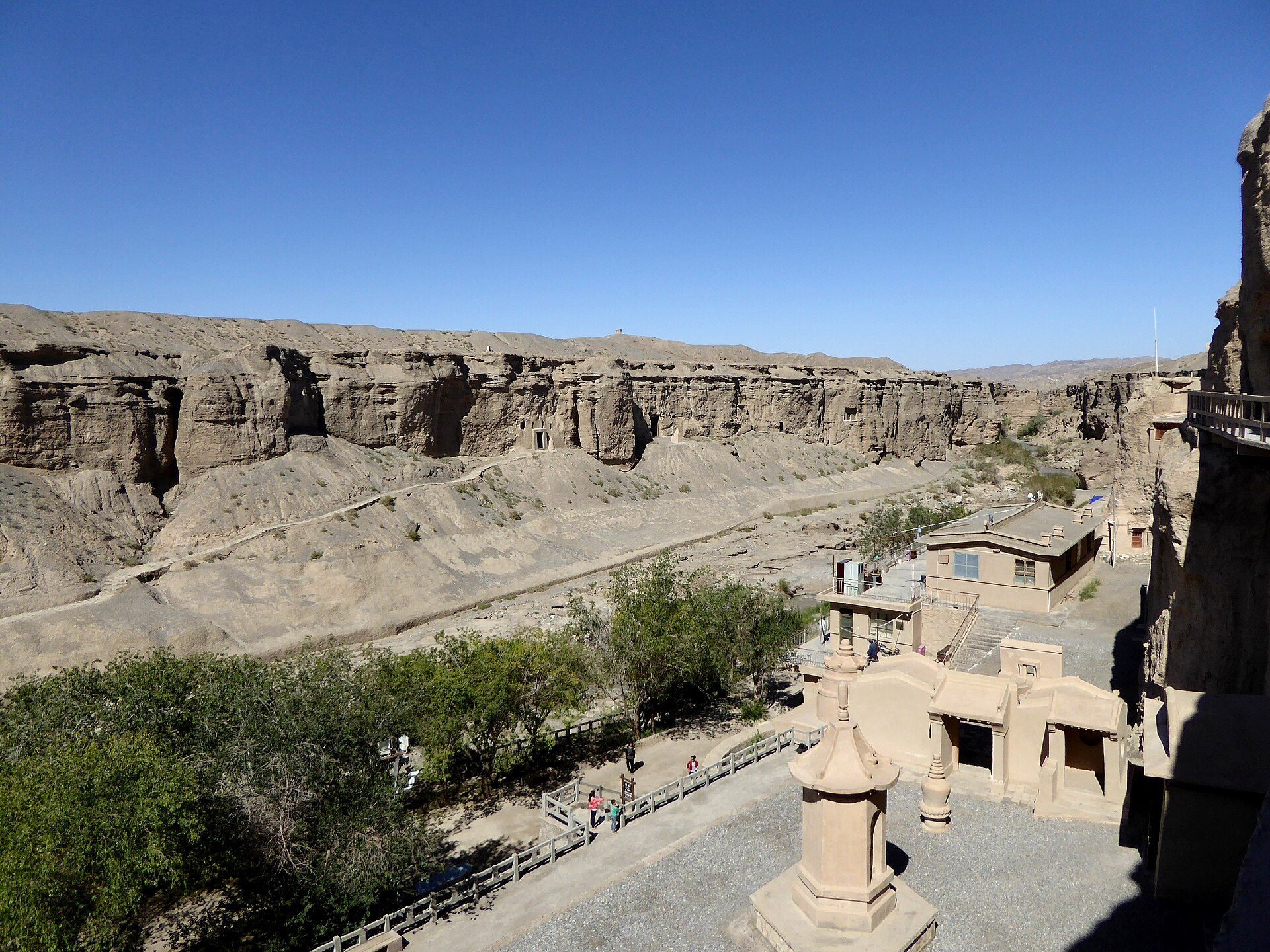
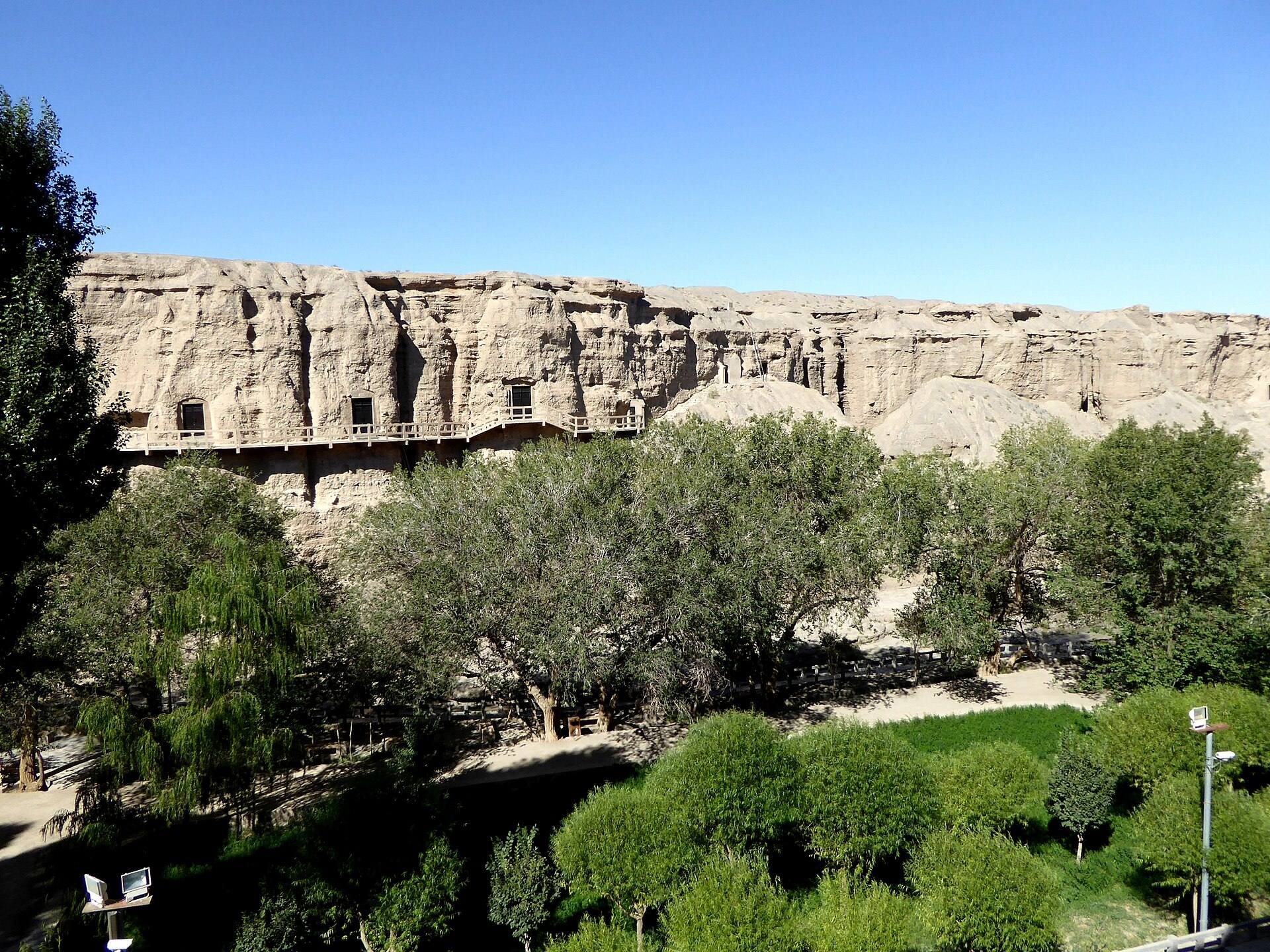
The caves were cut into gravel-conglomerate cliffs on both sides of the Yulin River, which divides the complex into eastern and western groups. Forty-three caves survive, with thirty-two on the eastern cliff and eleven on the western cliff. Together they contain more than 5,200 square meters of wall paintings and more than 270 polychrome sculptures.
The principal cave forms include central-pillar caves, central-altar caves, and large-image caves. A central-pillar cave is organized around a rock pillar left standing in the middle of the chamber, often with devotional niches carved into its sides. A central-altar cave instead focuses on an altar, while a large-image cave gives particular emphasis to a major sacred figure. Many interiors have an entrance passage, an antechamber, and a principal chamber. Three caves retain central piers with niches cut into all four sides, and some caves were later reworked, repainted, or joined by transverse passages.
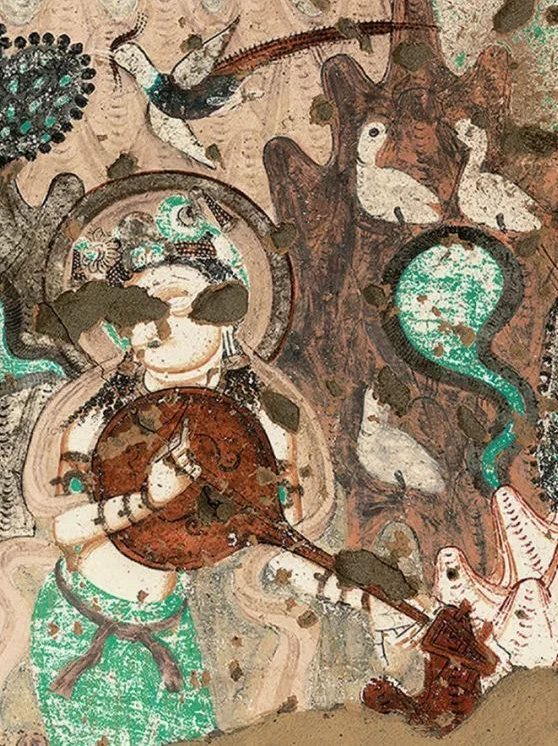
The paintings were applied to earthen plaster with mineral and organic pigments mixed with gum or other adhesive binders rather than being painted into wet plaster. Later repairs and repainting altered many interiors. The sculptures likewise underwent frequent repair and remodeling, especially during the Qing period, so their present polychrome surfaces do not always preserve the original appearance of the caves.
Late Tang and Guiyi Army caves
Cave 25
Cave 25 contains scenes from the Maitreya Sutra and the Visualization of Amitayus Sutra, together with compositions of Manjushri and Samantabhadra and a mandala of the Eight Great Bodhisattvas. A mandala is a diagrammatic sacred image used in Buddhist ritual and meditation, representing an ordered realm of deities. The cave’s principal sculpture was restored during the Qing period, while its other original sculptures have been lost. Old Tibetan inscriptions and figures in clothing associated with the Tibetan period accompany the Tang-period paintings.
Cave 12
Cave 12 preserves a donor portrait and processional composition centered on Murong Guiying and his wife, Cao. Officials, attendants, musicians, dancers, and ceremonial guards accompany them. The scene presents dress, insignia, ritual display, and family relationships associated with the Guiyi Army period. As a donor portrait, it depicts patrons who supported the religious monument and records their social and political position within the cave’s painted program.
Cave 19
The entrance passage of Cave 19 contains donor portraits of Cao Yuanzhong, the Lady of Liangguo Zhai, and Cao Yanlu. Inscriptions identify Cao Yuanzhong through several official titles, including Guiyi Army Military Governor, Grand Preceptor of the School of the Heir Apparent, and Chancellor. The portraits and inscriptions turn the entrance passage into a presentation of family identity and official standing.
Five Dynasties and Song imagery
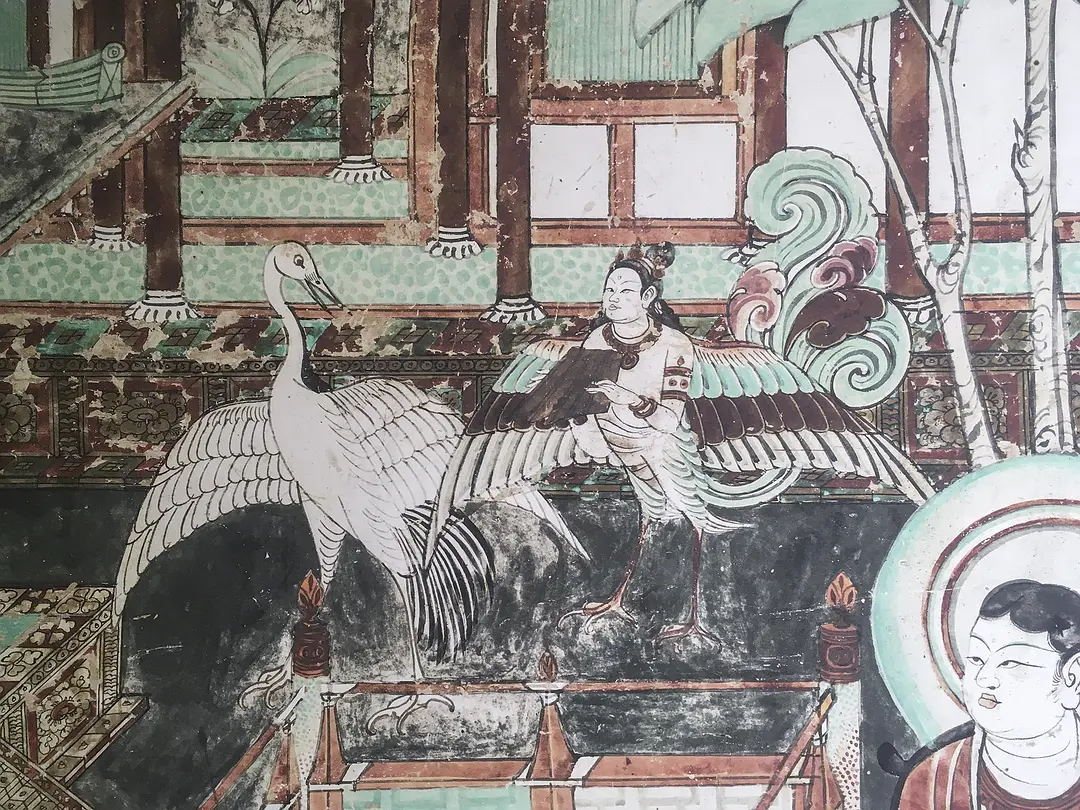
Wall paintings from the Five Dynasties and Song periods include Pure Land, Medicine Buddha, Maitreya, Manjushri, and Samantabhadra subjects. They also show scenes of filial piety, Vimalakirti, hell, and contests involving the monk Laoducha, whose story concerns a legendary debate between a Buddhist monk and a non-Buddhist opponent. Other religious figures include Buddhas, Avalokiteshvara, Kshitigarbha, heavenly kings, dragon kings, and esoteric forms of Avalokiteshvara.
Earlier paintings retain Late Tang characteristics, while later works develop a regional style. Secular scenes portray donors, go players, ethnic groups, musicians, dancers, agricultural work, milking, wine-making, metal smelting, and marriage ceremonies. Hairstyles, clothing, tools, and customs provide visual evidence for changing practices across the periods represented at the site.
Uyghur-period remains
Cave 39
Cave 39 preserves numerous male and female donor figures wearing Uyghur dress, along with inscriptions in the Uyghur script. The figures’ identities and the cave’s precise date remain unsettled. Interpretations have connected them with Uyghur royalty or aristocrats, members of the Shazhou Uyghur polity, or the Uyghurized Sogdian An family. The paintings nevertheless preserve evidence of Uyghur cultural influence in the Guazhou and Shazhou region.
Western Xia and Yuan remains
Caves 2, 3, and 29
Representative Western Xia works include the Water-Moon Avalokiteshvara in Cave 2, Manjushri and Samantabhadra compositions in Cave 3, and donor portraits in Cave 29. Some late Western Xia paintings use a relatively restrained central-Chinese manner, while others employ dense colors and complex Tibetan Buddhist ritual imagery. Their combination of styles reflects the movement of artistic ideas across the Hexi region.
Cave 3 has an octagonal, multi-level Buddhist altar. Its ceiling carries a mandala of the Five Buddhas of the Vajradhatu, a Diamond Realm mandala tradition in tantric Buddhism that presents an ordered assembly of Buddhas. The walls contain Eight Pagodas transformation tableaux, Thousand-Armed and Thousand-Eyed Avalokiteshvara, Pure Land scenes, the Visualization of Amitayus Sutra, and compositions of Manjushri and Samantabhadra. Materials in Sanskrit, Tibetan, Chinese, and Tangut reinforce the cave’s association with multilingual religious culture.
Caves 4 and 10
Caves 4 and 10 are regarded as representative Yuan-period caves. Their programs belong to the phase in which esoteric Buddhist subjects became more prominent. Transverse connecting passages between caves, most of which were probably cut during the Yuan period, formed part of the complex’s later physical organization and had been created by no later than 1341.
Conservation of the physical complex
Modern conservation has focused on preventive protection of the gravel-conglomerate cliffs, the caves, the wall paintings, and the sculptures. This work has included consolidation of the cliff faces and measures to regulate access, helping preserve the surviving painted and sculptural surfaces while continuing the study of the complex’s successive artistic phases.