Day Dream Smelter: An Early Silver-Processing Site in New South Wales
Site at a Glance
- Rating
- 4.6
- Popularity
- Low
- Country
- Australia
- Primary era
- Modern
- External website
- Open
- Eras represented
- Modern
- Civilizations
- British
- Site type
- Economic
- Remains
- Production Complex
On this page7 sections
History
Mining and smelting in the 1880s
Day Dream Smelter is a former smelter and archaeological site approximately 20 kilometres north-west of Broken Hill and north-east of Silverton, New South Wales, Australia. Built in 1885 during the early development of the region’s silver-mining industry, it processed ore from the Day Dream field before later handling ore from the Broken Hill Mine.
A settlement grew after rich silver-bearing ore was discovered in December 1882. By 1884, about 400 to 500 people were living on the field, and the Day Dream mine had become an important operation. Before the mine was floated as a company, it had raised approximately 96,000 tons of ore.
The Barrier Ranges Association built the smelter as part of its broader effort to take over mines, operate them, establish smelting facilities, and develop the mining field. The works opened with 25-ton and 40-ton water-jacket furnaces. These furnaces were surrounded by water-cooled jackets, allowing high-temperature smelting while helping protect their structure.
The Day Dream mine soon proved short-lived, and the smelter closed in April 1886 after about ten months because there was not enough ore to keep it operating. The furnaces reopened sometime between 1886 and 1887 to process the first approximately 1,500 tons of ore from the Broken Hill Mine, which had not yet begun using its own furnaces.
By the end of 1888, the Day Dream settlement was almost abandoned and the smelters had closed permanently. The settlement disappeared, while machinery and salvageable timber and corrugated iron from the buildings were removed. The surviving works remain associated with the early mining and industrial development of the Broken Hill and Silverton area, before the later development of Broken Hill itself.
Protection of the site
The isolated remains on a rounded hill in the arid Barrier Range preserve evidence of the intense activity and expectations surrounding the early mining field. The Heritage Council visited the site in 1980, after which the Barrier Environment Group nominated it for a Permanent Conservation Order. The order was placed on 11 February 1983 and transferred to the New South Wales State Heritage Register on 2 April 1999. Broken Hill City Council owns the site.
Remains
Smelting works on the hillside
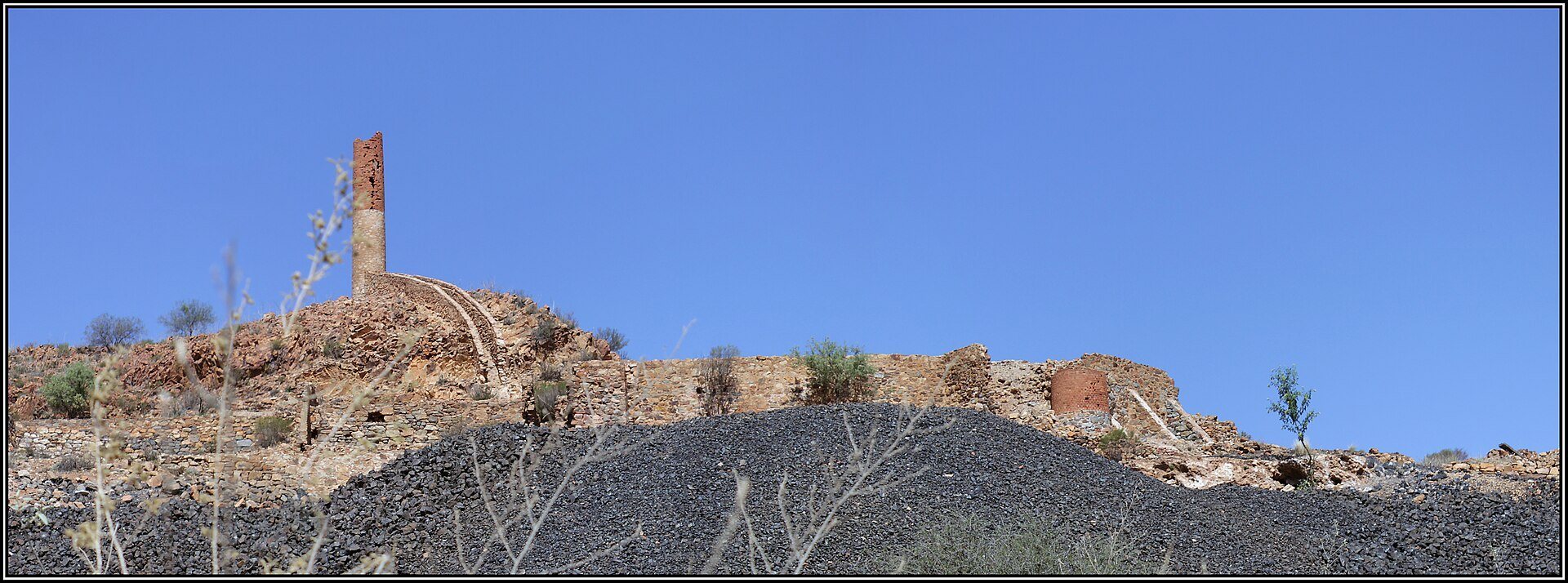
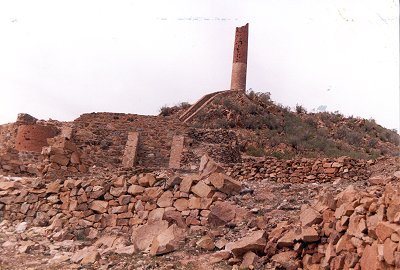
The surviving works are arranged on the slope of a rounded hill. They include the chimney stack, an adjoining surface trench, coursed-rubble stone walls, the platform where the smelter buildings stood, shaft-access holes, and walls that retained mullock, the waste rock removed during mining. The masonry and chimney stand in isolation, preserving the physical setting of the former smelting works.
Chimney and flue tunnel
The circular chimney has a lower section built of stone and an upper section built of brick. Stone side walls rise up the hillside toward the summit, forming a flue tunnel, a passage that carried hot furnace gases toward the chimney. On 3 October 2000, the upper brickwork was noted to have very weak mortar, with rainwater eroding it downward from the top.
Walls, platforms, and mining features
The stone-based smelter walls remain on the hillside beside the building platform. The surviving surface trench, shaft-access holes, and mullock-retaining walls extend the archaeological evidence beyond the furnace structures and help define the former works. Together, these fragmentary features retain the arrangement of the smelting site after its machinery and removable building materials had been salvaged.