Mehrangarh Fort: The Rathore Citadel of Jodhpur
Site at a Glance
- Rating
- 4.6
- Popularity
- Very High
- Country
- India
- Primary era
- Early Modern
- External website
- Open
- Eras represented
- Medieval, Early Modern, Modern
- Civilizations
- Rajput
- Site type
- Military
- Remains
- Castle
On this page13 sections
History
Foundation of Jodhpur’s New Capital
Mehrangarh Fort is a hilltop defensive complex in Jodhpur, India, founded in 1459 by Rao Jodha, the fifteenth Rathore ruler and founder of the city. The Rathores were a Rajput ruling clan whose principal territory was Marwar, the historical kingdom centered on the Jodhpur region. Jodhpur replaced Mandore as the capital of Marwar because Mandore’s thousand-year-old fort was considered insufficiently secure. The decision to establish the new stronghold on the rocky hill of Bhakurcheeria, about 9 kilometres south of Mandore, was made on 12 May 1459, roughly a year after Rao Jodha came to power.
Rao Nara, the son of Rao Samra, helped Jodha subdue Mewar forces at Mandore and was then appointed Diwan, a senior ministerial office. Construction began on the hilltop, although much of the fort that survives today took shape during the seventeenth century, particularly under Maharaja Jaswant Singh, who ruled from 1638 to 1678. The building work is traditionally said to have continued for more than ten years and to have involved over 10,000 workers, with 500 elephants transporting materials.
Foundation Traditions and the Rathore Name
Mehrangarh’s foundation is closely associated with Karni Mata, a Hindu saint and warrior ascetic linked with the Charan community. According to tradition, the hill’s hermit, Cheeria Nathji, refused to leave when Rao Jodha selected the site. Jodha sought Karni Mata’s intervention, and the hermit departed, but he cursed the fort with water scarcity. Jodha attempted to appease him by building a house and temple within the fort. Tradition also credits Karni Mata with laying the foundation stone.
Another foundation story holds that Raja Ram Meghwal voluntarily allowed himself to be buried alive beneath the foundations as an auspicious offering, in return for a promise that his family would receive continued support from the Rathores. His descendants are said to have remained at Raj Bagh near Soor Sagar. Rao Jodha also granted the villages of Mathania and Chopasni to two Charan warlords whom he had sent to invite Karni Mata to Jodhpur. Local tradition connects the Rathores’ continued possession of the Jodhpur and Bikaner forts with a miracle associated with her.
The name Mehrangarh is traditionally derived from the Sanskrit words Mihir, meaning “sun,” and garh, meaning “fort.” Its earlier form was Mihirgarh, and the name connects the Rathore claim of descent from Surya, the Hindu sun deity, with the fort’s identity.
Royal Power, Worship, and Conflict
The fort’s gates preserve memories of later Rathore victories. Maharaja Man Singh built Jai Pol in 1806 after victories over the armies of Jaipur and Bikaner. Fateh Pol commemorates Maharaja Ajit Singh’s victory over the Mughal Empire in 1707. The Mughals were a major Muslim-ruled empire in the Indian subcontinent, and their conflicts with the Rathore rulers shaped the political history reflected in the fort.
Rao Jodha brought the image of Chamunda from Mandore in 1460 and installed it at Mehrangarh. Chamunda is a Hindu goddess often understood as a fierce form of Devi. She became the chosen deity of the rulers and royal family of Jodhpur, and Dussehra, the Hindu festival associated with the victory of good over evil, continues to draw crowds to the fort. On 30 September 2008, a human stampede at the Chamunda Devi Temple killed 249 people and injured more than 400.
Modern Administration and Geological Recognition
Mehrangarh is administered by the Mehrangarh Museum Trust and functions partly as a museum. It is a state-protected monument and is associated with the World Sacred Spirit Festival and the Rajasthan International Folk Festival. The Jodhpur Group–Malani Igneous Suite Contact beneath the fort was declared a National Geological Monument by the Geological Survey of India. This recognition concerns a geological feature linked with the final phase of Precambrian volcanic activity in the Indian subcontinent.
Rao Jodha Desert Rock Park was established beside the fort in 2006 to restore the natural environment of a large adjoining rocky area. It opened to the public in February 2011 and forms part of the modern interpretation of the fort’s volcanic landscape.
Remains
Hilltop Defenses and Entrances
Mehrangarh occupies a rocky hill about 122 metres above the surrounding plains in central Jodhpur. The complex covers approximately 1,200 acres, or 486 hectares, and extends roughly 5 kilometres across the hilltop. It was built as a defensive stronghold with a strategic view over the city. Its red-sandstone walls reach up to 36 metres in height and 21 metres in width. Four lines of ramparts extend for more than 9.5 kilometres, with approximately twelve observation towers in each line.
Gates and Ramparts
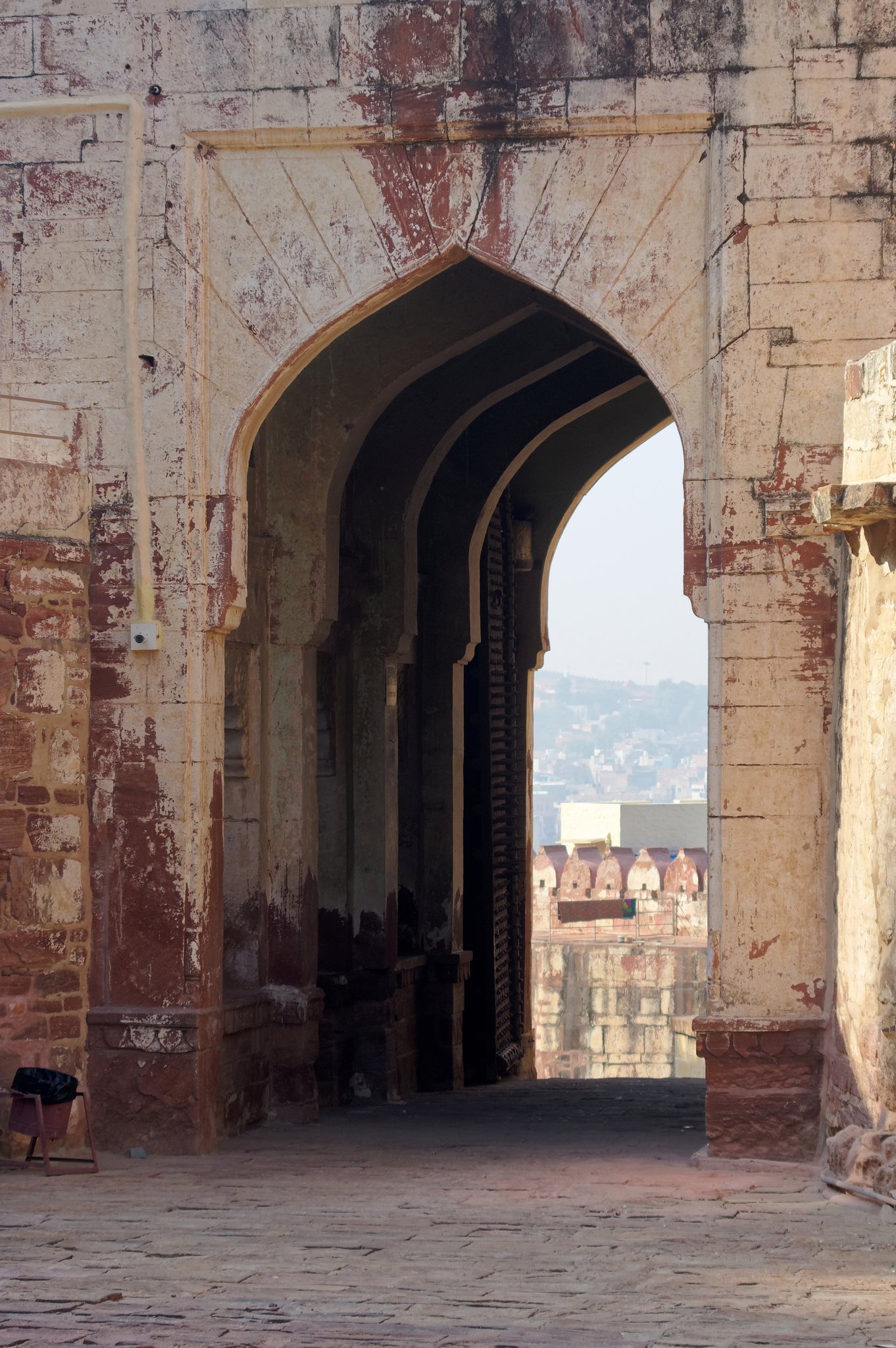
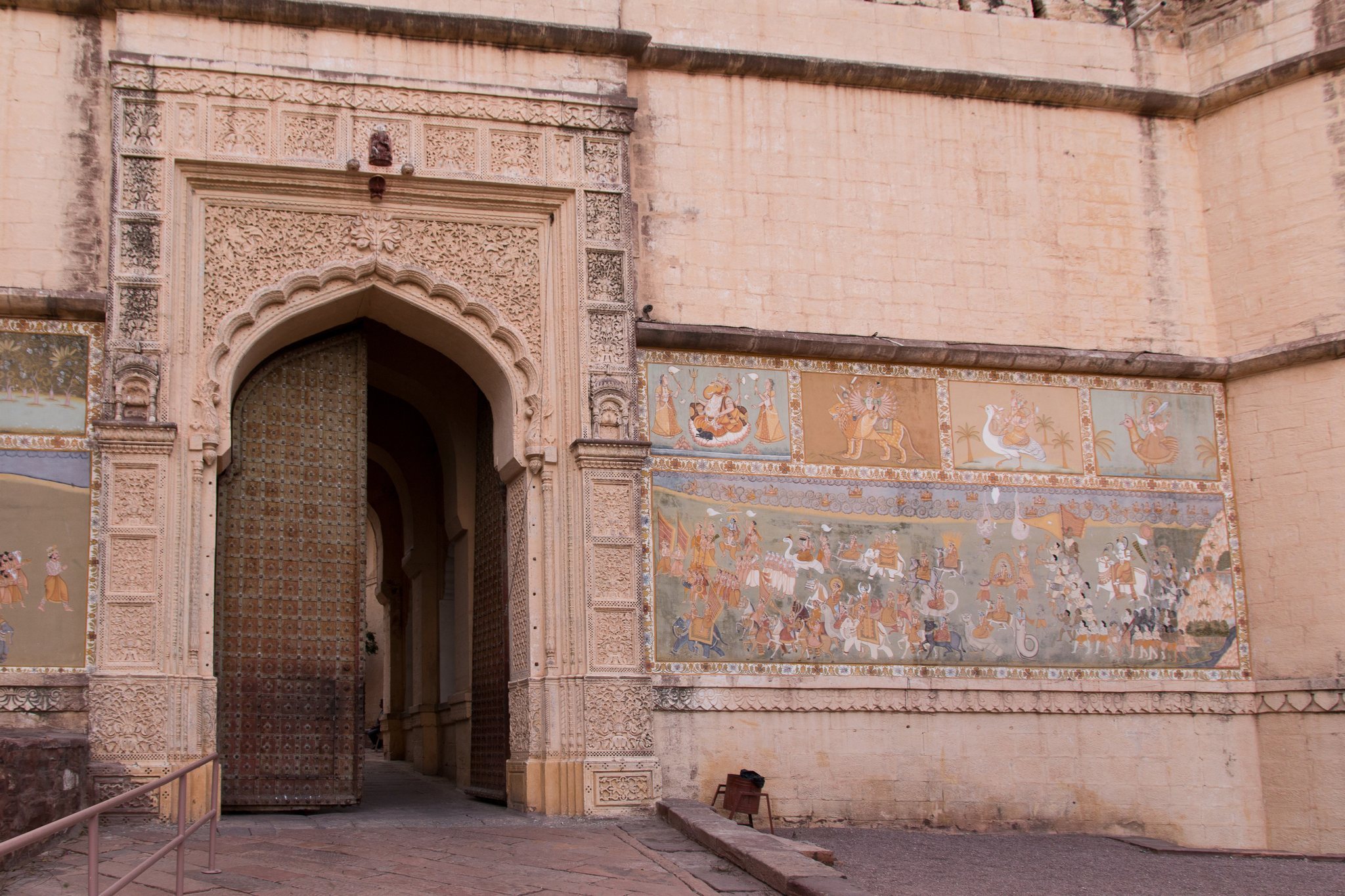
The fort has seven named gates, of which six are still standing: Jai Pol, Fateh Pol, Gopal Pol, Dedh Kangra Pol, Amruti Pol, Loha Pol, and Suraj Pol. Jai Pol is the principal victory gate associated with Man Singh’s campaigns of 1806, while Fateh Pol recalls Ajit Singh’s victory over the Mughals in 1707. Gopal Pol follows Fateh Pol. Amruti Pol lies between Dedh Kangra Pol and Loha Pol, and Loha Pol is the final gate before the principal fort complex. Suraj Pol, the innermost gate, gives access to the palace complex and Daulat Khana Chauk.
Dedh Kangra Pol retains impact scars from cannonballs fired by attacking Jaipur forces. Loha Pol bears handprints traditionally identified as the sati marks of royal women who died after their husbands. A sati mark refers to a handprint associated with a widow who died on her husband’s funeral pyre. The ramparts also preserve old cannon, including the Kilkila. A winding road links the fort with the city below.
Kirat Singh Sodha Memorial
At the north-east of the fort stands a chhatri commemorating Kirat Singh Sodha, a soldier who died defending Mehrangarh. A chhatri is a domed memorial pavilion traditionally erected in South Asian architecture to honor a ruler, noble, soldier, or other notable person.
Palaces, Temple, and Museum Collections
Royal Palaces
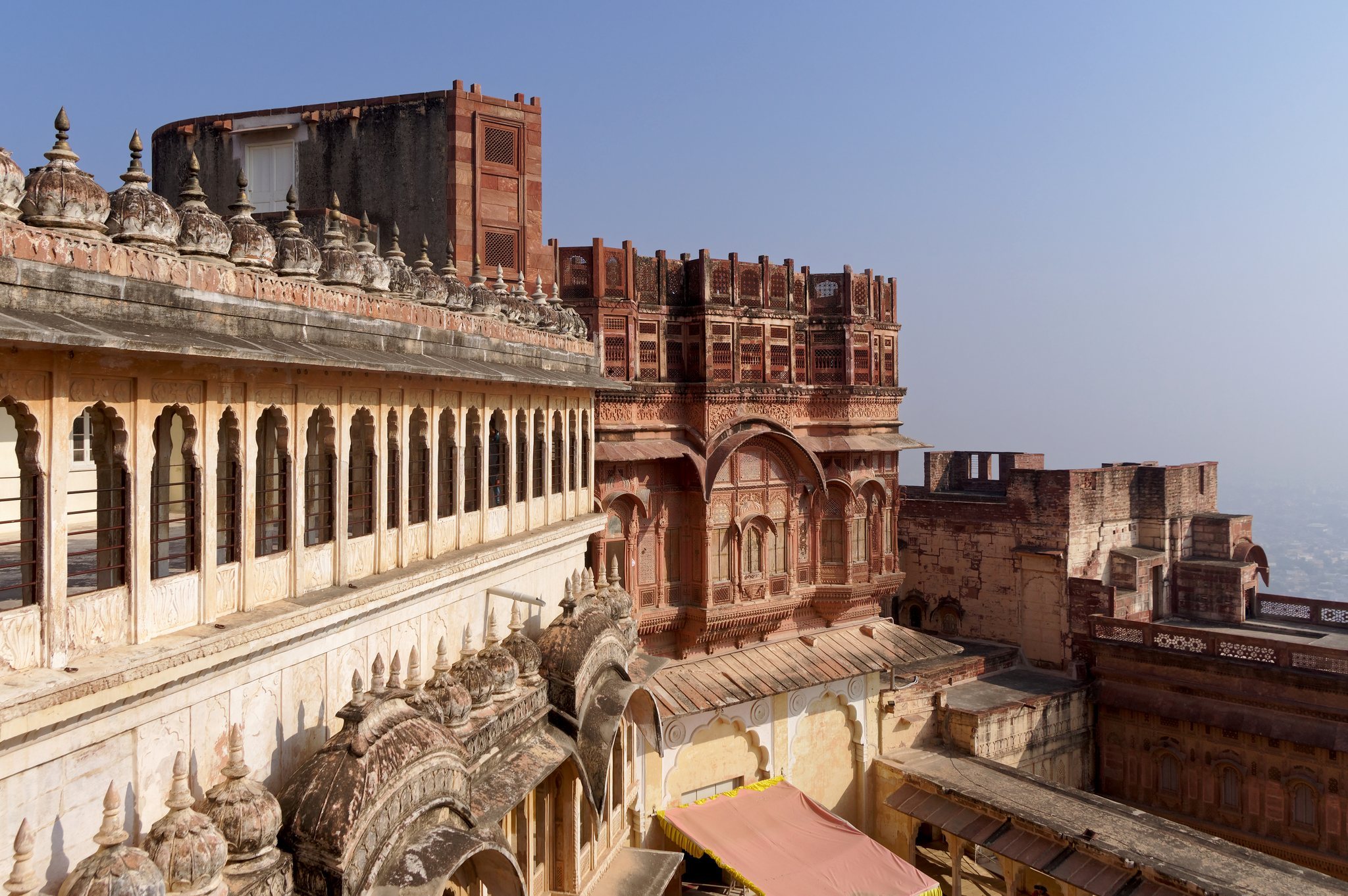
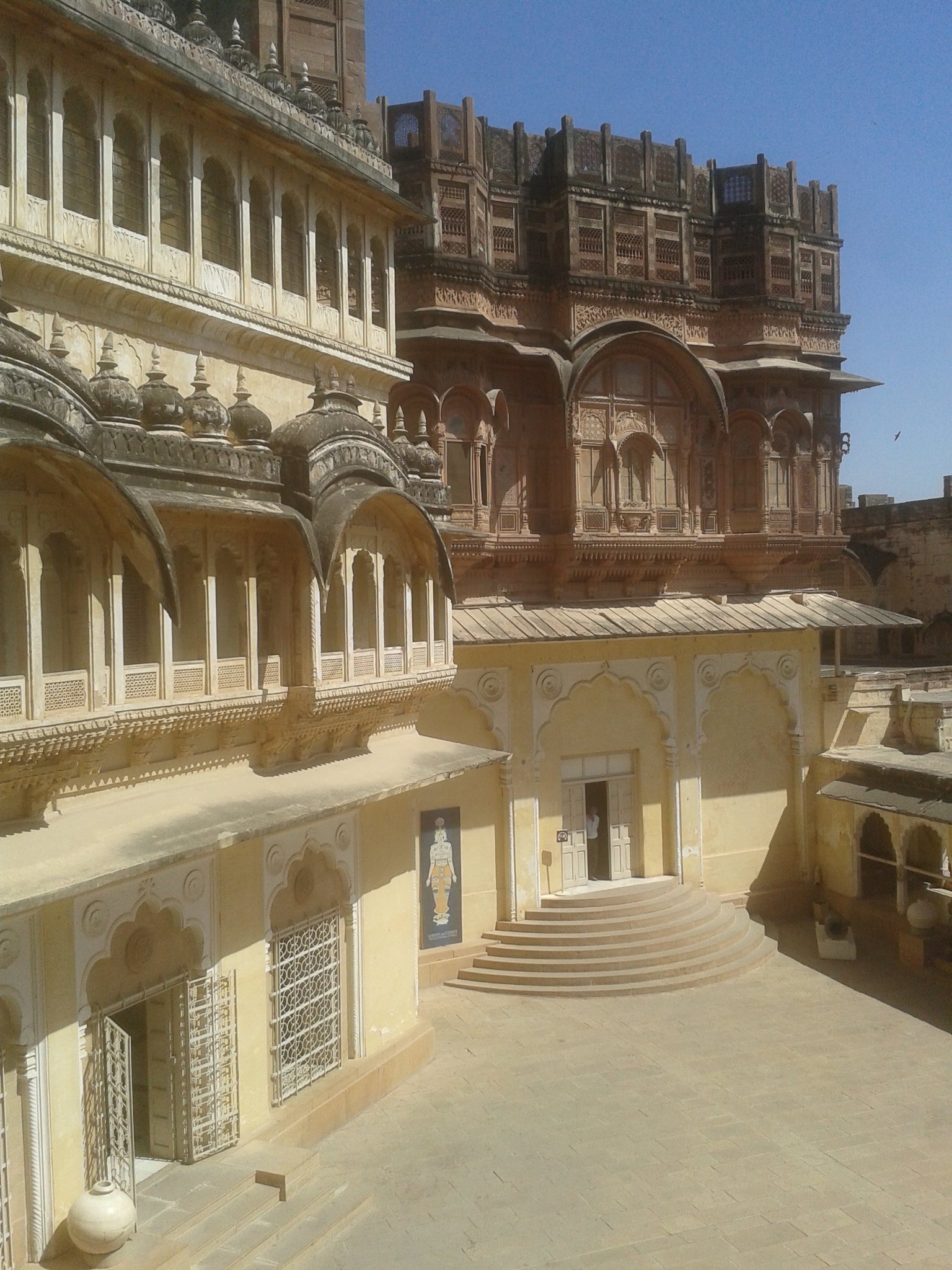
The principal palaces within Mehrangarh include Moti Mahal, or Pearl Palace; Phool Mahal, or Flower Palace; Sheesha Mahal, or Mirror Palace; Sileh Khana; and Daulat Khana. Their red-sandstone structures contain carved and richly decorated interiors arranged around large courtyards. The palace complex is reached through Suraj Pol and includes Daulat Khana Chauk.
Temple and Museum
The Chamunda Mataji Temple stands within the fort, preserving the image brought from Mandore by Rao Jodha in 1460. The museum preserves or displays palanquins, elephant howdahs, royal cradles, miniature paintings, musical instruments, costumes, furniture, and other objects associated with the fort and the Rathore court. A howdah is a seat or carriage fastened to an elephant’s back. At Mehrangarh, the larger forward compartment was intended for royalty and the smaller rear compartment for an attendant or bodyguard.
The Daulat Khana gallery contains Mughal-period fine and applied arts, reflecting the close relations maintained between the Rathore rulers of Jodhpur and the Mughal emperors. It also contains remains of Emperor Akbar. The armory gallery includes armor from different periods of Jodhpur’s history, sword hilts made from jade, silver, rhinoceros horn, and ivory, shields decorated with rubies, emeralds, and pearls, and firearms with gold and silver work on their barrels. Among the displayed weapons are Rao Jodha’s Khaanda, weighing more than 3 kilograms, and swords associated with Akbar and Timur, the fourteenth-century Central Asian conqueror and ruler.
The painting gallery contains examples of the Marwar-Jodhpur painting tradition, and the fort also includes a Turban Gallery. Together, these collections connect the surviving palace spaces with the material culture of the Rathore court.
Volcanic Setting and Desert Rock Park
Mehrangarh is built of red sandstone, while its characteristic red appearance is also associated with volcanic rocks obtained from the surrounding desert. The stonework reflects the knowledge of the Khandwaliya community, a traditional group associated with breaking large stones. Beneath the fort lies the Jodhpur Group–Malani Igneous Suite Contact, the specific geological feature on which the stronghold was built.
The adjoining Rao Jodha Desert Rock Park covers 72 hectares. Its terrain includes restored desert vegetation, barren rocky ground, and exposed volcanic formations such as rhyolite, welded tuff, volcanic conglomerate, and sandstone. Rhyolite is a volcanic rock, welded tuff is volcanic ash compacted and fused by heat, and volcanic conglomerate consists of rounded volcanic fragments cemented together. A local plant nursery and interpretive facilities are associated with the park.