St. Nicholas Church: Leipzig’s Protestant Parish and Reformation Church
Site at a Glance
- Rating
- 4.7
- Popularity
- Medium
- Country
- Germany
- Primary era
- Medieval
- External website
- Open
- Eras represented
- Medieval, Early Modern, Modern
- Civilizations
- Electorate of Saxony, German, Holy Roman Empire, Kingdom of Saxony
- Site type
- Religious
- Remains
- Church
On this page15 sections
History
St. Nicholas Church is a historic Protestant parish church in Leipzig, Germany, whose construction began after about 1165 in the Romanesque period and whose later rebuilding created a late Gothic hall church. Dedicated to Saint Nicholas, the Christian patron traditionally associated with charity, travelers, and merchants, it became the principal church of Leipzig’s medieval New Town. The church later became closely associated with the Reformation, Johann Sebastian Bach’s music, and the peaceful revolution of 1989.
From Romanesque church to late Gothic hall church
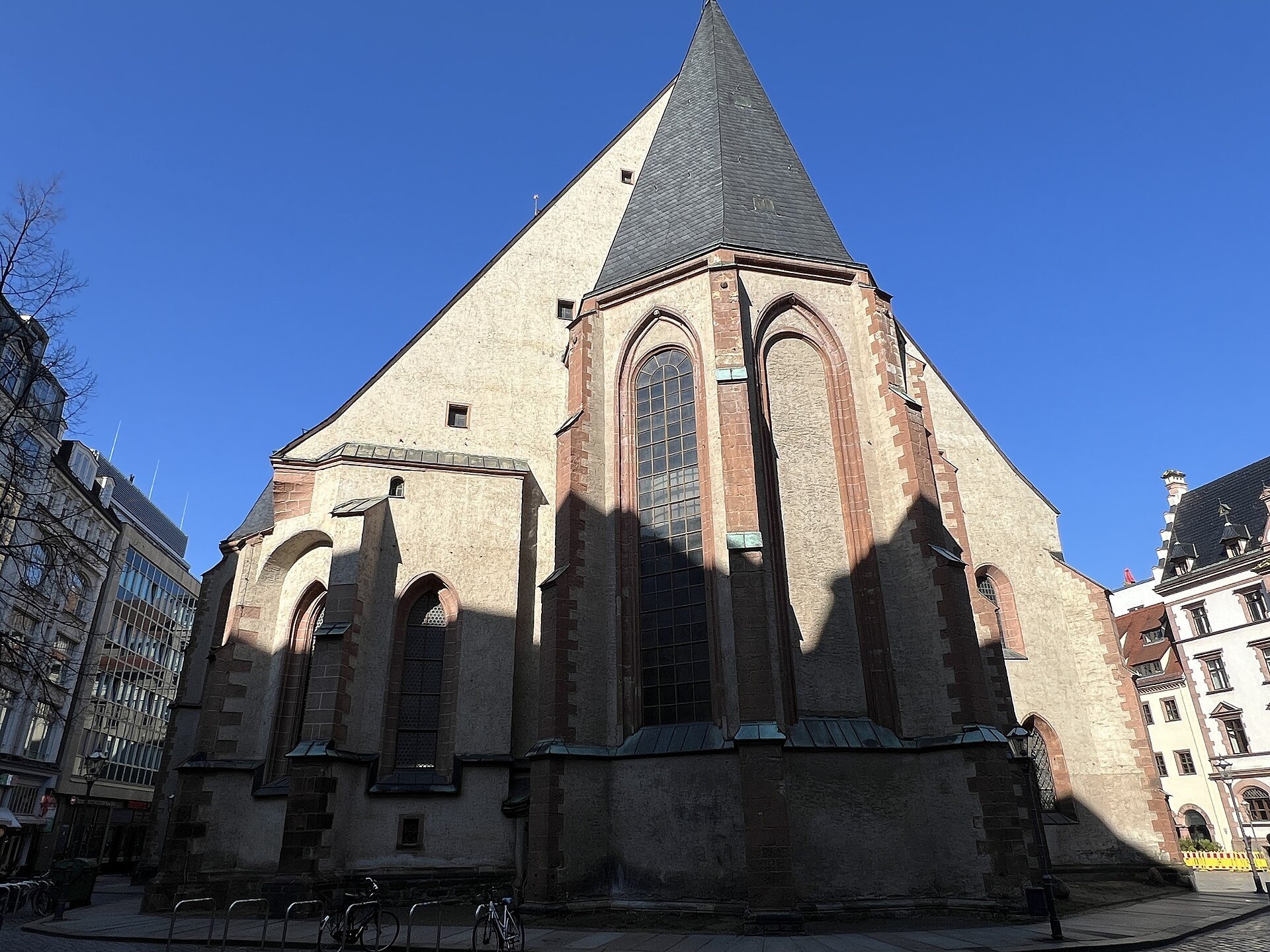
Construction followed Leipzig’s receipt of town and market rights. The first documented building was a stone Romanesque basilica on an older cemetery. It was enlarged eastward with a Gothic apse and later received a north chapel. From 1507, the church underwent extensive rebuilding. Work between 1513 and 1526, carried out under B. Eisenberg, produced the present three-aisled late Gothic hall church, while only the eastern part of the chancel and part of the west end were retained from the earlier structure.
The church was consecrated in 1525. Four years earlier, in 1519, Martin Luther debated the Catholic theologian Johann Mayer von Eck, commonly known as John Eck, at St. Nicholas. On 25 May 1539, sermons by the theologian Justus Jonas and Martin Luther marked the beginning of Leipzig’s Reformation, the sixteenth-century movement that challenged established Western Catholic institutions and led to the formation of Protestant churches. St. Nicholas then became the seat of Leipzig’s first superintendent, Johann Pfeffinger. The church has remained Protestant since that period, while the Catholic Propstei parish has also been permitted to hold services and other ceremonies there.
Music, worship, and civic life
Gottfried Wilhelm Leibniz, the German philosopher, mathematician, and polymath, was baptized at St. Nicholas on 3 July 1646. From 1723 to 1750, Johann Sebastian Bach served as music director of the Thomaskirche and St. Nicholas Church. Bach and the Thomanerchor, Leipzig’s historic boys’ choir associated with the Thomaskirche, gave numerous first performances of his cantatas and oratorios at the church. The St John Passion received its first performance there on Good Friday, 7 April 1724, and was performed again at St. Nicholas in 1728, 1732, and 1749.
A major interior reconstruction took place from 1784 to 1797 under Leipzig city architect Johann Carl Friedrich Dauthe. The work transformed the medieval interior according to Neoclassical principles, an eighteenth-century movement that revived Classical forms such as columns, ordered proportions, and restrained ornament. Leipzig Academy director Adam Friedrich Oeser created paintings and decorations for the altar area, entrance area, and tower hall. Dauthe’s scheme was influenced by the architectural theories of Marc-Antoine Laugier, whose criticism of medieval fittings encouraged a Classical reinterpretation of Gothic churches.
The church continued to absorb the effects of Leipzig’s changing religious and urban history. After the Johanniskirche burned during the bombing of Leipzig on 4 December 1943 and was demolished in 1949, its congregation became part of the St. Nicholas parish. The Heilig-Kreuz Church in Leipzig’s Neustadt district is the parish’s other church. St. Nicholas was also used for decades by the Leipzig Propsteichor for rehearsals and performances, including an annual Christmas carol service. The Catholic Propsteikirche had been damaged during the Second World War and was later demolished, while the choir continued to use St. Nicholas after the Catholic congregation moved to a new church in the 1980s.
Peace prayers and the peaceful revolution
Peace prayers were held at St. Nicholas on Mondays from the early 1980s. In late 1982, a large public display bearing the “Swords into Ploughshares” symbol was installed in the church for the first time in the German Democratic Republic, the communist state that governed East Germany from 1949 to 1990. The prayers developed into the Monday Demonstrations, recurring public protests that helped bring about the end of the East German regime. In the late 1980s, the demonstrations drew tens of thousands of people and sometimes more than 100,000.
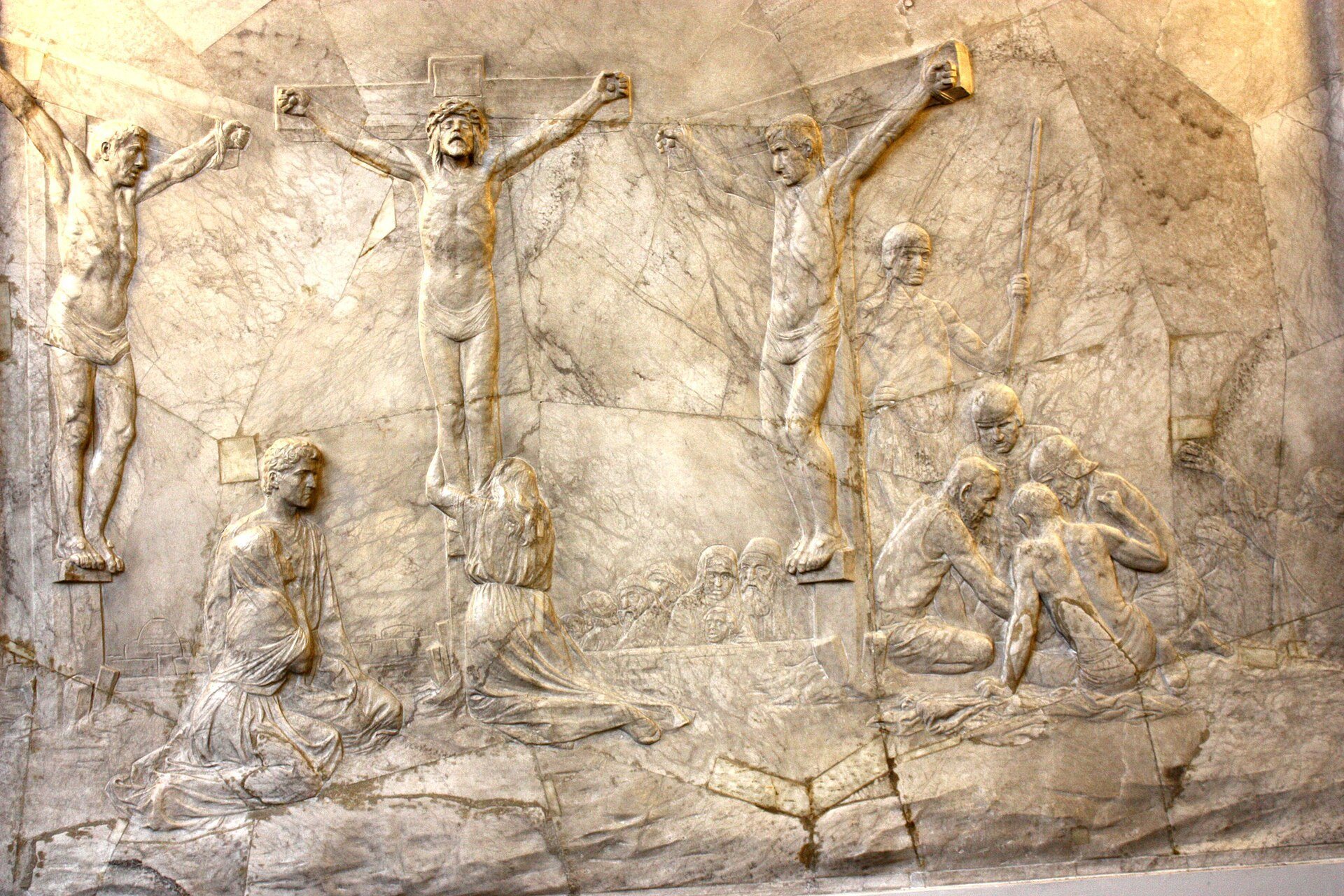
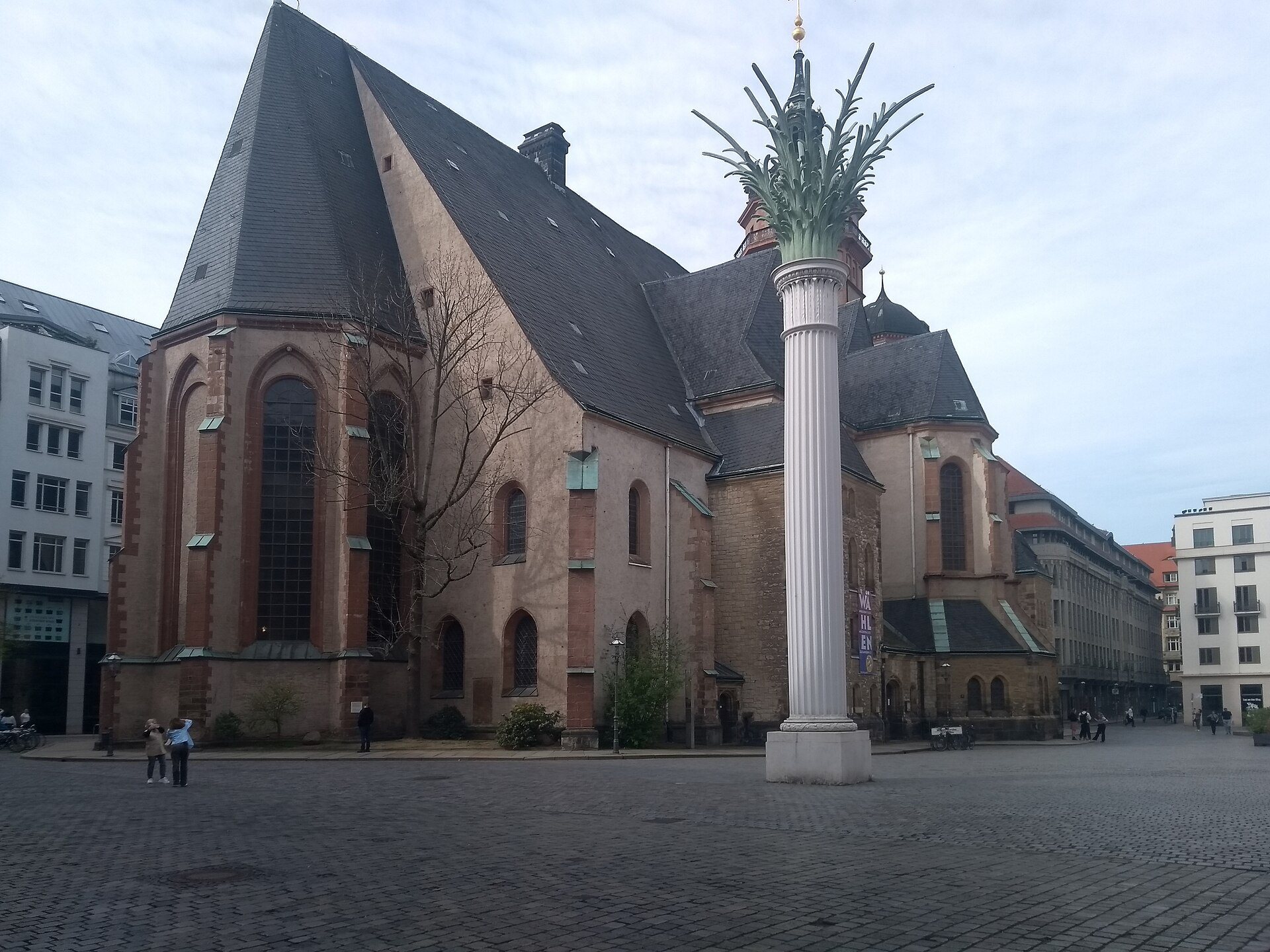
In autumn 1989, St. Nicholas Church became the central starting point of Leipzig’s peaceful revolution. Demonstrators demanded democracy, free elections, freedom of movement, and German unity. The movement was followed by the fall of the Berlin Wall on 9 November 1989 and German reunification on 3 October 1990. A simple wooden cross on a metal stand was installed beside the main altar for the first peace prayer in 1982. In 1999, Leipzig artist Andreas Stötzner designed and erected a Palm Column in the churchyard to commemorate the Monday Demonstrations and the peaceful character of the revolution, repeating the palm imagery of the church interior.
Later parish and cultural history
A major interior renovation begun in 1968 continued through three phases. The parish structure also changed during the twentieth and twenty-first centuries. St. Nicholas had four pastoral posts until 1992, and a further post was abolished in 2006. Sebastian Feydt became superintendent and first pastor in 2020, succeeding Martin Henker.
The church’s historical associations have continued in cultural works. Erich Loest’s 1995 novel and film Nikolaikirche, Martin Jankowski’s novel Rabet oder Das Verschwinden einer Himmelsrichtung, and Sir Colin Mawby’s 2016 oratorio Ecce homo all drew on aspects of its history. Mawby dedicated the oratorio to people who followed their consciences despite danger and persecution.
Remains
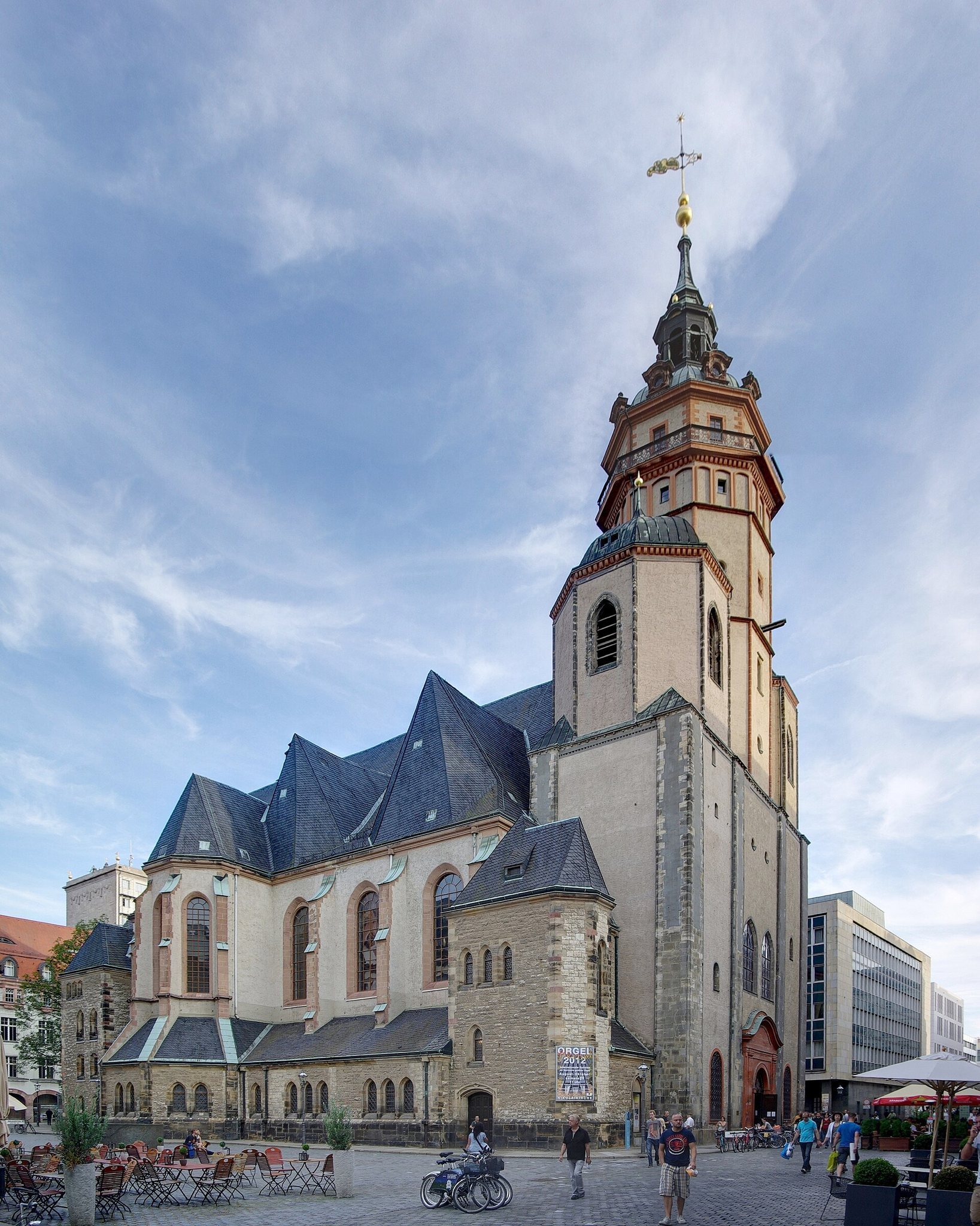
St. Nicholas Church combines visible Romanesque fabric, a late Gothic three-aisled hall, a Baroque tower finish, and a Neoclassical interior. The late Gothic building is made of dressed stone and provides more than 1,400 seats. Its original Romanesque western work remains visible on the west side, while the surviving north chapel belongs to the earlier sequence of enlargement.
Exterior and tower
Romanesque west end and late Gothic shell
The west side preserves part of the Romanesque building, whose earlier facade had two towers. The late Gothic reconstruction retained only part of this west end and the eastern portion of the chancel. The exterior facade was substantially altered in 1901 and 1902, although its late Gothic appearance was retained. A tower clock dating from 1874 remains part of the building.
Central tower
The central octagonal tower was substantially built in 1555 above the Romanesque west end. Hieronymus Lotter directed the work with the participation of master builder Paul Speck and others. The three lower octagonal stages date from this campaign. Between 1730 and 1734, Johann Michael Senckeisen added the tower keeper’s apartment, roof, and lantern, bringing the tower to a height of 75 metres. A tower keeper occupied the apartment until 1932. The tower received its Baroque finish in the eighteenth century, and the church portal dates to 1759. The earlier Romanesque portal was later demolished because it threatened to collapse.
The seven-level roof structure contains damage or cannonball impacts probably associated with the Battle of Leipzig. A slightly oversized horseshoe is set in a niche on the southern exterior of the chancel. Its origin is unknown. Later legends connect it either with Saint George’s horse or with the death of Landgrave Diezmann in Leipzig in 1307.
Neoclassical interior
Columns, vaults, and galleries
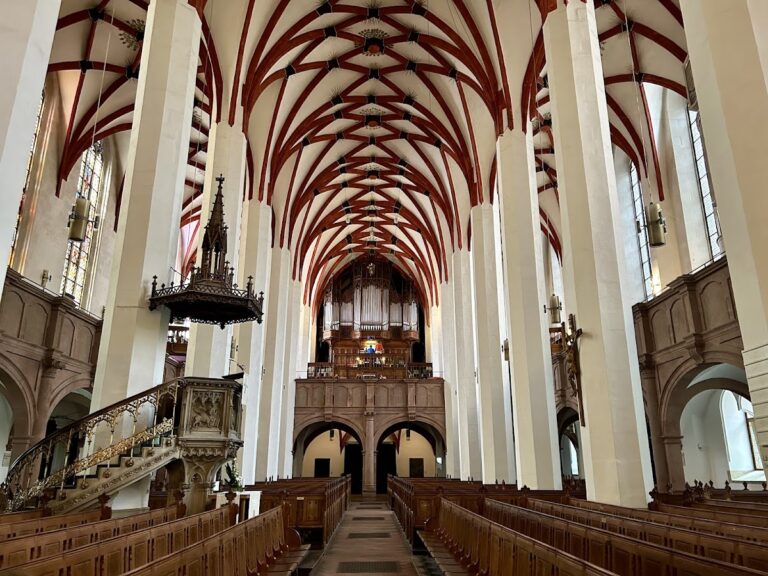
Dauthe’s interior scheme reshaped the Gothic piers with stucco, creating fluted reddish columns. Pale green palm-leaf capitals appear to grow into the Gothic cross vaults, whose panels were converted into Classical coffers with rosettes. Galleries are carried by paired columns of the Corinthian order. In the chancel, a wooden barrel vault was inserted below the medieval vault. The interior is organized around white, pinkish-red, and pale-green tones.
Altar furnishings and historic objects
The Luther Pulpit dates from 1521. It stood beside the third southern pier of the nave until 1785 and is now in the north chapel. A two-winged carved altar made by an unknown master in 1510 was acquired from the church of Niedergräfenhain in 1903. It stood in the north chapel until 1943 and returned there long after the Second World War.
Organs and bells
Organ tradition and the present instrument
An organ stood in the southern aisle by 1479. A small organ is recorded in 1506, and a Rodensteen organ was installed in 1577 before being dismantled by Zacharias Thayßner in 1693. Friedrich Ladegast built the principal organ in 1862. It originally had mechanical action, 83 registers, four manuals, and a pedal. Its design introduced a Barker machine, a pneumatic assist that reduces the force needed to operate mechanical action, and divided windchests at St. Nicholas. Its tonal design drew on the tradition of Gottfried Silbermann and supported the nineteenth-century revival of Bach performance.
Wilhelm Sauer rebuilt and enlarged the instrument in 1902 and 1903. Much of Ladegast’s pipework was retained, but the mechanical slider chests were replaced with pneumatic cone chests, a new console was installed, and the wind system was moved into the main case. Twelve registers were replaced with Neo-Baroque registers in 1934. Restoration from 1986 to 1988 electrified the actions. From 2002, Hermann Eule rebuilt the organ in the historic 1862 case, restoring mechanical action and slider chests while reusing and restoring surviving historical material. The instrument was rededicated on Reformation Day in 2004.
The restoration recovered Ladegast’s original disposition. Original pipes from 57 registers were restored, nine registers were completely reconstructed, and other registers were partly reconstructed. Sauer’s historically accumulated additions were retained, a fifth swell division was added, and eleven new registers integrated the different tonal materials. The present organ has 104 registers on five manuals and pedal and 6,892 pipes. Its registration system is electric, while its playing action is mechanical and partly assisted by Barker machines.
The console has a stainless-steel design inspired by a sports car, with dashboard-like pressure indicators, a heated organist’s seat, and a rear-view camera. Its design received a Red Dot Design Award. Three registers were added in 2024: Vox populi, a high-pressure tuba associated with the peaceful revolution of 1989; Macan, a carillon; and Panamera, a steel chime. The instrument is informally known as the “Porsche organ.” During the main organ’s rebuilding, an interim two-manual Eule organ with 17 registers stood near the chancel. Built in 2002 after Italian models, it was transferred in 2012 to the Marien Chapel of Naumburg Cathedral.
Bell collection
The first documented bell, Osanna, was hung in the north tower in 1452. It carried representations of the Crucified Christ, the four Evangelists, Saint Martin, and Saint Nicholas, and served both liturgical purposes and as a fire bell. Cannon fire damaged it in 1633, and it cracked soon afterward. Jakob König recast it in 1634. When that replacement cracked in 1867, the Leipzig foundry of Gustav Adolph Jauck cast a four-bell peal in 1869. The 4,055-kilogram Osanna hung in the south tower, while three bells weighing 2,060, 1,220, and 520 kilograms hung in the north tower.
Three bells were requisitioned for the armaments industry in 1917. During removal, Osanna fell nearly half a metre into the street pavement but reportedly suffered only minor damage. The Brautglocke and Morgenglocke were melted down, while the Beichtglocke and the 1737 clock-striking bell survived under protective certificates. Two replacement bronze bells were cast in 1925. The larger bells were again requisitioned in 1941, leaving one 1925 bell in regular use. The clock-striking bell survived because removing it would have endangered the tower’s stability.
Two bells cast by Franz Schilling in 1964 replaced those confiscated in 1941. Their reduced-diameter, lightweight construction was designed for the weakened postwar bell frame, although it reduced some tonal quality. Since 30 June 2019, eight bronze ringing bells have hung in the church towers. Six new bells were cast by the Bachert foundry, while the two 1964 bells were taken to the foundry for tonal matching. The 1925 bell was placed in a church depot because it did not match the new peal and remains parish property for possible future loan.
The new Osanna weighs 6,700 kilograms and contains 78 percent copper and 22 percent tin. Its measured decay time exceeds 300 seconds. It hangs in the restored 1793 bell frame in the south tower. The other seven bells hang in a new wooden frame in the north tower, where the 1964 bells received straight wooden yokes.