Palacio Federal Legislativo: Venezuela’s Federal Legislative Seat
Site at a Glance
- Rating
- 4.4
- Popularity
- Low
- Country
- Venezuela
- Primary era
- Modern
- External website
- Open
- Eras represented
- Modern
- Civilizations
- Unclassified
- Site type
- Civic
- Remains
- Palace
On this page17 sections
History
The Palacio Federal Legislativo is a nineteenth-century neoclassical complex in Caracas, Venezuela, built during the first government of Antonio Guzmán Blanco between 1870 and 1877. It became the country’s congressional seat in 1873 and remains the principal home of the federal legislature. Guzmán Blanco’s governments promoted secularization, infrastructure, and architectural modernization, reshaping the capital during this period.
Construction under Guzmán Blanco
Construction began on 21 September 1872 on the site of the Convent of the Reverendas Madres de la Inmaculada Concepción. A decree expropriated the convent’s land between the La Bolsa and San Francisco corners, while the Junta de Fomento del Capitolio was created to administer and inspect the building works. The project was associated with the architect and principal builder Luciano Urdaneta, with engineers Manuel María Urbaneja, Juan Hurtado Manrique, and Roberto García also taking part.
The southern section, which contained the legislative chambers, was built first. The complex was partially inaugurated in February 1873, and construction of the northern section was authorized in 1876. By 20 February 1877, the former convent plot was occupied by the completed group of buildings. The agreed cost was 42,893 bolívares, but the final expense reached 171,580 bolívares.
The first legislative sessions took place on 27 February 1873. Antonio Leocadio Guzmán became president of the Senate and Congress, while General Jesús María Paúl became president of the Chamber of Deputies. From 1877, the complex housed Venezuela’s three national powers, the Federal Executive, the legislature, and the judiciary.
Earlier congressional seats and changing functions
Before the Capitol was completed, Venezuela’s Congress had met in several buildings. In Caracas, it used the house of José Antonio Pacheco and later the Chapel of Santa Rosa de Lima in 1811 and 1812. The former Federal College of Guayana, also known as the Congress House of Angostura, hosted Congress in Ciudad Bolívar from 1819 to 1821. The Casa de la Estrella served in Valencia from 1830 to 1831, followed by several Caracas buildings between 1831 and 1842. From 1842 to 1873, Congress met in the Palacio de las Academias, formerly associated with the Central University of Venezuela.
The Capitol housed the former bicameral National Congress until the political transformations that began in 1999. It is now used by the unicameral National Assembly for ordinary and extraordinary sittings. Since 1961, the complex has served exclusively as the seat of the federal legislature. Its rooms have also hosted presidential inaugurations, state funerals, annual commemorations of Venezuela’s Declaration of Independence, and legislative and executive accountability proceedings.
Rooms of state and national memory
The Salón de los Escudos originally served as the meeting place of the High Federal Court. The Salón del Tríptico was formerly the office of the President of the Republic and later became, according to tradition, a reception room for presidential visits.
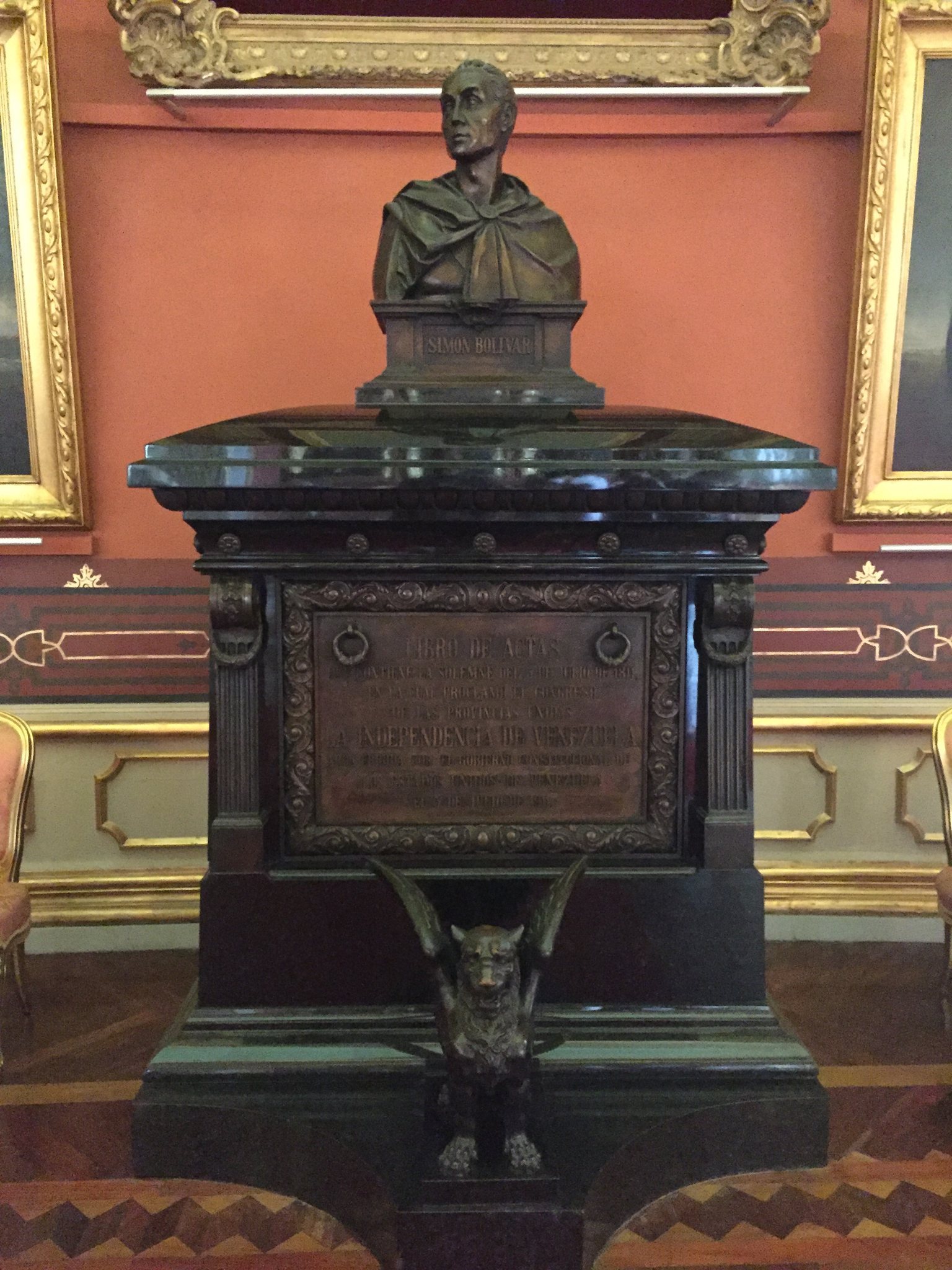
The Salón Elíptico preserves the book containing the proceedings and solemn declaration of Venezuelan independence. By decree of General Juan Vicente Gómez, the volume was placed in a special ark on 1 January 1910 and deposited there on 5 July 1911, during the centenary commemorations of emancipation. Known as the National Book of Venezuelans, it contains 436 pages and is associated with the Constitutional Congress of 1811 and 1812, the assembly that produced Venezuela’s first republican constitutional framework.
The complex was declared a national historic monument and a cultural asset of national interest on 22 August 1997. In 2026, structural damage caused by a double earthquake affecting northern Venezuela led legislators to meet temporarily at La Carlota Air Base.
Remains
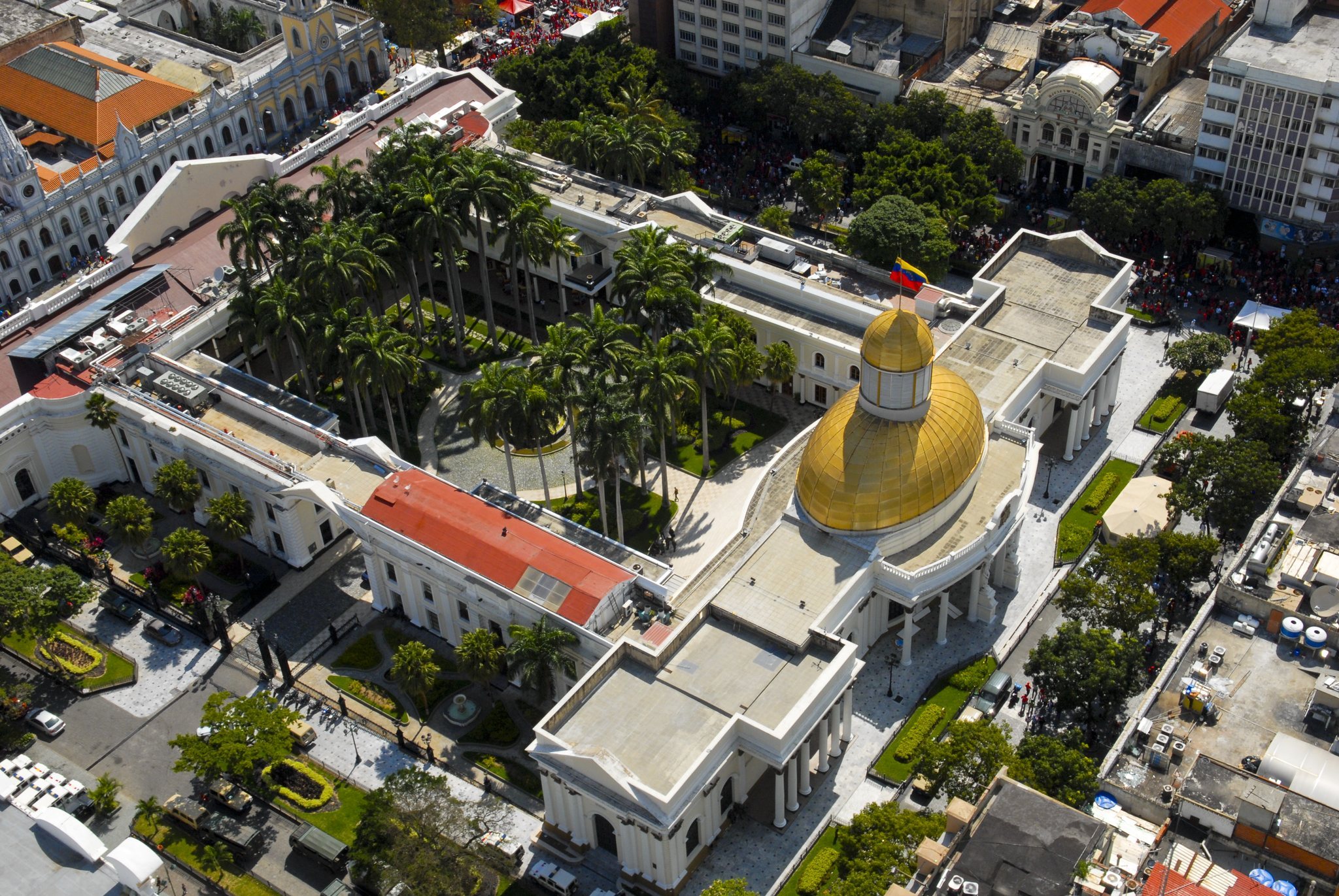
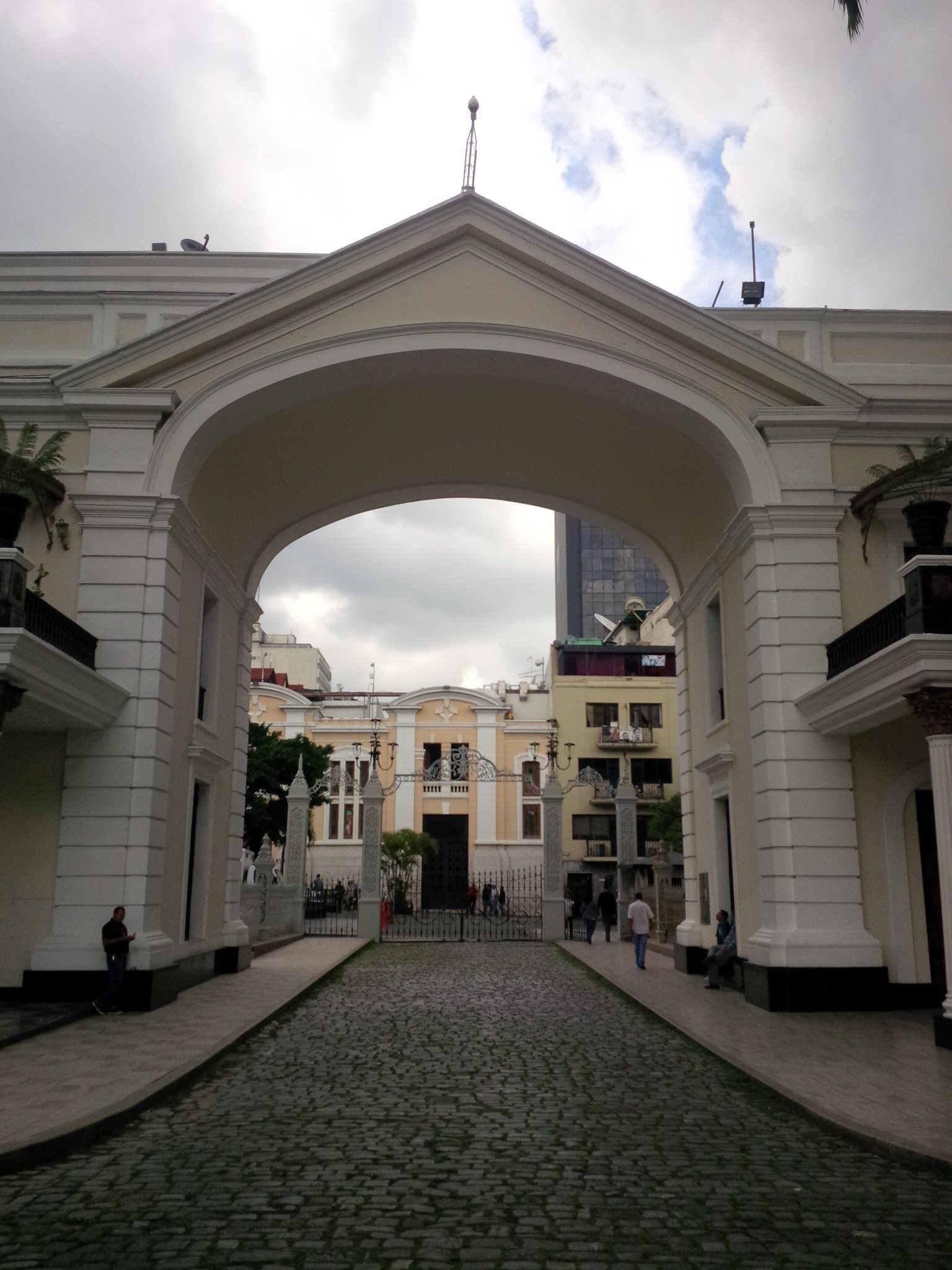
The Palacio Federal Legislativo occupies an entire city block diagonally opposite Plaza Bolívar in Caracas. Its neoclassical complex is painted bright white and incorporates structural cast iron. Two principal rectangular volumes, the southern Legislative Palace and the northern Federal Palace, are joined by two lower lateral galleries. Together they enclose a central courtyard and are accompanied by additional side buildings. The complex has two floors and covers approximately one city block.
Legislative Palace
Southern facade
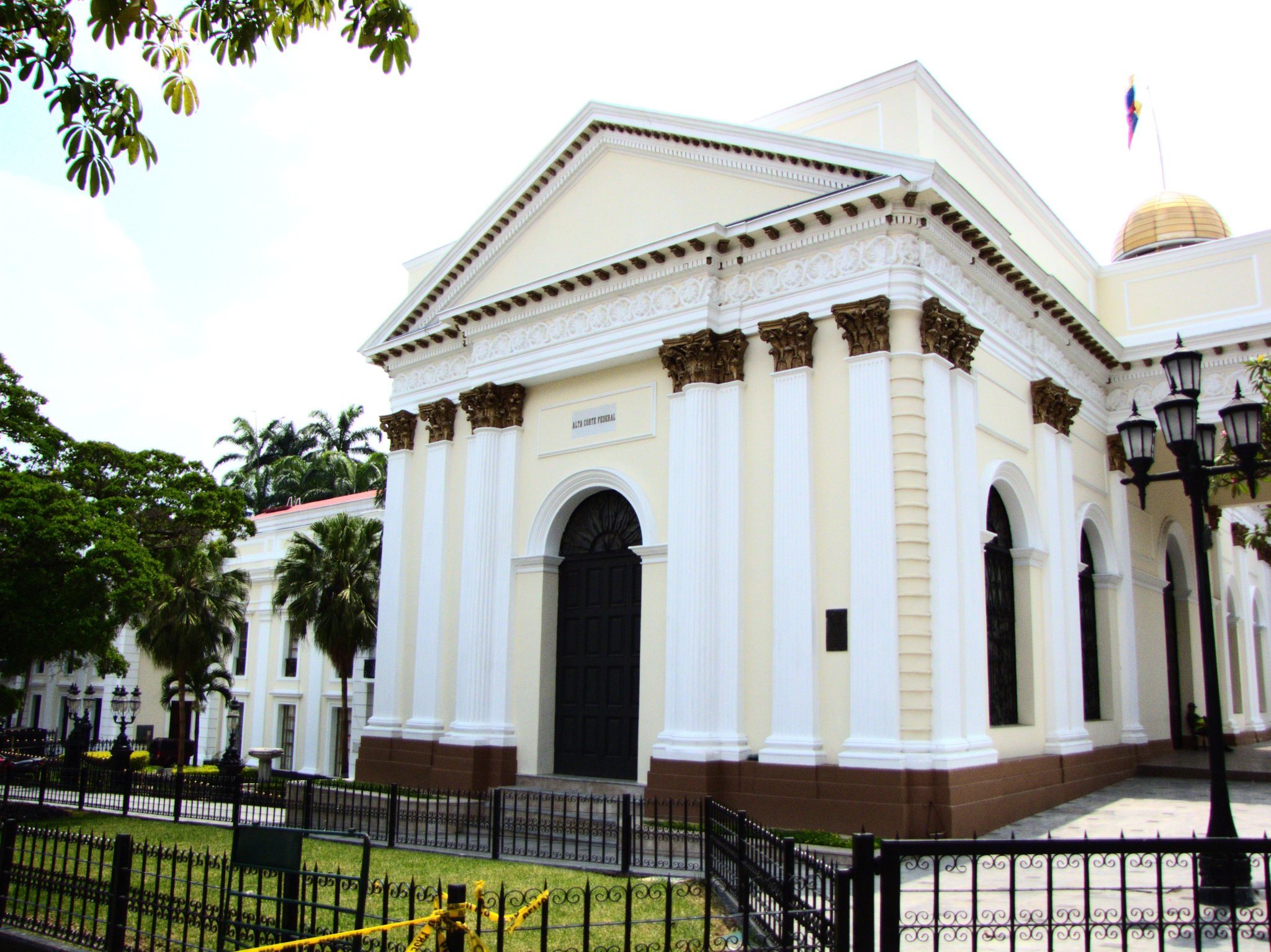
The southern Legislative Palace has a symmetrical facade organized around a central portico. Three columned portals support the composition, while a triangular pediment carries relief busts of Simón Bolívar, the principal military and political leader of Venezuela’s independence movement, and Antonio Guzmán Blanco. The central portal is supported by two caryatids, sculpted female figures used in place of columns or pilasters, representing Justice and Freedom.
Salón Elíptico
The Salón Elíptico is the principal hall of the complex. Two figures representing Justice and Freedom, made by the Venezuelan sculptor Eloy Palacios, decorate its main facade. Inside, two large arches divide the room into the Yellow, Blue, and Red Halls. An oval dome rises approximately 26 metres high and measures about 13 metres across. The original dome was imported from Belgium and installed in 1890; it was later replaced by an anodized-aluminium dome topped by the Venezuelan national flag.
Each of the three interior sections contains a major historical painting. The Blue Hall has Martín Tovar y Tovar’s depiction of the Battle of Carabobo on the ceiling beneath the dome. That 1821 victory secured Venezuelan independence from Spanish colonial rule. The Red Hall contains Tovar y Tovar’s 1890 painting of the Battle of Boyacá, while the Yellow Hall contains Antonio Herrera Toro’s 1890 painting of the Battle of Ayacucho. Boyacá, Junín, and Ayacucho were major victories in the wider South American independence campaigns.
The hall also contains the ark holding the 1811 congressional proceedings and the handwritten Declaration of Independence of Venezuela, signed on 5 July 1811. Materials associated with the Constitutional Congress of 1811 and 1812 are preserved there as well.
Legislative chamber
The southern complex contains a spacious legislative chamber extending through three levels. At its northern end, a concave dais accommodates the presiding board, with the honorary gallery and secretariat table below it. Deputies’ seats face the dais, while galleries for honoured guests, the press, and the public occupy the southern part of the room. On the northern wall, an arch displays the national colours, eight stars representing the Provinces of the Union, and the national coat of arms in gold.
Former Senate chamber
In the southwestern part of the complex, a chamber used for multinational sessions and other special events follows the general arrangement of a French hemicycle. It formerly served as the Senate chamber and was also used as the session hall of the 2017 National Constituent Assembly.
Federal Palace and ceremonial rooms
Salón del Tríptico
The Salón del Tríptico is separated from the Salón Elíptico by a vestibule. Its name comes from Tito Salas’s triptych. The left panel shows the Oath of the Sacred Mount in Rome, the central panel depicts the Crossing of the Andes, and the right panel represents the moment when Simón Bolívar’s spirit leaves his body. The hall contains Venezuela’s original republican constitutions, from the Federal Constitution of 1811 to the constitution promulgated in 1999.
Salón de los Escudos
At the eastern end of the northern body, the Salón de los Escudos takes its name from the national coat of arms and representations of the coats of arms of Venezuela’s federal entities. It contains Pedro Centeno Vallenilla’s Venezuela Receiving the Symbols of the National Coat of Arms, produced between 1952 and 1954. The room is used for important meetings between parliamentary commissions and officials or citizens.
Galleries, courtyard, and collections
Lateral buildings
The lateral buildings contain offices, the office of the president of the National Assembly, and the Federal Legislative Library. Their upper level includes the offices of the first vice-president and the secretary of the National Assembly.
Central courtyard
The central courtyard is a broad garden planted with chaguaramo palms, Roystonea oleracea, and other palms. A sculptural fountain made in the United Kingdom arrived in Venezuela in January 1876. It was first placed between the two lateral bodies and later moved to the centre because the original location did not provide enough space. Cast-iron railings enclose the garden.
Historical and artistic collection
The complex contains 101 historical and artistic works, including paintings by Martín Tovar y Tovar, Antonio Herrera Toro, Tito Salas, Pedro Centeno Vallenilla, and Jacinto Emilio Mauri. The collection includes portraits and other representations of the heroes and heroines of Venezuelan independence, especially Simón Bolívar. Other works include Herrera Toro’s 1904 painting of the Battle of Junín and Salas’s 1911 Bolivarian Triptych, alongside works associated with Venezuela’s national symbols and independence campaigns.