Transfiguration Monastery in Tryhiria: An Orthodox Monastic Complex in Ukraine
Site at a Glance
- Rating
- 4.8
- Popularity
- Low
- Country
- Ukraine
- Primary era
- Modern
- Eras represented
- Medieval, Early Modern, Modern
- Civilizations
- Polish–Lithuanian Commonwealth, Russian
- Site type
- Religious
- Remains
- Monastery
On this page16 sections
History
Transfiguration Monastery in Tryhiria, Ukraine, is an Eastern Orthodox male monastery whose origins are associated with traditions of a sixteenth-century monastic community and whose present architectural complex largely took shape between the seventeenth and nineteenth centuries. It belongs to the Zhytomyr and Novohrad-Volynsk Eparchy of the Ukrainian Orthodox Church of the Moscow Patriarchate and stands beside the Teteriv River, about 20 kilometres from Zhytomyr.
Early foundations and Orthodox community
The monastery’s earliest foundation date remains uncertain. One tradition places a monastic community at the site by about 1575, while another attributes its foundation in 1583 to Prince Vladimir of Zhytomyr. That attribution has been questioned because the area then formed part of the Volhynian Voivodeship of the Polish–Lithuanian Commonwealth. The Vladimir named in the tradition may instead have been Vladimir Olgerdovich, the ruler of the Principality of Kyiv from 1362 to 1394.
A more firmly established revival or refoundation took place in 1613. The Orthodox landowners Nikolai and Feodor Voronich were associated with this development, after Nikolai allocated land for a new hermitage at the request of Cyril, the abbot of the Lubar monastery. The new community became connected with the Berdychiv monastery. Its first church was dedicated to the Holy Trinity.
When Peter Mogila, the Orthodox Metropolitan of Kyiv, visited the monastery in 1644, about 80 monks lived there under the direct authority of the metropolitan. A Gospel manuscript from the first half of the seventeenth century preserves an inscription recording its donation to the Holy Trinity church at Tryhiria.
War, rebuilding, and the Uniate period
The monastery suffered repeatedly during the wars between the Cossacks and the Poles. In 1651, Cossacks returning after their defeat at Berestechko plundered the community, and the Holy Trinity church was destroyed. A wooden church dedicated to the Transfiguration was erected in 1685 to replace it.
In 1723 the monastery entered the Uniate Church, an Eastern Christian church in communion with Rome that retained Byzantine liturgical traditions. Its superiors adopted Latin titles, and the community became associated with the Basilian order, a monastic order within that tradition. It was attached to the Belolivka monastery in Galicia and placed under the administration of the Pochaiv monastery.
During the eighteenth century the community declined sharply, numbering about ten monks by the middle and later part of the century, while financial difficulties increased. The monastery nevertheless maintained a broad economic and charitable network. It owned 17 villages and, by the end of the century, operated a distillery, brewery, mead brewery, water mill, apiary, smithy, bakery, and farmyard with horses, cattle, pigs, and poultry. Agricultural land and serfs supplied further income. The monastery assisted nearby villages during crop failures, maintained Orthodox and Catholic schools, and ran a hospital from 1777.
The Haidamaka uprising, an eighteenth-century violent revolt in the Polish–Lithuanian borderlands, reached the monastery in 1768. Ivan Gonta seized the complex and expelled the Uniate abbot Levitsky. Levitsky fled to the Uman monastery, where Maksym Zalizniak later killed him.
Russian imperial administration and Orthodox restoration
After the second partition of Poland in 1793, the monastery and eastern Volhynia became part of the Russian Empire. Between 1795 and 1839, its ecclesiastical administration shifted among Uniate jurisdictions as those institutions were reorganized. In 1839–1841, the monastery was transferred to the Orthodox Church and assigned to the Volhynian–Zhytomyr Orthodox Eparchy. Uniate clergy who resisted conversion were sent to the monastery or removed to other monastic institutions.
Under the Orthodox abbot Leonty Skibovsky, the monastery promoted the conversion of laypeople in the Zhytomyr and Kyiv regions to Orthodoxy. It also housed Uniate clergy who opposed conversion, including the Basilian hieromonk Ignatius Bashnyansky. A hieromonk was a monk who was also an ordained priest, while a Basilian hieromonk belonged to the Uniate monastic order.
In 1842 the monastery was classified as a second-class monastery. Its established complement consisted of one archimandrite, six hieromonks, three hierodeacons, two monks, and four novices. An archimandrite was a senior monastic title, while a hierodeacon was a monk who served as a deacon. In 1862 the state granted the monastery 242 desyatinas, a historical land measure, of arable and haymaking land. By 1887, however, many residential and service buildings were severely deteriorated.
A parish school opened on 23 October 1883. It had 15 pupils in 1887 and was taught by a monastery novice. After 1915, nuns from the monastery at Turkowice came to Tryhiria during wartime evacuations.
Closure, revival, and continuing religious life
The monastery was closed during the 1930s and definitively dissolved by 1939. The Transfiguration church became a warehouse, while the brotherhood building was used for a rural school. The Epiphany church and the church of the Myrrh-Bearing Women were demolished in 1938.
German occupation authorities reopened the Transfiguration church as a parish church in 1941. It continued in that role until 1990, while the former monastic residential building remained a school after the Second World War. Monastic life resumed in 1990, and the parish was formally restored as a monastery in 1993. In 2012, the community comprised about 20 residents, including approximately nine monks and 11 novices.
A dam built on the Teteriv River in 1984 raised the water level by 20 metres, threatening the monastery and its fourteenth-century monastic caves. Repair and restoration work has continued. The monastery remains an active religious institution within the Zhytomyr and Novohrad-Volynsk Eparchy.
The eighteenth-century Tryhiria Icon of the Mother of God remains an important object of devotion at the monastery. Its veneration was extended to the wider Ukrainian Orthodox Church of the Moscow Patriarchate in 2018. A local tradition holds that the icon appeared at a spring near the monastery.
Remains
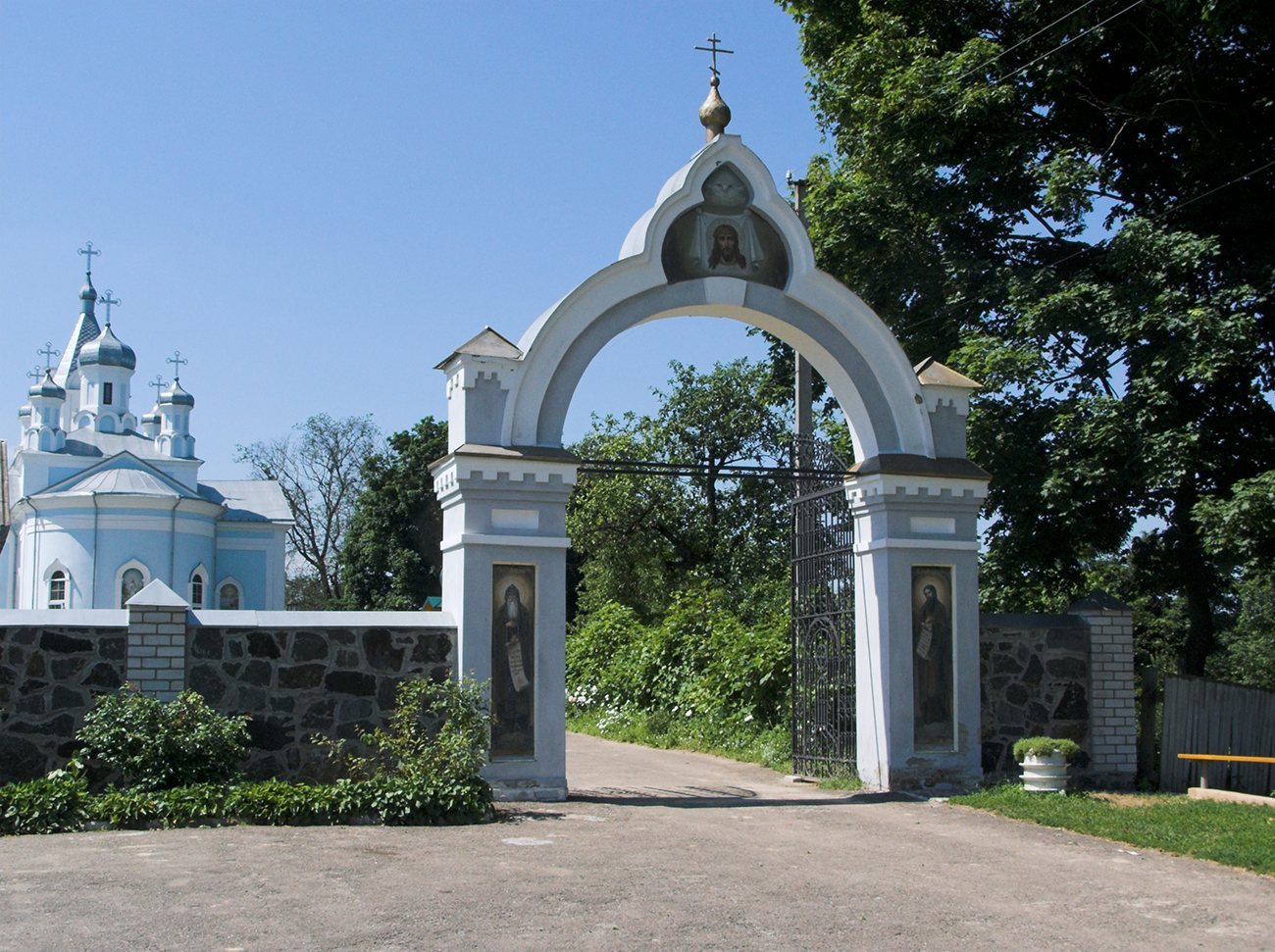
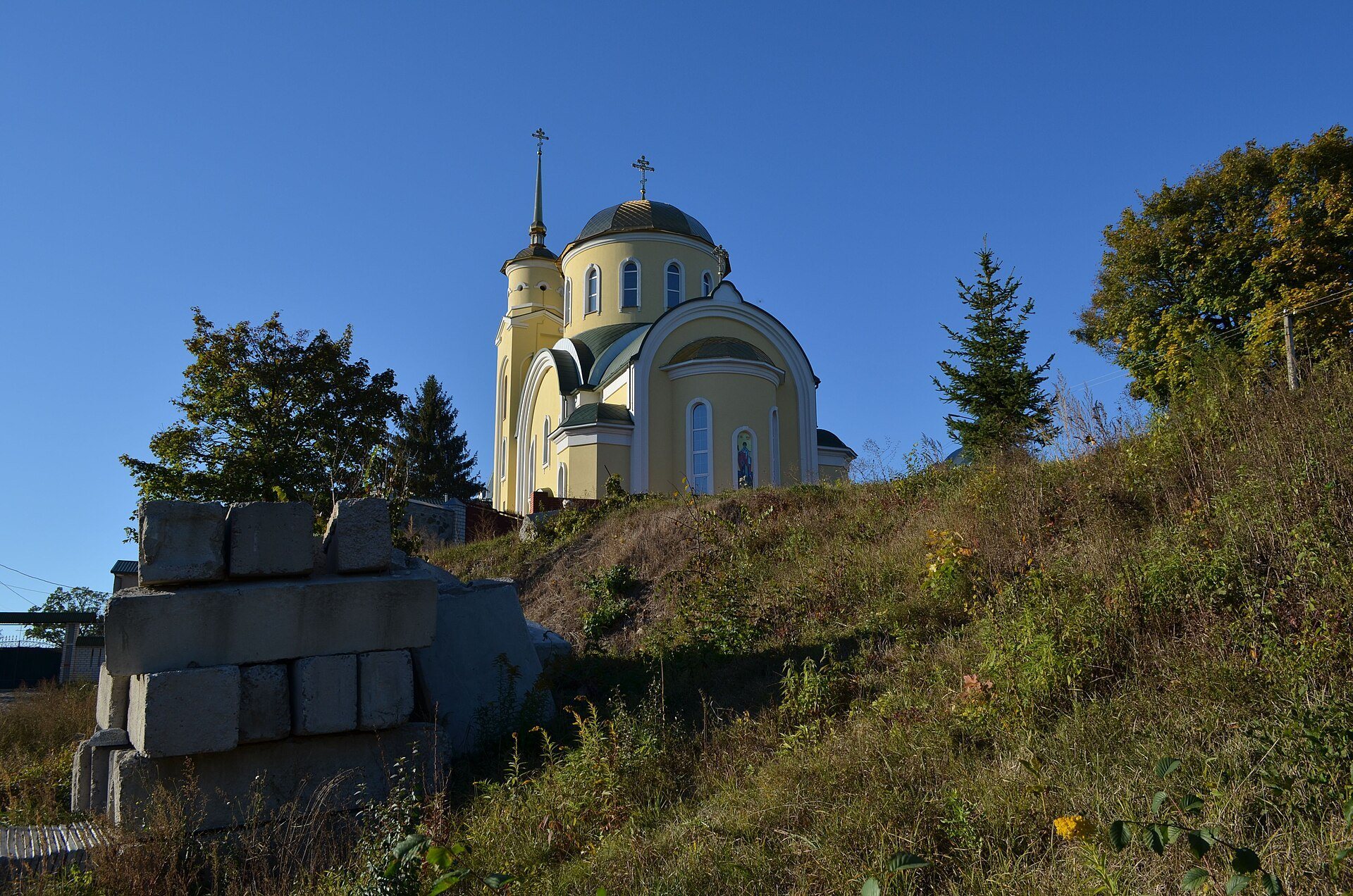
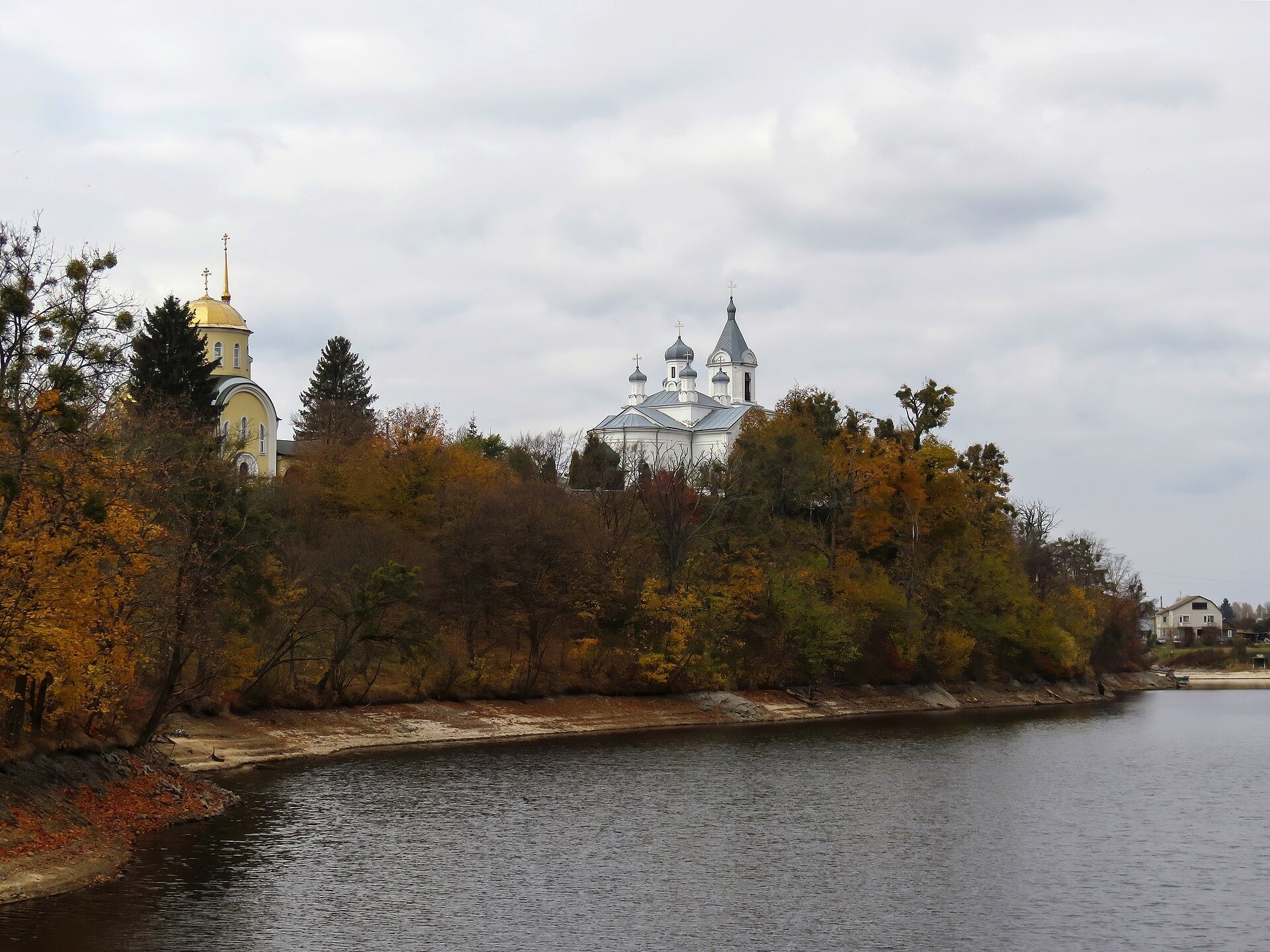
The monastery occupies the edge of a steep rocky promontory on a bend of the Teteriv River. Its surviving complex includes churches, former monastic buildings, a courtyard with a decorative garden, and fourteenth-century caves associated with early monastic activity. The buildings represent successive phases from the wooden churches of the seventeenth century to the stone and brick construction of the eighteenth and nineteenth centuries, with repair and restoration continuing in the present.
Monastic setting and early remains
Monastic caves
Fourteenth-century monastic caves are associated with the site. They lie within the rocky landscape beside the river and were threatened when the 1984 dam raised the Teteriv’s water level by 20 metres. Their association with the monastery provides a physical link between the later buildings and an earlier phase of monastic activity.
Brotherhood building
The two-storey stone brotherhood building was erected in 1762 on the site of older wooden cells. It was substantially reconstructed in 1782 by the Lviv architect Johann Schneider, whom Abbot Adrian Shubovich invited to undertake the work. The building later served as a rural school after the monastery’s dissolution and has since formed part of the repair and restoration of the former monastic complex.
Churches and chapels
Transfiguration church
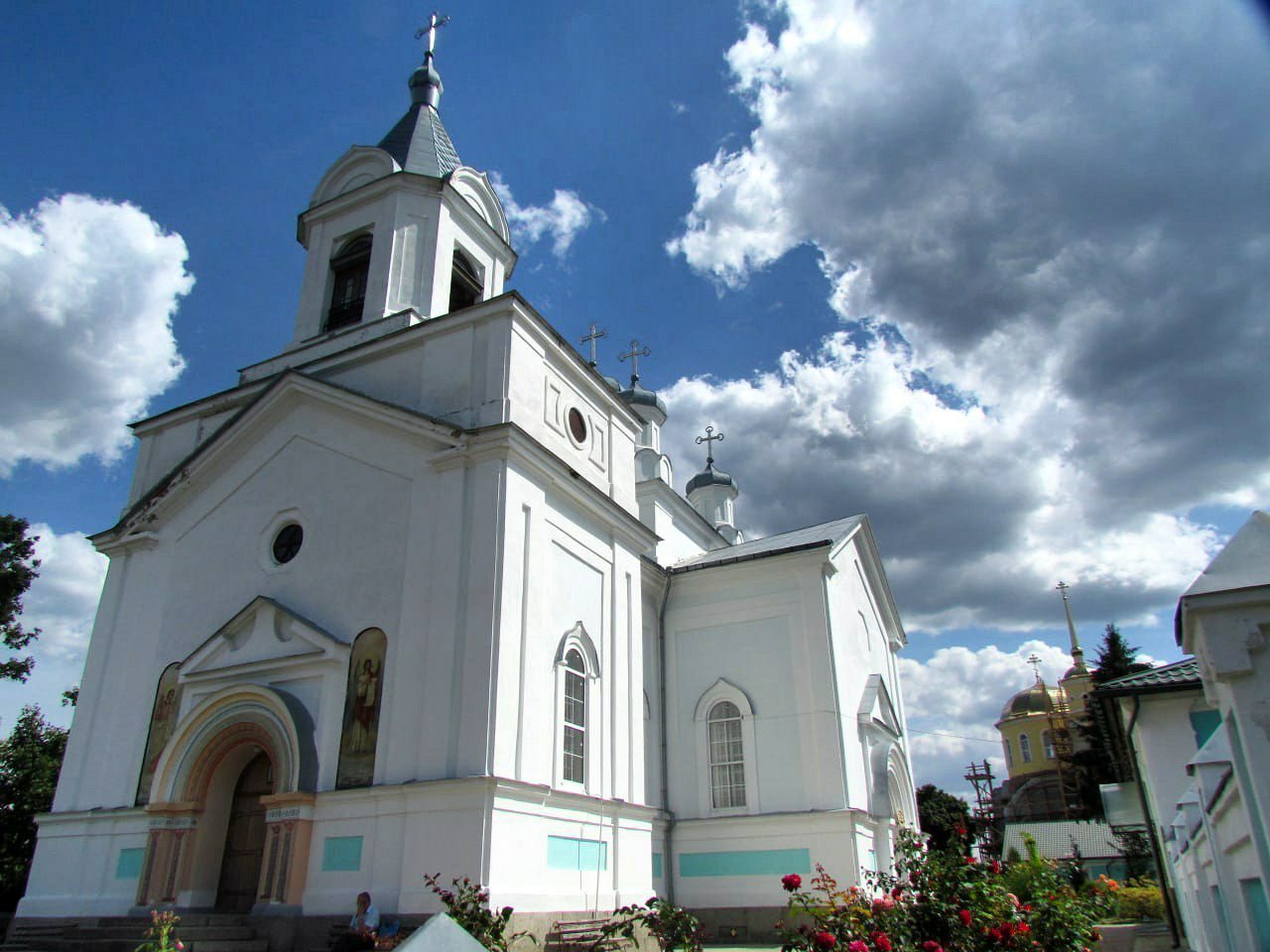
The main Transfiguration church was built in brick between 1854 and 1873, replacing the wooden church erected in 1685. Its architecture follows Russian-Byzantine forms associated with the Tonov style, an architectural direction linked with the architect Konstantin Ton. The church has a cruciform plan, meaning that its layout forms a cross, and includes a semicircular apse, five domes, and a bell tower above the narthex, or entrance area. The four lateral domes stand at the corners of the central volume, while the bell tower is capped by a tent roof.
Under Leonty Skibovsky, chapels dedicated to Saint Nicholas of Myra and Saint Basil the Great were added to the church. Its interior contains frescoes, including a prominent representation of the Last Judgment. The building was converted into a warehouse after the monastery closed, reopened as a parish church in 1941, and returned to monastic use after the revival of monastic life.
Epiphany church
The stone Epiphany church was constructed between 1848 and 1852. It formed part of the nineteenth-century rebuilding of the monastery and was later demolished in 1938.
Churches in the old cemetery
A church dedicated to the Mother of God as “Joy of All Who Sorrow” was built in the old cemetery in 1792. It was later rededicated to the Myrrh-Bearing Women. A separate church dedicated to Saint Barbara was also built in the cemetery area. The church of the Myrrh-Bearing Women was demolished in 1938.
Devotional objects
Tryhiria Icon of the Mother of God
The Tryhiria Icon of the Mother of God is an eighteenth-century image whose painting style belongs to that period. Its local tradition connects it with a spring near the monastery, where it was said to have appeared. The icon remains an object of veneration within the monastery.
Other sacred objects
The monastery preserves a copy of the Pryazhev Icon of the Mother of God, a Marian devotional image associated with Pryazhevo. It also holds a reliquary containing particles of relics connected with saints of the Kyiv Caves Monastery, the historic Orthodox monastic center in Kyiv known for its cave complex and relics.