Castro de Pragança: A Prehistoric Fortified Settlement in Portugal
Site at a Glance
- Rating
- 3.9
- Popularity
- Very Low
- Country
- Portugal
- Primary era
- Stone Age
- Eras represented
- Stone Age
- Civilizations
- Unclassified
- Site type
- Military
- Remains
- Fort
On this page13 sections
History
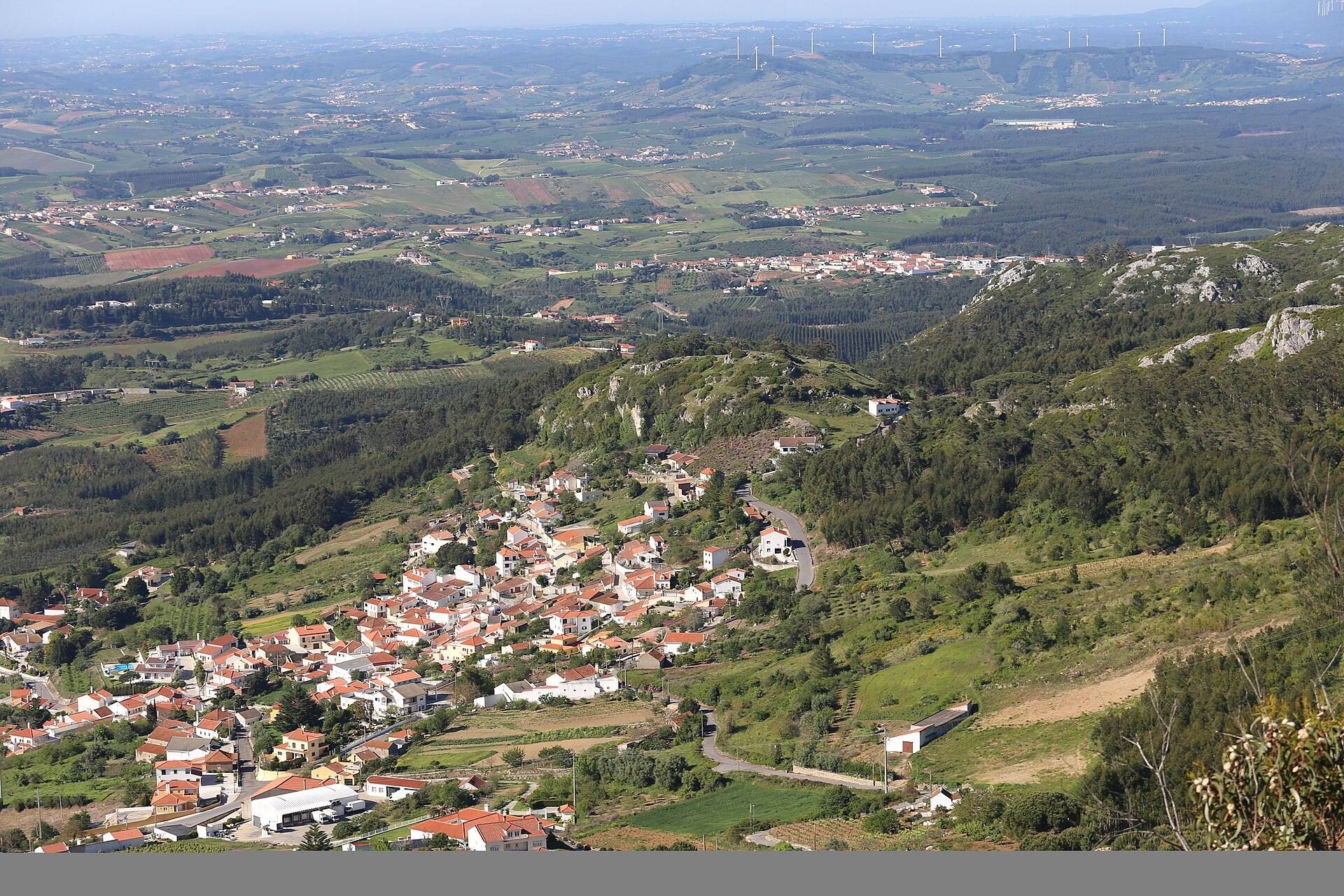
Castro de Pragança is a multi-period archaeological settlement in Portugal, located at Picoto do Castelo near Pragança on the northwestern slope of the Serra de Montejunto. Its principal fortification was built during the Early Chalcolithic, in the first half of the third millennium BC, over an earlier Final Neolithic occupation. The site remained in use through the Copper, Bronze, and Iron Ages and into the first century AD, when Romanization brought Roman political, cultural, technological, and economic practices into the region.
From the Final Neolithic to the Chalcolithic
Archaeological evidence places the earliest occupation at Castro de Pragança in the Final Neolithic, the later phase of the Neolithic. The settlement was subsequently fortified during the Early Chalcolithic, or Copper Age, a period when copper working developed alongside established stone technologies. The defensive work was built directly on bedrock and incorporated the natural cliffs of the rocky elevation, probably to protect the settlement.
Radiocarbon samples from the entrance corridor produced calibrated dates of approximately 2837–2471 BC and 2866–2581 BC. These dates relate to material that filled the corridor and probably belong to the abandonment phase rather than to the construction of the fortification itself. The defensive structure is therefore attributed to the first half of the third millennium BC, while earlier Neolithic activity represents a preceding phase of occupation.
Later prehistoric and Roman occupation
Castro de Pragança continued to be used after its Chalcolithic fortification was built. The archaeological collection contains substantial Bronze Age material, particularly from the Final Bronze Age, as well as objects from the Iron Age. This sequence shows that the settlement was not limited to a single Copper Age phase.
The assemblage also includes material from the Roman period, including silver coins of the Roman Republic, roof-tile fragments, and other objects associated with Romanization. Occupation continued into the first century AD, extending the history of the settlement beyond the prehistoric periods.
Discovery and archaeological investigation
The site was discovered in 1893. José de Leite de Vasconcelos, a Portuguese archaeologist and museum director, investigated it with António Maria Garcia, a primary-school teacher in Pragança. They collected artefacts and recognized the importance of the settlement as a site occupied across several periods. Extensive disturbance of the soil, however, prevented the identification of a clear sequence of archaeological layers.
Leite de Vasconcelos did not fully publish the material from his excavations and surface collections, and many objects collected by Garcia also lack secure archaeological contexts. This uncertain provenance limits precise dating and makes it difficult to connect individual artefacts with particular phases of occupation.
Cónego Boto later carried out small-scale interventions that produced a group of finds now held at the Museum of Faro. During the 1930s and 1940s, Leonel Trindade surveyed and excavated parts of the Serra de Montejunto, including Pragança. Material from this work was given to Manuel Heleno, then director of the Ethnological Museum in Lisbon.
Between 1988 and 1990, the archaeologist João Ludgero Gonçalves resumed investigation through three excavation campaigns. The work concentrated on the fortifications and supported comparative studies with the Chalcolithic settlement of Olelas. Excavations in 1989 exposed the outer wall face, its stone filling, the continuation of the wall around the northern part of the elevation, and the access corridor. Work in 1990 clarified the semicircular structure and its attached rectangular construction.
Research into the artefacts
The site’s dispersed finds continue to inform studies of Portuguese prehistory, protohistory, and Romanization. Raquel Vilaça examined 15 weighing objects in relation to Final Bronze Age and Early Iron Age contexts in western Iberia. Their internal sequence may represent sets of standardized weights used with balances, although the excavation records do not allow a secure attribution to either period.
Metallurgical research examined 53 artefacts through optical emission spectroscopy, with additional analysis by X-ray fluorescence. The wider metal collection contains about 500 objects, including fragments and casting waste. One studied sample comprised 21 weapons, 13 tools, and four ornaments. The results distinguish copper from bronze and represent the Chalcolithic, Early Bronze Age, Final Bronze Age, Iron Age, and Roman periods.
Castro de Pragança is currently described as completely abandoned. Its archaeological material is distributed among the National Museum of Archaeology, the Museum of the Portuguese Archaeologists’ Association, the Museum of the Geological Services, and the Museum of Faro, rather than being preserved as a fully contextualized collection at the settlement.
Remains
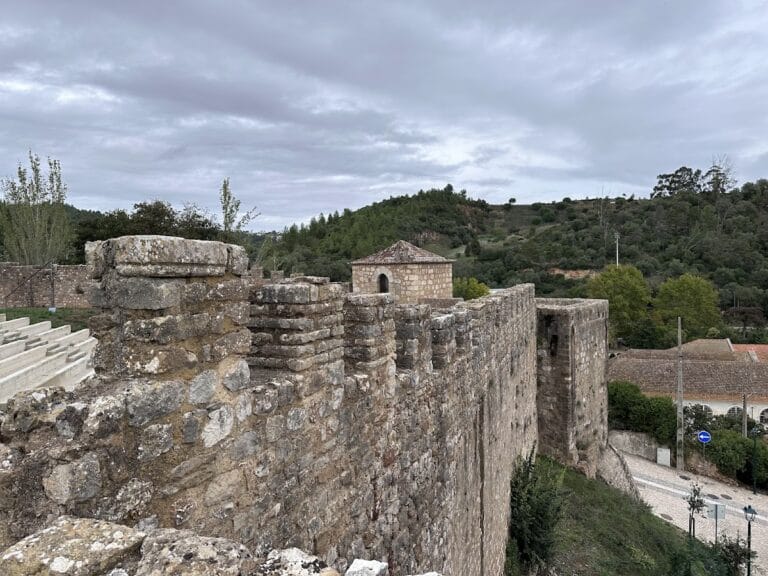
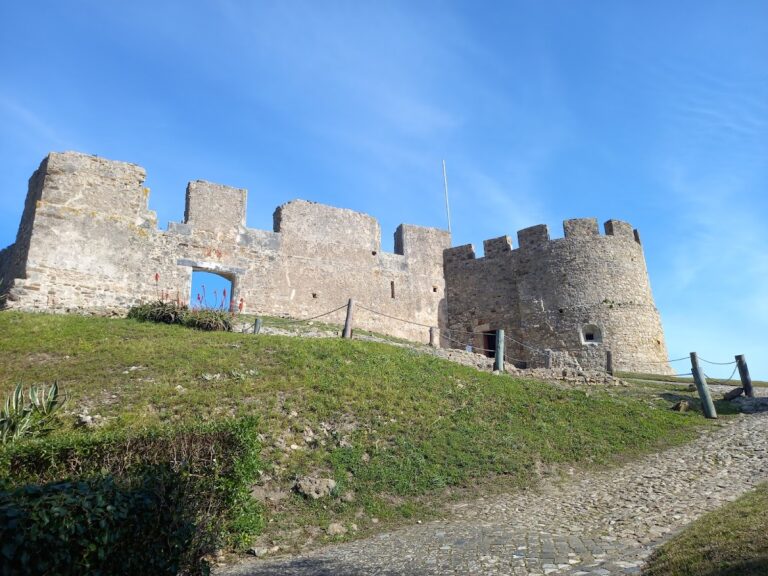
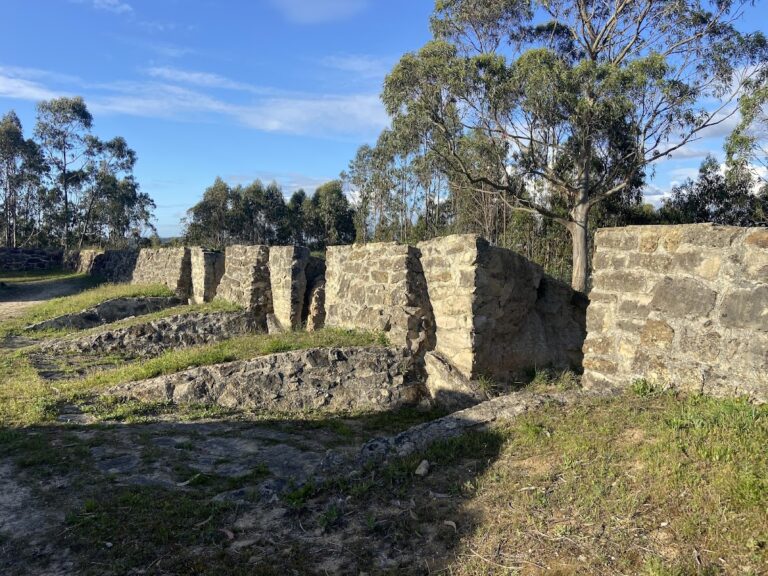
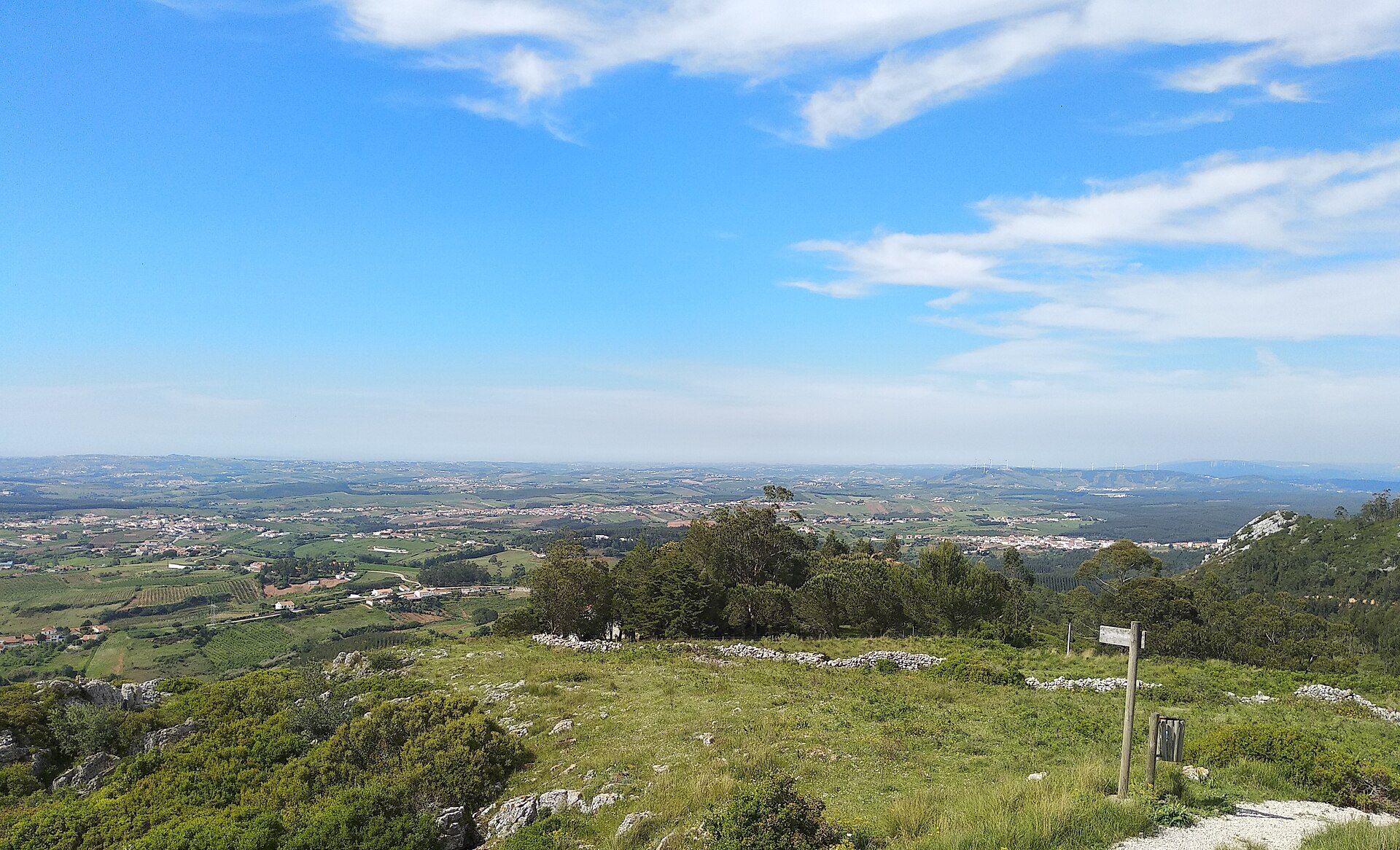
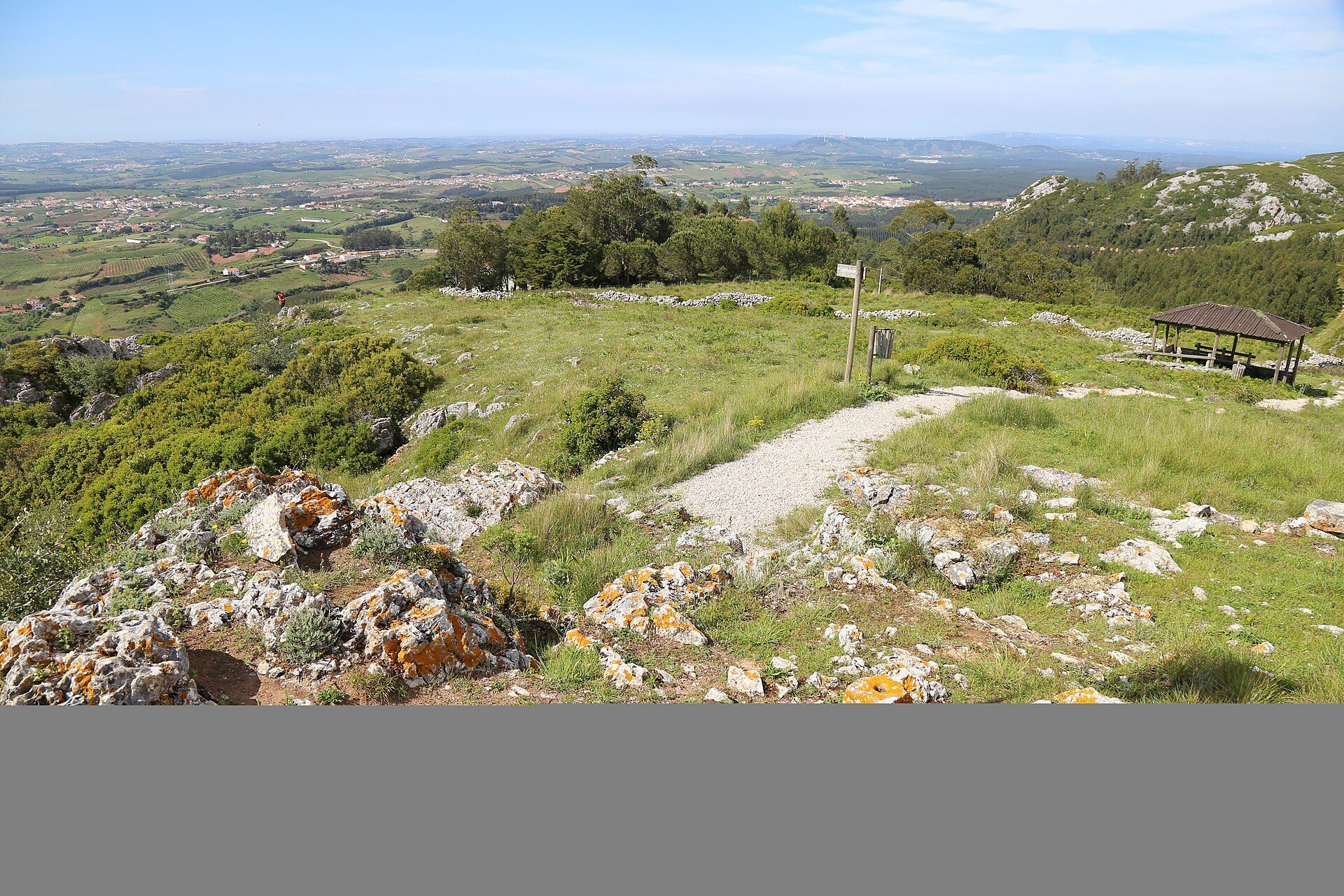
Castro de Pragança occupies a rocky elevation above 300 metres on the Serra de Montejunto. Its defensive arrangement uses the natural cliffs and the underlying bedrock as part of the settlement’s boundaries. The surviving fortification consists of a massive semicircular structure with a large-block outer wall, a stone-filled interior, a northern entrance corridor, and a rectangular addition on the southern side.
Fortification
Semicircular enclosure
The principal defensive structure measures approximately 15 metres in length and 10 metres in width. It was built directly on the bedrock, with large stones forming an exterior face and smaller stones packed inside to raise the internal area. This large-block construction has a cyclopean appearance, meaning that it uses very large, roughly fitted stones. The structure has a single exterior masonry face rather than the two-faced arrangement found at the comparable fortification of Olelas.
Entrance corridor and southern annex
On the northern side, a corridor rises from the entrance towards the centre of the fortification. It leads to an elevated internal platform formed partly by natural rock and partly by the stone fill of the structure. The corridor’s fill contained Campaniform pottery, a later prehistoric ceramic tradition associated with bell-shaped vessels and related decoration. Calibrated radiocarbon dates from this fill probably belong to the abandonment of the corridor.
A rectangular annex adjoins the southern side of the semicircular structure. It rests on bedrock and uses smaller blocks than the main defensive work, suggesting that it was added later as a reinforcement. Together, the semicircular structure and the annex extend for approximately 17 metres. The 1990 excavation defined this relationship and clarified the form of the attached construction.
Archaeological finds
Stone, ceramic, and small finds
The assemblage includes stone perforators and chisels, perforated pottery, a clay spoon, clay spheres, and an ivory cylindrical pendant interpreted as religious or ornamental. Other finds include blue glass beads, round hand-mills, and bronze fibulae, which were brooches used to fasten clothing. The collections also contain seven cylinders and one half-cylinder from an area known as Bico de Vela, although their precise archaeological context is uncertain.
Material from Cónego Boto’s interventions includes ceramic loom weights, a metal chisel, rings, and part of a metal dagger blade. These objects are held at the Museum of Faro. Other artefacts attributed to the settlement include socketed spearheads, grooved axes, a sickle, sword fragments, daggers, arrowheads, bronze or copper rings, and roof-tile fragments.
Weighing objects
The group of 15 weighing objects is typologically varied. Several are biconical, including pieces with hexagonal sections, while others are irregular, plano-convex, sub-spherical, sub-ovoid, or sub-circular. Their recorded dimensions range from less than 1 centimetre to 1.9 centimetres, and their weights range from 1.82 to 18.72 grams.
Individual examples include a sharply angular biconical object measuring 1.1 by 0.8 centimetres and weighing 4.79 grams, a biconical piece measuring 1.6 by 0.7 centimetres and weighing 9.32 grams, and a larger biconical object measuring 1.9 by 1.1 centimetres and weighing 18.72 grams. The group also includes a hollow half-calotte with a small circular opening, measuring 1.7 by 0.5 centimetres and weighing 4.34 grams, together with a circular lead weighing object studied separately.
Metal weapons, tools, and ornaments
The copper-alloy assemblage includes weapons, tools, and ornaments from several periods. In the X-ray fluorescence study, 27 of 38 selected artefacts were bronze and 11 were copper. The ornaments belonged to the bronze group, while weapons and tools occurred in both metals.
Most Bronze Age objects are binary bronzes. The copper artefacts correspond technologically to Chalcolithic and Early Bronze Age examples, while the more varied bronze objects belong mainly to the Final Bronze Age. Together with the Iron Age and Roman materials, these finds provide physical evidence for the long sequence of activity at the settlement.