Yanase Futagozuka Kofun: A Keyhole-Shaped Burial Mound in Japan
Site at a Glance
- Rating
- 3.8
- Popularity
- Very Low
- Country
- Japan
- Primary era
- Medieval
- External website
- Open
- Eras represented
- Medieval
- Civilizations
- Yamato
- Site type
- Burial
- Remains
- Burial Mound
On this page7 sections
History
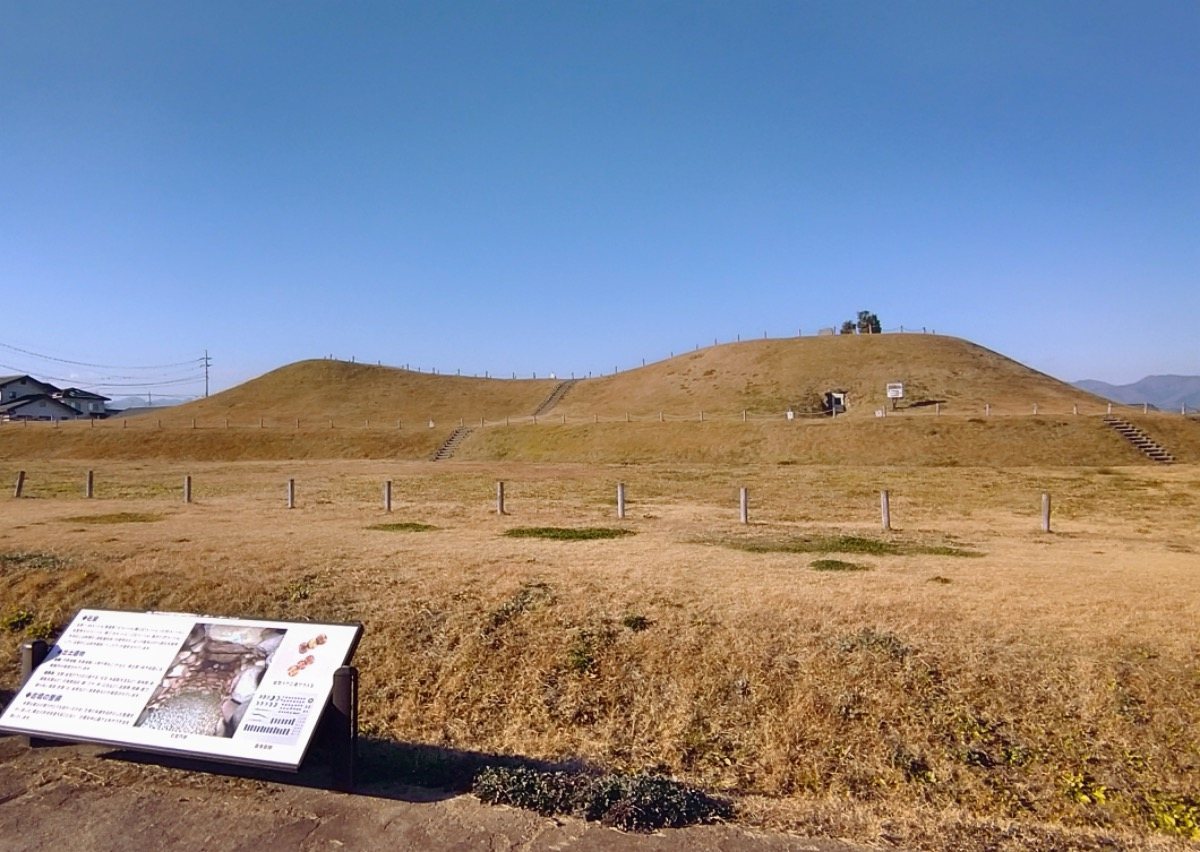
Yanase Futagozuka Kofun is a keyhole-shaped burial mound in Annaka, Japan, built at approximately the beginning of the sixth century AD during the late Kofun period. It was constructed for an elite burial and is the only identified keyhole-shaped mound along the middle and upper Usui River. At the time of its construction, it was among the largest burial mounds in Gunma Prefecture.
Construction in the Late Kofun Period
The mound was built on the edge of a middle river terrace beside the left bank of the Usui River in western Gunma. Its design combined a circular rear section with a square front section, forming the keyhole shape associated with some elite burials of ancient Japan. The stone chamber is regarded as one of the oldest examples of a horizontal-entry chamber in Gunma and, more broadly, in the Kanto region. Its construction retained methods inherited from the earlier tradition of chambers entered vertically from above.
Investigation and Preservation
The burial chamber was opened in 1879, and grave goods were recovered. A survey followed in 1957, while archaeological excavations began in 1995 and their results were reported in 2003. Site improvement works took place from fiscal years 2011 to 2014. The mound became a historic park in July 2015, while access to the stone chamber remained restricted.
Yanase Futagozuka Kofun was designated a National Historic Site of Japan on October 15, 2018, and its protected area was expanded on February 17, 2026. The excavated objects received designation as Important Tangible Cultural Properties of Annaka City on November 27, 2012. They are preserved and displayed at the Furusato Learning Museum in Annaka City’s Learning Forest.
Remains
Mound and Surrounding Earthworks
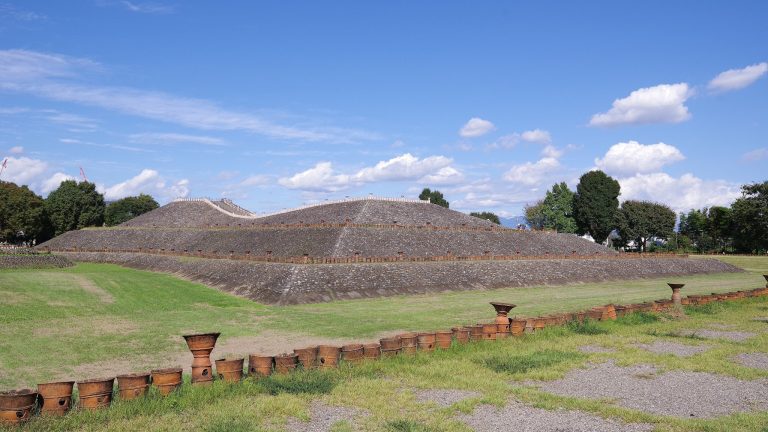
The mound is approximately 80 meters long and was built in two tiers. Its circular rear section measures about 50 meters across and rises 8 meters high, while the west-facing front section is about 60 meters wide and 7 meters high. Including the surrounding earthworks, the monument extends for more than 125 meters from end to end and about 110 meters across. An inner moat and an outer peripheral ditch encircle the mound, with crossing structures attached to both corners of the inner moat at the front.
Stones known as fukiishi, which protected and reinforced the slopes, covered the mound surface. Rows of cylindrical haniwa, fired-clay objects placed on or around burial mounds, stood on the summit and on the terraces between the two tiers. Other haniwa took the form of human and horse figures.
Horizontal-Entry Stone Chamber
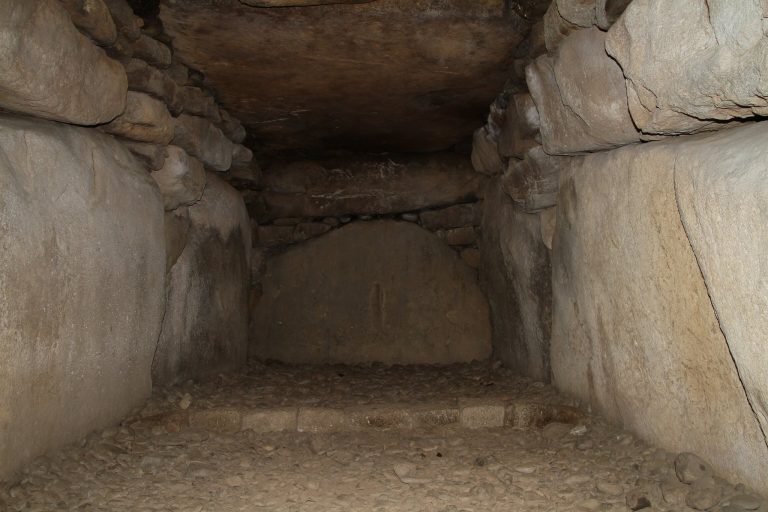
A double-sleeved horizontal-entry stone chamber occupies the circular rear section and opens toward the south. In this type of chamber, a passage descends from the side of the mound rather than entering from above. The full structure is 11.54 meters long. Its burial chamber measures 4.07 meters in length, 2.16 to 2.32 meters in width, and 2.20 meters in height. The entrance passage is 7.47 meters long and between 0.67 and 0.95 meters wide.
The chamber was constructed on the original ground surface before the mound was raised. From an entrance on the terrace, a narrow, stair-like passage descends approximately 1.2 meters before reaching the chamber. Irregularly laid river stones form the walls, while the interior of the burial chamber was painted red with bengara, a red iron-oxide pigment. The ceiling stones are made of welded tuff.
Burial Goods
Excavated grave goods include fragments of iron swords and other weapons, armor, horse fittings, numerous beads, magatama ornaments, other jewelry, and Sue ware pottery. Magatama are curved, comma-shaped ornaments associated with ancient East Asian and Japanese cultures. Sue ware is a high-fired ceramic tradition produced in Japan during the Kofun period. Approximately 1,240 artifacts were designated as Annaka City cultural properties in 2012 and are displayed at the Furusato Learning Museum.