Sans-Souci Palace: The Royal Residence of Henry I in Haiti
Site at a Glance
- Rating
- 4.6
- Popularity
- Low
- Country
- Haiti
- Primary era
- Modern
- Eras represented
- Modern
- Civilizations
- Unclassified
- Site type
- Domestic
- Remains
- Palace
On this page8 sections
History
Construction and the northern kingdom
Sans-Souci Palace is a ruined royal residence at Milot in Haiti, built by Henri Christophe, also known as Henry I, between 1810 and 1813. It became the principal home of Christophe, Queen Marie-Louise, their children, royal staff, advisers, ministers, and household. The palace was the most important of nine residences commissioned by Christophe, who also ordered forts, châteaux, summer houses, and other buildings on his plantations.
The site had previously been a French plantation that Christophe managed during the Haitian Revolution. He imposed a coercive labor system there, and the number of workers who died during construction is unknown. After Christophe became king of northern Haiti in March 1811, Sans-Souci helped establish the royal court and presented the political authority and architectural abilities of Haiti’s African-descended population to European and American observers.
During Christophe’s reign, the palace hosted lavish feasts and dances and served as a political and ceremonial center. His kingdom’s principal capital was Cap-Haïtien, which he renamed Cap-Henri. Sans-Souci and the nearby Citadelle Laferrière, a massive mountaintop fortress built as a defensive and political stronghold, formed central parts of his political and military landscape. The citadel was intended to protect the kingdom from internal and external enemies, especially a feared French invasion.
The name and the death of Christophe
The palace’s name is linked to Jean-Baptiste Sans Souci, an early Haitian revolutionary commander who opposed Christophe’s authority and refused to join his forces. Christophe later invited him to a meeting at the Grand Pré plantation, where his guards killed him. The palace was built near, and possibly directly over, the site of the killing. Some interpretations therefore regard its location as a deliberate assertion of Christophe’s power.
Christophe suffered a stroke on 15 August 1820 and died by suicide at the palace on 8 October that year. The precise place within the complex and the type of bullet remain uncertain, although later legend describes it as gold. His son and heir, Jacques-Victor Henry, was killed by revolutionaries ten days later. Christophe was buried at the nearby Citadelle Laferrière.
Destruction and preservation
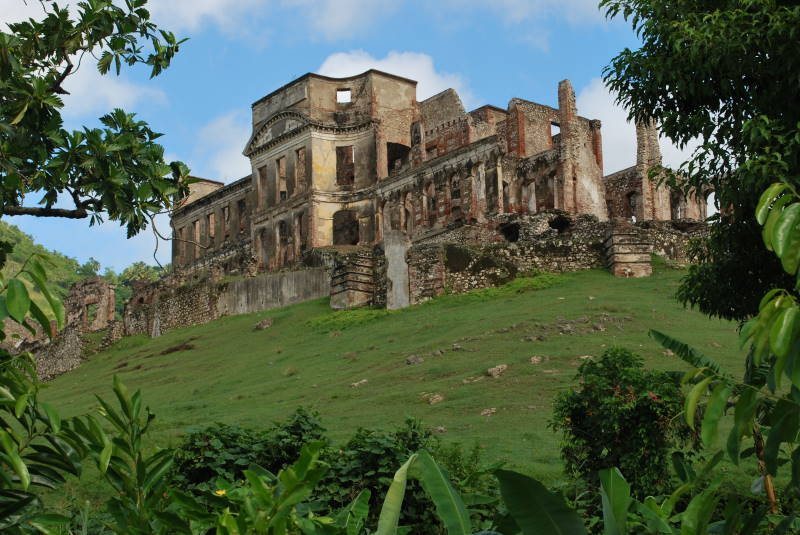
After Christophe’s death, the southern Republic took control of his territory. Sans-Souci was stripped of valuables and abandoned, ending its original role as a royal residence and political center. A severe earthquake on 7 May 1842 destroyed a substantial part of the palace and devastated Cap-Haïtien. Another earthquake in February 1843 caused further damage, and the palace and its associated buildings were never rebuilt.
Sans-Souci and the Citadelle Laferrière were among the first major buildings constructed in a free Haiti. Their remains became associated with Haitian liberty, resistance, national pride, and the rejection of slavery and colonial rule. The ruins form part of the National History Park, Citadel, Sans-Souci, Ramiers, which was inscribed on the UNESCO World Heritage List in 1982. In 2015, an ICOMOS report recommended strengthening and restoring several structures at the site.
The palace’s architectural authorship remains uncertain. Pompée Valentin Vastey, a member of Christophe’s privy council and an adviser who defended the achievements and dignity of Haiti’s African-descended population, assisted with the project. Attributions have also been made to the military engineer Henri Barre and to Henri Besse. Claims that the palace was directly inspired by Frederick the Great’s Sanssouci Palace in Potsdam remain disputed. Other interpretations emphasize French urban planning and eighteenth-century European models. Contemporary observers praised the building’s magnificence, sometimes calling it the “Versailles of the Caribbean” or one of the most impressive buildings in the West Indies.
Remains
The palace and grounds
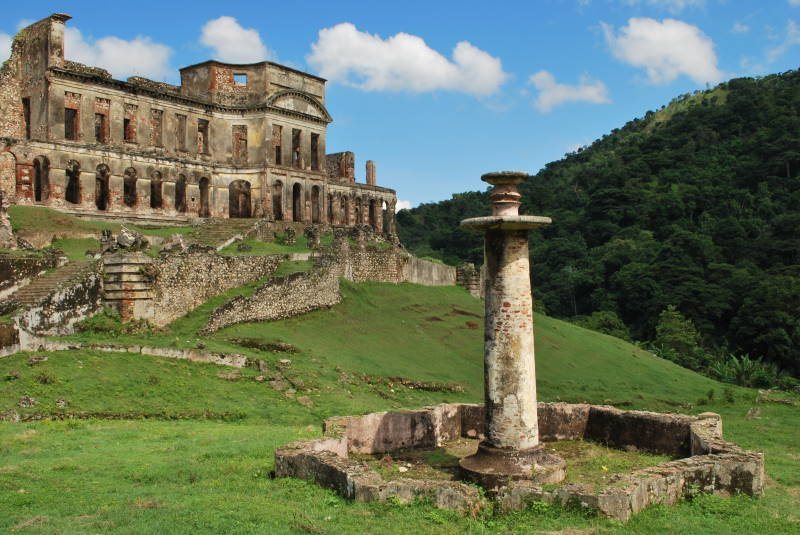
Sans-Souci stands at Milot, approximately five kilometres northeast of the Citadelle Laferrière. The complex was organized around a three-storey principal palace, a chapel or church with a broad dome, and numerous supporting buildings. The main structure had entrances on both sides, while the ceremonial entrance led to a monumental double staircase rising toward the central pavilion.
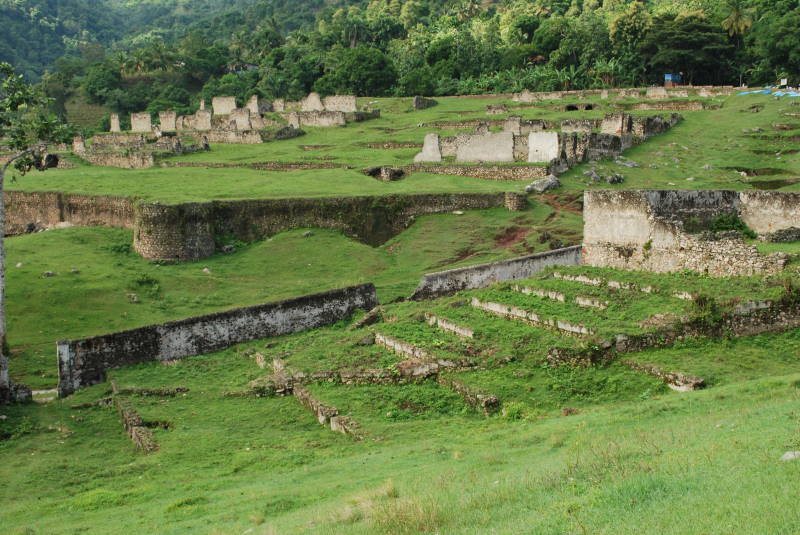
The palace combined features associated with eighteenth-century European Baroque, French planning, and London neo-Palladian architecture. Neo-Palladian design adapts the balanced proportions and classical vocabulary associated with Andrea Palladio and later European revivals. The surviving chapel façade has been identified with this influence. The grounds included broad esplanades, terraces, artificial springs, and waterworks. Mountain water reached the palace through canals that remained in place and passed beneath the mezzanine level, helping to cool the building.
Earthquake damage left the palace in ruins. Much of the interior decoration and landscaped grounds has disappeared, while some peristyles, or colonnaded passages around a building or open court, survive. A marble bust believed to represent Queen Marie-Louise is also among the remaining features.
Associated buildings
The wider complex included barracks, a hospital, ministries, a printing press, a mint, a school, an art academy, and a farm. These facilities placed royal administration, military organization, education, production, and household life around the principal residence.
Church of Our Lady of the Immaculate Conception
The Church of Our Lady of the Immaculate Conception stood beside the palace. Rebuilt after the earthquakes, it later served as a parish church and tourist attraction before fire destroyed it in 2020.