Kunšperk Castle: A Medieval Fortress in Slovenia
Site at a Glance
- Rating
- 4.4
- Popularity
- Very Low
- Country
- Slovenia
- Primary era
- Medieval
- Eras represented
- Medieval
- Civilizations
- Duchy of Styria, Holy Roman Empire
- Site type
- Military
- Remains
- Castle
On this page6 sections
History
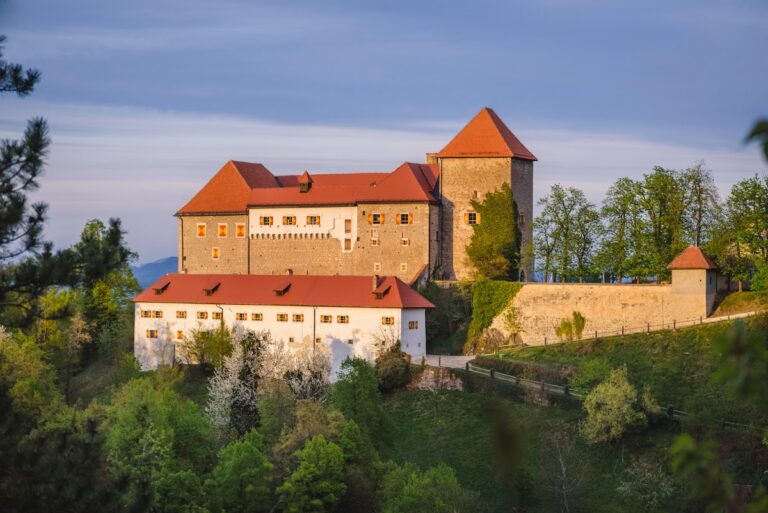
Kunšperk Castle is a medieval fortress in Slovenia, standing above the town of Kunšperk in the municipality of Bistrica ob Sotli. It was reportedly first built in the early twelfth century, when the free lord Oton Ehrnegg held the site. A replacement castle was constructed between 1167 and 1174, after Bishop Henry of Gurk ordered the original demolished in 1173 during a dispute with the Ehrnegg family of Velikovec in Carinthia.
The Ehrnegg and Kunšperk lords
The lords of Kunšperk were related to the prominent lords of Ptuj. They served as ministerials, medieval noble retainers who performed administrative or military duties for a ruler or church lord while holding landed property. Their estate came through the Gurk monastery from Countess Hemma of Gurk, and the family administered the castle until the end of the fourteenth century.
Oton Ehrnegg often accompanied the Styrian border counts and died soon after 1185. The Bishop of Gurk then entrusted the castle’s defence to another Oton, probably Ehrnegg’s nephew and the brother of Frederick of Ptuj. Later known as Oton I, he was among the leading knights at the tournament held at Friesach in 1224, where he fought Ulrich von Liechtenstein. He is mentioned three times in the poem Vrowen dienest, Aventiure von dem turnay ze Frisach.
After 1250, Oton II was followed as head of the family by his son Oton III. When Oton III died around 1270, his sons Oton IV and Frederick initially governed jointly. Frederick died around 1323, after which Hans took control. Hans died shortly before 1388, and his son Andrej inherited the estate before dying in 1395, bringing the male line of Kunšperk to an end.
Estates, inheritance, and the Counts of Celje
During the early thirteenth century, the Kunšperk and Ptuj families acquired a large allodial estate in the Upper Savinja Valley. An allodial estate was hereditary land rather than a fief granted in return for service. The two families divided the property equally and appear to have been joint heirs of certain Carinthian lords. The Ptuj family received Kacenštajn and the Žamberk territory, while the Kunšperk family received territories later associated with Hekenberg, Turn, and Velenje.
The Kunšperk family and its knights controlled the castle until Andrej transferred it to Herman I of Celje in 1395. Andrej’s sister Agnes, then married to Henry of Ehrenfels, claimed Kunšperk as her inheritance. Because the castle was a hereditary fief that could pass through women, the Bishop of Gurk granted it to Agnes in 1397. She probably soon reached an agreement with the Counts of Celje and ceded the castle to them, since no possible heir of Andrej was recorded there after 1395.
Kunšperk remained with the Counts of Celje until 1456. It was subsequently administered by the Bishops of Gurk, an ecclesiastical lordship based in Carinthia, and later by stewards and leaseholders of the territorial prince. Gasper Esenkover received the castle as a fief in 1458. In 1465, the Bishop of Gurk purchased it and appointed administrators, with the Gall family holding that position for the longest period, until 1575.
Damage, later ownership, and decline
Peasant rebels captured and damaged Kunšperk in 1515. Sigmund Tattenbach purchased the castle and its estate in 1586, and from 1608 the Tattenbach family also owned Bizeljsko Castle. Later owners included Countess Walburga, born Tattenbach, in 1749; Count M. J. Wildenstein in 1764; Countess M. Dietrichstein in 1803; F. Hirschhofer in 1820; and Prince Windischgrätz in 1858.
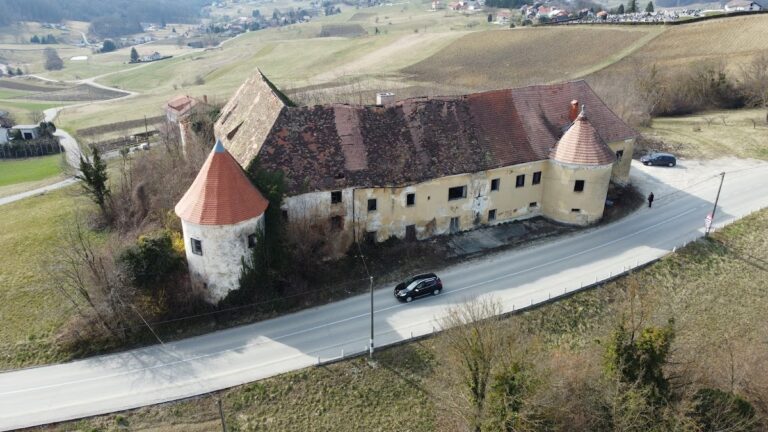
Prince Windischgrätz united the Bizeljsko and Kunšperk estates, and his family retained the castle until the end of the Second World War. Kunšperk had already begun to fall into decay during the seventeenth century.
A local legend associates the castle with a knight named Kuno. According to the story, Kuno and his armed retainers attacked nearby Cesargrad, killed its Templar knights, and burned the castle. After Kuno died following the capture of Cesargrad, his men supposedly burned Kunšperk as well. The Knights Templar were a medieval military-religious order associated with the protection of Christian pilgrims and crusading activities.
Remains
Castle ruins above the Sotla
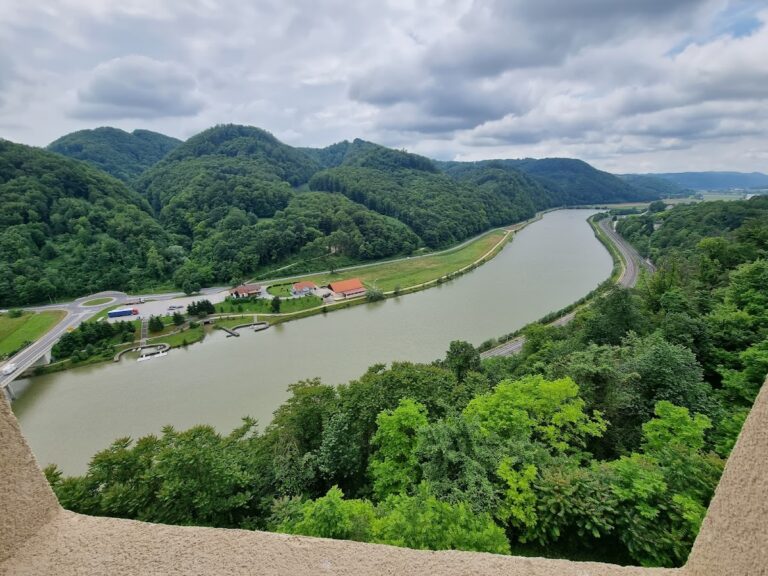
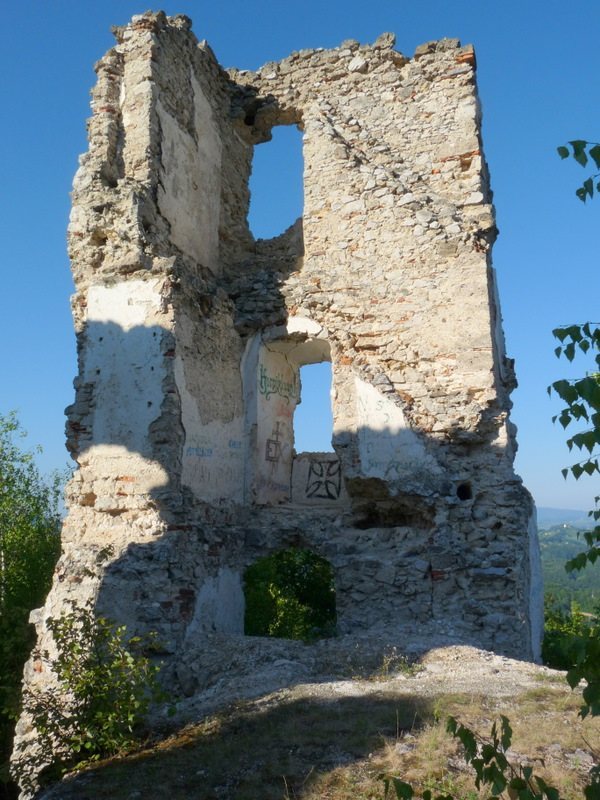
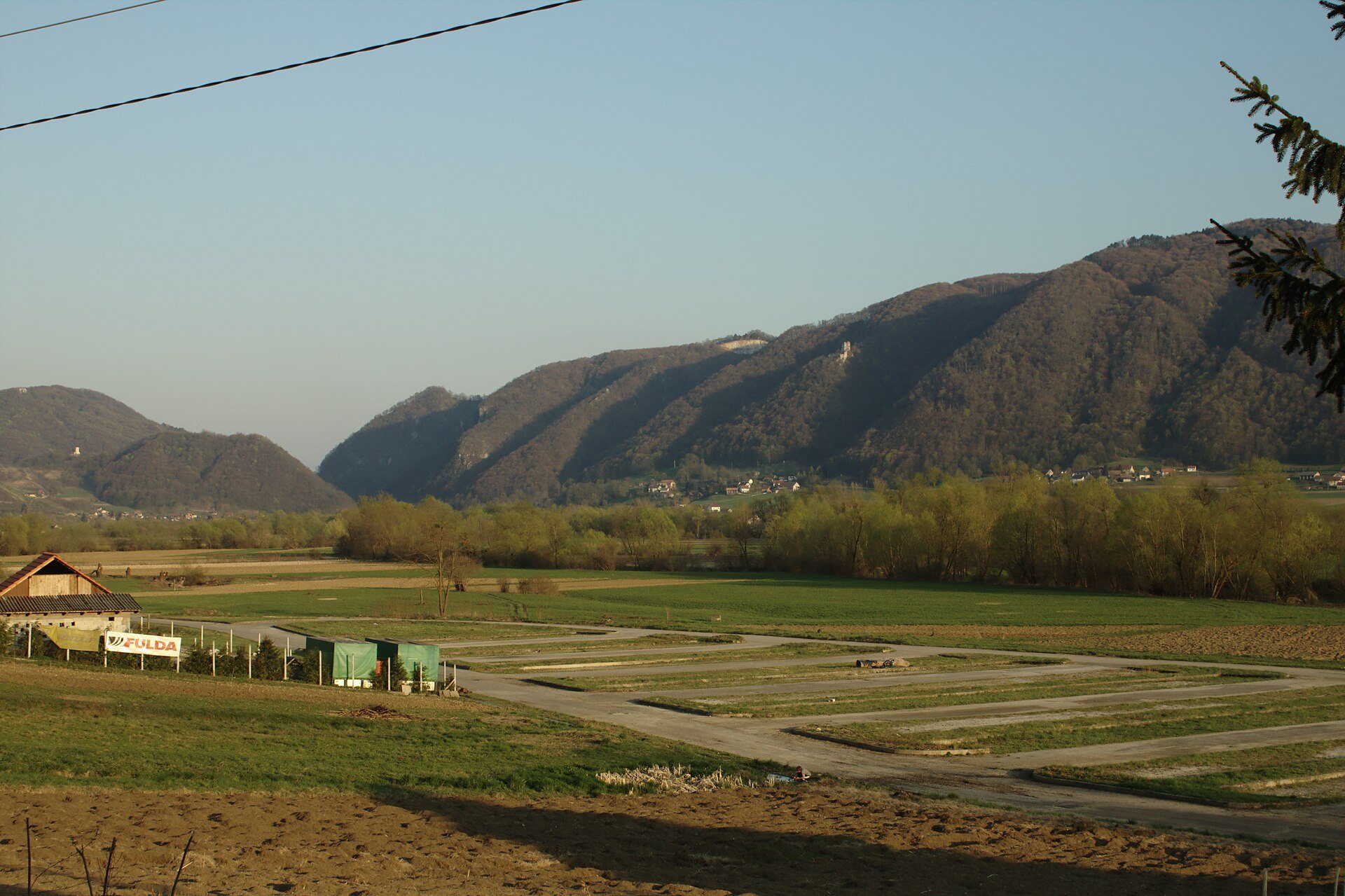
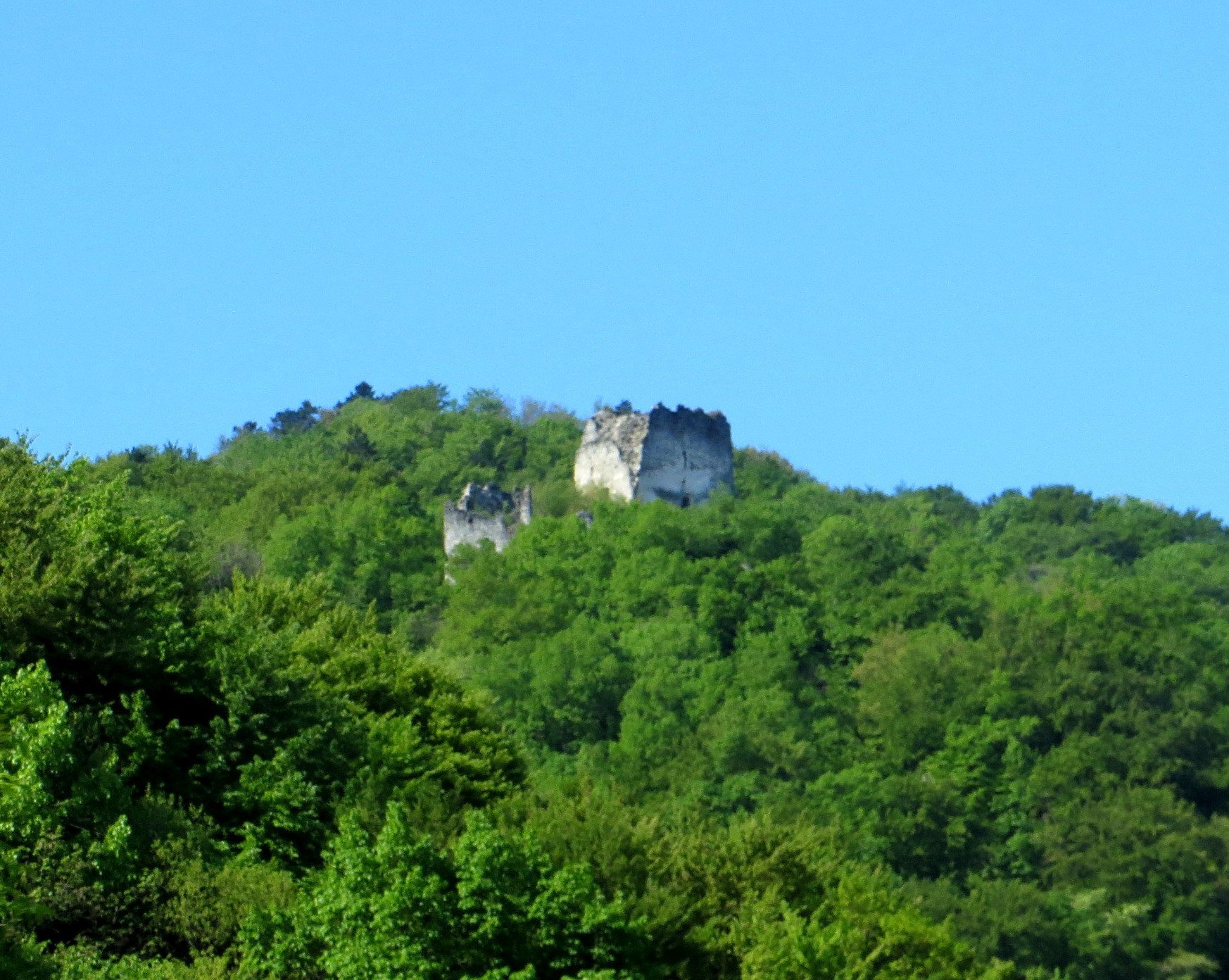
The ruins occupy a rocky shelf above Kunšperk, above the Sotla River and opposite Croatian Cesargrad. The surviving complex includes the bergfried, the principal defensive tower of a medieval castle, with its interior still preserved. The remains also contain the southeastern palace with an entrance and sections of the western walls. These structures form substantial surviving ruins, although trees can obscure them during spring.