Tupholme Abbey: A Premonstratensian Monastic House in Lincolnshire
Site at a Glance
- Rating
- 4.3
- Popularity
- Low
- Country
- United Kingdom
- Primary era
- Medieval
- Eras represented
- Medieval, Early Modern
- Civilizations
- English
- Site type
- Religious
- Remains
- Monastery
On this page8 sections
History
Tupholme Abbey is a medieval Premonstratensian abbey in the United Kingdom, near the River Witham in Tupholme, Lincolnshire. Founded between 1155 and 1165 in honour of the Annunciation, it was established by Gilbert and Alan de Neville with a community of an abbot and twelve canons from Newsham Abbey. The Premonstratensians, also known as the White Canons, combined communal religious life with preaching and pastoral ministry under the Rule of Saint Augustine.
Foundation and medieval development
Tupholme formed part of a substantial group of Premonstratensian houses in medieval Lincolnshire. Six monasteries stood on the eastern bank of the Witham and three on the western bank, probably because the river provided transport and carried wealth generated by the wool trade. The abbey’s first endowment included the demesne at Tupholme, smaller parcels of land, and the churches of Burreth, Middle Rasen, Market Stainton, Ranby, and Sturton.
Further gifts enlarged its holdings. Henry, Earl of Lancaster, granted the manor of Burreth in 1329, while Ralf de Neville donated the manor of Ranby in 1342. Tupholme nevertheless remained a poor institution. In 1347, when the abbey was deeply in debt, an abbot was accused of forging and counterfeiting coin, then using the proceeds to buy and resell corn and wine.
Visitation records also reveal disciplinary difficulties within the community. In 1482 the canons were forbidden to leave the precinct without permission or to drink after Compline, the final traditional prayer service of the day. The prescribed punishment was three days on bread and water. In 1497 Thomas Pynderwelle was sent to Croxton Abbey after becoming involved with a local woman and fathering her child. Despite such episodes, Tupholme continued for almost four centuries as a religious institution devoted to prayer, pastoral work among local people, and care for the poor.
Suppression and Tudor transformation
Tupholme Abbey was suppressed in 1536 during the first wave of Henry VIII’s Dissolution of the Monasteries, the seizure and suppression of England’s religious houses following the break with Rome. Its clear revenue in 1534 was £100 14 shillings and 10 pence. The last abbot, John Ancaster, received a pension of £18, while each of the eight other canons received £1.
By 1538 the abbey had been largely destroyed. The site, including the church, bell tower, and churchyard, was granted to Sir Thomas Heneage. The church was probably demolished early in the remodelling of the property, allowing its lead and building materials to be reused. Heneage adapted the remaining monastic buildings into a substantial Tudor house for his daughter Elizabeth and her husband, William Willoughby, 1st Baron Willoughby of Parham. A large formal Tudor garden was created around the house, and the property remained with the Willoughby family until 1661.
Vyner ownership and agricultural reuse
The property passed to the Vyner family in 1661. By about 1700, the Vyners considered the Tudor house unfashionable and demolished it, retaining the surviving medieval abbey wall as a feature of their landscaped park. They built Tupholme Hall in the classical style about 750 metres north-east of the abbey site. Tupholme Hall was demolished in 1976.
The Vyners moved to Gautby Hall in the 1730s and let Tupholme to tenants. During the eighteenth century, a farmyard grew around the medieval wall. It had become a busy farmstead by the early twentieth century, later declining into labourers’ housing. By the 1970s the buildings stood empty and derelict. Despite attempts to save them, the farmstead was demolished in 1984, leaving the surviving wall and traces of the earlier garden landscape.
Later preservation
Heritage Lincolnshire acquired the site in 1988, after which the ruin was repaired and opened to the public. Tupholme Abbey is a Grade I listed building, a status assigned on 25 January 1927. Heritage Lincolnshire maintains the ruin, with Historic England identified as the governing body.
The abbots associated with Tupholme include Ivo in the late twelfth century; Geoffrey, active from 1202 to 1230; Thomas, from 1276 to 1289; Ralf, elected in 1293; William, elected in 1310 and mentioned in 1316; Roger around 1348; Simon of Lincoln, elected in 1349; John of Beseby, elected in 1373; William of Tynton, elected in 1383 and mentioned in 1385; John Spalding, who died in 1456; John Coventry, elected that year; John Ancaster, mentioned in 1474 and later the last abbot; Thomas Sotby, mentioned from 1488 to 1491; Thomas Gryme, from 1494 to 1509; and John Sword, mentioned in 1522.
The name Tupholme reflects the Scandinavian influence that shaped Lincolnshire during the Danelaw, the area where Scandinavian settlement and Danish political and legal influence were especially strong from the ninth to the eleventh centuries. It is interpreted as meaning an island where rams were raised. “Tupp” refers to a male sheep, while “holme” comes from Old Norse for an island. The name accords with the tradition that the abbey stood on an island in marshy ground before surrounding land was drained for farming.
Remains
The surviving monastic wall
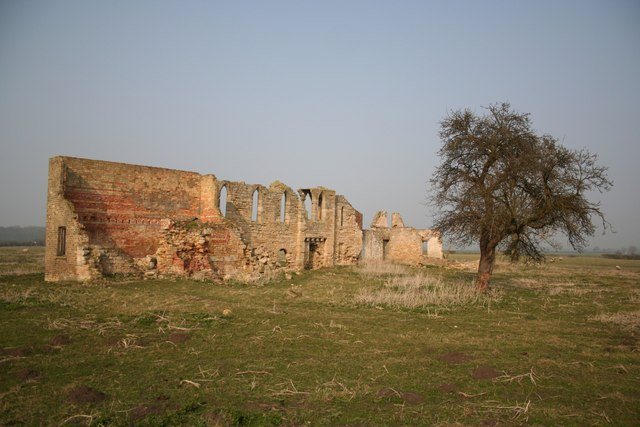
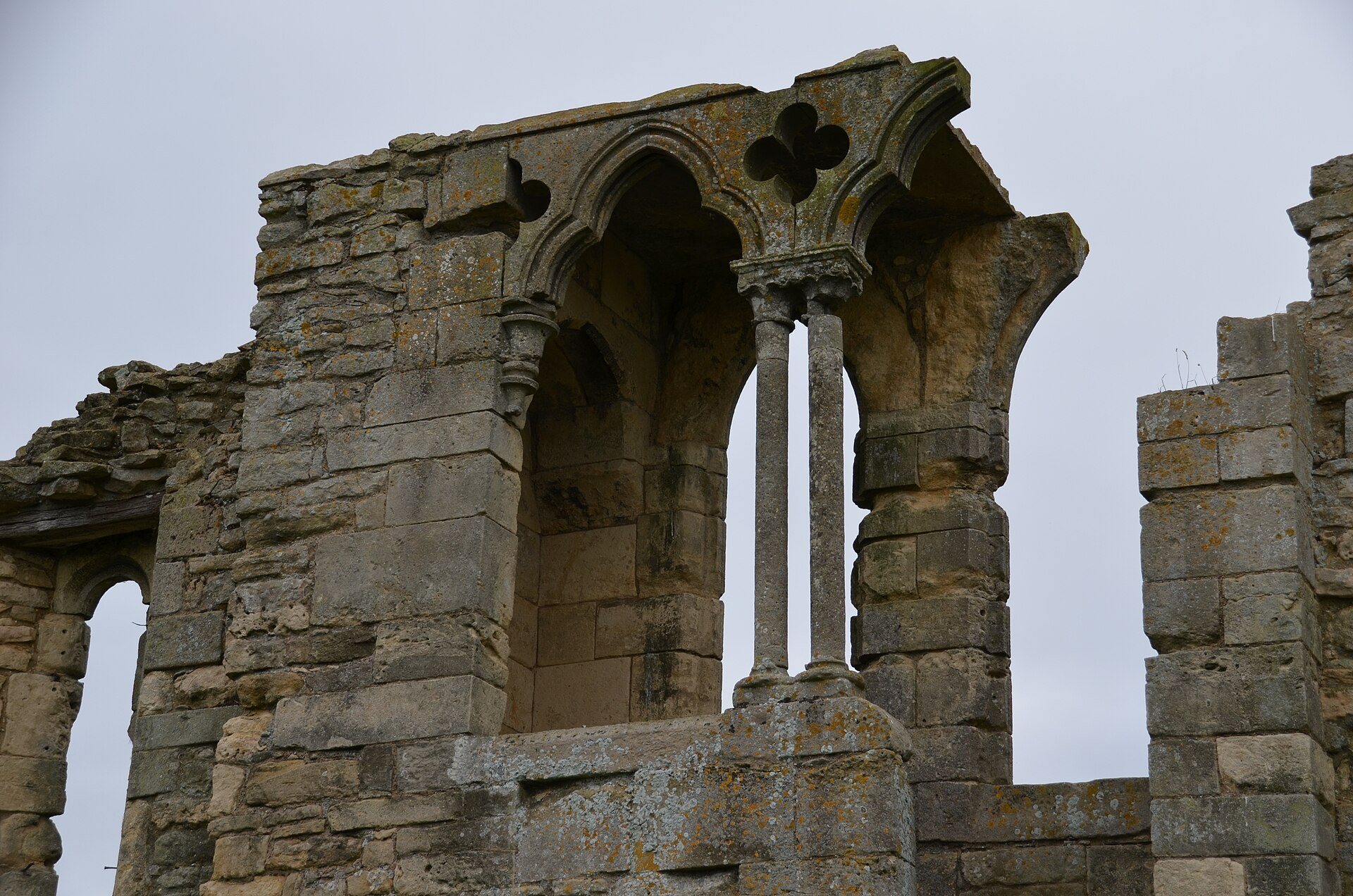
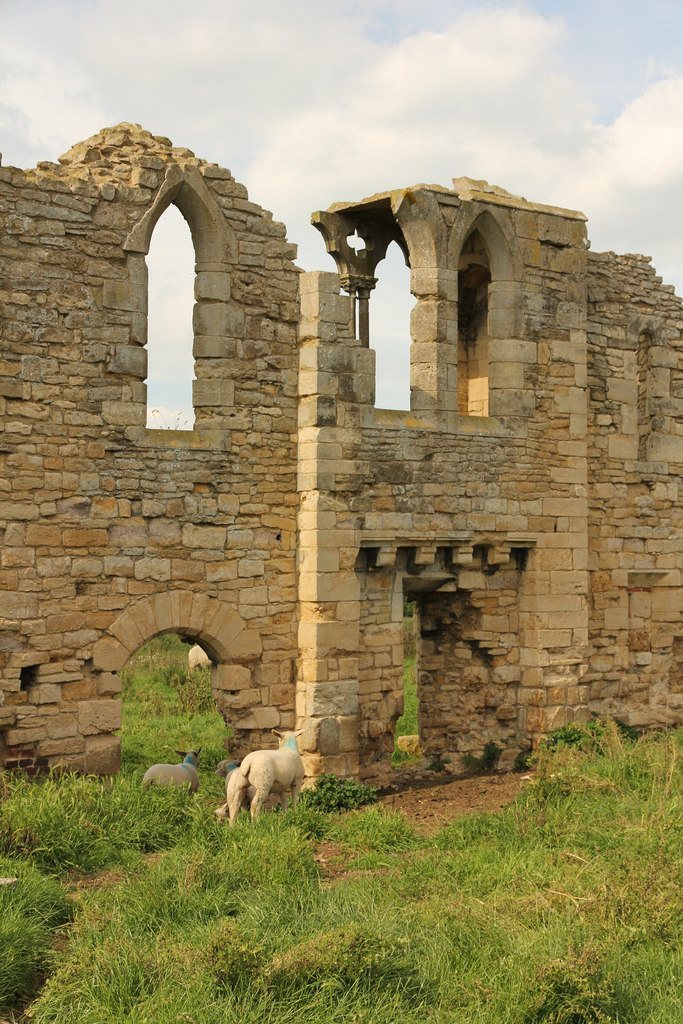
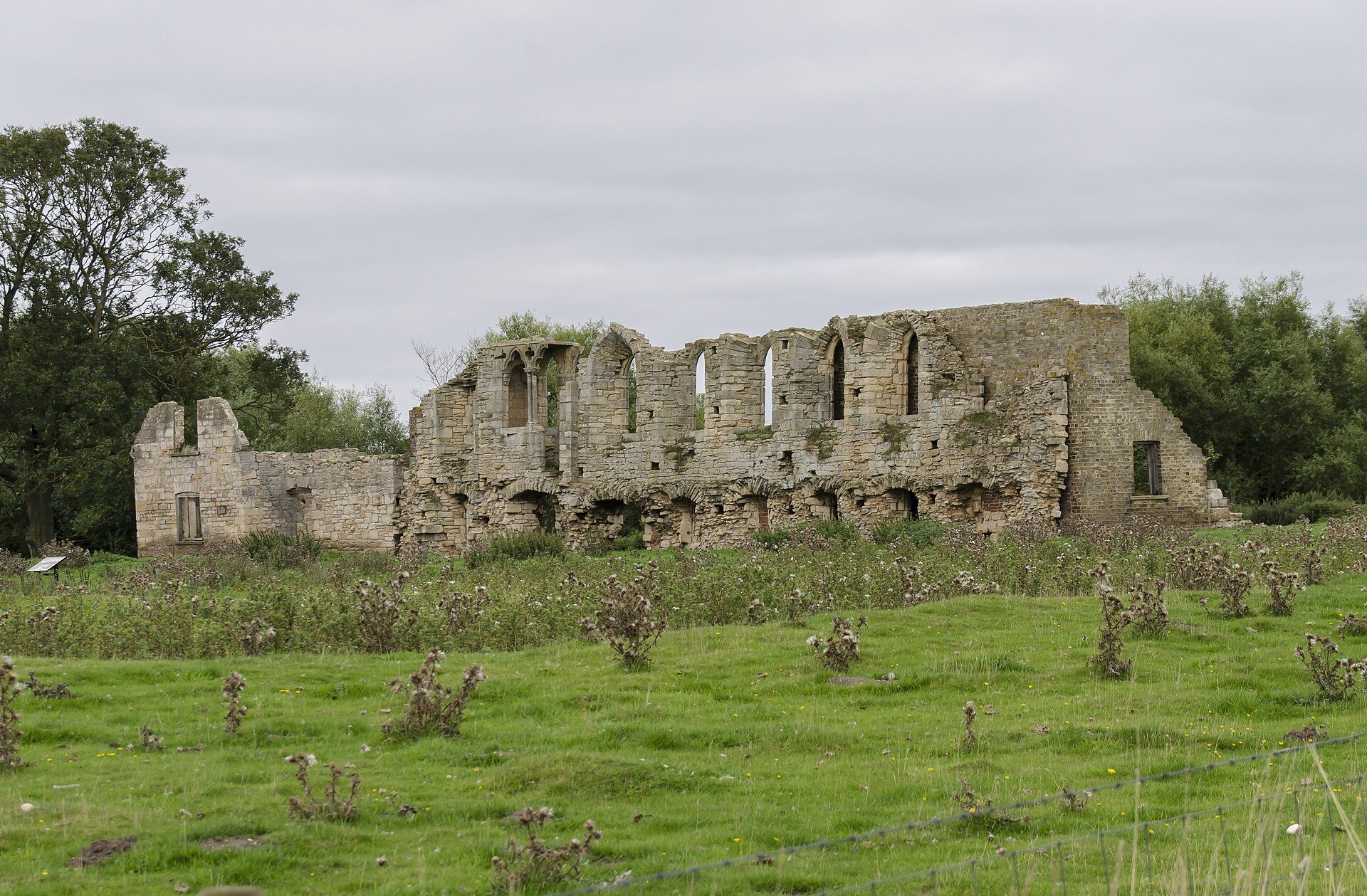
The surviving ruin is a single monastic wall standing two storeys high, almost to eaves level. Its lower storey contains small square-headed windows and was built as a vaulted undercroft, a vaulted lower room beneath a larger structure. Above it, the former refectory, or communal dining hall, retains fine lancet windows, which are narrow pointed medieval windows, together with a reader’s pulpit.
The pulpit was altered or “prettified,” probably during the Vyners’ landscaping of the grounds. This intervention helped preserve it in a region where stone was widely taken for reuse. The wall also survived the later farmyard that developed around it, although the farm buildings were demolished in 1984.
Garden and agricultural landscape
Traces of the large formal Tudor garden created around Heneage’s post-Dissolution house remain within the grounds. The wider site includes several fruiting trees, among them apple and bullace, as well as numerous ponds. The ponds support fine-leaved water dropwort and great crested newts, while nearby Southrey Wood contains abundant forest wildlife.
Sheep have influenced the vegetation at Tupholme for thousands of years. Their dung encourages the growth of stinging nettles and thistles, adding a continuing agricultural element to the landscape around the surviving medieval fabric.