Bermondsey Abbey: An English Benedictine Monastery in London
Site at a Glance
- Rating
- 4.5
- Popularity
- Very Low
- Country
- United Kingdom
- Primary era
- Medieval
- External website
- Open
- Eras represented
- Medieval
- Civilizations
- English
- Site type
- Religious
- Remains
- Monastery
On this page14 sections
History
Bermondsey Abbey was an English Benedictine monastery dedicated to St Saviour in London, United Kingdom, founded as a medieval monastery in 1082. It stood at what is now Bermondsey Square in southeast London and became an important religious house with royal connections, extensive estates, and a carefully managed landscape of reclaimed marshes.
Early monastery and Norman foundation
A monastery existed at Bermondsey before AD 715. It was a Surrey colony of the Mercian monastery of Medeshamstede, later known as Peterborough. A surviving copy of a letter issued by Pope Constantine between AD 708 and 715 grants privileges to a monastery at Vermundesei. The institution probably continued as a secular minster, a church serving a wider community, until at least the Viking invasions of the ninth century.
No later church is recorded at Bermondsey until 1082, when Alwinus Child, the lay founder named in the medieval annals, established a monastery under royal licence. The foundation probably occupied the earlier sacred site and may have followed the eighth-century church directly. It is generally identified with the “new and handsome church” at Bermondsey listed in the Domesday Book of 1086, the survey of landholding and resources ordered by William the Conqueror.
In 1089, four monks named Peter, Richard, Osbert, and Umbald arrived from St Mary’s of La Charité-sur-Loire, apparently at the invitation of Lanfranc, Archbishop of Canterbury. Bermondsey consequently became a Cluniac priory. Cluniac houses belonged to the reform movement centred on Cluny, and Bermondsey was initially dependent on the foreign priory at La Charité-sur-Loire. Peter became its first prior.
Royal patronage and the growth of the priory
Royal support strengthened the new foundation. William Rufus gave the royal estate at Bermondsey in 1089 or 1090, while Henry I made further grants during the 1120s and 1130s. Robert, Count of Mortain, held part of the Bermondsey estate, and his son William of Mortain became a monk at the priory in 1140. Alwinus Child’s contribution consisted of rents in London, probably represented by thirteen burgesses who paid 44 pence each year to the Bermondsey estate.
The monks reshaped the surrounding wetland by reclaiming and cultivating the marshes, embanking the riverside, and creating a 140-acre Priory Close. They also converted the tidal inlet at the mouth of the River Neckinger into St Saviour’s Dock. This provided a secure landing place for ecclesiastical dignitaries and goods below the congested crossing at London Bridge.
The abbey rapidly accumulated temporal and spiritual possessions. Henry I granted it interests in Southwark in 1103–04, land at Dulwich and elsewhere in 1127, and the church of St George the Martyr in 1122. In 1093, Robert Bloet, Bishop of Lincoln, gave the monastery the manor of Charlton in Kent. Charlton received a Monday market and a three-day annual fair centred on Trinity Sunday in 1268.
By 1291, the abbey’s temporalities were valued at almost £229 and its spiritualities at just over £50. The Valor Ecclesiasticus, Henry VIII’s comprehensive assessment of ecclesiastical property shortly before the Dissolution, recorded a clear annual value of slightly more than £474 in 1535. The abbey’s estates extended across Surrey, Leicestershire, Hertfordshire, Buckinghamshire, Gloucestershire, Somerset, and Kent.
Royal residence and independent abbey
Bermondsey remained a Cluniac priory until the late fourteenth century. In 1380, Richard Dunton, its first English prior, paid 200 marks to have the monastery naturalised. This protected it from wartime measures directed against alien, or foreign-controlled, properties. In 1390, the priory became an independent abbey, separate from both La Charité and Cluny.
Bermondsey itself remained principally a ribbon settlement along the route now represented by Bermondsey Street. The surrounding area included property held by the Knights Templar and other ecclesiastical institutions. Edward III built a manor house near the Thames at Bermondsey in 1353.
The monastery also hosted members of the royal family. At Christmas 1154, the newly crowned Henry II and Eleanor of Aquitaine held court at Bermondsey Priory. Their second son, Prince Henry, was born there on 28 February 1155. Prince Henry later became known as Henry the Young King.
Catherine of Valois, widow of Henry V and mother of Henry VI, spent part of her later life at Bermondsey. Elizabeth Woodville, the former queen consort of Edward IV and mother of Edward V, registered as a boarder at the abbey on 12 February 1487 after retiring from the court of her son-in-law Henry VII. She received free hospitality and died at Bermondsey on 8 June 1492. Her daughter Elizabeth of York had married Henry VII in 1486.
Mathewe Baker, a courtier of Henry VII and Henry VIII, died at the abbey in May 1513. His will requested burial before the image of St Saviour in the chancel. Archaeological work has revealed approximately 500 burials at the abbey, with the total possibly reaching 750. Among those buried there were Mary of Scotland, Countess of Boulogne; Ann Echingham, widow of John Tuchet, sixth Baron Audley; Mathewe Baker; and William, Count of Mortain.
Dissolution and later changes
During the Dissolution of the Monasteries, Henry VIII’s programme of suppressing English monasteries and transferring their property to the Crown and secular owners, the last abbot was forced to surrender Bermondsey Abbey to the king. Henry granted the abbey and its lands to Sir Robert Southwell, who sold the buildings to Sir Thomas Pope.
Pope dismantled parts of the abbey and built a house incorporating some of its surviving structures, while other buildings were demolished. He later sold the property back to Southwell, who transferred it to a London goldsmith. Thomas Radclyffe, 3rd Earl of Sussex, subsequently used the house as a residence. Queen Elizabeth I visited him there in 1570, and some remaining buildings appear to have served as a hospital and for general relief. Sussex himself received treatment there in 1575.
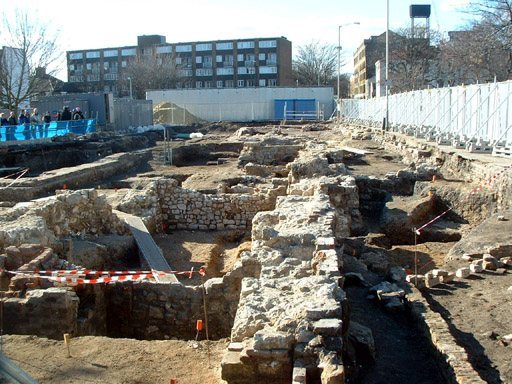
A seventeenth-century legend claimed that the abbey had originally been King John’s Palace. The antiquarian John Aubrey accepted the story, but it was later rejected as a confusion with another royal residence nearer the Thames within the abbey’s manor of Bermondsey. The former abbey site was extensively redeveloped, while archaeological excavations along Abbey Street and at Bermondsey Square in 2005–06, followed by further investigation along Tower Bridge Road, revealed parts of its buried history.
Remains
The abbey complex occupied the area now represented by Bermondsey Square and extended across reclaimed marshland, meadows, embankments, and dykes. Its managed landscape also included the tidal inlet later converted into St Saviour’s Dock. The abbey and the post-Dissolution house no longer survive as standing complexes, but fragments of walls, a medieval gatehouse, the remains of the church, burials, foundations, and reused stone preserve parts of the former site.
Surviving architectural fabric
Grange Walk gatehouse
Numbers 5, 6, and 7 Grange Walk incorporate one side of a late-medieval stone gatehouse. Number 7 preserves the chamfered south jamb of the gateway, with two wrought-iron gate hooks projecting from the wall. A surviving sign reading “Gatehouse” continues to identify the incorporated medieval fabric.
South-western church tower
The south-western tower of the abbey church survives as archaeological fabric beneath the glass floor of a restaurant and bar on Bermondsey Square. It forms part of the buried remains of the church within the area occupied by the medieval complex.
Later fragments
By 1822, only isolated fragments of stone wall, described as being in King John’s Court, and several old buildings remained above ground. These fragments belonged to the reduced remains of the abbey and the post-Dissolution occupation of its site.
Burials and archaeological discoveries
Stone coffins and foundations
Building work in Abbey Street in 1904 uncovered two stone coffins containing human remains approximately ten feet below ground. Six further burials without coffins lay above and nearby, and parts of the abbey’s foundations were exposed at the same time.
Consecration stone
The abbey’s consecration stone was found in 1932 by a workman at a petrol station on Tower Bridge Road. It had been reused in the foundations of a later building, preserving material connected with the religious history of the former monastery.
Excavated site areas
Excavations during the redevelopment of Bermondsey Square exposed archaeological remains along Abbey Street. Additional areas of the former abbey site were investigated along Tower Bridge Road, adding to the surviving evidence for the complex beneath the redeveloped streets and buildings.