Sinhagad: A Historic Hill Fortress in Maharashtra
Site at a Glance
- Rating
- 4.6
- Popularity
- Very High
- Country
- India
- Primary era
- Early Modern
- External website
- Open
- Eras represented
- Early Modern, Modern
- Civilizations
- Unclassified
- Site type
- Military
- Remains
- Fort
On this page14 sections
History
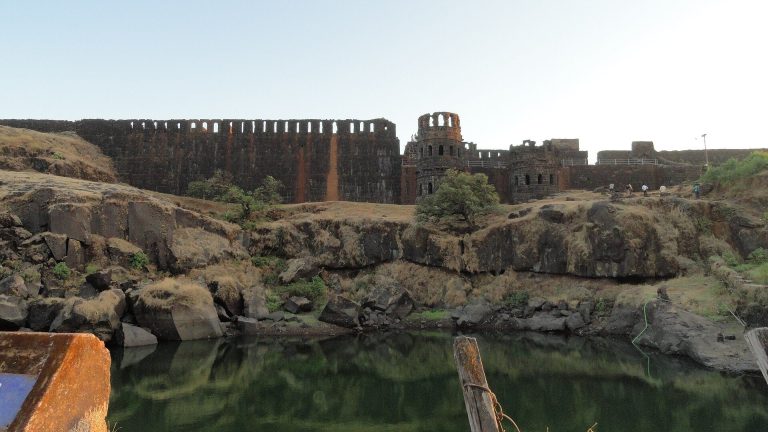
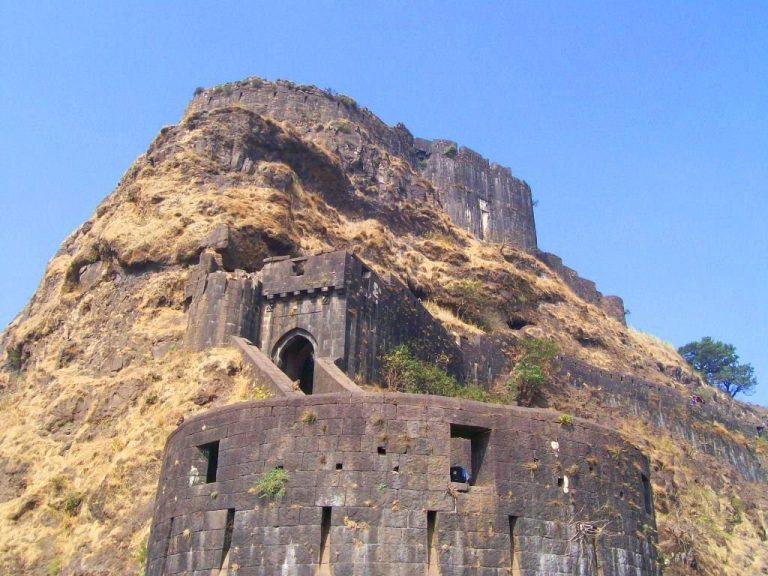
Sinhagad is an ancient hill fortress in India, near Pune in Maharashtra. Formerly known as Kondhana and also called the Lion’s Fort, it occupies an isolated height in the Sahyadri Mountains and became closely associated with the rise of Maratha power. Its earlier name was traditionally linked with the sage Kaundinya.
Early Sultanate Control
Until the fourteenth century, Kondhana was held by the Koli chieftain Nag Naik. Forces of Muhammad bin Tughluq, the fourteenth-century sultan of the Delhi Sultanate, captured the fortress in 1328 after an eight-month siege. It subsequently passed to the Bahmani Kingdom in the mid-fourteenth century, the Ahmadnagar Sultanate in the late fifteenth century, and the Sultanate of Bijapur in the late sixteenth century. These were successive Islamic states that controlled parts of the Deccan before and during the rise of the Marathas.
Shivaji and the Maratha Reconquests
Shahaji, serving as commander under Ibrahim Adil Shah II of Bijapur, was entrusted with control of the Pune region. His son Shivaji, the founder of the Maratha state, gained control of Kondhana in 1647 after persuading Siddi Amber, the Adilshahi officer in command, that he could strengthen its defenses. Bapuji Mudgal Deshpande played an important part in the takeover. Bijapur responded by imprisoning Siddi Amber and Shahaji, and the fort was exchanged for Shahaji’s release in 1649.
Shivaji regained Kondhana in 1656 with Deshpande’s assistance. Deshpande persuaded the fort commander to surrender peacefully by granting him land in the newly established village of Khed Shivapur. Mughal forces attacked in 1662, 1663, and 1665, while the Mughal general Shaista Khan unsuccessfully tried to bribe the garrison into surrender in 1664. Under the Treaty of Purandar in 1665, negotiated by Shivaji with the Mughal general Mirza Raja Jai Singh I, the fort passed to the Mughals.
Shivaji reconquered the fortress in 1670 during the Battle of Sinhagad. Tanaji Malusare, a Maratha military commander and subedar, led the assault against the Mughal garrison commanded by Udaybhan Singh Rathod, a Rajput officer. Tanaji and his men scaled a steep cliff at night with the aid of a trained monitor lizard called Yashwanti. Tanaji was killed during the fighting, but his brother Suryaji continued the attack and captured the fort. The tradition that Shivaji lamented, “The fort is conquered, but the lion is lost,” connects the battle with the later name Sinhagad, or Lion’s Fort. The fort remained under Maratha control until 1689.
Mughal and Maratha Struggles
After Sambhaji’s death, Mughal forces regained Sinhagad. Maratha forces led by Sardar Balkawade recaptured it in 1693. Rajaram I, the third Chhatrapati, or ruler, of the Maratha state, took refuge at the fort during a Mughal raid on Satara and died there on 3 March 1700. Aurangzeb, the Mughal emperor, reconquered Sinhagad in 1703. It returned to Maratha control in 1706 after actions involving Panaji Shivdev of Sangole, Visaji Chafer, and Shankar Narayan, the Pant Sachiv.
Sinhagad remained under Maratha rule until 1817. During more than a century of Maratha control, it served both as a refuge from forces attacking Pune and as a place of confinement for rebels. In the Third Anglo-Maratha War, the conflict in which the East India Company defeated the Maratha powers and extended British control over their territories, East India Company General Pritzler besieged the fort in 1817 on the orders of Mountstuart Elphinstone, the Company’s resident in Pune. Sinhagad then passed to British control, which lasted until 1947, when it became part of India.
Freedom Movement and Modern Use
Sinhagad was associated with India’s freedom struggle. Bal Gangadhar Tilak, an Indian nationalist leader, used the fort as a summer retreat, and Mahatma Gandhi held a historic meeting with Tilak there after Gandhi’s return from South Africa. A television relay station was installed in 1973 to transmit Doordarshan signals from Mumbai to Pune.
Restoration work in February 2019 uncovered Tanaji Malusare’s original commemorative memorial. The stone structure had been buried beneath cement, concrete, and layers of oil paint, and is believed to be about 350 years old.
Remains
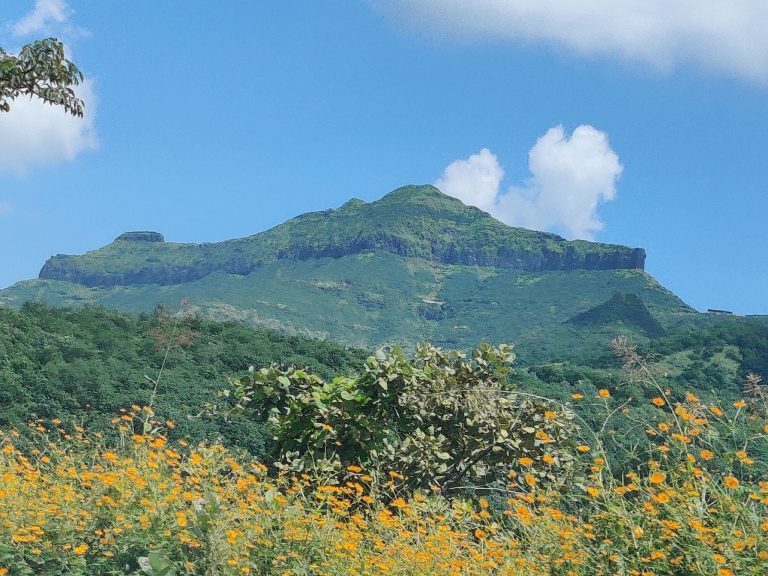
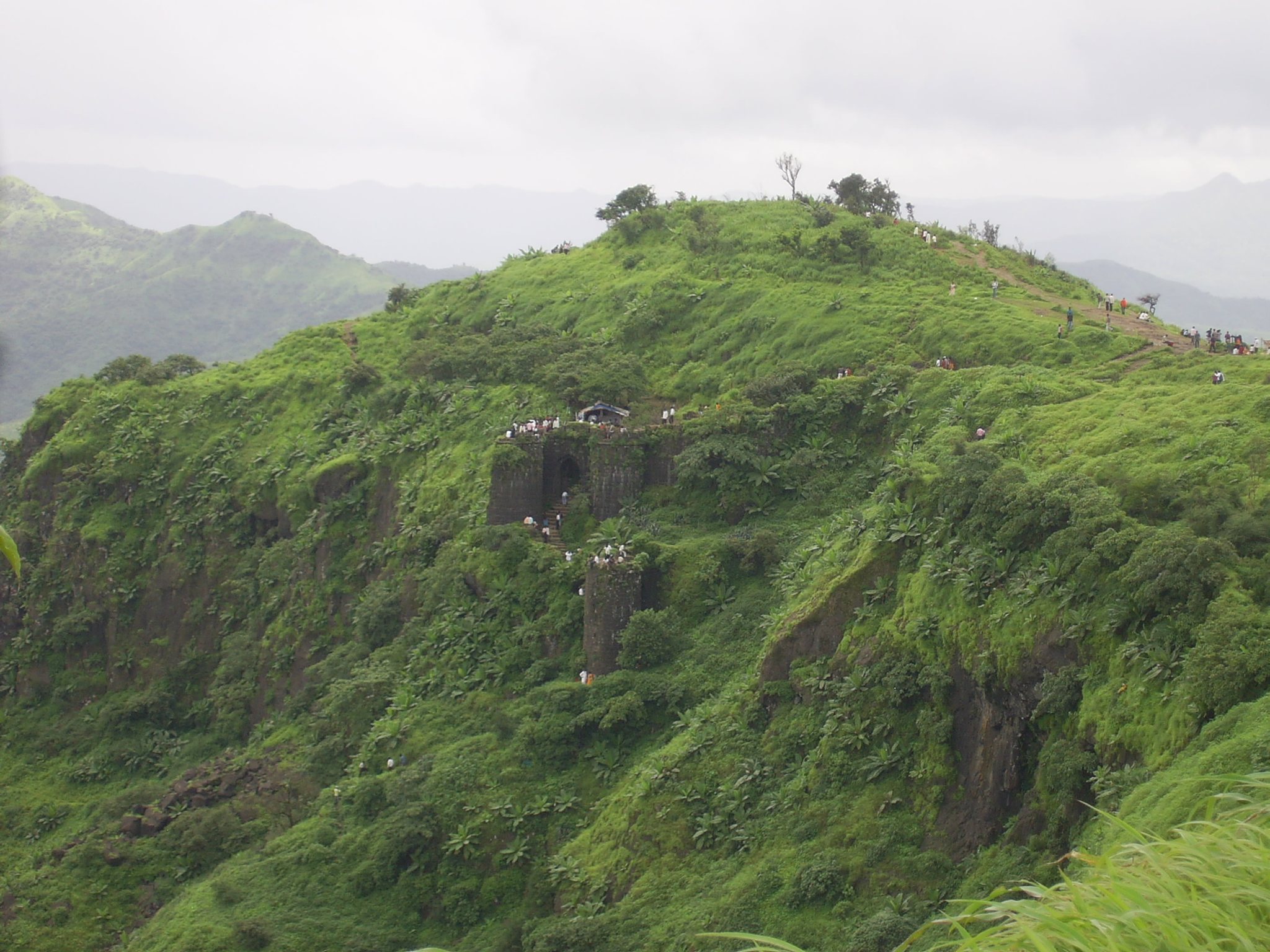
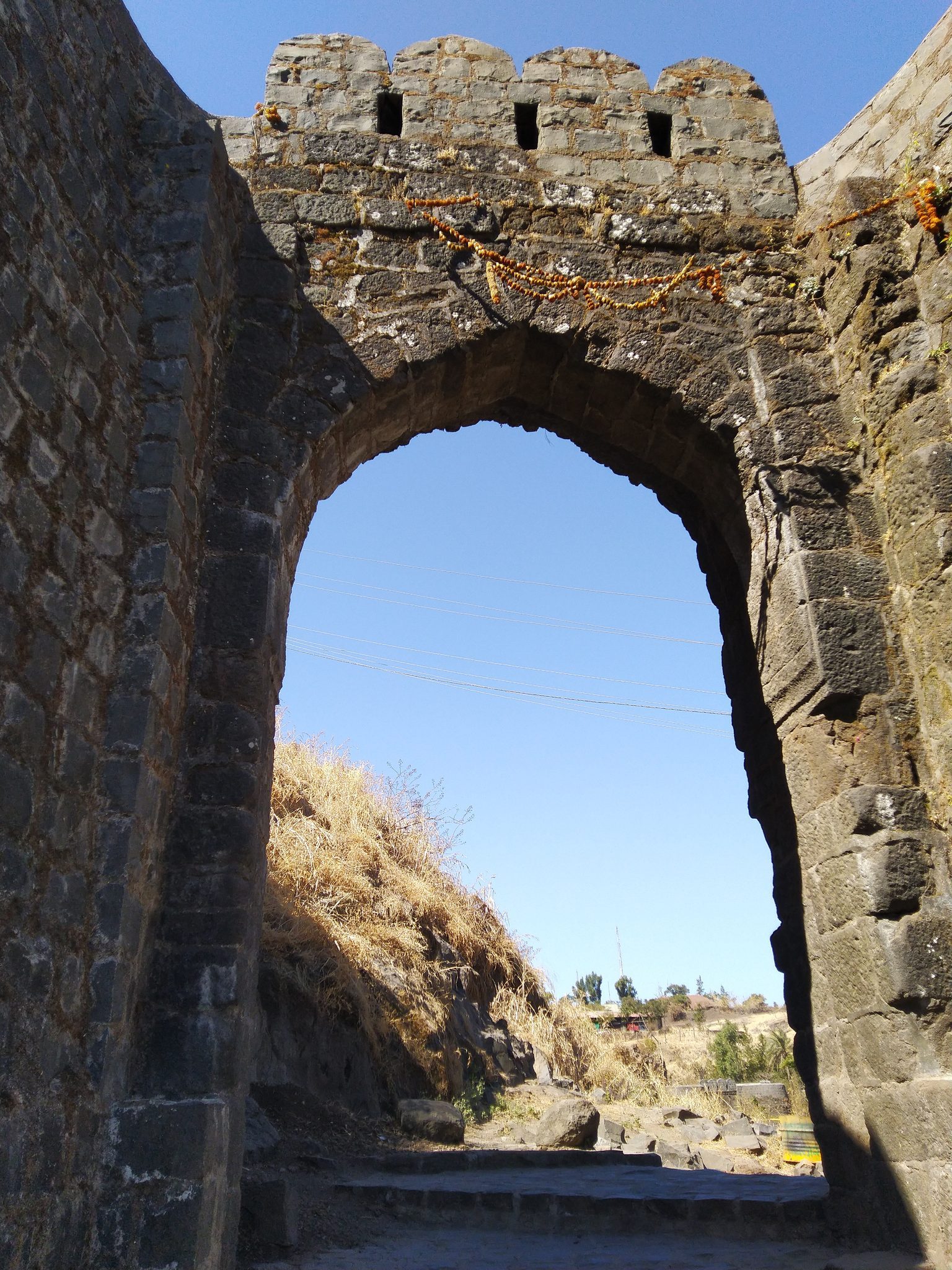
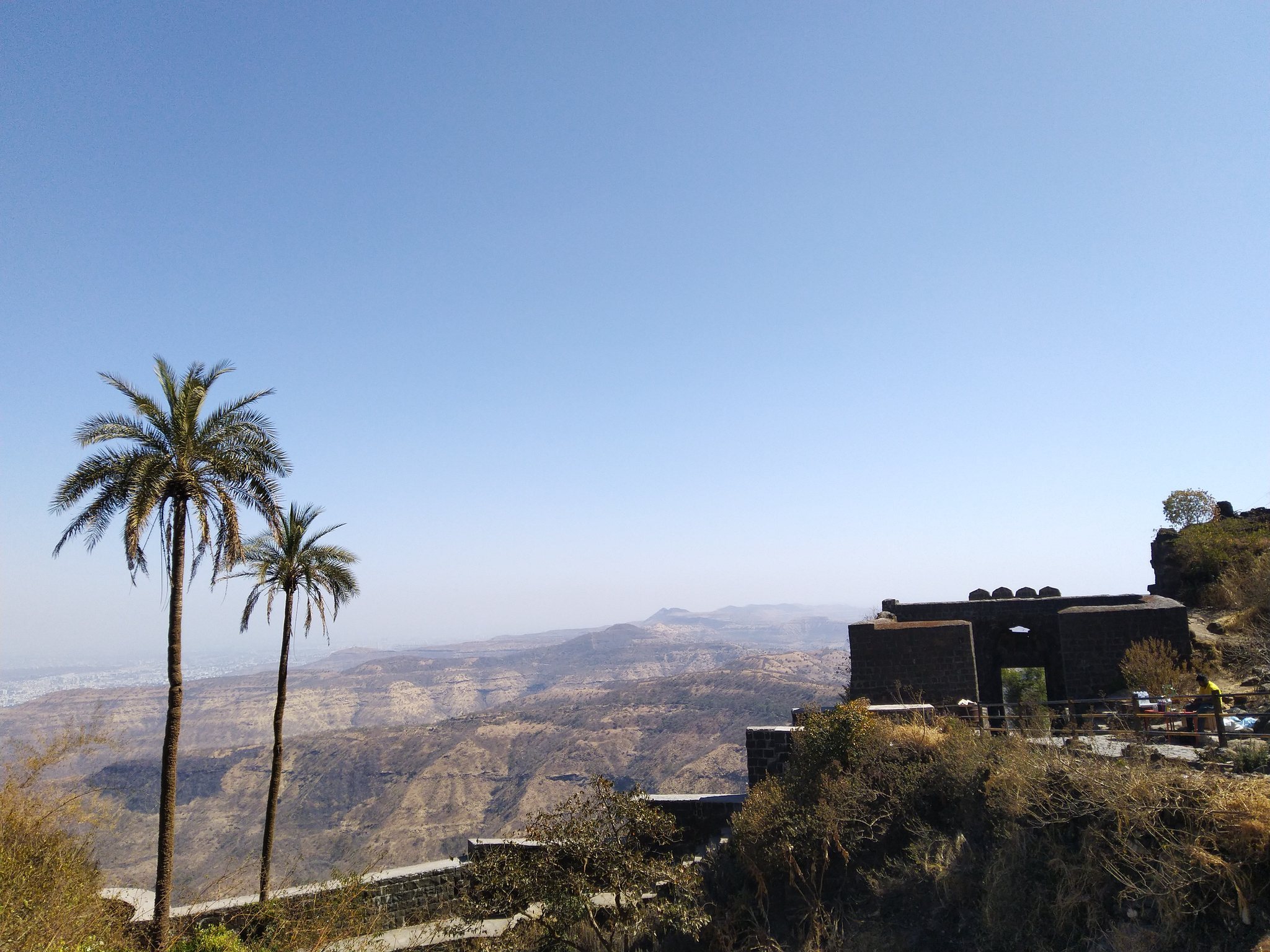
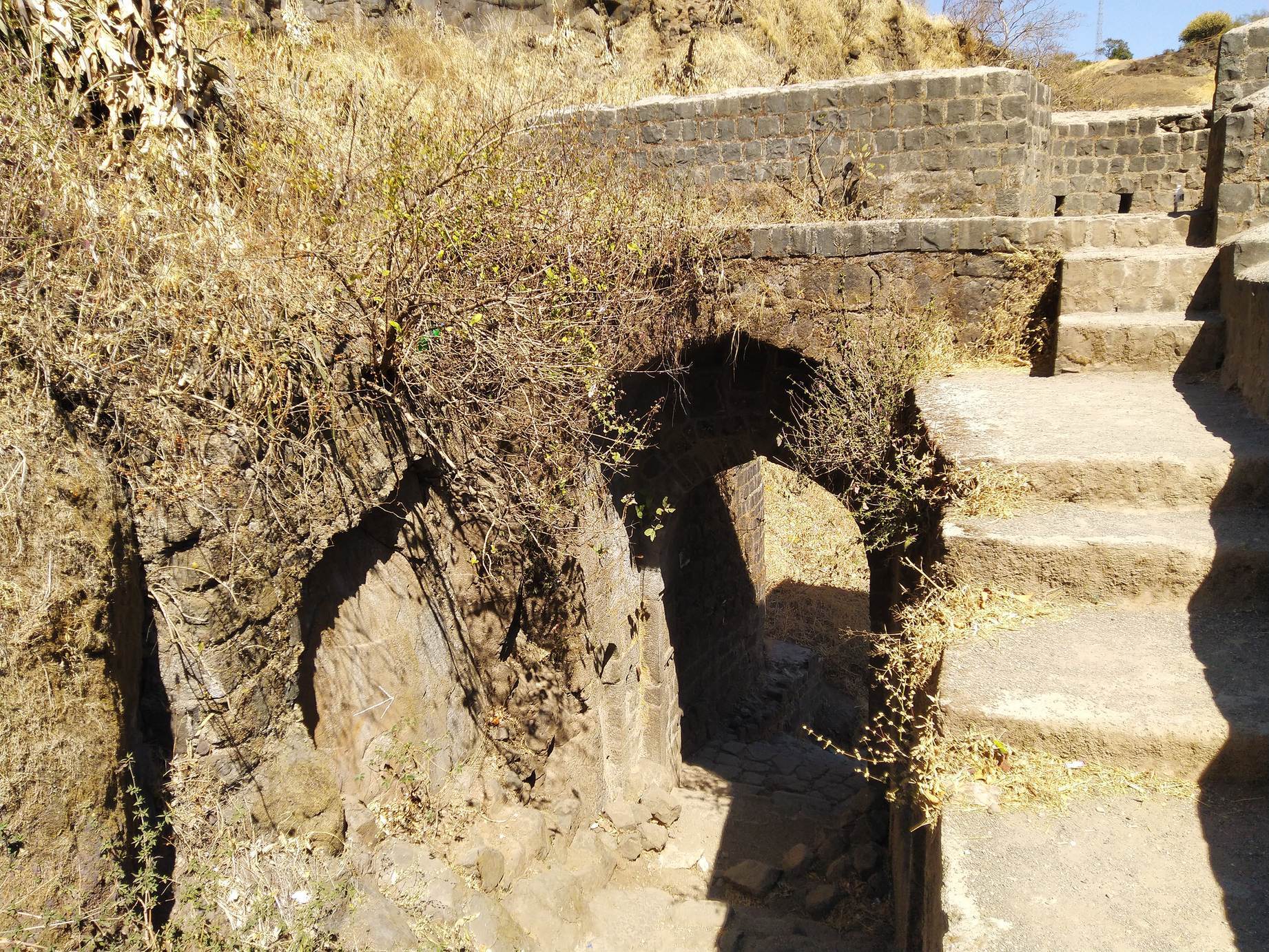
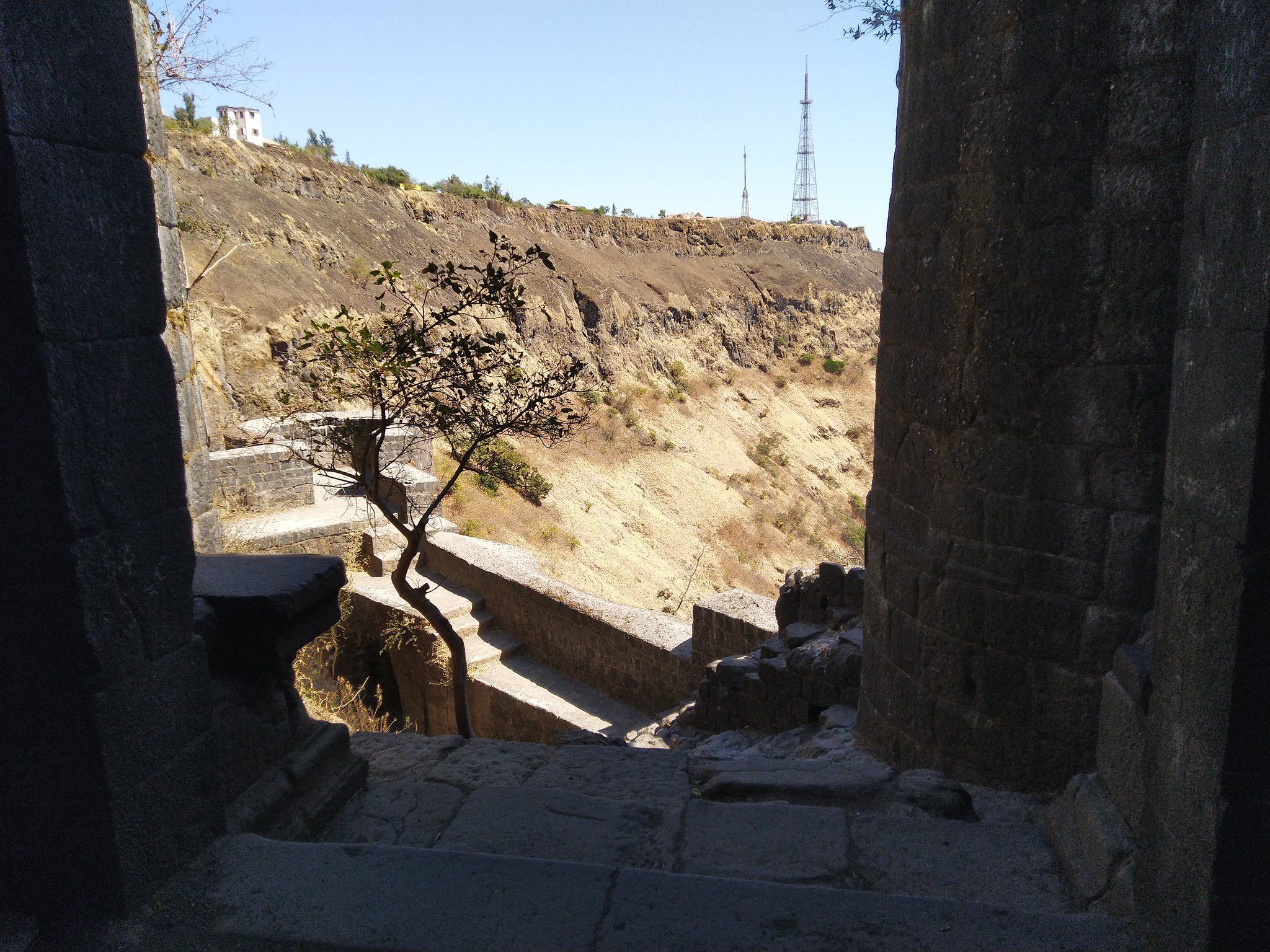
Sinhagad occupies an isolated cliff in the Bhuleswar range of the Sahyadri Mountains. The hill rises about 760 metres above the surrounding ground and reaches 1,317 metres above mean sea level, while another description places the cliff at about 800 metres above the surrounding plain. Very steep slopes form the fort’s natural protection. The complex has two named entrances, Pune Darwaja on the northeast side and Kalyan Darwaja on the southeast side. On clear days, Rajgad, Purandar, and Torna can be seen from the fort, linking Sinhagad visually with a wider belt of fortified sites in the surrounding mountain landscape.
Fort Buildings and Religious Features
Military and Brewing Installations
The fort complex includes a military stable and a brewery, reflecting its historic role as a defended settlement and military position. These structures form part of the surviving built features within the hilltop enclosure.
Kali Temple
A temple dedicated to the goddess Kali stands within the fort. A statue of Hanuman is positioned to the right of the temple.
Memorials and Later Structures
Tanaji Malusare Memorial
A commemorative memorial to Tanaji Malusare stands at Sinhagad. During restoration work in 2019, workers uncovered an older stone memorial beneath later cement, concrete, and layers of oil paint. The structure is believed to be about 350 years old.
Rajaram I Memorial
A memorial to Rajaram I forms part of the fort complex. Rajaram took refuge at Sinhagad during a Mughal raid on Satara and died at the fort on 3 March 1700.
Tilak Bungalow
The fort contains a bungalow associated with Bal Gangadhar Tilak. A bust of Tilak stands at its entrance, preserving the connection between the site and the nationalist leader’s use of Sinhagad as a summer retreat.
Television Relay Tower
A television relay tower was erected at the fort in 1973 as a modern communications installation. It transmitted Doordarshan television signals from Mumbai to Pune.