Rajgad Fort: Capital and Hill Fort of the Maratha State
Site at a Glance
- Rating
- 4.8
- Popularity
- High
- Country
- India
- Primary era
- Early Modern
- Eras represented
- Early Modern
- Civilizations
- Unclassified
- Site type
- Military
- Remains
- Fort
On this page10 sections
History
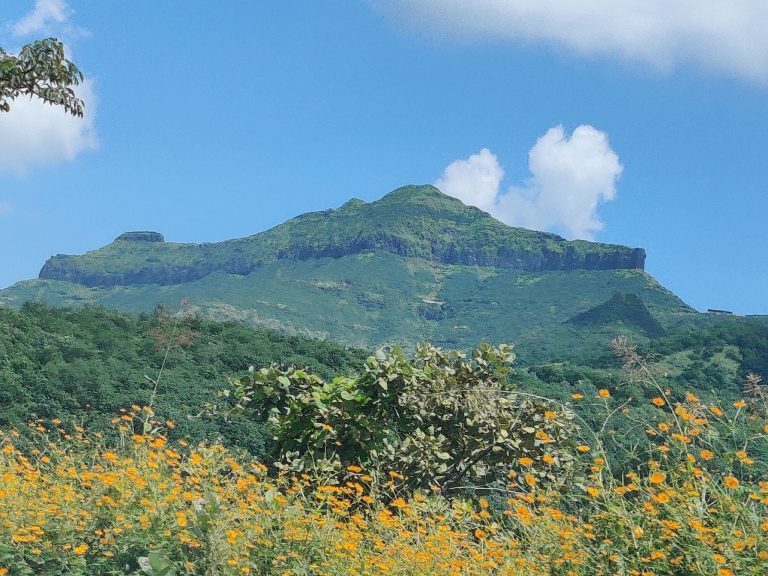
Rajgad Fort is a hill fort in Maharashtra, India, built by the Maratha state on Murumbdev, a hill in the Sahyadri range. Captured by Chhatrapati Shivaji Maharaj, the founder and first ruler of the Maratha state, in 1647, it became his capital for almost 26 years and was later inscribed in 2025 as part of the UNESCO World Heritage property Maratha Military Landscapes of India.
Foundation and Maratha Capital
Known previously as Murumbdev, the fort underwent repairs from 1649. In the same year, Shamrao Neelkanth Ranzekar was appointed Peshwa, a senior minister who later became the chief executive of the Maratha state. The fort was renamed Rajgad in 1654, when new defensive works and buildings were begun. Wealth taken from nearby Torna Fort financed its construction and extensive fortification, which was completed in January 1662.
Rajgad remained Shivaji’s capital until the seat of government was transferred to Raigad Fort. It was also the fort where he spent more days than at any other. Important events during his reign were connected with Rajgad, including his return from Agra, movements during the campaigns against Afzal Khan and Siddi Jauhar, and the arrival of wealth taken during the sack of Surat in February 1664.
Shivaji’s family history was also closely tied to the fort. His wife, Saibai, died there on 5 September 1659, and their son Rajaram I was born at Rajgad on 24 February 1670. In July 1661, an idol of Bhavani intended for installation at Pratapgad was brought to Rajgad so that Jijabai could examine it. Repairs began again in 1671. Afzal Khan’s head was buried in the walls of the Mahadarwaja, the principal gateway, at Balle Killa. The fort was also the setting for a severe exchange between Sonopant Dabir and Shivaji.
Mughal Conflict and Later Rule
Rajgad was one of the twelve forts retained by Shivaji under the Treaty of Purandar, the 1665 agreement with the Mughal Empire. Jai Singh I, the Mughal general who led the imperial forces involved in the agreement, received the surrender of twenty-three other forts, while Rajgad remained under Shivaji’s control. A Mughal attack on Rajgad failed on 30 April 1665, after which Shivaji sent Jai Singh a letter acknowledging the defeat.
Following Sambhaji’s death, the Mughals captured Rajgad in June 1689. Shankarji Narayan recaptured it in 1692, and Rajaram returned to Maharashtra in 1697 and made the fort his capital. On 18 February 1704, Rajgad was surrendered to Aurangzeb, the Mughal emperor, under an agreement and was renamed Nabishahagad. Sidojirao Thopte and Santaji Shilimkar were executed there.
Gunaji Sawant recaptured the fort on 29 May 1707, an event associated with the end of the Maratha War of Independence. Shahu ordered repairs in 1709, but British forces took control of Rajgad in 1818. In 2025, the fort became a component of the Maratha Military Landscapes of India World Heritage property, inscribed under criteria iv and vi for its architectural and technological ensemble and its associations with important ideas, traditions, and events.
Remains
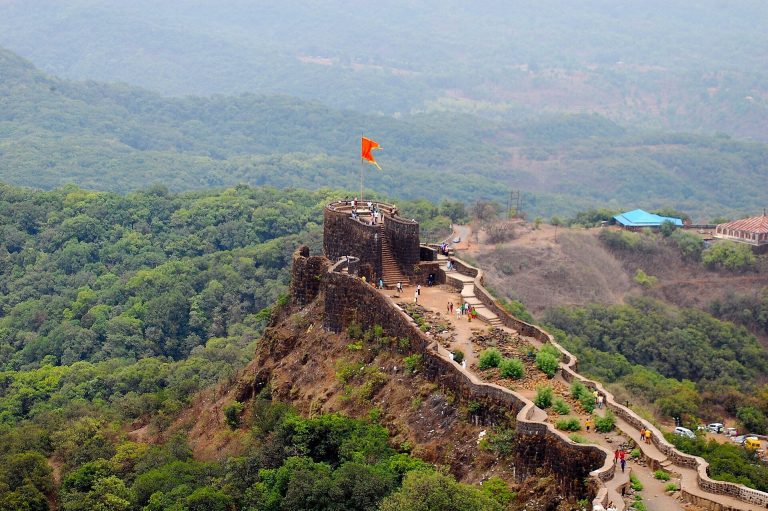
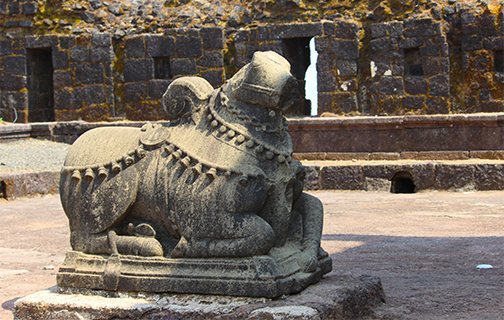
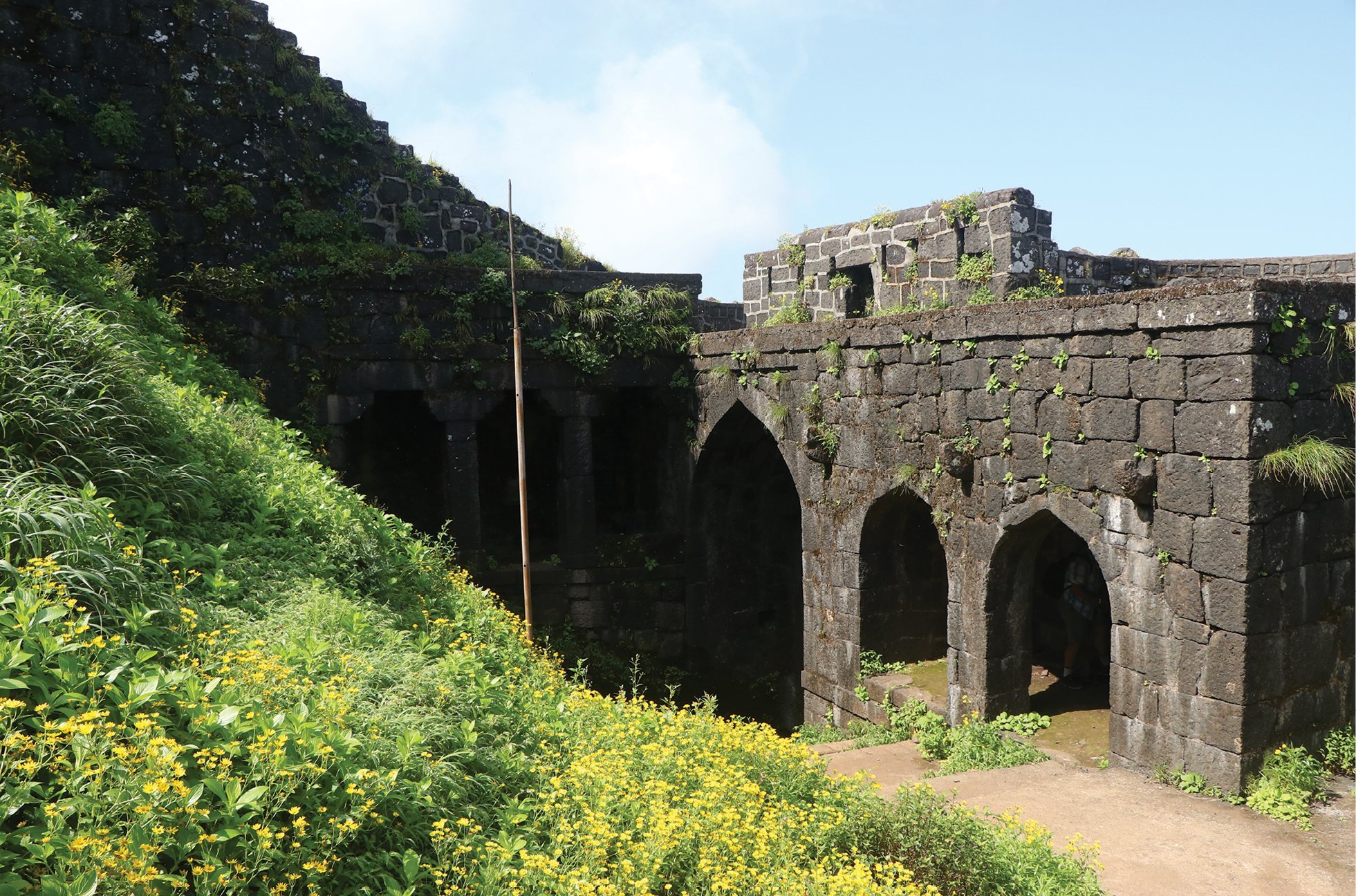
Rajgad occupies Murumbadevi Dongar, or the mountain of the goddess Murumba, at approximately 1,376 metres above sea level. Its complex plan is centred on a high stronghold with three long, narrow projecting spurs. The fort’s base is described as approximately 40 kilometres in diameter, a scale that made it difficult to besiege. The surviving remains include palaces, cisterns, caves, temples, fortifications, and other buildings.
Central Citadel
Balle Killa
Balle Killa, meaning the inner or principal citadel, forms the highest and central part of Rajgad. Its remains include the principal palaces, the royal court known as Rajsadar, and water cisterns. The Mahadarwaja of Balle Killa retains the burial place of Afzal Khan’s head within its walls.
Fortified Spurs
Suvela Machi
Suvela Machi, a fortified projecting spur or terrace, is the longest and easternmost of Rajgad’s three principal spurs. It has double fortifications and a gateway whose form resembles a cow’s mouth.
Padmavati Machi
Padmavati Machi contains temples, water cisterns, and other structures. The Padmavati Temple can accommodate approximately fifty people. The fort’s cisterns are described as supplying fresh water throughout the year.
Sanjivani Machi
Sanjivani Machi is heavily fortified and protects Rajgad from one direction. Its defensive works form part of the fort’s extended system of walls and terraces.