Green Hill Fort: A Pre-Federation Colonial Defence Battery on Thursday Island
Site at a Glance
- Rating
- 4.6
- Popularity
- Low
- Country
- Australia
- Primary era
- Modern
- External website
- Open
- Eras represented
- Modern
- Civilizations
- British
- Site type
- Military
- Remains
- Fort
On this page14 sections
History
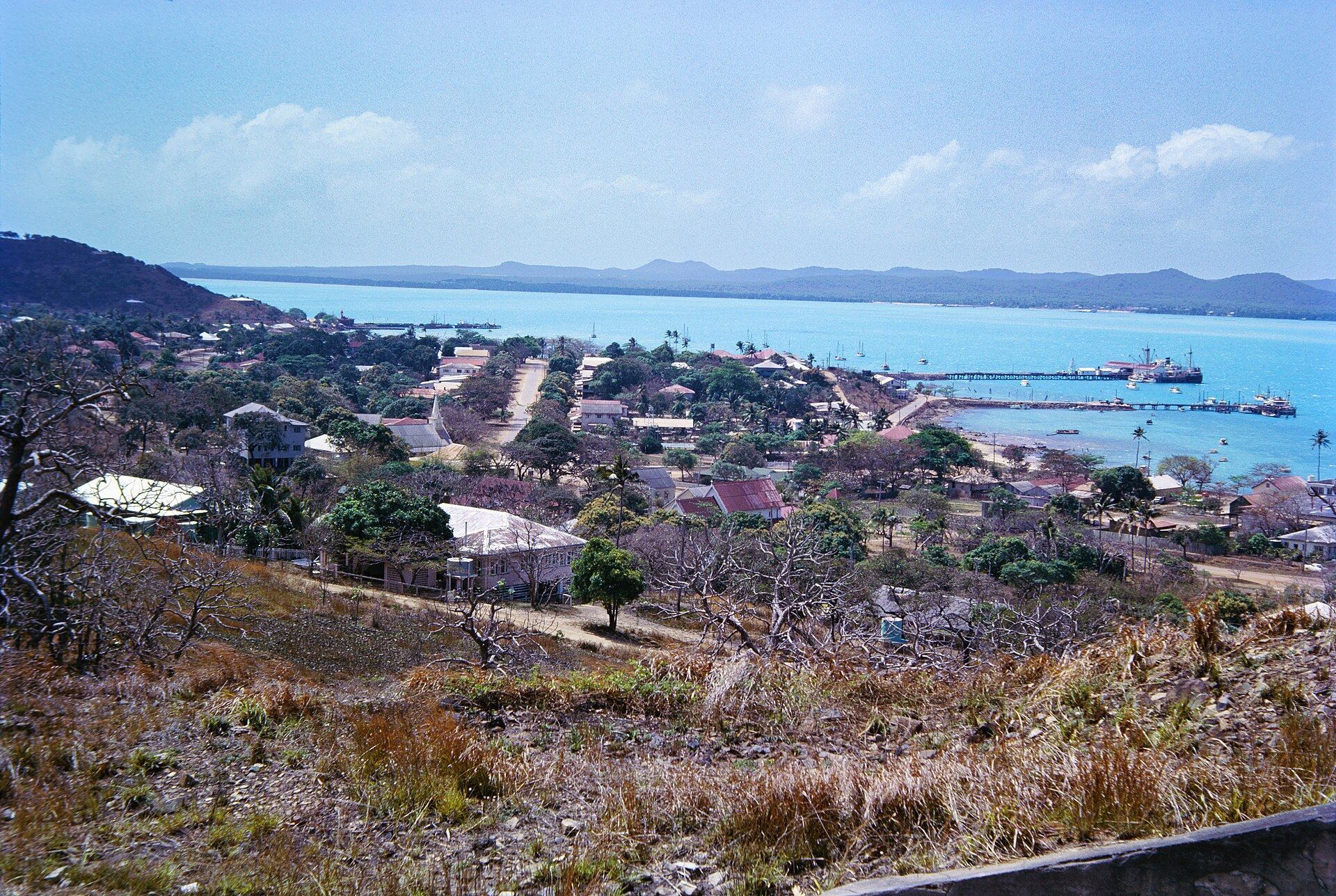
Green Hill Fort is a late-nineteenth-century British and Australian colonial coastal defence fort on Thursday Island, Australia, constructed between 1891 and 1893. It protected the coaling station at Port Kennedy, rather than the Torres Strait itself, and formed part of a coordinated defence scheme developed before the Federation of Australia in 1901. The fort occupied a strategic position near the northern entrance to Australian waters and on the main shipping route between Asia and England.
Strategic origins
Torres Strait had been regarded as important to British and colonial trade and defence since at least the late 1830s. In 1860, the British and Queensland governments agreed in principle to establish a northern port and military presence. Somerset was founded in 1864 as a refuge, coal depot, and supply station, but the Queensland government transferred the official port of refuge to Thursday Island, then known as Port Kennedy, in 1877.
That same year, several Australian colonial governments asked British Royal Engineer Colonel Sir William F. D. Jervois to inspect Australian defences, assisted by Lieutenant-Colonel Peter H. Scratchley. Jervois identified the danger of attacks from the sea against Queensland’s principal ports. Scratchley later recommended fortifying Thursday Island in 1881, describing it as an essential northern link between Australia and Asia. Queensland could not meet the cost alone.
Britain’s refusal to support Queensland’s proposed annexation of New Guinea, followed by German and British territorial claims there, increased concern about the region. The confrontation between Britain and Russia in 1885, together with wider European colonial expansion into New Guinea and the South Pacific, encouraged Britain and the Australian colonies to strengthen their northern defences. At the Federation Conference in February 1890, the colonies agreed to share the cost of fortifications at Thursday Island and King George’s Sound and to accept British armaments.
The fort was intended partly as a deterrent, or bluff. Longer-range weapons and ironclad cruisers had already made its wider role in coastal defence technologically outdated, but its position still gave it importance in the defence of Port Kennedy. New South Wales, Victoria, Queensland, Western Australia, and South Australia contributed to the construction. Britain supplied the guns, while Queensland provided and funded the garrison.
Construction and colonial service
Construction began in August 1891 under Major Edward Druitt of the Queensland Permanent Artillery, the colony’s standing artillery force. The Queensland Colonial Architect’s office appears to have prepared the plans for the underground magazines and store rooms and certainly prepared the plans for the barracks and several additions made in the early twentieth century.
The fort was garrisoned from 1893 until 1926. In June 1893, two officers and 30 men from the A Battery of the Queensland Permanent Artillery arrived on Thursday Island. A 4.7-inch gun was installed on Milman Hill in 1897, the Green Hill garrison grew from 30 to 45 personnel, and 30 local volunteers formed the Thursday Island Detachment of the North Queensland Garrison Battery. Green Hill Fort never fired a shot in conflict during this period.
After Federation took effect on 1 January 1901, the fort passed to the Australian Government. Improvements in 1912 included a new underground powder magazine, an air-conditioning system for the cordite store, and a laboratory outside the fort gate. Cordite was a smokeless propellant used in ammunition.
War, abandonment, and later uses
Thursday Island went on full alert when the First World War began. After the German threat in the Indian and Pacific oceans declined after 1915, the garrison was transferred to active service and Green Hill Fort was used to train Queensland militia until 1918. The main northern defence focus later shifted to Port Darwin. Most of the garrison was withdrawn in 1926, and the Thursday Island defences were dismantled in 1932.
From 1942 to 1945, Thursday Island served as the headquarters of Allied military operations in Torres Strait. The civilian population was evacuated, and Green Hill Fort became a signals and wireless station and an ammunition store for Australian and American forces. Several anti-aircraft batteries were added to strengthen the local defences.
The fort no longer had a military purpose after the Second World War. From 1954 to 1993, the Bureau of Meteorology operated a weather station inside the fort as part of Australia’s national weather-reporting system. A conservation and restoration project was completed in April 2002. Green Hill Fort was added to the Commonwealth Heritage List on 28 May 2008 because of its place in Australian military history, its largely intact late-nineteenth-century colonial fortification, its association with Jervois, Scratchley, and Druitt, and its rarity as one of only two Australian forts jointly funded by all the participating colonies.
The Torres Strait Regional Authority owns Green Hill Fort, and the Torres Strait Historical Society and Museum Association manages it. The authority is an independent agency within the Indigenous Affairs portfolio that reports directly to the Commonwealth Minister for Families, Community Services and Indigenous Affairs.
Remains
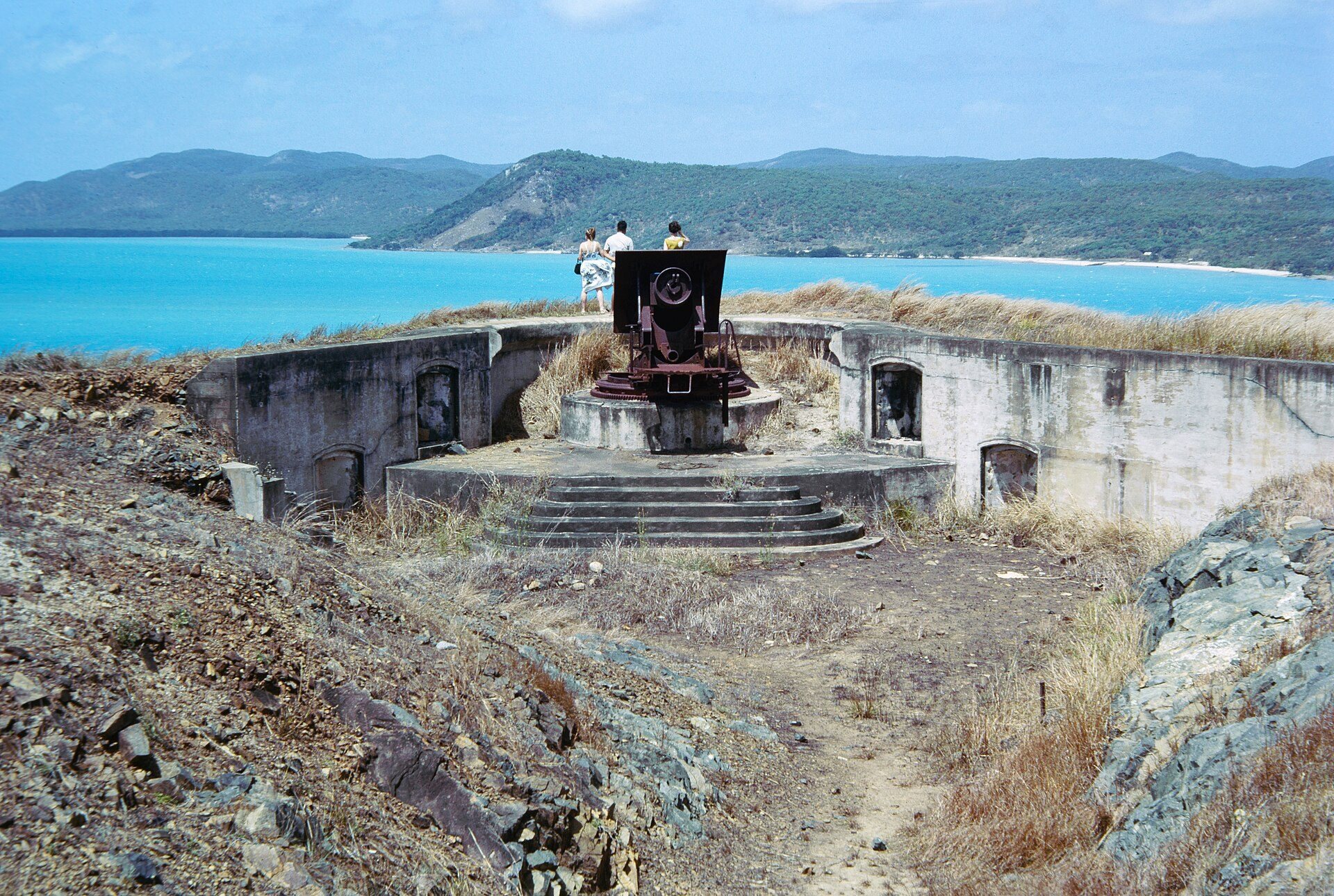
The Green Hill Fort complex covers about 16 hectares on the western end of the high ridge that forms Thursday Island’s east-west spine. The fortifications stand at the western end, with a densely forested saddle between two small eastern knolls and the former barracks site farther east. The main defensive works combine earth embankments, a level artillery platform, external gun positions, sunken working areas, underground rooms, and connecting routes.
Battery and underground works
Artillery battery
The battery on Green Hill contains three six-inch breech-loading guns, which were loaded from the rear of the barrel. It commands a 270-degree view over Thursday Island harbour and Horn Island to the south, the boat channel and Prince of Wales Island to the southwest, Friday and Goode Islands and the western passages, and the Aplin Pass boat channel and Hammond Island to the north. The ridge falls steeply on three sides of the summit. The battery is supported by embankments and a terreplein, a level platform formed from packed earth for mounting artillery. Three external gun emplacements and sunken working platforms are protected by abutment walls. All three guns were treated during the 2002 conservation project.
Magazines and passages
Much of the fort’s operational infrastructure lies underground. Magazines, storage rooms, passages, steps, ammunition-trolley tracks, and entrance paths connect the principal spaces, which include a cordite store, artillery store, shell store, powder magazine, lamp store, machinery room, and store. The protected rooms reflect the fort’s role in handling guns, shells, and propellant. A sunken observation pit, an access walkway, tunnels, and tracks for ammunition trolleys form part of the surviving defensive arrangement.
Barracks and support area
Former barracks site
The eastern support complex included Victoria Barracks, a canteen, sergeants’ mess, gun shed, guard house, and two concrete-lined underground water tanks. Surviving elements at the former barracks site include water-tank remains, walls, footings, and concrete drains. Remnants of exotic plantings, particularly mango trees, also survive around the area.
Weather station
A small weather-station complex built in the 1950s stood within the fort area. Constructed from timber and fibrous cement, it included a main office, balloon shed, masts, and a toilet. Severe vandalism led to the removal of the office in 1999. The associated concrete slabs, posts, and septic trench were removed during the 2002 conservation works, and a low-impact public viewing area was created on the former weather-station site.
Ridge landscape and conservation
Forested saddle
The saddle between the eastern knolls contains indigenous wet-tropical forest mixed with exotic species that were planted or became self-sown. A small cleared area at its western end may relate either to the Kaurareg, an Indigenous people of the Torres Strait, or to late-nineteenth-century Chinese market gardening. The area also contains a quarry. A road connecting the former barracks site to the fort passes through the forest.
Surviving structure
The fort remains structurally sound and essentially intact. Erosion affected the southeastern ramparts, while the weather-station office had a severe impact on the fort’s view before its removal. The restoration project made limited repairs to other rampart walls, reopened two external drain sumps, corrected drainage problems in the magazine area, and used landfill and turf to control erosion.
The conservation works also upgraded doors and sash windows, installed ventilation fans and a toilet, relocated power lines to the saddle north of the fort, upgraded internal power, provided mains water, and moved telephone lines through a trench. A telecommunications facility east of the fortifications occupies a separate lot outside the Green Hill Fort listing boundary.