Church of St Martin, Vrbové: A Gothic and Baroque Parish Church in Slovakia


Site at a Glance
- Rating
- 4.7
- Popularity
- Very Low
- Country
- Slovakia
- Primary era
- Medieval
- Eras represented
- Medieval, Early Modern, Modern
- Civilizations
- Austrian Empire, Habsburg, Hungarian
- Site type
- Religious
- Remains
- Church
On this page11 sections
History
The Church of St Martin, Vrbové, is a Roman Catholic parish church in Slovakia, completed and consecrated in 1397 in the Gothic style. Dedicated to St Martin of Tours, a fourth-century Christian bishop and major saint in Western Christianity, it belongs to the Diocese of Trnava, the Piešťany Deanery, and the Vrbové parish within the Western Province. A parish at Vrbové is recorded from the same year, placing the church within the settlement’s documented medieval development.
Medieval Vrbové and the parish church
The settlement associated with Vrbové has yielded archaeological finds from the Paleolithic, Neolithic, and Bronze Age. Its first written record dates to 1390, when it appeared under the form Orbo. In 1437, Sigismund of Luxembourg, who later became Holy Roman Emperor, granted Vrbové municipal privileges. The church completed its first major phase during this period, serving as the Gothic parish church of the community.
Religious and architectural changes
Between 1612 and 1662, the church served non-Catholics. During the seventeenth century, the medieval building was altered in the Baroque style, including the installation of a new vault. A north aisle was added later, followed by a south aisle in the eighteenth century. These changes expanded the Gothic structure while giving its interior a different architectural character.
The parish’s later history is reflected in its institutions and records. Parish registers have been maintained since 1699. A parish school known from the sixteenth century was destroyed during the Turkish devastation of 1599 and restored as a Roman Catholic elementary school in 1752. A parish chronicle, or kondochium, recording parish history and affairs is documented from the late eighteenth century. The parish also includes Šípkové and Prašník. A memorial plaque to Ján Baltazar Magin is located at the parish rectory.
Remains
Gothic masonry and vaulted spaces
Sanctuary and aisles
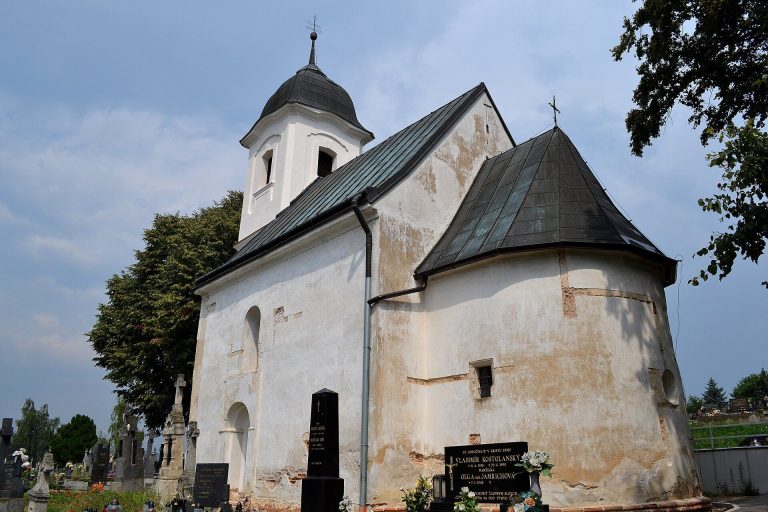
Built of stone, the church retains the masonry of its original Gothic structure and the columns of the main nave. The sanctuary ends in three sides and is reinforced externally by buttresses, with further buttresses along the north facade. The south and west exterior walls have smooth masonry. Inside, the sanctuary carries a lunette vault, a vault interrupted by curved sections, with stucco decoration. The main and south aisles have cross vaults formed by intersecting barrel vaults, while the north aisle is covered by a continuous barrel vault.
Towers and entrances
The projecting Gothic tower has a pointed entrance at ground level and a separate entrance leading to the crypt, a space beneath the church used for burial or commemoration. Beside the church stands a tower built in 1835 on the site of the original Gothic tower. Together, these elements reflect the building’s medieval foundation and later reconstruction.
Altars, pulpit, and devotional furnishings
Main altar and side altars
The newer main altar places a statue of St Martin at its center, with statues of St Peter and St Paul on either side. The north aisle ends in an altar dedicated to Our Lady of the Seven Sorrows. In the south aisle is an altar of the Sacred Heart, while a pillar carries an altar dedicated to the Heart of Mary. Stations of the Cross, a cross, and additional statues complete the church’s devotional furnishings.
Pulpit and organ
The pulpit dates from the beginning of the eighteenth century. Its decoration includes sculptures of the four Evangelists, Matthew, Mark, Luke, and John, together with reliefs of the Doctors of the Church, Christian theologians and teachers recognized for the importance of their doctrine. The used side entrance opens into the south aisle, where an organ dating from 1947 is installed.
Commemorative plaque
A plaque on a subsidiary pillar commemorates Mass endowments made by Titular Bishop Pavol Forgáč in 1736. A titular bishop holds the title of a historical or nominal episcopal see without governing it as the ordinary diocesan bishop.