Yeni Mosque, Edessa: An Ottoman Mosque and Museum in Greece


Site at a Glance
- Rating
- 3.4
- Popularity
- Very Low
- Country
- Greece
- Primary era
- Early Modern
- External website
- Open
- Eras represented
- Early Modern, Modern
- Civilizations
- Ottoman
- Site type
- Religious
- Remains
- Mosque
On this page6 sections
History
Yeni Mosque is a former Sunni Muslim mosque in Edessa, Greece, built during the Ottoman period in the mid-seventeenth century. Its date is indicated by the building’s form and by the Ottoman traveler Evliya Çelebi, who mentioned it in 1668. It is the only surviving mosque in Edessa and is also preserved as the town’s only mosque that retains its original form.
Ottoman mosque
The mosque served the town’s Muslim community until 1912, when it was abandoned as a place of Islamic worship following the Balkan Wars, conflicts in southeastern Europe that brought major territorial changes in 1912 and 1913. The other mosques in Edessa were later demolished or transformed, leaving Yeni Mosque as the sole surviving example of the town’s Ottoman mosques.
Museum use
The building was designated a cultural monument in 1934 and again in 1937. In 1942, it was converted into a city history museum. It now functions as an exhibition space for archaeological finds, giving the former religious building a continuing public and historical role.
Remains
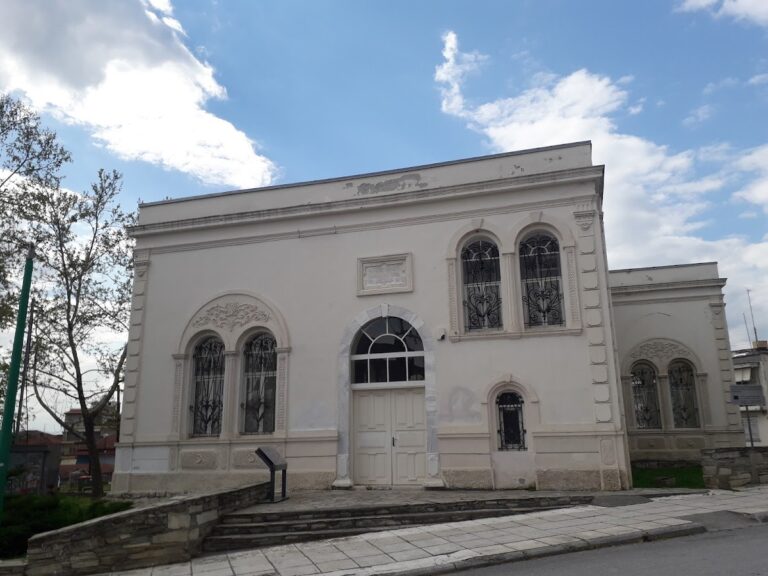
Yeni Mosque is an Ottoman-style brick-and-stone building measuring approximately 15 by 20 metres and reaching a maximum height of 16 metres. Its square prayer hall is covered by a hemispherical dome with a scaly-tile covering. On the northern facade, an open porch supported by columns carries three low domes, while a tall minaret rises at the northwestern corner. The building has thirty-three windows in total.
Prayer hall and surviving fittings
The southern wall retains the mihrab, the prayer niche indicating the direction of Mecca. Two square wooden balconies survive at the interior corners, reached by stairways that open into the thickness of the walls. A long wooden portico, or covered walkway supported by columns, formerly extended along the northern wall. Although the portico no longer survives, the access stairs leading toward it and the minaret preserve evidence of its former arrangement.
Dome decoration
Painted decoration remains on the dome in a radial arrangement. Its triangular compartments contain repeating geometric and floral patterns, stars with crescents, and heart-shaped shell motifs associated with the artistic vocabulary of the nineteenth century. Excerpts from the Quran run around the perimeter at the base of the dome.