Titi Caravanserai: A Safavid Roadside Lodging Complex in Iran


Site at a Glance
- Rating
- 4.2
- Popularity
- Low
- Country
- Iran
- Primary era
- Early Modern
- Eras represented
- Early Modern
- Civilizations
- Safavid
- Site type
- Economic
- Remains
- Caravanserai
History
Titi Caravanserai is a Safavid-period caravanserai in Iran, built under Safavid rule at Balarud village in Siahkal County. Its construction belongs to the final days of Kiyaid rule in Siahkal, a period associated with a local dynasty that governed parts of the Gilan and Deylaman region. A caravanserai was a roadside lodging complex where travelers, merchants, and their animals could rest during long journeys.
The building was ordered by Titi Khanum, identified as the aunt of a Safavid ruler. It provided lodging for travelers journeying from Siahkal and Deylaman toward Taleqan. The name titi means “blossom” in Gilaki.
Heritage Recognition
Titi Caravanserai entered Iran’s national heritage list under number 1784 on 2 December 1996. In 2023, at the 45th session of the UNESCO World Heritage Committee in Riyadh, it became part of The Persian Caravanserai, a serial World Heritage property comprising 54 historic caravanserais in 24 Iranian provinces. The property was inscribed under cultural criteria (ii) and (iii), with Titi Caravanserai’s distinctive architecture identified as the reason for its inclusion.
Remains
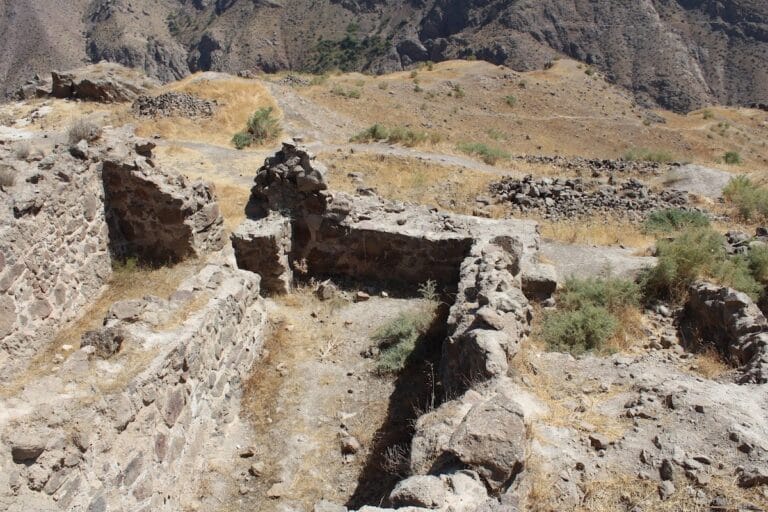
Titi Caravanserai is an extramural complex, meaning that it stands outside a settlement, and follows a two-iwan plan around a central courtyard. Its approximately 398-square-metre layout includes an entrance, a vestibule, iwans, pointed arches, a kolombo vault, and barrel vaults. An iwan is a large vaulted hall open on one side, and the iwans organize the building around its central open space.
The walls were constructed from rounded stones. Brick, mortar, and sarooj were used for the vaults, while brick, gypsum, and stone also formed part of the building materials. The combination of the courtyard plan, pointed arches, and varied vaulting gives the caravanserai the distinctive architectural character associated with its World Heritage inclusion.