Roosendael Abbey: A Cistercian Nunnery in Belgium


Site at a Glance
- Rating
- 4.4
- Popularity
- Very Low
- Country
- Belgium
- Primary era
- Early Modern
- Eras represented
- Early Modern
- Civilizations
- Duchy of Brabant, Habsburg, Holy Roman Empire, Spanish
- Site type
- Religious
- Remains
- Fortified Monastery
On this page13 sections
History
Roosendael Abbey is a former Cistercian nunnery in Belgium, founded between 1220 and 1227 on the southern bank of the River Nete. The Cistercians were a reform branch of Western Christian monasticism whose communities emphasized communal prayer, disciplined religious life, and agricultural self-sufficiency. The abbey stood in the Duchy of Brabant, within the lordship of Duffel, in an area now divided between Sint-Katelijne-Waver and Walem.
Foundation and medieval development
Tradition attributes the foundation to Gillis I Berthout, lord of Duffel, who established the community for his daughters Oda and Blessed Elizabeth. Oda became its first abbess, and the institution was explicitly described as an abbey in 1233. Roosendael initially depended on Villers Abbey and later on St Bernard’s Abbey at Hemiksem. It belonged to the Diocese of Cambrai, a regional administrative jurisdiction of the Christian Church, until 1559, when it passed to the Diocese of Antwerp.
Leadership remained within the Berthout family until 1350. Roosendael became a wealthy institution as women from the local nobility entered the community with dowries. Its holdings eventually reached 920 hectares, including 22 farms and two windmills. Before the suppression, the abbey housed 96 choir and lay sisters and 25 male and female servants.
Religious life and renewal
Blessed Ida of Louvain, a medieval Cistercian nun venerated for her holiness, was an early member of the community. Her reputation for sanctity contributed to Roosendael’s wider renown. A period of stagnation ended in the second half of the fifteenth century with the appointment of Christina Vastrix as abbess.
War, exile, and reconstruction
The abbey was looted repeatedly during the sixteenth-century religious wars, in 1537, 1542, 1566, and 1576. In 1578, most of the monastic buildings were destroyed by fire. The nuns first fled to the abbey’s refuge house in Mechelen, an urban residence used by a religious community displaced by war or unrest, and later moved to the lands of Cleves after Mechelen came under Protestant control.
The community remained at the Mechelen refuge house from 1585 to 1660, where reconstruction of Roosendael began. A new church and monastery were completed in 1661. Joanna Van Laethem, abbess from 1639 to 1662, is regarded as the abbey’s second foundress because of her role in restoring the institution.
Eighteenth-century disruption and suppression
Military bands caused further disruption during the first half of the eighteenth century, including during the War of the Spanish Succession and Louis XV’s invasion. Louis XV was king of France from 1715 to 1774. Prosperity returned in the second half of the century, when an abbess’s palace was constructed.
To avoid Emperor Joseph II’s policy of suppressing monasteries judged to have insufficient social or religious utility, the nuns established a boarding school within the abbey. Joseph II was the Habsburg emperor whose reforms included the closure of religious houses considered unnecessary.
The French army occupied Roosendael in 1794. The abbey was ordered to close in 1795, and the last nuns were expelled in January 1797. Its property was sold, after which the church and most of the monastic buildings were demolished.
Later transformations and preservation
After the suppression, the main building became a country house during the nineteenth century. The abbess’s palace was destroyed in 1914 during the First World War, and a villa was built on the former abbey site in 1920. In 1958, the last private owner bequeathed the estate to the archdiocese on the condition that it be used as a youth hostel.
Restoration of the surviving buildings began in 1984, followed by extensive work from 1995 to 2009. The estate subsequently served hospitality and events and now functions as a residential youth centre. The surviving buildings are protected built heritage, while the approximately seven-hectare estate is protected as a cultural-historic landscape.
Documentary heritage
During the sixteenth-century iconoclasm, Roosendael’s records were moved to the Mechelen refuge house. After the rebuilt abbey received them back, most were confiscated by the French in 1797. They resurfaced in Brussels in 1828 and were acquired for the National Archives of Belgium. The State Archives in Antwerp preserve 1,024 original charters, the oldest dating from 1226. These records include papal bulls, formal documents issued by the pope, and ducal charters, legal documents issued by a duke. Bornem Abbey preserves two Roosendael cartularies, or compiled collections of institutional documents.
Remains
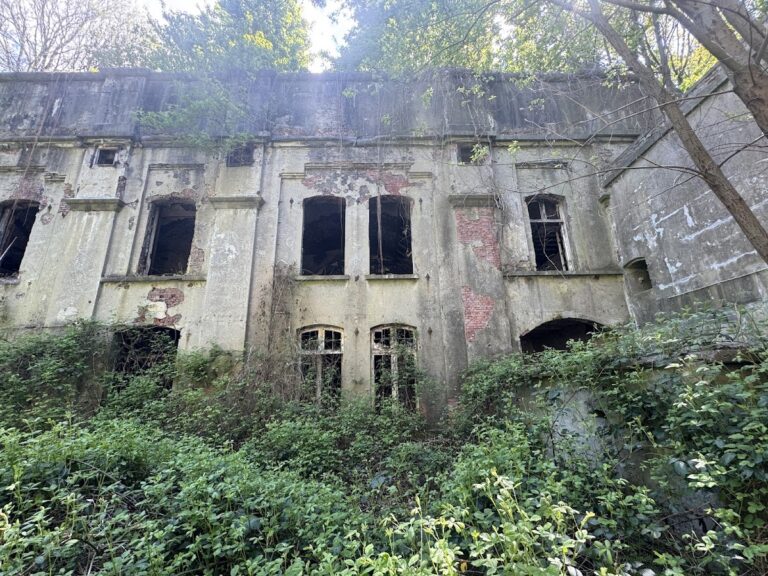
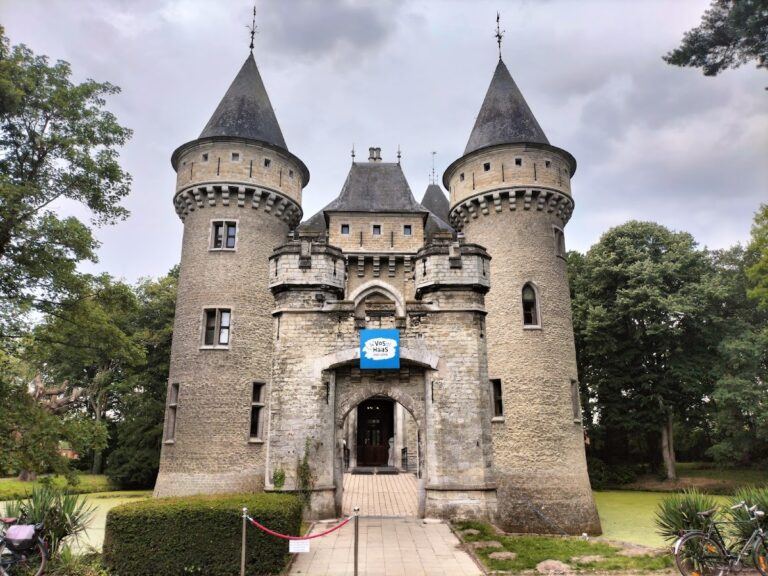
The former monastery stood beside the River Nete within a complete enclosing wall and surrounding moat. Most of the complex was demolished after the suppression, but several ancillary buildings survive in the park. The physical remains include the seventeenth-century infirmary, traditionally called the pest house, an ice cellar, a monumental entrance gate, and a coach house.
Surviving abbey buildings
Infirmary and ice cellar
The seventeenth-century infirmary and ice cellar are the oldest surviving buildings at Roosendael. The infirmary is traditionally known as the pest house. Both form part of the surviving complex within the park and are used in connection with the residential youth centre and the estate’s hospitality and events.
Entrance gate
The monumental entrance gate was built in 1777 and 1778 under Abbess Agnes Haegens. Its construction reportedly marked the twenty-fifth year of her abbacy. The gate remains part of the approach to the surviving estate.
Coach house
The coach house was constructed in 1781 and survives among the ancillary buildings in the park. Together with the entrance gate, it represents the eighteenth-century phase of the estate that followed the abbey’s renewed prosperity.
Park and landscape
Access to the estate follows a long lime-tree avenue from Lange Zandstraat. An English landscape garden was laid out east of the dwelling. The park contains common and copper beech, summer and winter oak, white and red horse chestnut, and common plane trees. Introduced species include Pyrenean oak, Lebanon cedar, bald cypress, catalpa, and smoketree. Near the former pest house stands the thickest common plane tree in Belgium. The surviving buildings and park continue to serve as the grounds of a residential youth centre and for hospitality and events.