Røldal stave church: A Medieval Pilgrimage Church in Norway


Site at a Glance
- Rating
- 4.4
- Popularity
- Low
- Country
- Norway
- Primary era
- Medieval
- Eras represented
- Medieval, Early Modern, Modern
- Civilizations
- Norwegian
- Site type
- Religious
- Remains
- Church
On this page13 sections
History
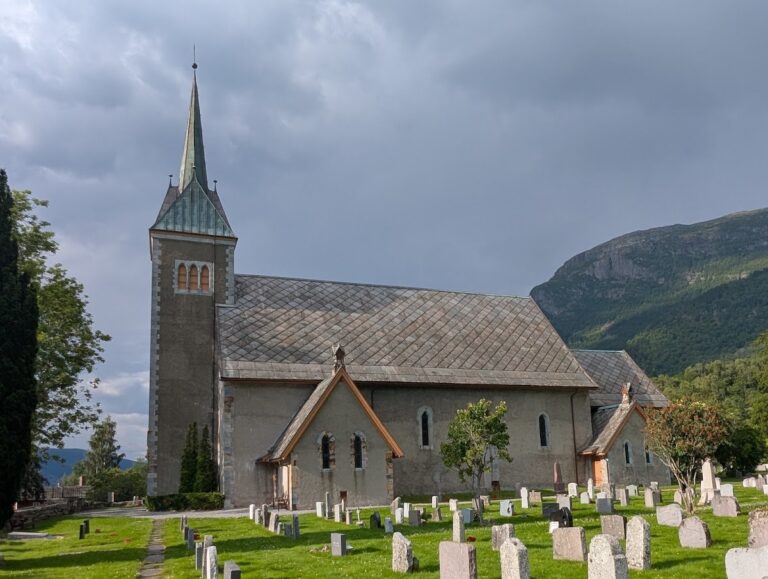
Røldal stave church is a thirteenth-century church in Røldal, Norway, built around 1250 in the medieval timber-building tradition. It is now an Evangelical Lutheran parish church of the Church of Norway, but it began as a Catholic church and became a major pilgrimage and votive center during the Middle Ages.
Medieval pilgrimage center
The church was first mentioned in writing in 1462. During the Middle Ages, pilgrims travelled to Røldal to make offerings in return for divine favors. Their donations helped bring prosperity to the village. Pilgrimages were especially connected with a medieval crucifix traditionally believed to shed tears or sweat around the summer solstice. The moisture was regarded as healing, and pilgrims collected it with cloths. Another explanation attributes the phenomenon to condensation caused by the humidity of pilgrims’ breath.
The pilgrimage was formerly accompanied by a Mass on Saint John’s Day. In 1835, the local Lutheran bishop prohibited the practice. Catholic pilgrimages later resumed on a regular basis, preserving an important religious association with the church.
Alterations and restoration
The building was enlarged westward in the 1840s. Work in 1844 raised the interior and exposed earlier construction details, prompting an investigation into the church’s structural history. The findings also led to debate over its classification. A stave church is a medieval timber church supported by upright posts, or staves. At Røldal, however, the load-bearing corner posts rested directly on a stone foundation rather than on a continuous frame of ground beams, an arrangement associated with an earlier type of timber building called a post church.
Extensive reconstruction and restoration took place from 1915 to 1918 under the direction of the Norwegian architect Jens Zetlitz Monrad Kielland. Domenico Erdmann restored the colors with assistance from Alfred Obert Hagn and Ulrik Hendriksen. The work removed later wall paneling, restored the Renaissance interior, and created a new covered passage around the church to protect the nave and chancel walls. Røldal stave church remains an active parish church and a preserved historic museum, with regular worship services. It is also an automatically protected Norwegian cultural-heritage site.
Remains
Røldal stave church is a brown wooden long church with a rectangular nave and chancel, designed to hold approximately 130 people. The nave is the main central room, while the chancel is the area near the altar traditionally associated with clergy and choir. The building was originally a single-nave hall in which the nave and chancel were equally wide. Soon after construction, the nave was widened in relation to the chancel, producing a form more typical of other stave churches.
Timber structure and exterior
Foundations and covered passage
Archaeological investigation revealed that the corner posts stand directly on a stone foundation, with threshold beams placed between them. This arrangement differs from the continuous ground-beam frame commonly associated with stave churches. A covered passage, known as a svalgang, once surrounded the building. The earlier passage was replaced by a new one during the twentieth-century restoration.
Nave, chancel, and portals
Most of the medieval construction of the nave and chancel survives, together with their associated roofs. The church was extended towards the west in 1844, and later paneling covered both the interior and exterior walls. That paneling was removed during the restoration of 1915 to 1918. Only part of the original south portal remains.
Interior furnishings and decoration
Renaissance interior
Seventeenth-century changes introduced Renaissance furnishings, painted interior walls, and windows. The Renaissance was a European cultural and artistic period whose influence shaped the church’s furnishings and painted decoration. The walls retain rich painted work, including rose motifs associated with Gottfried Hendtzschel.
Altarpiece and pulpit
The altarpiece dates from 1629 and was designed by Gottfried Hendtzschel, a German-born painter from Breslau in Silesia. He also painted the pulpit and altar retable. An altar frontal, a decorative panel placed at the front of an altar, is preserved at the Bergen Museum. It depicts the Crucifixion and Christ at the gates of Hell.
Medieval objects
Crucifix and baptismal font
A medieval crucifix dating from approximately 1250 stands at the entrance to the chancel. It is the object at the center of the church’s summer-solstice pilgrimage tradition. A soapstone baptismal font from approximately the same period is also preserved in the church.
Sculptures and removed furnishings
The Bergen Museum preserves further structural components and furnishings removed from the medieval church. These include wooden sculptures of Saint Olaf and the Virgin Mary with the Child, both dated to approximately 1250, and a sculpture of the Archangel Michael dated to approximately 1200. Saint Olaf was a medieval Norwegian king who became Norway’s principal Christian royal saint, while the Archangel Michael was traditionally regarded as a protector and warrior against evil.