Church of Sant’Omobono: A Norman-Byzantine Place of Worship in Catanzaro
Site at a Glance
- Rating
- 4.3
- Popularity
- Very Low
- Country
- Italy
- Primary era
- Medieval
- Eras represented
- Medieval
- Civilizations
- Kingdom of Sicily, Norman
- Site type
- Religious
- Remains
- Church
On this page6 sections
History
The Church of Sant’Omobono, also called the Church of the Most Holy Savior, is a Catholic church in Catanzaro, Italy, built by the medieval communities of the region in the twelfth century. Dedicated to Saint Omobono of Cremona, a Christian saint traditionally associated with merchants and tailors, it is described as the oldest place of worship in Calabria’s regional capital.
Origins and religious traditions
Tradition holds that the church was erected over a Temple of the Sun in the western part of Catanzaro. Its earliest religious affiliation was with the Greek Orthodox rite of Constantinople, reflecting the Byzantine traditions associated with the church’s origins. The building later became a Catholic place of worship within the Archdiocese of Catanzaro-Squillace.
From the seventeenth century, Sant’Omobono served as the seat of the Tailors’ Congregation, an association of tailors. Its dedication to Saint Omobono was closely connected with this role, since the saint was traditionally regarded as a protector of merchants and tailors. A relic of the saint is preserved inside the church.
Earthquakes, confiscation, and ownership
Major earthquakes in 1744, 1783, and 1832 caused extensive damage. The church was subsequently renovated and altered, leaving visible changes in its form. During the Kingdom of Naples, the southern Italian monarchy that preceded the Kingdom of the Two Sicilies, the building was confiscated and converted into an ammunition depot.
Under the Kingdom of the Two Sicilies, which existed from 1816 until Italian unification in the nineteenth century, Luigi Varano purchased the church for 320 ducats. In 1999, through the intervention of the archbishop of Catanzaro-Squillace, ownership passed to the diocesan curia, the administrative body assisting a bishop in governing a diocese. The church was reconsecrated in 2002.
Archaeology and local tradition
Excavations at the church uncovered several burials, seventeenth-century coins, and ceramics. These finds add archaeological evidence to the building’s long religious and civic history. A nineteenth-century legend also links Sant’Omobono with the Curatolo sect, described as a criminal organization formed by the area’s worst criminals. According to the legend, members deceived victims, brought them to the church, and killed and buried them there.
Remains
Plan and exterior features
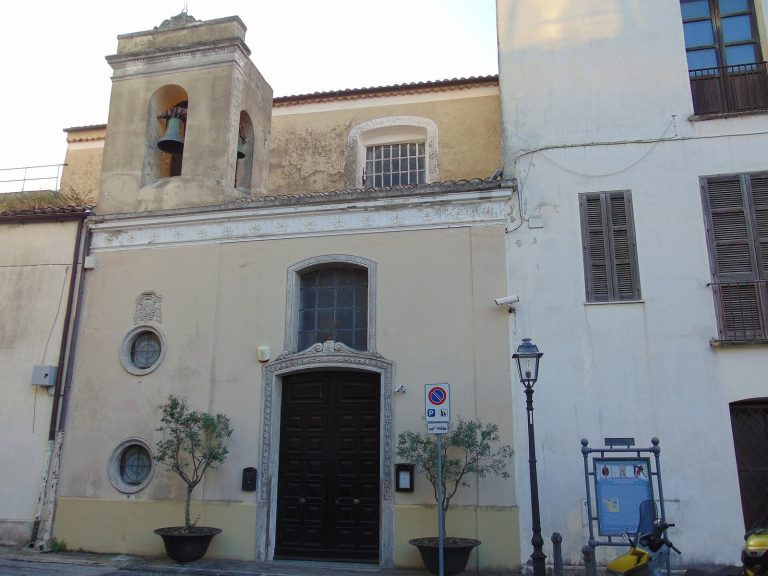
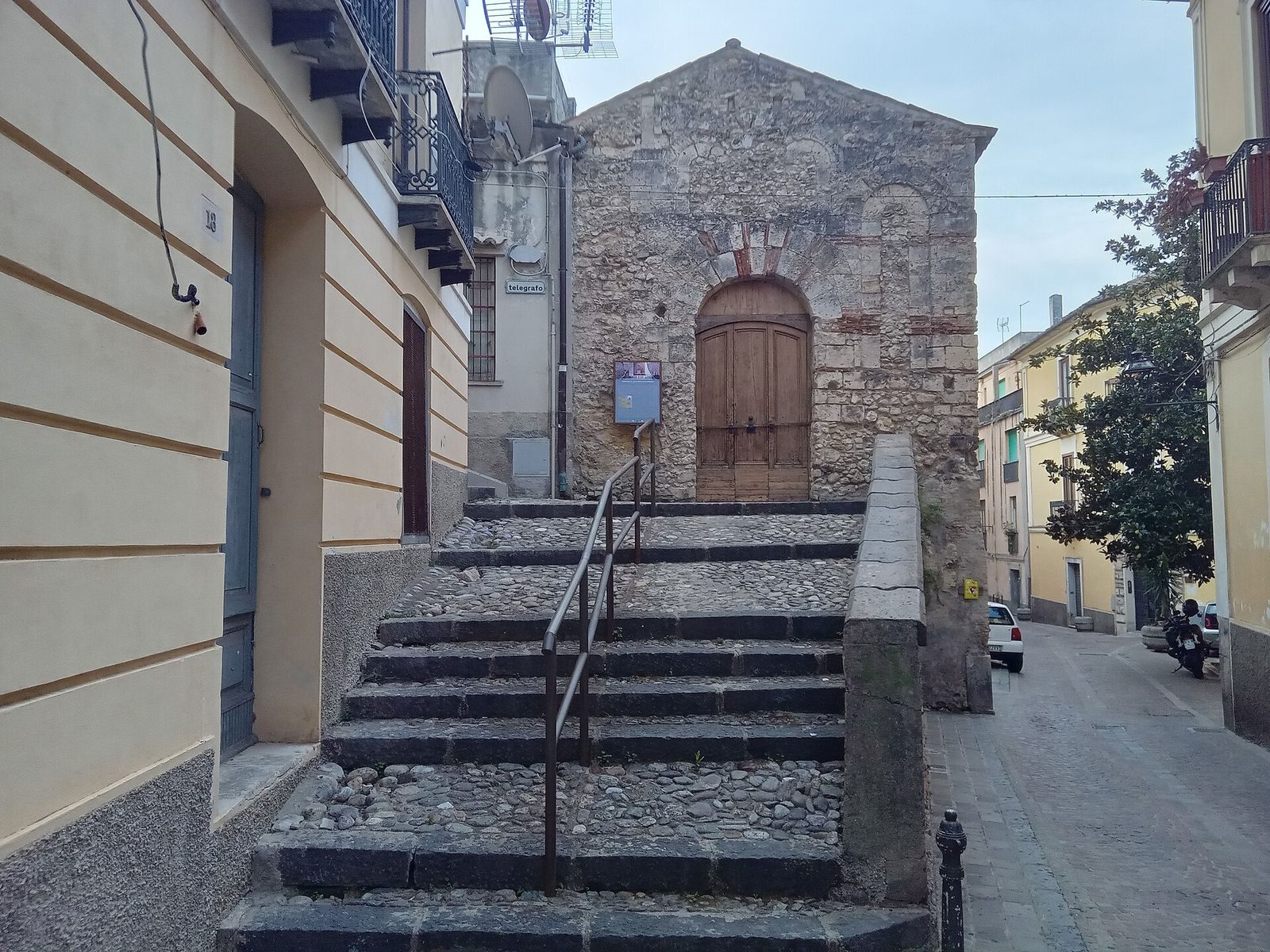
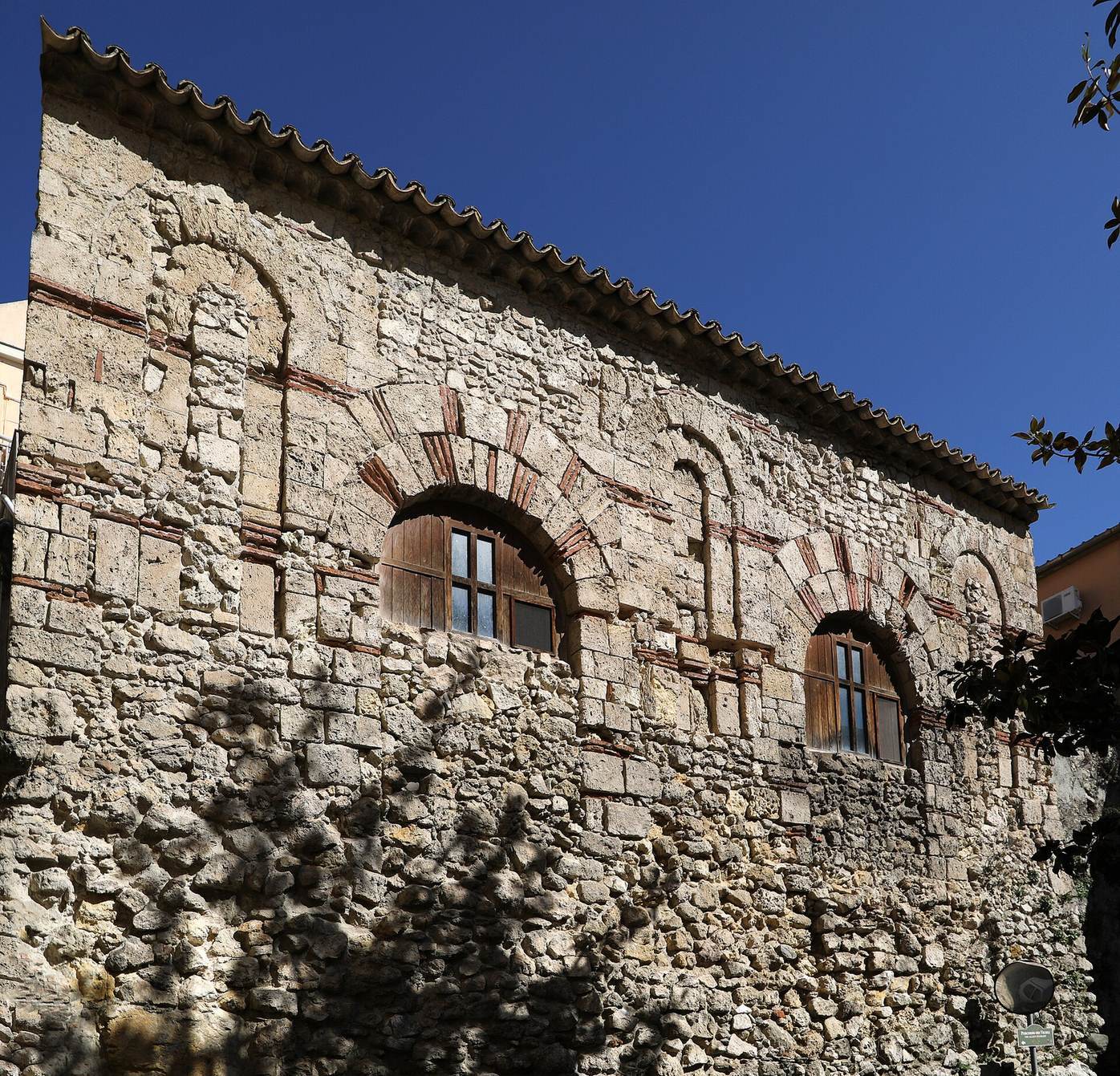
The church has a rectangular plan and a single nave, with six arches arranged around the perimeter. Its Norman-Byzantine architecture combines forms associated with Norman medieval building traditions and Byzantine influence. The entrance is reached by a flight of steps. Above the doorway, an arch with two courses of wedge-shaped stones, known as voussoirs, supports a now-blocked trifora, a window divided into three openings.
A blind single-lancet window, a narrow opening with one vertical aperture, stands to the right of the entrance. Along the right side, arches formed from alternating voussoirs and brickwork are interrupted by three single-lancet windows. The earthquake-related alterations remain visible in the differing lengths of the side walls, with the left side shorter than the right.