San Vincenzo in Prato: An Early Christian Basilica in Milan
Site at a Glance
- Rating
- 4.6
- Popularity
- Low
- Country
- Italy
- Primary era
- Medieval
- Eras represented
- Medieval, Modern
- Civilizations
- Italian, Lombard
- Site type
- Religious
- Remains
- Basilica
On this page13 sections
History
San Vincenzo in Prato is a Roman Catholic basilica in Milan, Italy, traditionally founded by the Lombards in 770 and retaining an early Christian architectural character. Affiliated with the Ambrosian rite, the distinctive Catholic liturgical tradition of the Church of Milan, it belongs to the Archdiocese of Milan, is recognized as a national monument, and remains an active place of worship.
Early Christian and Lombard origins
The church’s original name was Basilica virginum. It rose on the site of a Roman temple beside the Via Gallica, probably dedicated to Jupiter, or on the site of an oratory within a Roman necropolis. Tradition attributes the earliest foundation to Desiderius, the last king of the Lombard kingdom in Italy, who dedicated the church to the Virgin Mary in 770.
The dedication later changed to Saint Vincent after an urn containing his remains was found in the crypt. Saint Vincent of Valencia was a Christian deacon and martyr whose cult spread widely during late antiquity and the Middle Ages. The remains of Saints Quirinus and Nicomedes were found in 859, followed by those of Saint Abbondius in 1000. The church was consecrated around the turn of the ninth and tenth centuries.
The Prata estate and Benedictine monastery
The name “in Prato” comes from Prata, an estate owned by Bishop Odelpert. In January 806, Odelpert granted it to Arigauso, abbot of the monastery of Sant’Ambrogio, in return for his services, with the condition that the property would return to the Milanese curia after Arigauso’s death.
A Benedictine monastery was added to the church in 806. Benedictines are members of the Order of Saint Benedict, a Western Christian monastic tradition organized around communal religious life and the Rule of Saint Benedict. Between the ninth and eleventh centuries, the monks rebuilt the deteriorating church while preserving its original plan and appearance.
Suppression, secular reuse, and restoration
The monastery was suppressed in 1520. The church was restored in 1598 and converted into a parish church, but the Napoleonic laws led to its deconsecration in 1797. It was then used successively as a military warehouse, a stable, and barracks. During the nineteenth century, the building housed a chemical factory, while the bell tower served as a chimney.
Between 1880 and 1890, architect Gaetano Landriani restored the church at the urging of civic commissions associated with the Brera Academy of Fine Arts. The work produced its present appearance, reconstructed the right apse, and returned the building to religious use under the parish of Sant’Ambrogio. The painter Attilio Nicora added neo-Paleochristian decoration.
Twentieth-century interventions
During the second half of the twentieth century, the Milanese architects Vito and Gustavo Latis carried out work on the flooring in 1962 and the roof in 1973. After the Second Vatican Council, they also reformed the altars and removed much of the nineteenth-century work that had been made in an early Christian style, including most painted decorations, the ambons, and the concrete balustrades.
The fifteenth-century Madonna del Pianto was repositioned as the altarpiece between 1972 and 1978. New windows designed by Marta Latis were installed between 1980 and 1988, and the crypt was restored in 1989.
Remains
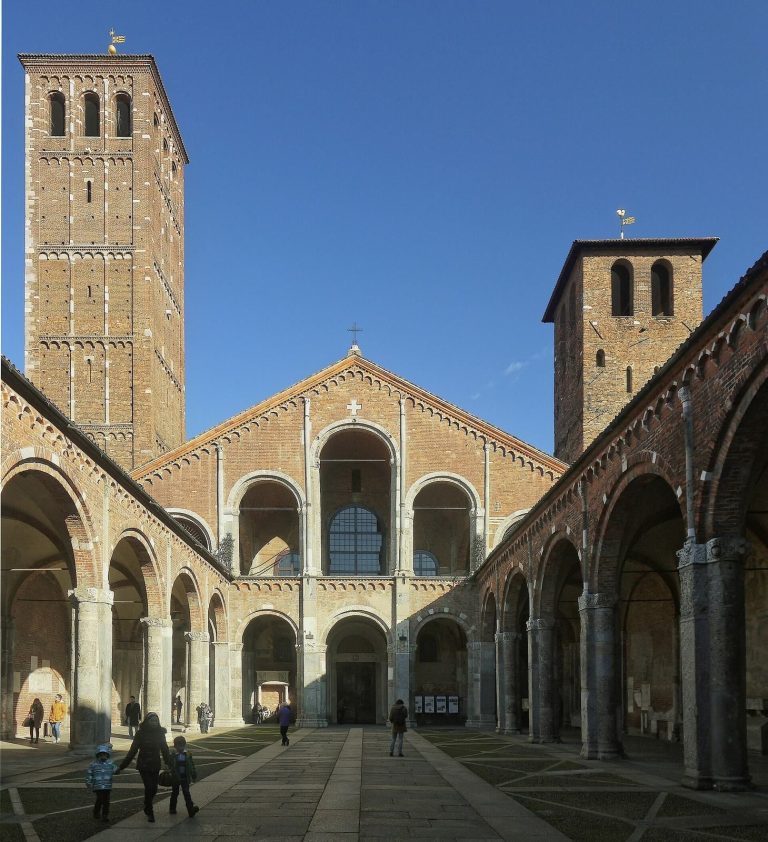
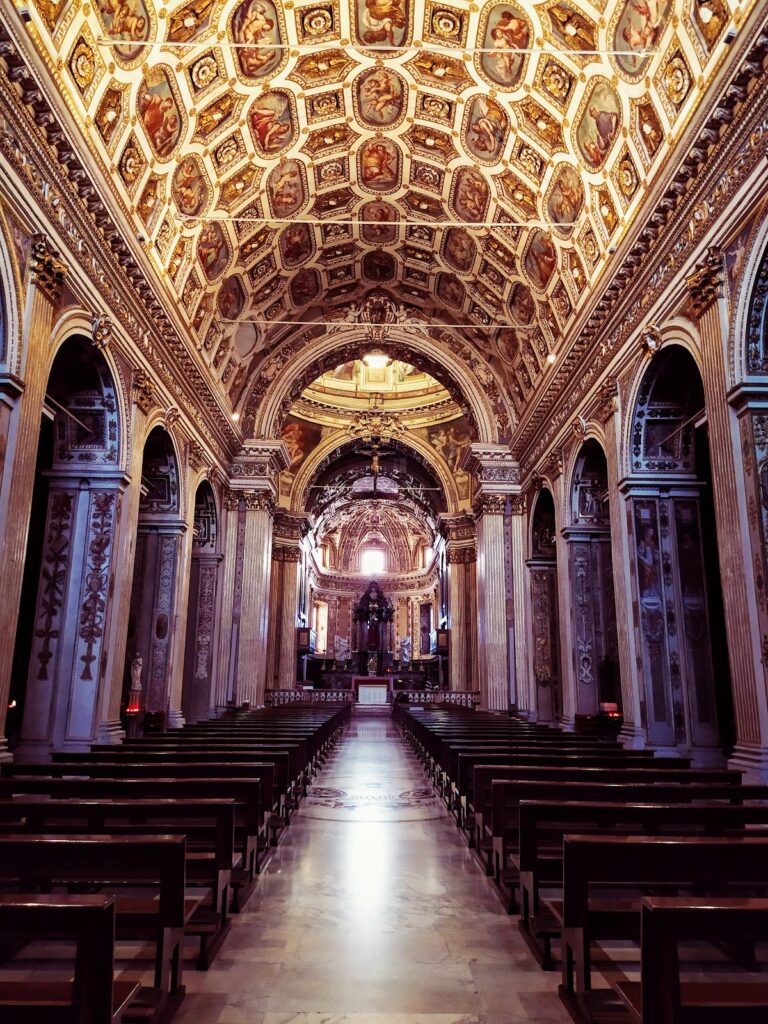
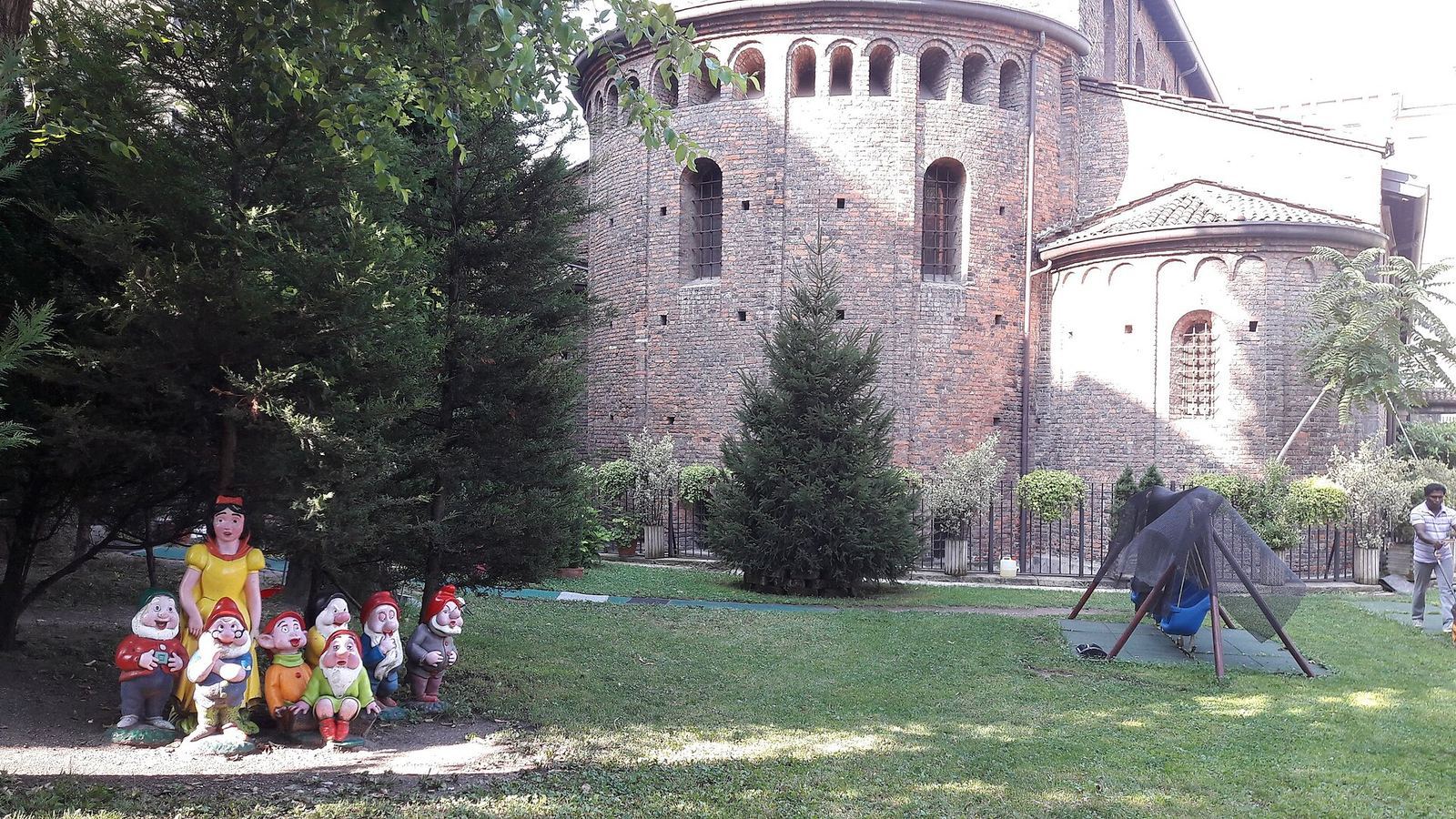
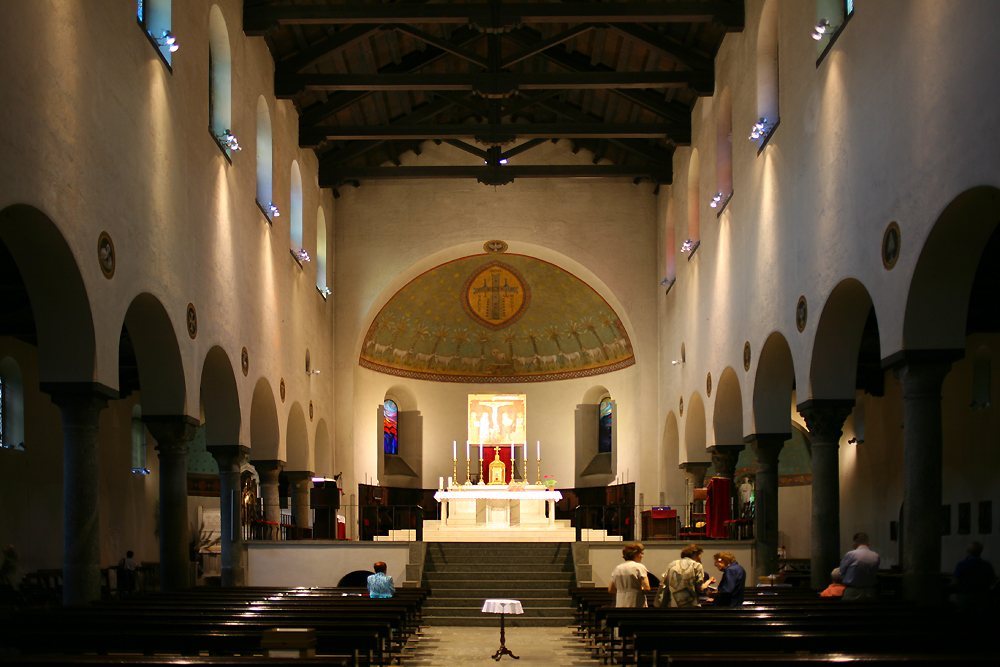
San Vincenzo in Prato is a small brick basilica measuring approximately 40 by 20 metres. Its surviving structure retains the original arrangement because successive restorations did not substantially alter it. The building preserves an unusually complete example of Milan’s earliest Christian architectural forms, with one nave, two aisles, a wooden-span ceiling, columns from different periods, an elevated choir, and a large apse.
The basilica and crypt
Nave, aisles, and Roman remains
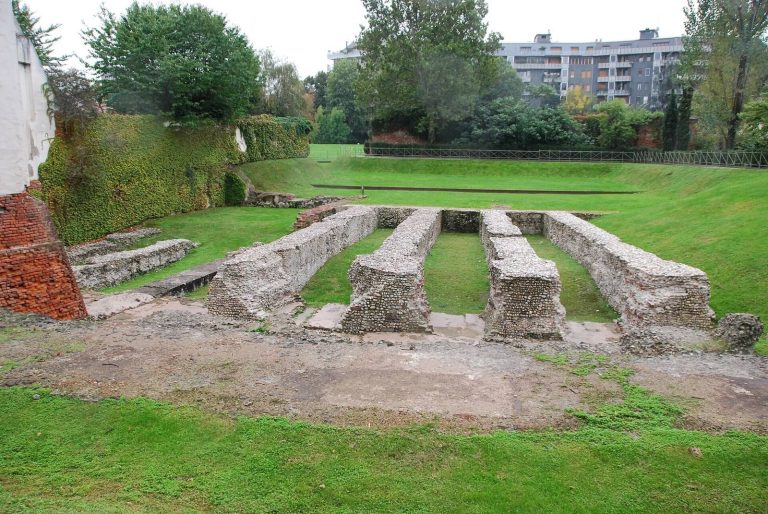
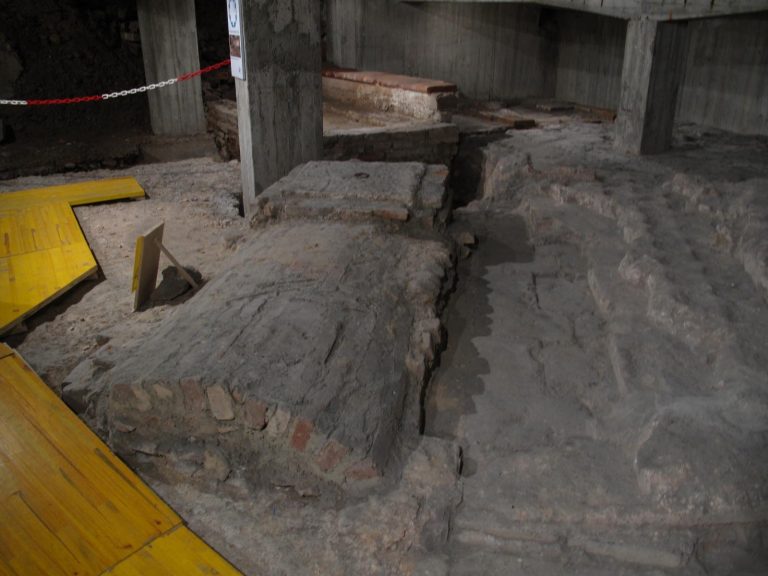
The church’s interior is organized around a central nave flanked by two aisles. Columns of different periods support the arcades, including a Roman column that supported the first bay of the left arcade until 1885. Remains from the Roman necropolis are incorporated into the external left wall, and some of these finds date from the Lombard period.
Crypt
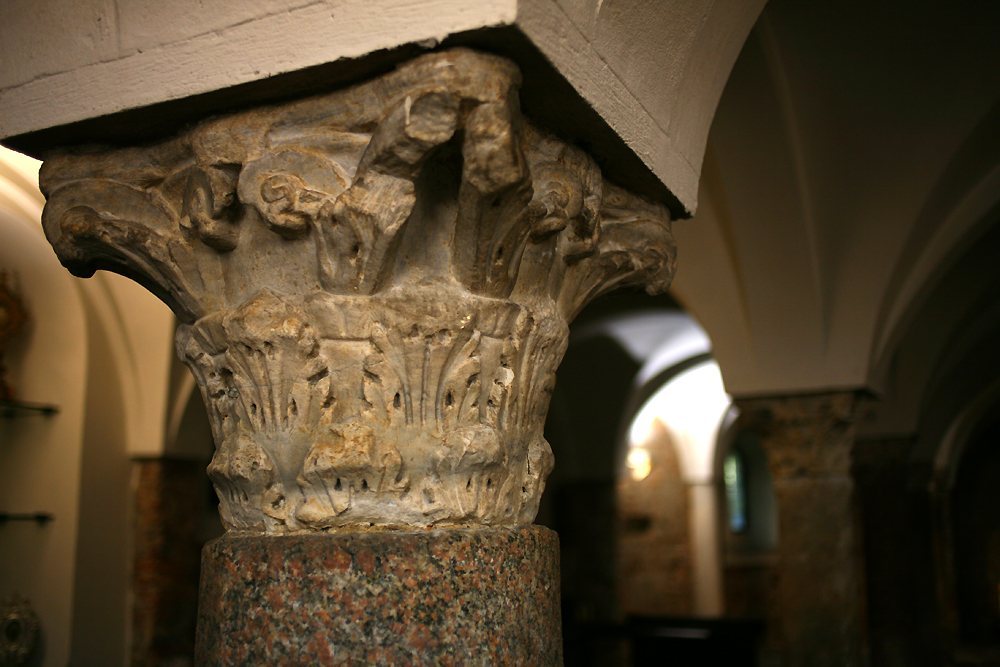
Below the presbytery lies a crypt, a chamber beneath the sanctuary used for burials, relics, or worship. It has one nave and two aisles divided by ten small columns with sculpted capitals. The crypt is one of only two surviving original Romanesque crypts in Milan, together with the crypt of San Giovanni in Conca. The body of Saint Quirinus the Martyr is preserved there.
Frescoes and organs
Madonna del Pianto and Madonna dell’Aiuto
The high altar contains the fifteenth-century fresco of the Crucifixion known as the Madonna del Pianto. It came from the nearby church of San Calocero, which was demolished, and is attributed to the school of the Zavattari. A fragment of another fresco, the Madonna dell’Aiuto, also from San Calocero, is placed in the right aisle.
Organs
The organ on the choir loft in the counter-façade is Mascioni opus 1146, built in 1998 with the case and part of the pipework from the earlier Cesare Bernasconi organ of 1897. Its transmission is mechanical for the manuals and pedal, and electric for the stops and combinations. It has two 58-note keyboards and a 30-note pedalboard.
A second organ stands in the apse behind the high altar. Built by Mascheroni, it has fully mechanical transmission, one 51-note keyboard, and a straight 12-note pedalboard.
External baptistery
An octagonal baptistery stands outside the church on the left. Designed by architect Paolo Mezzanotte, it was added in 1932 and contains a baptismal font incorporating the Pietra santa. The stone came from San Nazaro in Pietrasanta, demolished in 1889 during construction of Via Dante. The baptistery has three simple embossed-copper doors by sculptor Geminiano Cibau and bears a dedication to those who fell in the First World War.