Ibn Salah Mosque: A Marinid Mosque in Marrakesh


Site at a Glance
- Rating
- 4.4
- Popularity
- Low
- Country
- Morocco
- Primary era
- Medieval
- Eras represented
- Medieval, Early Modern
- Civilizations
- Alaouite, Marinid
- Site type
- Religious
- Remains
- Mosque
On this page9 sections
History
Ibn Salah Mosque, also known as Ben Salah or Ben Saleh Mosque, is a Sunni mosque in Marrakesh, Morocco, built during the fourteenth-century Marinid period in a Moroccan architectural tradition. It is the only major surviving monument of the Marinid era in Marrakesh. The mosque was built around or in association with the tomb of Muhammad ben Salah, a local saint also called Ibn Salih.
Marinid Foundation
The mosque’s precise foundation history remains uncertain. An inscription records that work on the minaret began in August 1321, while the historian Ibn al-Muwaqqit attributed the mosque to Sultan Abu al-Hasan and assigned it to 1318–1319. A likely chronology places its construction between 1318 and 1321, during the reign of the Marinid sultan Abu Sa’id Uthman, who ruled from 1310 to 1331. Because the foundation inscription does not name a sultan, the historian Gaston Deverdun considered a private patron a likely commissioner.
The mosque’s dedication reflects the local veneration of Muhammad ben Salah. Folklore portrays him as a humble butcher who possessed the gift of foresight, and the mosque developed around his burial place. Repeated repairs over the centuries altered parts of the building but appear to have preserved its essential form and layout.
Alaouite Addition
Around 1669–1671, the Alaouite sultan Moulay Rashid built a madrasa beside the mosque. The Alaouites, Morocco’s ruling dynasty from the seventeenth century to the present, added this religious and educational institution behind the mosque. Ibn Salah Mosque remains an active place of Sunni worship.
Remains
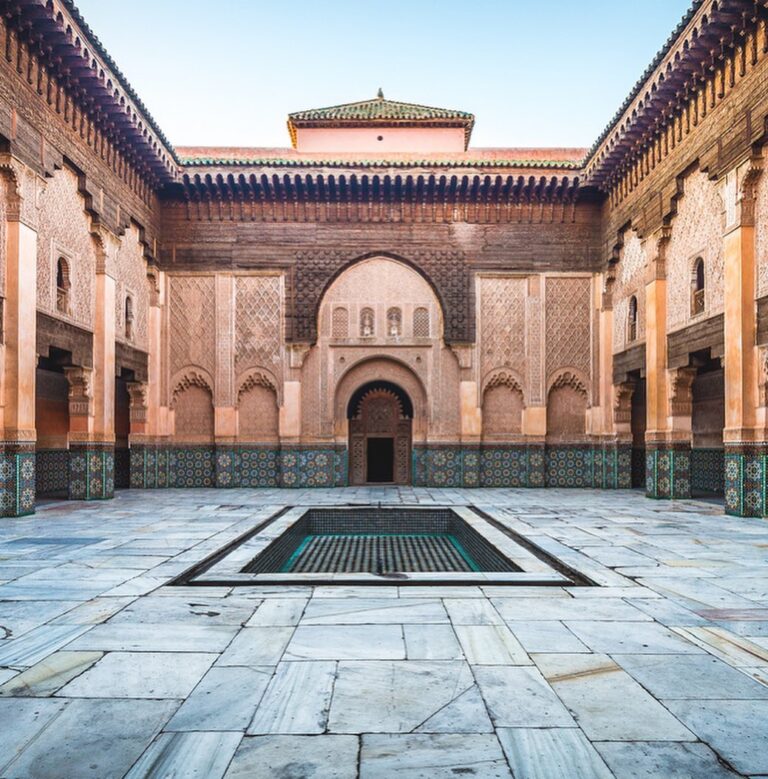
The surviving complex combines a single-minaret mosque with a madrasa behind it. The mosque follows a broad, shallow rectangular courtyard plan, with arcades around a small basin or fountain. Beyond this court, the prayer hall is divided by two rows of arches into nine aisles. The wider aisle leading toward the prayer niche creates the characteristic T-shaped arrangement associated with the building.
Prayer Hall and Courtyard
Courtyard and Aisles
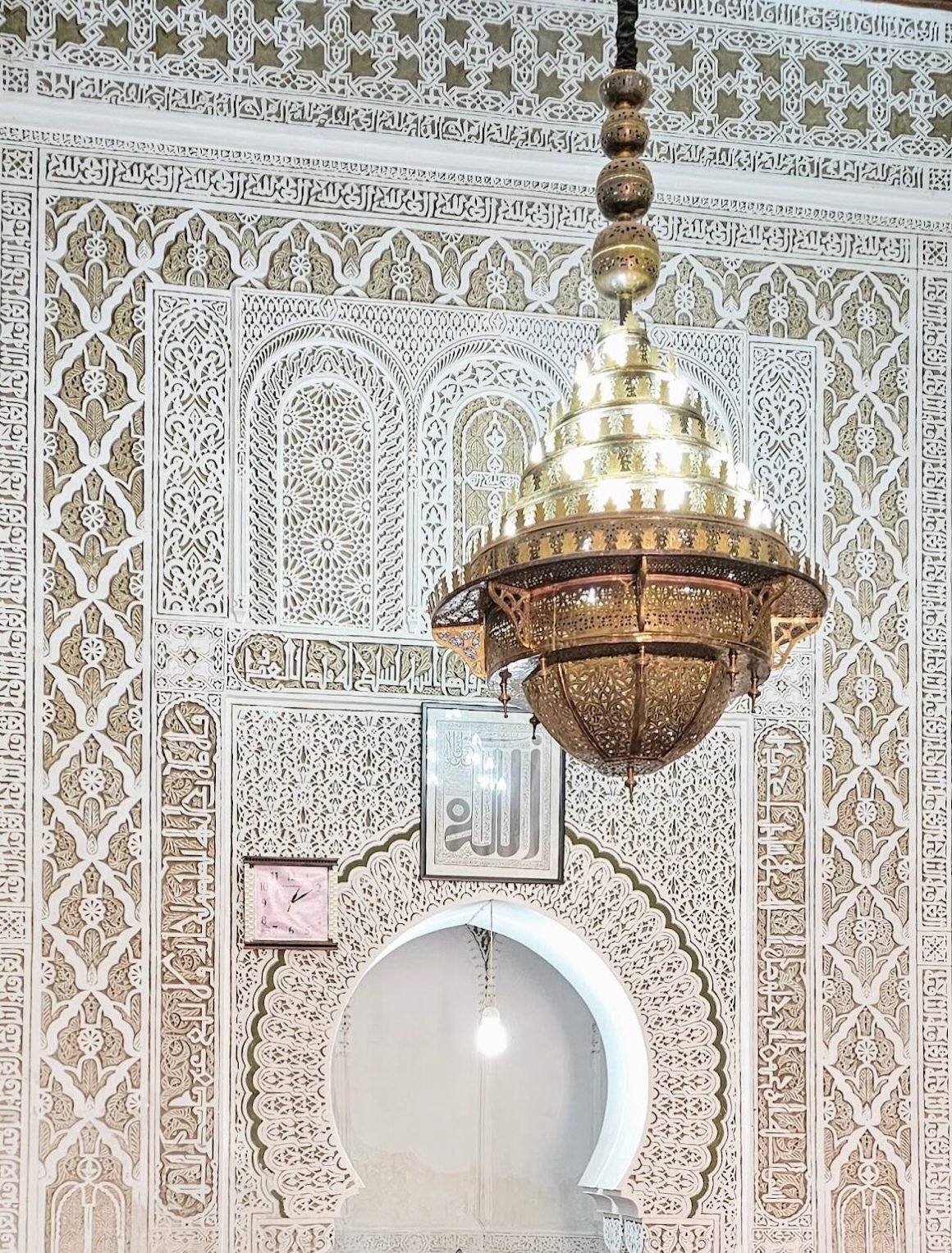
The courtyard forms the central organizing space of the mosque. Its surrounding arcades lead into the prayer hall, where the easternmost and westernmost side aisles are shortened and do not reach the northern end. This unusual arrangement also appears at a Marinid mosque in Chellah. The mihrab, a niche indicating the direction of prayer, stands at the center of the qibla wall.
Orientation and Tomb
The mosque’s qibla, the direction of prayer toward the Kaaba in Mecca, faces south-southeast. This differs from the nearly due-east orientation used for the modern Moroccan qibla. Three entrances serve the mosque, while the tomb associated with Muhammad ben Salah occupies its northwestern corner.
Minaret
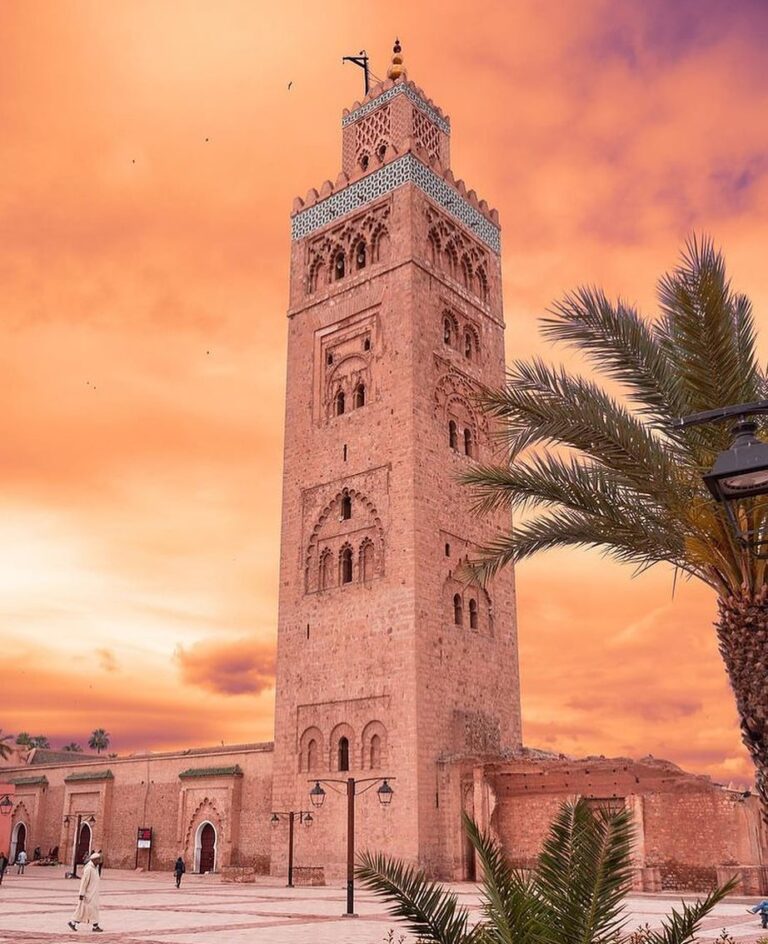
The minaret rises on the mosque’s western side and is its most prominent and richly decorated element. Its design draws on Almohad forms and appears partly modeled on the Almohad minaret of the Kasbah Mosque in Marrakesh. The upper facades carry a sebka, or repeated interlacing geometric pattern, whose forms resemble palmettes or fleur-de-lis. The patterns vary slightly between the northern and southern faces and between the eastern and western faces. Large polylobed arches decorate the lower facades, molded in brick against turquoise-green faience tiles.
Unlike Almohad minarets, the tower has no tile frieze near its top. Each facade contains three horseshoe-arched windows arranged with the surrounding polylobed designs. Merlons, raised elements along a parapet, line the top of the tower and its upper lantern. The decorative scheme was repeated soon afterward at the Marinid Chrabliyin Mosque in Fez, making Ibn Salah’s minaret an example of the transition from Almohad models to forms that later became characteristic of Moroccan architecture. A smaller minaret with very similar decoration was probably built around the same period for Marrakesh’s Moulay el-Ksour Mosque, also known as the Mosque of the Cat.
Madrasa
The madrasa stands east of, or behind, the mosque. It is arranged around a large square courtyard, with a two-storey gallery providing access to numerous rooms. Built under Moulay Rashid in the later seventeenth century, it forms a distinct educational component of the historic complex.