Cherepovets Resurrection Monastery: An Orthodox Monastic Center in Russia


Site at a Glance
- Rating
- 4.7
- Popularity
- Low
- Country
- Russia
- Primary era
- Early Modern
- External website
- Open
- Eras represented
- Early Modern, Modern
- Civilizations
- Russian
- Site type
- Religious
- Remains
- Cathedral
On this page7 sections
History
Cherepovets Resurrection Monastery is a Russian Orthodox monastic site in Cherepovets, Russia, founded by monks in the late fourteenth century. Its precise foundation date is uncertain, although local historical tradition associates it with the episcopate of Ignatius, the Orthodox bishop who served from 1355 to 1365. The monastery was established by Feodosy and Afanasy, disciples of Sergius of Radonezh, a major fourteenth-century Russian Orthodox monastic leader linked with the expansion of monastic foundations in northern Russia.
Foundation and Development
Later monastic tradition connected the foundation with a miraculous appearance of rays of light. The monastery is mentioned continuously from 1449, and its presence encouraged settlement around it. During the sixteenth century, the large village of Fedosyevo developed nearby, adding to the population and activity of the area.
The monastery and its surroundings suffered repeated devastation during attacks by Polish-Lithuanian detachments in 1610, 1613, and 1618. Despite these disruptions, the settlement continued to develop around the religious center.
Secularization and the Growth of Cherepovets
In 1764, the monastery was abolished during the secularization of monastic property under Catherine the Great, empress of Russia from 1762 to 1796. Her policy transferred substantial monastic lands and institutions to state administration. The former monastery settlement was placed under the College of Economy, the state body responsible for administering secularized church and monastic lands, and subsequently functioned as an ordinary parish.
Cherepovets grew from the settlement surrounding the monastery. In 1777, the monastery settlement and Fedosyevo were merged to create the city of Cherepovets, which received city status under Catherine the Great.
Religious Use in the Twentieth Century
During the 1920s and 1930s, the Resurrection Cathedral belonged to the Renovationist movement, a reformist current within the Russian Orthodox Church that controlled some churches after the 1917 Revolution. Archpriest Ioann Maltsev served as its rector from 1924 to 1931.
During the Second World War, the cathedral was closed for worship and used as a warehouse and an aircraft-engine repair workshop. It was returned to the faithful after the war, and worship had resumed by 1946. The surviving church later became the cathedral of the Cherepovets and Belozersk Diocese within the Vologda Metropolitanate, an ecclesiastical province comprising several dioceses under a metropolitan bishop. The monastery is protected as a cultural heritage object of Russia.
Remains
The monastery stood on a hill at the confluence of the Sheksna and Yagorba rivers. The site included two churches, an unheated Resurrection Church of Christ and a heated Trinity Church. The surviving Resurrection Cathedral preserves the principal church of the former monastery and is the oldest surviving building in Cherepovets.
Resurrection Cathedral
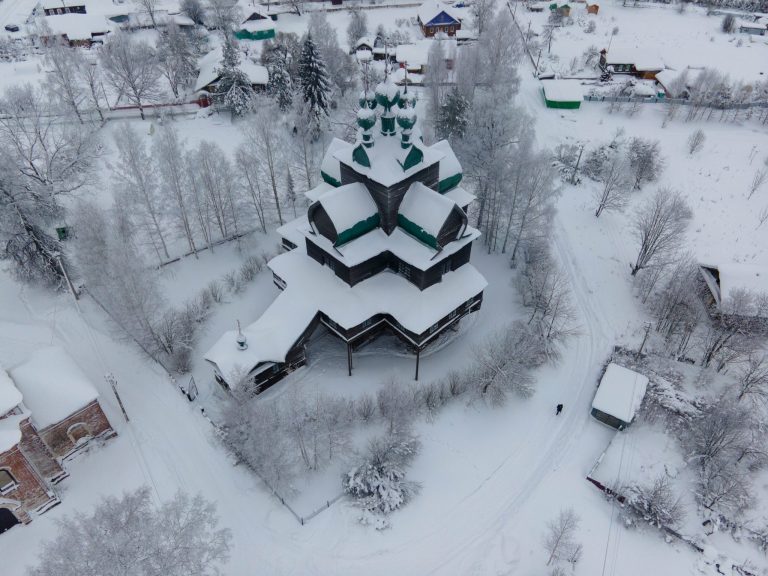
The five-domed Resurrection Cathedral was built between 1752 and 1756. Its plan includes side chapels, smaller worship spaces attached to or contained within the main church, dedicated to Saint John the Baptist, Saints Afanasy and Feodosy of Cherepovets, and Saint Philip of Irap. Frescoes were added to the interior in 1851. The cathedral remains the surviving monastic cathedral and continues to define the physical remains of the former foundation.
Trinity Cathedral and Bell Tower
The Trinity Cathedral was built between 1761 and 1781, during the period when the former monastery was becoming an ordinary parish. Its three-tiered bell tower was added in 1792. Both the Trinity Cathedral and the bell tower were destroyed in the 1930s, while the Resurrection Cathedral continued as the surviving church of the former monastery.