Church of Saint Salvator: Munich’s Late Gothic Greek Orthodox Church


Site at a Glance
- Rating
- 4.8
- Popularity
- Low
- Country
- Germany
- Primary era
- Medieval
- External website
- Open
- Eras represented
- Medieval, Early Modern, Modern
- Civilizations
- Duchy of Bavaria, German, Holy Roman Empire
- Site type
- Religious
- Remains
- Church
On this page10 sections
History
A cemetery church in late medieval Munich
Church of Saint Salvator is a late Gothic Catholic church in Munich, Germany, built as the cemetery church of the Frauenkirche, Munich’s Cathedral of Our Blessed Lady. Its cemetery was created after the older burial grounds around St. Peter’s and the Frauenkirche could no longer serve the expanding city. When the St. Peter parish cemetery was moved in 1478 and the cemetery church of All Saints at the Cross was consecrated in 1485, Duke Albrecht IV ordered the Frauenkirche cemetery to be relocated to the former outskirts of Munich, still inside the city walls.
Construction was probably completed in April 1493, and the church was consecrated on 15 August 1494. The builder is not securely known, although Lukas Rottaler, a pupil and successor of Jörg von Halsbach at the Frauenkirche building site, is considered the probable architect. The church therefore belonged to the final phase of medieval Gothic architecture, when central European builders produced increasingly elaborate brick and stone churches with pointed arches, complex vaulting, and intricate tracery.
Closure and changing ownership
The cemetery closed in 1789. The northern side portal, which had opened directly into the burial ground, was probably sealed after that change. During the secularization of church property, demolition was ordered on 20 April 1803 and again on 25 May 1804. The building survived because it was being used as a depot and no alternative storage space could be found.
King Max I Joseph gave Saint Salvator to Munich’s Evangelical Lutheran congregation on 21 December 1806. It continued to serve practical rather than religious purposes, first as a storage room and carriage shed and later as a grain store. After St. Matthew’s Church was built near the Stachus, Saint Salvator returned to the Crown. The building is now owned by the Free State of Bavaria, the legal successor to the Wittelsbach holdings.
Greek Orthodox use
King Ludwig I granted the building for use by Munich’s Greek community through royal decisions of 22 and 30 September 1828. Friedrich Thiersch played an important part in securing the arrangement. He argued that Greek Christianity and Eastern Orthodoxy were essential to understanding the culture and scholarship of the Eastern Roman Empire, and hoped that the church would help establish a larger Greek community in Munich. An initial objection by the Russian diplomat Alexandru Sturdza was eventually overcome after the philosopher Wilhelm Traugott Krug persuaded him.
The architect Leo von Klenze adapted the church for Orthodox worship, and it was consecrated according to the Greek Orthodox rite on 18 December 1829. Since then, the Greek Orthodox community has used it under the name Church of the Transfiguration of the Savior. It belongs to the Greek Orthodox Metropolis of Germany, the Orthodox jurisdiction associated with the Ecumenical Patriarchate of Constantinople for Greek Orthodox communities in Germany. The church also served as the seat of the Metropolitan of Germany and Exarch of Central Europe, an exarch being a senior ecclesiastical representative with authority over a defined territory or community.
War damage, legal conflict, and conservation
During the Nazi period, the mathematician Constantin Carathéodory served on the church council and acted as a patron of the church. He opposed a decision by the Bavarian Ministry of Education that would have allowed Old Catholics to use the building.
Bombing during the Second World War left the church largely undamaged, but aerial bombs destroyed most of the late Gothic stained glass that had been removed for protection. Surviving fragments were later incorporated into the choir windows of the Frauenkirche. In the 1990s, a box containing many additional fragments was found in the church gallery. The Mayer Court Art Institute workshops reassembled them, and four restored windows were returned to the church in 2000.
A legal dispute that began in the mid-1970s concerned whether Ludwig I had granted exclusive use of the building to the Greek Church Community of Munich and Bavaria. The community argued that this arrangement gave it special autonomy from Orthodox ecclesiastical jurisdiction, including the right to choose its own bishops and priests. The Free State of Bavaria disputed the claim and sought the church’s return. The conflict temporarily prevented either side from accessing the building and involved Greek state and ecclesiastical institutions. On 13 October 1998, the Second Senate of the Federal Constitutional Court rejected the community’s constitutional complaint, and the church was handed over to the Greek Orthodox Metropolis of Germany on 27 June 1999.
Saint Salvator is recognized as an architectural-heritage monument in Bavaria. Its exterior was restored and regothicized in 1869, bringing it closer to its Gothic appearance and removing the Baroque tower top. Later work included window repairs in 1903, renovation in 1934, re-roofing of the sacristy and tower in 1982, exterior repairs in 1992 and 1993, tower renovation in 2008, and installation of a new portal in 2009.
Remains
Building and tower
Saint Salvator is a late Gothic brick building on Salvatorplatz in Munich’s Kreuzviertel and historic city center. It stands near the former city wall and the site of the Jungfernturm, which was demolished in 1804. The exterior retains a Gothic character shaped by the nineteenth-century regothicization, when later Baroque elements were removed and the tower was brought nearer to its earlier form.
The tower originally carried a Gothic spire. Lightning damaged the spire on 24 July 1767, after which the damaged section was removed and replaced by a Baroque onion-shaped top. That top was removed during the 1869 restoration. The sacristy and tower were re-roofed in 1982, and a new portal was installed in 2009.
Windows and surviving medieval decoration
Gothic leaded-glass windows dated 1497 and 1499 remain part of the church’s fabric. The late Gothic stained-glass fragments found in the gallery during the 1990s were reassembled, allowing four restored windows to be reinstalled in the church in 2000. Other fragments had been incorporated into the choir windows of the Frauenkirche after wartime destruction damaged most of the protected medieval glazing.
Remains of late Gothic sacred frescoes survive on the north facade. The church also preserves evidence of changes made during the 1869 restoration, when twelve Apostle figures inserted into the wall piers were replaced by icons.
Orthodox interior
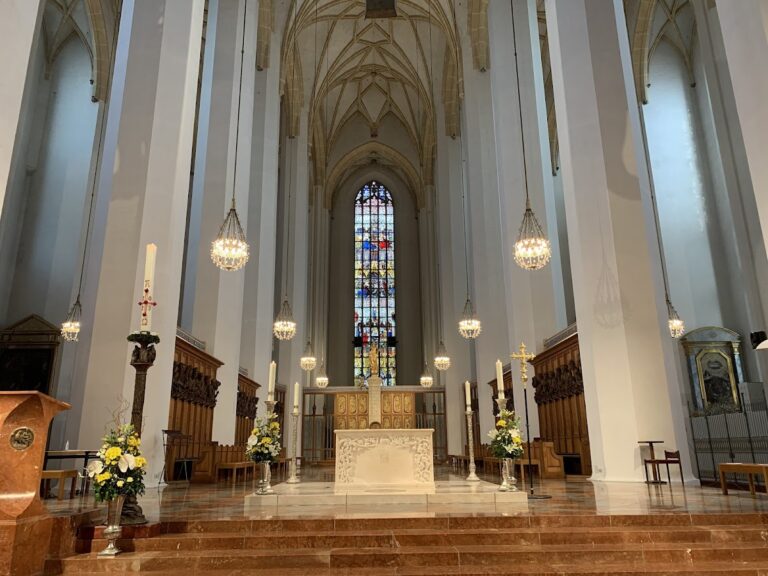
An upper gallery was probably added during the first quarter of the seventeenth century. The interior was adapted for Greek Orthodox worship in the nineteenth century, and Leo von Klenze designed the 1829 iconostasis, the screen of icons separating the sanctuary from the main worship space. The iconostasis was moved back into position in 1970, reducing the size of the altar area.
Cemetery entrance
The northern side portal formerly opened directly onto the Frauenkirche cemetery. Its position preserves the connection between Saint Salvator and the burial ground for which it was built, while its probable sealing after the cemetery’s closure in 1789 reflects the building’s changed surroundings and use.